About the Report
Base Year 2024Middle East Wind Turbine Rotor Blade Market Overview
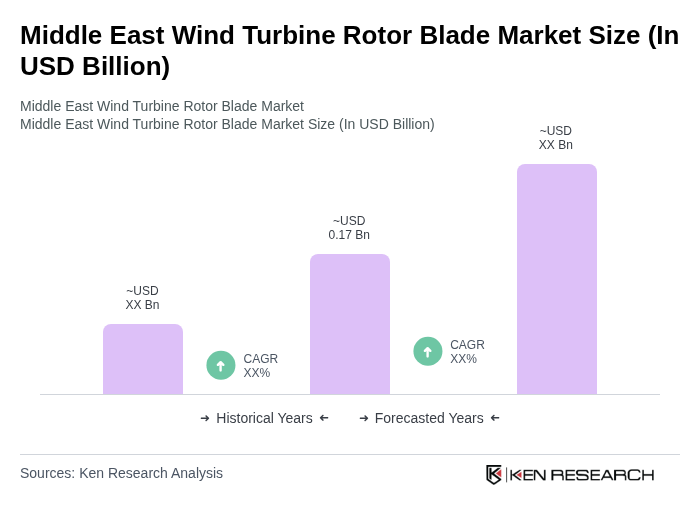
- The Middle East Wind Turbine Rotor Blade Market is valued at USD 0.17 billion, based on a five-year historical analysis of the wider Middle East and Africa rotor blade market and the regional share of installed wind capacity. This growth is primarily driven by the increasing investments in renewable energy projects, government initiatives to diversify power mixes away from hydrocarbons, and the rising demand for sustainable energy solutions across the region.
- Key countries driving wind-related activity in the broader region include Saudi Arabia, the United Arab Emirates, Egypt, and Morocco, supported by large-scale tenders, clear renewable energy targets, and strong onshore wind resources along coastal and high?wind corridors.
- In the United Arab Emirates, industrial policy is increasingly linked to local value creation in clean energy supply chains through programs such as the In?Country Value (ICV) Program overseen by the Ministry of Industry and Advanced Technology and ADNOC, which encourages higher domestic content in energy and industrial projects; however, there is currently no binding federal rule that mandates a specific minimum local content percentage for all new wind projects analogous to the detailed requirements established for oil and gas projects under the ADNOC ICV program (launched by ADNOC in 2018 and later expanded under the Unified ICV Program, 2021).
Middle East Wind Turbine Rotor Blade Market Segmentation
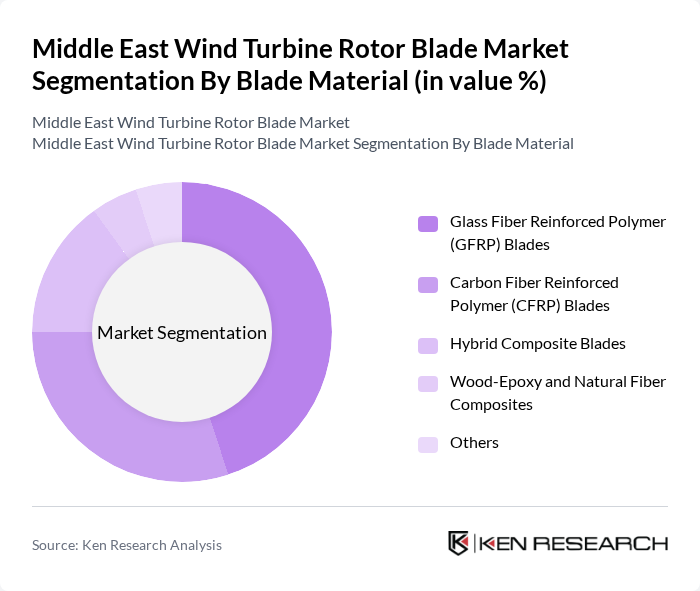
By Blade Material:The segmentation by blade material includes various types such as Glass Fiber Reinforced Polymer (GFRP) Blades, Carbon Fiber Reinforced Polymer (CFRP) Blades, Hybrid Composite Blades, Wood-Epoxy and Natural Fiber Composites, and Others. GFRP blades are the most widely used in commercial wind turbines globally due to their cost-effectiveness, mature manufacturing base, and good fatigue resistance, making them a preferred choice for many wind turbine manufacturers. At the same time, the increasing focus on lightweight materials, larger rotor diameters, and higher specific power ratings is driving the demand for CFRP and hybrid composite blades, which are gaining traction in high-performance onshore and offshore applications despite their higher cost.
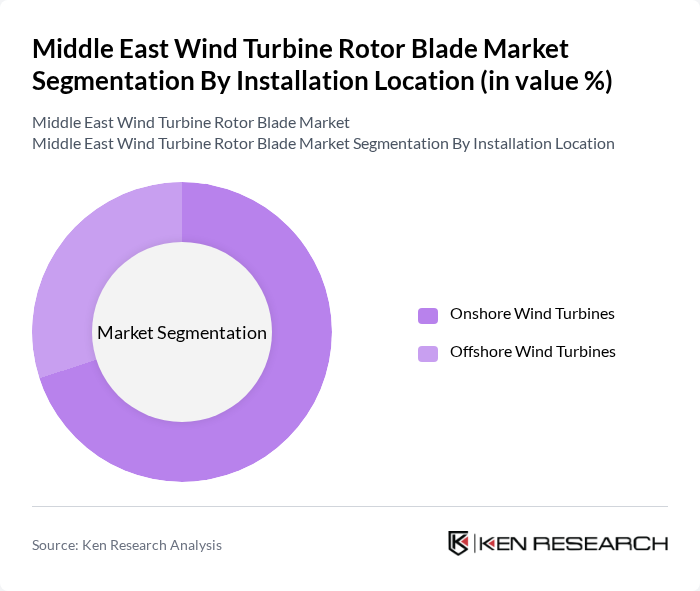
By Installation Location:The market is segmented based on installation location into Onshore Wind Turbines and Offshore Wind Turbines. Onshore wind turbines currently dominate installed capacity in the Middle East and wider MEA region, supported by lower installation and grid-connection costs, shorter project lead times, and easier access for construction and maintenance. However, offshore wind turbines are gaining strategic interest as governments and developers assess high?capacity factor sites in the Red Sea, Arabian Gulf, and eastern Mediterranean; their higher energy generation potential per project and lower visual and land?use impact are encouraging early?stage feasibility studies and tenders, which will gradually increase the relevance of offshore rotor blades in the region.
Middle East Wind Turbine Rotor Blade Market Competitive Landscape
The Middle East Wind Turbine Rotor Blade Market is characterized by a dynamic mix of regional and international players. Leading participants such as LM Wind Power (a GE Vernova business), TPI Composites, Inc., Siemens Gamesa Renewable Energy, Vestas Wind Systems A/S, GE Vernova (GE Renewable Energy), Nordex SE, Suzlon Energy Limited, Envision Energy, Xinjiang Goldwind Science & Technology Co., Ltd. (Goldwind), Mingyang Smart Energy Group Co., Ltd., Sinoma Wind Power Blade Co., Ltd., Zhongfu Lianzhong Composites Group Co., Ltd., SANY Renewable Energy Co., Ltd., ACCIONA Energía, S.A., Enercon GmbH contribute to innovation, geographic expansion, and service delivery in this space.
Middle East Wind Turbine Rotor Blade Market Industry Analysis
Growth Drivers
- Increasing Demand for Renewable Energy Sources:The Middle East is witnessing a significant shift towards renewable energy, with investments reaching approximately $20 billion in future. This trend is driven by the region's commitment to diversify energy sources and reduce reliance on fossil fuels. The International Renewable Energy Agency (IRENA) reported that renewable energy capacity in the Middle East is expected to grow by 50% in future, highlighting the increasing demand for wind energy solutions, particularly rotor blades.
- Government Initiatives Promoting Wind Energy:Governments across the Middle East are implementing policies to support wind energy development. For instance, Saudi Arabia's Vision 2030 aims to generate 58.7 GW of renewable energy, with wind energy playing a crucial role in future. The UAE has also set a target of 44% clean energy in future, leading to increased funding and incentives for wind turbine projects, thereby driving the rotor blade market's growth.
- Technological Advancements in Rotor Blade Design:Innovations in rotor blade technology are enhancing efficiency and performance, with new designs increasing energy capture by up to 15% in future. Companies are investing in research and development, with the global wind turbine rotor blade market expected to reach $10 billion in future. These advancements are crucial for meeting the growing energy demands in the Middle East, making rotor blades more competitive and appealing to investors.
Market Challenges
- High Initial Capital Investment:The wind turbine rotor blade market faces significant barriers due to high initial capital costs, which can exceed $1.5 million per turbine in future. This financial burden can deter potential investors, especially in a region where traditional energy sources have historically been cheaper. The need for substantial upfront investment poses a challenge to the widespread adoption of wind energy technologies in the Middle East.
- Supply Chain Disruptions:The Middle East's wind turbine rotor blade market is vulnerable to supply chain disruptions, particularly due to geopolitical tensions and logistical challenges. For example, the COVID-19 pandemic caused delays in the delivery of critical components, leading to project postponements. The reliance on international suppliers for materials and technology further exacerbates this issue, impacting the timely deployment of wind energy projects in the region.
Middle East Wind Turbine Rotor Blade Market Future Outlook
The future of the Middle East wind turbine rotor blade market appears promising, driven by increasing investments in renewable energy and supportive government policies. As countries in the region strive to meet ambitious clean energy targets, the demand for advanced rotor blade technologies is expected to rise. Additionally, the integration of smart technologies and AI in wind energy management will enhance operational efficiency, paving the way for a more sustainable energy landscape in the coming years.
Market Opportunities
- Expansion of Offshore Wind Projects:The Middle East is exploring offshore wind potential, with projects like the 1.5 GW offshore wind farm in Saudi Arabia in future. This expansion presents significant opportunities for rotor blade manufacturers, as offshore installations require specialized designs and materials, potentially increasing market demand and driving innovation in rotor blade technology.
- Collaborations with International Technology Providers:Partnerships with global technology firms can enhance local capabilities in rotor blade manufacturing. Collaborations can lead to knowledge transfer and access to advanced technologies, enabling Middle Eastern companies to improve production efficiency and product quality, thus positioning themselves competitively in the growing wind energy market.
Scope of the Report
| Segment | Sub-Segments |
|---|---|
| By Blade Material | Glass Fiber Reinforced Polymer (GFRP) Blades Carbon Fiber Reinforced Polymer (CFRP) Blades Hybrid Composite Blades Wood-Epoxy and Natural Fiber Composites Others |
| By Installation Location | Onshore Wind Turbines Offshore Wind Turbines |
| By Blade Length / Rated Power Class | Up to 2 MW (? 45 m) –4 MW (46–70 m) Above 4 MW (> 70 m) |
| By Application | New Turbine Installations (Greenfield) Repowering & Blade Replacement |
| By Customer Type | Turbine OEMs IPPs & Utility Developers EPC Contractors Operations & Maintenance (O&M) Service Providers |
| By Country | Saudi Arabia United Arab Emirates Egypt Morocco Jordan Others (Rest of Middle East) |
Key Target Audience
Investors and Venture Capitalist Firms
Government and Regulatory Bodies (e.g., Ministry of Energy, Saudi Arabia; UAE Federal Electricity and Water Authority)
Manufacturers and Producers
Wind Energy Project Developers
Energy Utilities and Service Providers
Environmental Agencies (e.g., Qatar Ministry of Environment and Climate Change)
Industry Associations (e.g., Middle East Wind Energy Association)
Financial Institutions and Banks
Players Mentioned in the Report:
LM Wind Power (a GE Vernova business)
TPI Composites, Inc.
Siemens Gamesa Renewable Energy
Vestas Wind Systems A/S
GE Vernova (GE Renewable Energy)
Nordex SE
Suzlon Energy Limited
Envision Energy
Xinjiang Goldwind Science & Technology Co., Ltd. (Goldwind)
Mingyang Smart Energy Group Co., Ltd.
Sinoma Wind Power Blade Co., Ltd.
Zhongfu Lianzhong Composites Group Co., Ltd.
SANY Renewable Energy Co., Ltd.
ACCIONA Energia, S.A.
Enercon GmbH
Table of Contents
Market Assessment Phase
1. Executive Summary and Approach
2. Middle East Wind Turbine Rotor Blade Market Overview
2.1 Key Insights and Strategic Recommendations
2.2 Middle East Wind Turbine Rotor Blade Market Overview
2.3 Definition and Scope
2.4 Evolution of Market Ecosystem
2.5 Timeline of Key Regulatory Milestones
2.6 Value Chain & Stakeholder Mapping
2.7 Business Cycle Analysis
2.8 Policy & Incentive Landscape
3. Middle East Wind Turbine Rotor Blade Market Analysis
3.1 Growth Drivers
3.1.1 Increasing demand for renewable energy sources
3.1.2 Government initiatives promoting wind energy
3.1.3 Technological advancements in rotor blade design
3.1.4 Rising investments in infrastructure development
3.2 Market Challenges
3.2.1 High initial capital investment
3.2.2 Supply chain disruptions
3.2.3 Limited local manufacturing capabilities
3.2.4 Regulatory hurdles and compliance issues
3.3 Market Opportunities
3.3.1 Expansion of offshore wind projects
3.3.2 Collaborations with international technology providers
3.3.3 Development of hybrid energy systems
3.3.4 Increasing focus on sustainability and carbon neutrality
3.4 Market Trends
3.4.1 Growing adoption of smart wind turbine technologies
3.4.2 Integration of AI and IoT in wind energy management
3.4.3 Shift towards larger rotor blades for efficiency
3.4.4 Emphasis on recycling and sustainability in manufacturing
3.5 Government Regulation
3.5.1 Renewable Energy Certificates (RECs)
3.5.2 Feed-in Tariffs (FiTs)
3.5.3 Emission reduction targets
3.5.4 Local content requirements for manufacturing
4. SWOT Analysis
5. Stakeholder Analysis
6. Porter's Five Forces Analysis
7. Middle East Wind Turbine Rotor Blade Market Market Size, 2019-2024
7.1 By Value
7.2 By Volume
7.3 By Average Selling Price
8. Middle East Wind Turbine Rotor Blade Market Segmentation
8.1 By Blade Material
8.1.1 Glass Fiber Reinforced Polymer (GFRP) Blades
8.1.2 Carbon Fiber Reinforced Polymer (CFRP) Blades
8.1.3 Hybrid Composite Blades
8.1.4 Wood-Epoxy and Natural Fiber Composites
8.1.5 Others
8.2 By Installation Location
8.2.1 Onshore Wind Turbines
8.2.2 Offshore Wind Turbines
8.3 By Blade Length / Rated Power Class
8.3.1 Up to 2 MW (? 45 m)
8.3.2 2–4 MW (46–70 m)
8.3.3 Above 4 MW (> 70 m)
8.4 By Application
8.4.1 New Turbine Installations (Greenfield)
8.4.2 Repowering & Blade Replacement
8.5 By Customer Type
8.5.1 Turbine OEMs
8.5.2 IPPs & Utility Developers
8.5.3 EPC Contractors
8.5.4 Operations & Maintenance (O&M) Service Providers
8.6 By Country
8.6.1 Saudi Arabia
8.6.2 United Arab Emirates
8.6.3 Egypt
8.6.4 Morocco
8.6.5 Jordan
8.6.6 Others (Rest of Middle East)
9. Middle East Wind Turbine Rotor Blade Market Competitive Analysis
9.1 Market Share of Key Players
9.2 Cross Comparison of Key Players
9.2.1 Company Name
9.2.2 Group Size (Global, Regional, or Local Manufacturer)
9.2.3 Middle East Rotor Blade Revenue
9.2.4 Installed Blade Capacity in the Middle East (MW)
9.2.5 Average Selling Price per Meter of Blade Length
9.2.6 Share of Local Sourcing / Local Content (%)
9.2.7 Order Backlog and Awarded Projects in the Region
9.2.8 Manufacturing & Assembly Footprint in/for the Middle East
9.2.9 R&D Spend on Advanced Blade Materials and Designs
9.2.10 EBITDA Margin for Blade Business
9.2.11 Market Share Percentage (Middle East Rotor Blade Market)
9.3 SWOT Analysis of Top Players
9.4 Pricing Analysis
9.5 Detailed Profile of Major Companies
9.5.1 LM Wind Power (a GE Vernova business)
9.5.2 TPI Composites, Inc.
9.5.3 Siemens Gamesa Renewable Energy
9.5.4 Vestas Wind Systems A/S
9.5.5 GE Vernova (GE Renewable Energy)
9.5.6 Nordex SE
9.5.7 Suzlon Energy Limited
9.5.8 Envision Energy
9.5.9 Xinjiang Goldwind Science & Technology Co., Ltd. (Goldwind)
9.5.10 Mingyang Smart Energy Group Co., Ltd.
9.5.11 Sinoma Wind Power Blade Co., Ltd.
9.5.12 Zhongfu Lianzhong Composites Group Co., Ltd.
9.5.13 SANY Renewable Energy Co., Ltd.
9.5.14 ACCIONA Energía, S.A.
9.5.15 Enercon GmbH
10. Middle East Wind Turbine Rotor Blade Market End-User Analysis
10.1 Procurement Behavior of Key Ministries
10.1.1 Government procurement policies
10.1.2 Budget allocation for renewable projects
10.1.3 Collaboration with private sector
10.1.4 Evaluation criteria for tenders
10.2 Corporate Spend on Infrastructure & Energy
10.2.1 Investment trends in renewable energy
10.2.2 Corporate sustainability initiatives
10.2.3 Energy efficiency programs
10.2.4 Partnerships with energy providers
10.3 Pain Point Analysis by End-User Category
10.3.1 Cost of energy production
10.3.2 Reliability of energy supply
10.3.3 Regulatory compliance challenges
10.3.4 Technological adaptation issues
10.4 User Readiness for Adoption
10.4.1 Awareness of wind energy benefits
10.4.2 Training and skill development needs
10.4.3 Financial readiness for investment
10.4.4 Infrastructure readiness for deployment
10.5 Post-Deployment ROI and Use Case Expansion
10.5.1 Performance metrics tracking
10.5.2 Case studies of successful implementations
10.5.3 Opportunities for scaling operations
10.5.4 Long-term maintenance considerations
11. Middle East Wind Turbine Rotor Blade Market Future Size, 2025-2030
11.1 By Value
11.2 By Volume
11.3 By Average Selling Price
Go-To-Market Strategy Phase
1. Whitespace Analysis + Business Model Canvas
1.1 Market gaps identification
1.2 Value proposition development
1.3 Revenue model exploration
1.4 Customer segmentation analysis
1.5 Competitive landscape assessment
1.6 Key partnerships identification
1.7 Resource allocation strategy
2. Marketing and Positioning Recommendations
2.1 Branding strategies
2.2 Product USPs
2.3 Target audience engagement
2.4 Digital marketing initiatives
2.5 Trade show participation
2.6 Public relations campaigns
2.7 Customer feedback mechanisms
3. Distribution Plan
3.1 Urban retail strategies
3.2 Rural NGO tie-ups
3.3 Online distribution channels
3.4 Direct sales approaches
3.5 Partnership with local distributors
3.6 Logistics and supply chain management
3.7 Inventory management practices
4. Channel & Pricing Gaps
4.1 Underserved routes
4.2 Pricing bands analysis
4.3 Competitor pricing strategies
4.4 Customer willingness to pay
4.5 Value-based pricing models
4.6 Discount and promotion strategies
4.7 Price elasticity considerations
5. Unmet Demand & Latent Needs
5.1 Category gaps identification
5.2 Consumer segments analysis
5.3 Emerging trends in consumer preferences
5.4 Product development opportunities
5.5 Market entry barriers
5.6 Customer service expectations
5.7 Future demand forecasting
6. Customer Relationship
6.1 Loyalty programs
6.2 After-sales service
6.3 Customer engagement strategies
6.4 Feedback and improvement loops
6.5 Community building initiatives
6.6 Customer education programs
6.7 Relationship management tools
7. Value Proposition
7.1 Sustainability initiatives
7.2 Integrated supply chains
7.3 Cost-saving measures
7.4 Innovation in product offerings
7.5 Customer-centric solutions
7.6 Long-term partnership benefits
7.7 Competitive advantages
8. Key Activities
8.1 Regulatory compliance
8.2 Branding efforts
8.3 Distribution setup
8.4 Market research and analysis
8.5 Training and development programs
8.6 Stakeholder engagement
8.7 Performance monitoring
9. Entry Strategy Evaluation
9.1 Domestic Market Entry Strategy
9.1.1 Product mix considerations
9.1.2 Pricing band analysis
9.1.3 Packaging strategies
9.2 Export Entry Strategy
9.2.1 Target countries identification
9.2.2 Compliance roadmap development
10. Entry Mode Assessment
10.1 Joint Ventures
10.2 Greenfield Investments
10.3 Mergers & Acquisitions
10.4 Distributor Model
11. Capital and Timeline Estimation
11.1 Capital requirements
11.2 Timelines for market entry
12. Control vs Risk Trade-Off
12.1 Ownership considerations
12.2 Partnerships evaluation
13. Profitability Outlook
13.1 Breakeven analysis
13.2 Long-term sustainability strategies
14. Potential Partner List
14.1 Distributors
14.2 Joint Ventures
14.3 Acquisition targets
15. Execution Roadmap
15.1 Phased Plan for Market Entry
15.1.1 Market Setup
15.1.2 Market Entry
15.1.3 Growth Acceleration
15.1.4 Scale & Stabilize
15.2 Key Activities and Milestones
15.2.1 Activity timelines
15.2.2 Milestone tracking
Research Methodology
Phase 1: Approach1
Desk Research
- Industry reports from renewable energy associations and market research firms
- Government publications on renewable energy policies and wind energy initiatives in the Middle East
- Academic journals and white papers focusing on wind turbine technology and rotor blade advancements
Primary Research
- Interviews with engineers and product managers from leading wind turbine manufacturers
- Surveys with project developers and energy consultants specializing in wind energy projects
- Field interviews with maintenance and operations personnel at wind farms across the region
Validation & Triangulation
- Cross-validation of data through multiple industry sources and expert opinions
- Triangulation of market size estimates using production, installation, and operational data
- Sanity checks through feedback from industry panels and expert reviews
Phase 2: Market Size Estimation1
Top-down Assessment
- Analysis of national energy consumption data and wind energy contribution to the energy mix
- Breakdown of rotor blade demand by country and project type within the Middle East
- Incorporation of government targets for renewable energy capacity by 2030
Bottom-up Modeling
- Estimation of rotor blade production volumes based on installed wind capacity and average blade size
- Cost analysis of rotor blade manufacturing, including materials and labor
- Volume x cost basis for rotor blades across different wind turbine models
Forecasting & Scenario Analysis
- Multi-factor regression analysis incorporating factors such as energy policy changes and technological advancements
- Scenario modeling based on varying levels of investment in renewable energy infrastructure
- Baseline, optimistic, and pessimistic projections for rotor blade demand through 2030
Phase 3: CATI Sample Composition1
| Scope Item/Segment | Sample Size | Target Respondent Profiles |
|---|---|---|
| Wind Farm Developers | 100 | Project Managers, Development Directors |
| Manufacturers of Rotor Blades | 60 | Production Managers, R&D Engineers |
| Energy Policy Makers | 40 | Government Officials, Regulatory Analysts |
| Maintenance and Operations Teams | 50 | Operations Managers, Field Technicians |
| Consultants in Renewable Energy | 40 | Energy Analysts, Market Researchers |
Frequently Asked Questions
What is the current value of the Middle East Wind Turbine Rotor Blade Market?
The Middle East Wind Turbine Rotor Blade Market is valued at approximately USD 0.17 billion, reflecting a historical analysis of the region's wind capacity and investments in renewable energy projects.
Which countries are leading in the Middle East Wind Turbine Rotor Blade Market?
What are the main drivers of growth in the Middle East Wind Turbine Rotor Blade Market?
What types of materials are used for wind turbine rotor blades?
Other Regional/Country Reports
Indonesia Wind Turbine Rotor Blade Market
Malaysia Wind Turbine Rotor Blade Market
KSA Wind Turbine Rotor Blade Market
APAC Wind Turbine Rotor Blade Market
SEA Wind Turbine Rotor Blade Market
Vietnam Wind Turbine Rotor Blade Market
Other Adjacent Reports
Mexico Wind Turbine Gearbox Market
Qatar Wind Turbine Generator Market
UAE Wind Turbine Nacelle MarketSouth Korea Wind Turbine Foundation Market
Qatar Composite Materials Market
Philippines Renewable Energy Storage Market
KSA Wind Farm Development Market
UAE Offshore Wind Energy MarketKuwait Wind Energy Maintenance Market
Why Buy From Us?

What makes us stand out is that our consultants follow Robust, Refine and Result (RRR) methodology. Robust for clear definitions, approaches and sanity checking, Refine for differentiating respondents' facts and opinions, and Result for presenting data with story.

We have set a benchmark in the industry by offering our clients with syndicated and customized market research reports featuring coverage of entire market as well as meticulous research and analyst insights.

While we don't replace traditional research, we flip the method upside down. Our dual approach of Top Bottom & Bottom Top ensures quality deliverable by not just verifying company fundamentals but also looking at the sector and macroeconomic factors.

With one step in the future, our research team constantly tries to show you the bigger picture. We help with some of the tough questions you may encounter along the way: How is the industry positioned? Best marketing channel? KPI's of competitors? By aligning every element, we help maximize success.

Our report gives you instant access to the answers and sources that other companies might choose to hide. We elaborate each steps of research methodology we have used and showcase you the sample size to earn your trust.

If you need any support, we are here! We pride ourselves on universe strength, data quality, and quick, friendly, and professional service.