About the Report
Base Year 2024New Zealand Brake Pads Market Overview
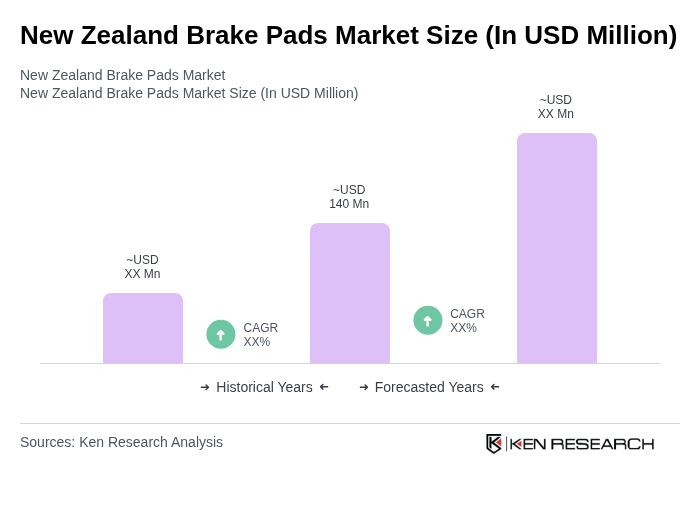
- The New Zealand Brake Pads Market is valued at USD 140 million, based on a five-year historical analysis that aligns with the size and trajectory of the global automotive brake pad market and New Zealand’s share of worldwide vehicle parc and parts retailing activity. This growth is primarily driven by the increasing demand for vehicle safety and performance, coupled with the rising number of vehicles on the road and steady expansion of the motor vehicle parts retailing industry in New Zealand. The market is also influenced by advancements in brake pad technology, including low-copper and copper-free friction materials, improved heat resistance, and noise-reduction formulations, which enhance durability and comfort and are being adopted by leading global suppliers.
- Auckland and Wellington are the dominant cities in the New Zealand Brake Pads Market due to their high population density, substantial vehicle ownership, and concentration of economic activity and freight movement. These urban centers have a robust road and workshop infrastructure and a high density of automotive service centers and parts retailers, which contributes to the demand for replacement brake pads. Additionally, major international aftermarket brands distribute through wholesalers and retailers located primarily in Auckland and other large urban areas, strengthening these regions’ position as key hubs for brake components in New Zealand.
- The New Zealand government has progressively tightened vehicle safety and environmental standards that materially influence the brake pads market. In particular, the Land Transport Rule: Brakes 2002 issued by Waka Kotahi NZ Transport Agency specifies performance, design and maintenance requirements for brake systems on light and heavy vehicles, including braking efficiency thresholds and compatibility of replacement components. In parallel, the Land Transport Rule: Vehicle Exhaust Emissions 2007 and updates, together with hazardous substances rules under the Hazardous Substances and New Organisms Act 1996, encourage the adoption of low-emission, low?copper and asbestos?free friction materials by setting emissions limits and controlling hazardous substances used in automotive products. These instruments promote the use of high-quality, environmentally considerate brake pad materials and support broader sustainability and road?safety objectives in the automotive sector.
New Zealand Brake Pads Market Segmentation
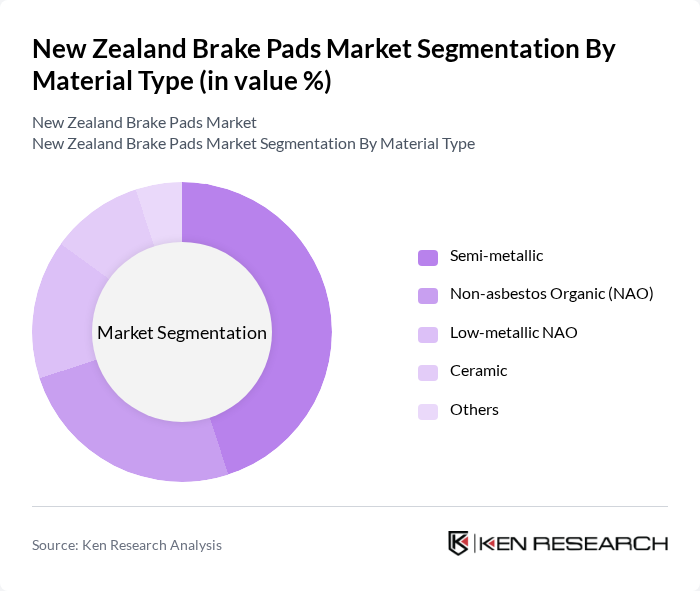
By Material Type:The brake pads market is segmented by material type into several categories, including semi-metallic, non-asbestos organic (NAO), low-metallic NAO, ceramic, and others. Semi-metallic and related metallic formulations collectively account for the largest share of the global brake pad market due to their good balance of friction performance, heat dissipation, and cost, and this pattern is broadly reflected in developed aftermarkets such as New Zealand. Ceramic pads are gaining traction in passenger vehicles because of lower noise, reduced dust, and stable friction at a wide range of temperatures, while NAO and low?metallic NAO materials are preferred where comfort and reduced rotor wear are prioritised.
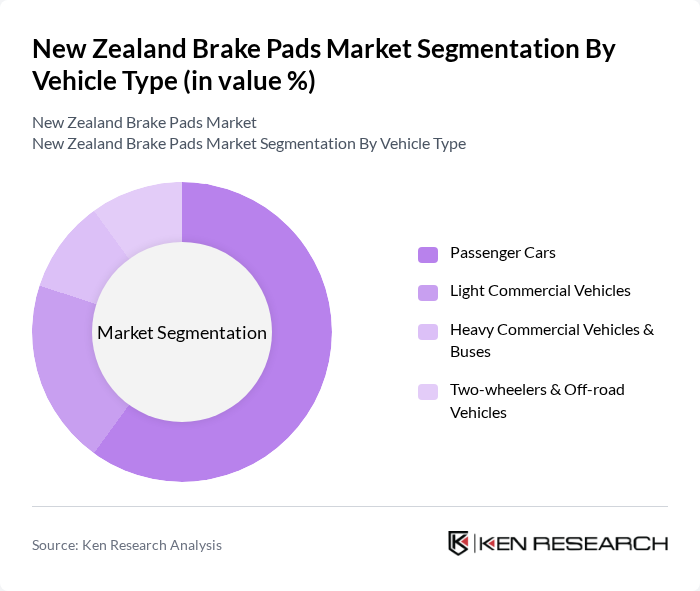
By Vehicle Type:The market is also segmented by vehicle type, which includes passenger cars, light commercial vehicles, heavy commercial vehicles & buses, and two-wheelers & off-road vehicles. Passenger cars hold the largest share of demand, consistent with global trends where passenger vehicles account for the majority of brake pad consumption because of their high parc, annual mileage and relatively frequent replacement cycles. In New Zealand, growth in the light vehicle fleet and strong dependence on road transport for commuting support the dominance of passenger cars, while commercial vehicles and buses contribute significantly in urban freight and intercity transport corridors.
New Zealand Brake Pads Market Competitive Landscape
The New Zealand Brake Pads Market is characterized by a dynamic mix of regional and international players. Leading participants such as Brake Parts NZ, ACDelco, Bendix, TRW Automotive, Robert Bosch GmbH, Ferodo (Tenneco), EBC Brakes, DBA (Disc Brakes Australia), Nissin Kogyo, Raybestos, Akebono Brake Industry Co., Ltd., Centric Parts, Wagner Brake, Monroe, Power Stop contribute to innovation, geographic expansion, and service delivery in this space.
New Zealand Brake Pads Market Industry Analysis
Growth Drivers
- Increasing Vehicle Sales:In future, New Zealand's vehicle sales are projected to reach approximately 180,000 units, reflecting a steady increase from previous years. This growth is driven by a robust economy, with GDP expected to grow by 2.5%, leading to higher disposable incomes. As more vehicles are sold, the demand for brake pads naturally rises, creating a significant opportunity for manufacturers and suppliers in the market.
- Rising Awareness of Vehicle Safety:The New Zealand Transport Agency reported that road safety campaigns have led to a 15% increase in consumer awareness regarding vehicle safety features, including brake systems. This heightened awareness is prompting consumers to prioritize high-quality brake pads, which are essential for ensuring vehicle safety. Consequently, manufacturers are focusing on producing advanced brake pad technologies to meet this growing demand.
- Technological Advancements in Brake Pad Materials:The brake pad industry is witnessing significant innovations, with new materials such as carbon-ceramic and organic compounds gaining traction. In future, it is estimated that 30% of brake pads sold will utilize these advanced materials, which offer improved performance and reduced wear. This trend is driven by consumer demand for better braking efficiency and lower environmental impact, further propelling market growth.
Market Challenges
- High Competition and Price Sensitivity:The New Zealand brake pads market is characterized by intense competition, with over 50 manufacturers vying for market share. This saturation leads to price wars, with average prices for brake pads declining by 10% in the last year. As consumers become more price-sensitive, manufacturers must balance quality and affordability, which can strain profit margins and hinder innovation.
- Fluctuating Raw Material Prices:The brake pad industry is heavily reliant on raw materials such as steel and friction materials, which have seen price volatility. In future, steel prices are projected to fluctuate between NZD 800 to NZD 1,000 per ton, impacting production costs. This unpredictability can lead to increased operational costs for manufacturers, forcing them to adjust pricing strategies and potentially affecting market stability.
New Zealand Brake Pads Market Future Outlook
The New Zealand brake pads market is poised for significant transformation, driven by technological advancements and evolving consumer preferences. As electric vehicle adoption increases, manufacturers will need to innovate to meet the specific braking requirements of these vehicles. Additionally, the rise of e-commerce platforms will facilitate easier access to aftermarket products, enhancing consumer choice. Sustainability will also play a crucial role, with a growing emphasis on eco-friendly materials and recycling initiatives shaping future product offerings.
Market Opportunities
- Growth in Electric Vehicle Market:With New Zealand's electric vehicle sales projected to reach 30,000 units in future, there is a significant opportunity for brake pad manufacturers to develop specialized products tailored for electric vehicles. This segment is expected to drive innovation and create new revenue streams for companies willing to invest in research and development.
- Expansion of E-commerce Platforms:The rise of e-commerce is transforming the way consumers purchase automotive parts, with online sales expected to account for 25% of brake pad sales in future. This shift presents an opportunity for manufacturers to enhance their online presence and leverage digital marketing strategies to reach a broader audience, ultimately increasing sales and brand visibility.
Scope of the Report
| Segment | Sub-Segments |
|---|---|
| By Material Type | Semi-metallic Non-asbestos Organic (NAO) Low-metallic NAO Ceramic Others |
| By Vehicle Type | Passenger Cars Light Commercial Vehicles Heavy Commercial Vehicles & Buses Two-wheelers & Off-road Vehicles |
| By Sales Channel | OEM (Original Equipment Manufacturer) Aftermarket – Independent Workshops Aftermarket – Retailers & E-commerce |
| By Position | Front Rear Front & Rear Sets |
| By End-User | Individual Vehicle Owners Fleet Operators (Logistics, Bus, Rental) Government & Municipal Fleets Workshops & Service Chains |
| By Region | North Island – Major Urban (Auckland, Wellington) North Island – Other South Island – Major Urban (Christchurch, Dunedin) South Island – Other |
Key Target Audience
Investors and Venture Capitalist Firms
Government and Regulatory Bodies (e.g., New Zealand Transport Agency, Ministry of Business, Innovation and Employment)
Manufacturers and Producers
Distributors and Retailers
Automotive Repair Shops and Service Centers
Fleet Operators and Logistics Companies
Automotive Aftermarket Suppliers
Environmental and Safety Advocacy Groups
Players Mentioned in the Report:
Brake Parts NZ
ACDelco
Bendix
TRW Automotive
Robert Bosch GmbH
Ferodo (Tenneco)
EBC Brakes
DBA (Disc Brakes Australia)
Nissin Kogyo
Raybestos
Akebono Brake Industry Co., Ltd.
Centric Parts
Wagner Brake
Monroe
Power Stop
Table of Contents
Market Assessment Phase
1. Executive Summary and Approach
2. New Zealand Brake Pads Market Overview
2.1 Key Insights and Strategic Recommendations
2.2 New Zealand Brake Pads Market Overview
2.3 Definition and Scope
2.4 Evolution of Market Ecosystem
2.5 Timeline of Key Regulatory Milestones
2.6 Value Chain & Stakeholder Mapping
2.7 Business Cycle Analysis
2.8 Policy & Incentive Landscape
3. New Zealand Brake Pads Market Analysis
3.1 Growth Drivers
3.1.1 Increasing Vehicle Sales
3.1.2 Rising Awareness of Vehicle Safety
3.1.3 Technological Advancements in Brake Pad Materials
3.1.4 Government Regulations on Emissions and Safety Standards
3.2 Market Challenges
3.2.1 High Competition and Price Sensitivity
3.2.2 Fluctuating Raw Material Prices
3.2.3 Limited Awareness of Aftermarket Products
3.2.4 Supply Chain Disruptions
3.3 Market Opportunities
3.3.1 Growth in Electric Vehicle Market
3.3.2 Expansion of E-commerce Platforms
3.3.3 Increasing Demand for Eco-friendly Products
3.3.4 Strategic Partnerships with Automotive Manufacturers
3.4 Market Trends
3.4.1 Shift Towards High-performance Brake Pads
3.4.2 Adoption of Smart Technologies in Brake Systems
3.4.3 Growing Preference for Online Purchases
3.4.4 Focus on Sustainability and Recycling
3.5 Government Regulation
3.5.1 Emission Standards Compliance
3.5.2 Safety Regulations for Automotive Components
3.5.3 Import Tariffs on Automotive Parts
3.5.4 Incentives for Electric Vehicle Adoption
4. SWOT Analysis
5. Stakeholder Analysis
6. Porter's Five Forces Analysis
7. New Zealand Brake Pads Market Market Size, 2019-2024
7.1 By Value
7.2 By Volume
7.3 By Average Selling Price
8. New Zealand Brake Pads Market Segmentation
8.1 By Material Type
8.1.1 Semi-metallic
8.1.2 Non-asbestos Organic (NAO)
8.1.3 Low-metallic NAO
8.1.4 Ceramic
8.1.5 Others
8.2 By Vehicle Type
8.2.1 Passenger Cars
8.2.2 Light Commercial Vehicles
8.2.3 Heavy Commercial Vehicles & Buses
8.2.4 Two-wheelers & Off-road Vehicles
8.3 By Sales Channel
8.3.1 OEM (Original Equipment Manufacturer)
8.3.2 Aftermarket – Independent Workshops
8.3.3 Aftermarket – Retailers & E-commerce
8.4 By Position
8.4.1 Front
8.4.2 Rear
8.4.3 Front & Rear Sets
8.5 By End-User
8.5.1 Individual Vehicle Owners
8.5.2 Fleet Operators (Logistics, Bus, Rental)
8.5.3 Government & Municipal Fleets
8.5.4 Workshops & Service Chains
8.6 By Region
8.6.1 North Island – Major Urban (Auckland, Wellington)
8.6.2 North Island – Other
8.6.3 South Island – Major Urban (Christchurch, Dunedin)
8.6.4 South Island – Other
9. New Zealand Brake Pads Market Competitive Analysis
9.1 Market Share of Key Players
9.2 Cross Comparison of Key Players
9.2.1 Company Name
9.2.2 Group Size (Large, Medium, or Small as per industry convention)
9.2.3 New Zealand Brake Pad Revenue (NZD, Latest FY)
9.2.4 3-year Revenue CAGR in New Zealand (%)
9.2.5 New Zealand Market Share (%)
9.2.6 EBITDA Margin from Brake Pad Business (%)
9.2.7 Average Realized Price per Set in New Zealand (NZD)
9.2.8 Channel Mix (OEM vs Aftermarket, % of Sales)
9.2.9 Product Portfolio Breadth (No. of SKUs / Vehicle Models Covered)
9.2.10 On-time Delivery Rate to Key Customers (%)
9.2.11 Customer Retention / Renewal Rate (%)
9.2.12 R&D Intensity (% of Revenue Spent on Product Development)
9.3 SWOT Analysis of Top Players
9.4 Pricing Analysis
9.5 Detailed Profile of Major Companies
9.5.1 Brake Parts NZ
9.5.2 ACDelco
9.5.3 Bendix
9.5.4 TRW Automotive
9.5.5 Robert Bosch GmbH
9.5.6 Ferodo (Tenneco)
9.5.7 EBC Brakes
9.5.8 DBA (Disc Brakes Australia)
9.5.9 Nissin Kogyo
9.5.10 Raybestos
9.5.11 Akebono Brake Industry Co., Ltd.
9.5.12 Centric Parts
9.5.13 Wagner Brake
9.5.14 Monroe
9.5.15 Power Stop
10. New Zealand Brake Pads Market End-User Analysis
10.1 Procurement Behavior of Key Ministries
10.1.1 Government Fleet Management
10.1.2 Public Transport Procurement
10.1.3 Infrastructure Projects
10.1.4 Others
10.2 Corporate Spend on Infrastructure & Energy
10.2.1 Investment in Vehicle Maintenance
10.2.2 Budget Allocation for Safety Equipment
10.2.3 Others
10.3 Pain Point Analysis by End-User Category
10.3.1 Cost of Replacement Parts
10.3.2 Availability of Quality Products
10.3.3 Performance Reliability
10.3.4 Others
10.4 User Readiness for Adoption
10.4.1 Awareness of Product Benefits
10.4.2 Training and Support Needs
10.4.3 Others
10.5 Post-Deployment ROI and Use Case Expansion
10.5.1 Performance Metrics Tracking
10.5.2 Long-term Cost Savings
10.5.3 Others
11. New Zealand Brake Pads Market Future Size, 2025-2030
11.1 By Value
11.2 By Volume
11.3 By Average Selling Price
Go-To-Market Strategy Phase
1. Whitespace Analysis + Business Model Canvas
1.1 Market Gaps Identification
1.2 Business Model Development
2. Marketing and Positioning Recommendations
2.1 Branding Strategies
2.2 Product USPs
3. Distribution Plan
3.1 Urban Retail Strategies
3.2 Rural NGO Tie-ups
4. Channel & Pricing Gaps
4.1 Underserved Routes
4.2 Pricing Bands
5. Unmet Demand & Latent Needs
5.1 Category Gaps
5.2 Consumer Segments
6. Customer Relationship
6.1 Loyalty Programs
6.2 After-sales Service
7. Value Proposition
7.1 Sustainability Initiatives
7.2 Integrated Supply Chains
8. Key Activities
8.1 Regulatory Compliance
8.2 Branding Efforts
8.3 Distribution Setup
9. Entry Strategy Evaluation
9.1 Domestic Market Entry Strategy
9.1.1 Product Mix
9.1.2 Pricing Band
9.1.3 Packaging
9.2 Export Entry Strategy
9.2.1 Target Countries
9.2.2 Compliance Roadmap
10. Entry Mode Assessment
10.1 Joint Ventures
10.2 Greenfield Investments
10.3 Mergers & Acquisitions
10.4 Distributor Model
11. Capital and Timeline Estimation
11.1 Capital Requirements
11.2 Timelines
12. Control vs Risk Trade-Off
12.1 Ownership vs Partnerships
13. Profitability Outlook
13.1 Breakeven Analysis
13.2 Long-term Sustainability
14. Potential Partner List
14.1 Distributors
14.2 Joint Ventures
14.3 Acquisition Targets
15. Execution Roadmap
15.1 Phased Plan for Market Entry
15.1.1 Market Setup
15.1.2 Market Entry
15.1.3 Growth Acceleration
15.1.4 Scale & Stabilize
15.2 Key Activities and Milestones
15.2.1 Milestone Tracking
15.2.2 Activity Scheduling
Research Methodology
Phase 1: Approach1
Desk Research
- Industry reports from New Zealand automotive associations and brake pad manufacturers
- Market analysis from government publications and trade statistics
- Academic journals focusing on automotive technology and materials science
Primary Research
- Interviews with product managers at leading brake pad manufacturers in New Zealand
- Surveys with automotive repair shop owners and mechanics
- Field interviews with automotive industry experts and consultants
Validation & Triangulation
- Cross-validation of findings through multiple industry reports and expert opinions
- Triangulation of data from sales figures, consumer trends, and regulatory insights
- Sanity checks through feedback from a panel of automotive industry veterans
Phase 2: Market Size Estimation1
Top-down Assessment
- Analysis of total automotive market size in New Zealand and brake pad segment share
- Breakdown of brake pad demand by vehicle type (passenger cars, commercial vehicles)
- Incorporation of trends in vehicle ownership and maintenance practices
Bottom-up Modeling
- Volume estimates based on sales data from major automotive retailers and distributors
- Cost analysis of brake pad production and pricing strategies
- Estimation of replacement frequency based on vehicle usage patterns
Forecasting & Scenario Analysis
- Multi-factor regression analysis incorporating economic indicators and automotive trends
- Scenario modeling based on potential regulatory changes and environmental policies
- Baseline, optimistic, and pessimistic forecasts through 2030
Phase 3: CATI Sample Composition1
| Scope Item/Segment | Sample Size | Target Respondent Profiles |
|---|---|---|
| Passenger Vehicle Brake Pad Market | 120 | Automotive Retailers, Service Managers |
| Commercial Vehicle Brake Pad Market | 90 | Fleet Managers, Procurement Officers |
| Aftermarket Brake Pad Sales | 70 | Auto Parts Distributors, Workshop Owners |
| Brake Pad Manufacturing Insights | 50 | Manufacturing Engineers, Quality Control Managers |
| Consumer Preferences in Brake Pads | 100 | Car Owners, Automotive Enthusiasts |
Frequently Asked Questions
What is the current value of the New Zealand Brake Pads Market?
The New Zealand Brake Pads Market is valued at approximately USD 140 million, reflecting growth driven by increasing vehicle safety demands, a rising number of vehicles on the road, and advancements in brake pad technology.
Which cities dominate the New Zealand Brake Pads Market?
What are the key factors driving growth in the New Zealand Brake Pads Market?
What types of materials are used in brake pads in New Zealand?
Other Regional/Country Reports
Other Adjacent Reports
South Africa Automotive Brake Rotors Market
Singapore Automotive Brake Calipers Market
UAE Automotive Tires MarketKuwait Automotive Aftermarket Parts Market
Vietnam Friction Materials Market
Belgium Vehicle Safety Systems Market
Mexico Electric Vehicle Components Market
Kuwait Brake Fluid Market
Oman Suspension Systems Market
Qatar automotive exhaust systems market Size, Share, Growth Drivers, Trends, Opportunities & Forecast 2025–2030Why Buy From Us?

What makes us stand out is that our consultants follow Robust, Refine and Result (RRR) methodology. Robust for clear definitions, approaches and sanity checking, Refine for differentiating respondents' facts and opinions, and Result for presenting data with story.

We have set a benchmark in the industry by offering our clients with syndicated and customized market research reports featuring coverage of entire market as well as meticulous research and analyst insights.

While we don't replace traditional research, we flip the method upside down. Our dual approach of Top Bottom & Bottom Top ensures quality deliverable by not just verifying company fundamentals but also looking at the sector and macroeconomic factors.

With one step in the future, our research team constantly tries to show you the bigger picture. We help with some of the tough questions you may encounter along the way: How is the industry positioned? Best marketing channel? KPI's of competitors? By aligning every element, we help maximize success.

Our report gives you instant access to the answers and sources that other companies might choose to hide. We elaborate each steps of research methodology we have used and showcase you the sample size to earn your trust.

If you need any support, we are here! We pride ourselves on universe strength, data quality, and quick, friendly, and professional service.