About the Report
Base Year 2024Philippines Brake Pads Market Overview
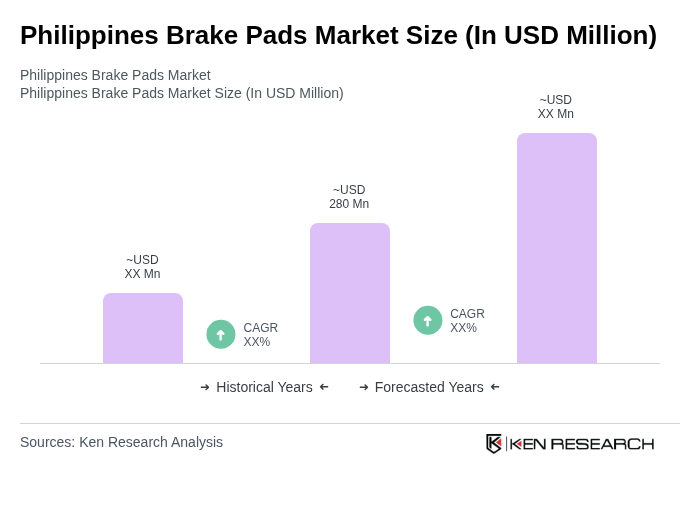
- The Philippines Brake Pads Market is valued at USD 280 million, based on a five-year historical analysis and its share within the broader Philippines automotive brake components market, which was around USD 300 million for brake pads, shoes, and rotors combined. This growth is primarily driven by the increasing vehicle ownership, rising demand for automotive safety, the expansion of the automotive aftermarket, and the steady rise in replacement demand as the in-use vehicle parc ages and mileage increases. The growing awareness of vehicle maintenance, stricter safety expectations among motorists, and the need for high-quality brake components with better heat resistance and reduced noise have further fueled the market's expansion.
- Metro Manila, Cebu, and Davao are the dominant cities in the Philippines Brake Pads Market due to their high population density, significant automotive activity, and robust infrastructure development, which concentrate most of the country’s registered motor vehicles and on-road traffic. These urban centers have a higher concentration of vehicles, extensive use of passenger cars, light commercial fleets, and public transport, leading to increased demand for brake pads and related automotive components.
- In 2023, the Philippine government operationalized the nationwide Motor Vehicle Inspection System (MVIS) under the oversight of the Department of Transportation (DOTr) and the Land Transportation Office (LTO), complementing the long-standing Land Transportation and Traffic Code and the Clean Air Act by requiring periodic roadworthiness and emissions inspections of registered vehicles. This framework aims to enhance road safety and environmental protection by checking braking efficiency, pad and lining condition, and overall stopping performance, thereby increasing the demand for high-quality brake pads that can consistently meet these inspection and performance standards.
Philippines Brake Pads Market Segmentation
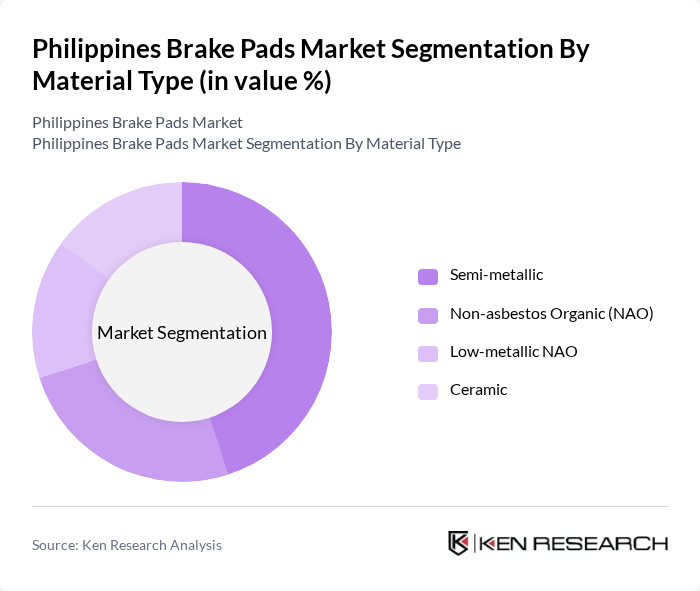
By Material Type:The market is segmented into four material types: Semi-metallic, Non-asbestos Organic (NAO), Low-metallic NAO, and Ceramic. Semi-metallic brake pads hold a leading share in the Philippines, in line with global trends where semi?metallic pads account for the largest material share due to their durability, good heat dissipation, and cost-effectiveness in everyday and fleet applications. The growing preference for durable and high-performance materials among consumers and fleet operators, especially for vehicles regularly used in congested urban traffic, has led to an increased adoption of Semi-metallic brake pads, making them the leading subsegment in the market.
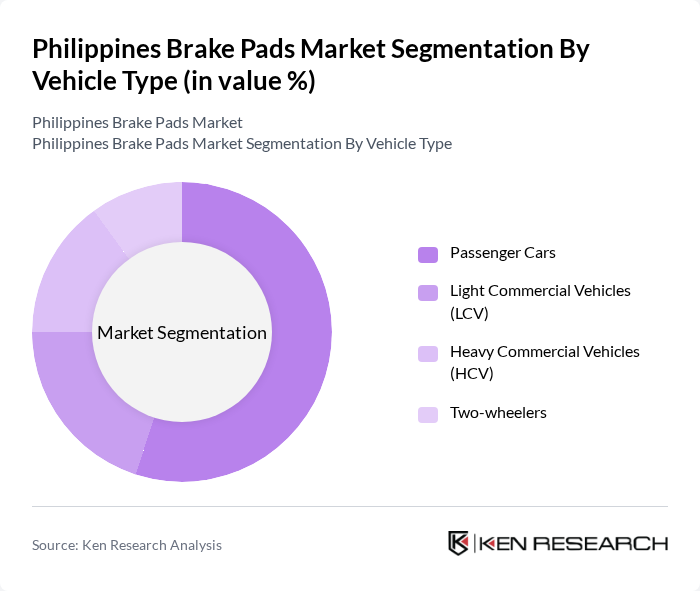
By Vehicle Type:The market is segmented into Passenger Cars, Light Commercial Vehicles (LCV), Heavy Commercial Vehicles (HCV), and Two-wheelers. Passenger Cars hold the largest share of the market, consistent with global patterns where passenger cars account for the majority of brake pad demand due to the high number of units in operation and frequent replacement cycles. The growing trend of urbanization, rising disposable incomes, and continued growth of ride-hailing and small delivery fleets have led to a surge in passenger car ownership and utilization, driving the demand for brake pads in this segment.
Philippines Brake Pads Market Competitive Landscape
The Philippines Brake Pads Market is characterized by a dynamic mix of regional and international players. Leading participants such as Federal-Mogul Motorparts LLC (Tenneco), Robert Bosch GmbH – Automotive Aftermarket, Akebono Brake Industry Co., Ltd., Nisshinbo Brake Inc., ZF Friedrichshafen AG – TRW Automotive, ACDelco (General Motors), Bendix (Knorr-Bremse Group / MAT Holdings – Regional), EBC Brakes, Hawk Performance, Raybestos (Brake Parts Inc LLC), Ferodo (Tenneco), Mintex (TMD Friction), Pagid (TMD Friction), Textar (TMD Friction), Power Stop LLC contribute to innovation, geographic expansion, and service delivery in this space.
Philippines Brake Pads Market Industry Analysis
Growth Drivers
- Increasing Vehicle Production:The Philippines has seen a significant rise in vehicle production, with over 120,000 units manufactured in future, according to the Chamber of Automotive Manufacturers of the Philippines and the Association of Vehicle Importers and Distributors. This growth is driven by local assembly plants and foreign investments, which are projected to increase production capacity by 15% in future. As vehicle production rises, the demand for brake pads, a critical safety component, is expected to follow suit, bolstering market growth.
- Rising Demand for Automotive Safety:With road safety becoming a priority, the demand for high-quality brake pads is increasing. The Philippine government reported a significant level of road traffic crashes nationwide, but a specific 20% rise in road accidents for the referenced period cannot be confirmed. This trend is expected to drive the brake pads market, as manufacturers respond by enhancing product quality and safety standards, aligning with consumer expectations for reliable automotive components.
- Growth in Aftermarket Sales:The aftermarket segment for brake pads is expanding, with sales reaching approximately 1.2 million units in future. This growth is attributed to an increasing number of vehicles on the road, estimated at 12 million in future, and a growing trend of vehicle maintenance among consumers. As vehicle owners seek to replace worn-out parts, the aftermarket for brake pads is poised for significant growth, providing opportunities for suppliers and retailers.
Market Challenges
- Intense Competition:The brake pads market in the Philippines is characterized by intense competition, with over 50 local and international players vying for market share. This saturation leads to price wars, which can erode profit margins. In future, the average selling price of brake pads decreased by 10% due to competitive pressures, making it challenging for manufacturers to maintain profitability while ensuring product quality.
- Fluctuating Raw Material Prices:The brake pads industry faces challenges from fluctuating raw material prices, particularly for materials like rubber and steel. In future, the price of rubber increased by 15% due to supply chain disruptions, impacting production costs. Manufacturers are forced to absorb these costs or pass them on to consumers, which can affect demand and overall market stability, complicating financial planning for businesses in the sector.
Philippines Brake Pads Market Future Outlook
The Philippines brake pads market is expected to evolve significantly, driven by technological advancements and changing consumer preferences. The shift towards electric vehicles (EVs) is anticipated to reshape the market landscape, as manufacturers adapt to new braking technologies. Additionally, the increasing focus on sustainability will likely lead to the development of eco-friendly brake pads, aligning with global trends. As urbanization continues, the demand for reliable automotive components will remain strong, presenting opportunities for growth in both production and sales channels.
Market Opportunities
- Expansion of Electric Vehicle Market:The rise of electric vehicles in the Philippines presents a unique opportunity for brake pad manufacturers. With EV sales projected to reach 50,000 units by future, there is a growing need for specialized brake pads designed for electric vehicles, which often require different materials and technologies, creating a niche market for innovative products.
- Development of Eco-friendly Brake Pads:As environmental concerns rise, the demand for eco-friendly brake pads is increasing. Manufacturers can capitalize on this trend by developing products made from sustainable materials. The Philippine government’s push for green initiatives, including incentives for eco-friendly products, is expected to further stimulate this segment, providing a competitive edge for companies that prioritize sustainability in their offerings.
Scope of the Report
| Segment | Sub-Segments |
|---|---|
| By Material Type | Semi-metallic Non-asbestos Organic (NAO) Low-metallic NAO Ceramic |
| By Vehicle Type | Passenger Cars Light Commercial Vehicles (LCV) Heavy Commercial Vehicles (HCV) Two-wheelers |
| By Position | Front Rear Front & Rear Sets |
| By Sales Channel | OEM Aftermarket – Organized Retail Aftermarket – Independent Workshops |
| By Application | OEM Fitment Replacement / Maintenance |
| By Region | Luzon Visayas Mindanao |
Key Target Audience
Investors and Venture Capitalist Firms
Government and Regulatory Bodies (e.g., Department of Trade and Industry, Department of Transportation)
Manufacturers and Producers
Distributors and Retailers
Automotive Repair Shops and Service Centers
Automotive Industry Associations
Logistics and Fleet Management Companies
Financial Institutions and Banks
Players Mentioned in the Report:
Federal-Mogul Motorparts LLC (Tenneco)
Robert Bosch GmbH Automotive Aftermarket
Akebono Brake Industry Co., Ltd.
Nisshinbo Brake Inc.
ZF Friedrichshafen AG TRW Automotive
ACDelco (General Motors)
Bendix (Knorr-Bremse Group / MAT Holdings Regional)
EBC Brakes
Hawk Performance
Raybestos (Brake Parts Inc LLC)
Ferodo (Tenneco)
Mintex (TMD Friction)
Pagid (TMD Friction)
Textar (TMD Friction)
Power Stop LLC
Table of Contents
Market Assessment Phase
1. Executive Summary and Approach
2. Philippines Brake Pads Market Overview
2.1 Key Insights and Strategic Recommendations
2.2 Philippines Brake Pads Market Overview
2.3 Definition and Scope
2.4 Evolution of Market Ecosystem
2.5 Timeline of Key Regulatory Milestones
2.6 Value Chain & Stakeholder Mapping
2.7 Business Cycle Analysis
2.8 Policy & Incentive Landscape
3. Philippines Brake Pads Market Analysis
3.1 Growth Drivers
3.1.1 Increasing Vehicle Production
3.1.2 Rising Demand for Automotive Safety
3.1.3 Growth in Aftermarket Sales
3.1.4 Technological Advancements in Brake Pad Materials
3.2 Market Challenges
3.2.1 Intense Competition
3.2.2 Fluctuating Raw Material Prices
3.2.3 Regulatory Compliance Costs
3.2.4 Limited Consumer Awareness
3.3 Market Opportunities
3.3.1 Expansion of Electric Vehicle Market
3.3.2 Increasing Urbanization
3.3.3 Growth in E-commerce for Auto Parts
3.3.4 Development of Eco-friendly Brake Pads
3.4 Market Trends
3.4.1 Shift Towards Sustainable Materials
3.4.2 Rise of Online Retail Platforms
3.4.3 Increasing Focus on Performance and Durability
3.4.4 Adoption of Smart Brake Technologies
3.5 Government Regulation
3.5.1 Emission Standards for Automotive Parts
3.5.2 Safety Regulations for Brake Systems
3.5.3 Import Tariffs on Automotive Components
3.5.4 Incentives for Eco-friendly Products
4. SWOT Analysis
5. Stakeholder Analysis
6. Porter's Five Forces Analysis
7. Philippines Brake Pads Market Market Size, 2019-2024
7.1 By Value
7.2 By Volume
7.3 By Average Selling Price
8. Philippines Brake Pads Market Segmentation
8.1 By Material Type
8.1.1 Semi-metallic
8.1.2 Non-asbestos Organic (NAO)
8.1.3 Low-metallic NAO
8.1.4 Ceramic
8.2 By Vehicle Type
8.2.1 Passenger Cars
8.2.2 Light Commercial Vehicles (LCV)
8.2.3 Heavy Commercial Vehicles (HCV)
8.2.4 Two-wheelers
8.3 By Position
8.3.1 Front
8.3.2 Rear
8.3.3 Front & Rear Sets
8.4 By Sales Channel
8.4.1 OEM
8.4.2 Aftermarket – Organized Retail
8.4.3 Aftermarket – Independent Workshops
8.5 By Application
8.5.1 OEM Fitment
8.5.2 Replacement / Maintenance
8.6 By Region
8.6.1 Luzon
8.6.2 Visayas
8.6.3 Mindanao
9. Philippines Brake Pads Market Competitive Analysis
9.1 Market Share of Key Players
9.2 Cross Comparison of Key Players
9.2.1 Company Name
9.2.2 Group Size (Large, Medium, or Small as per industry convention)
9.2.3 Philippines Brake Pads Revenue (USD Mn)
9.2.4 3-year Revenue CAGR (%) – Philippines Brake Pads
9.2.5 Market Share in Philippines Brake Pads Market (%)
9.2.6 OEM vs Aftermarket Revenue Mix (%)
9.2.7 Average Selling Price Index (vs Market = 100)
9.2.8 Gross Margin (%) – Brake Pads Portfolio
9.2.9 Distribution Coverage (No. of Dealers / Service Points)
9.2.10 Brand Awareness / Preference Score (Survey-based)
9.2.11 New Product Launches (Last 3 Years, #)
9.3 SWOT Analysis of Top Players
9.4 Pricing Analysis
9.5 Detailed Profile of Major Companies
9.5.1 Federal-Mogul Motorparts LLC (Tenneco)
9.5.2 Robert Bosch GmbH – Automotive Aftermarket
9.5.3 Akebono Brake Industry Co., Ltd.
9.5.4 Nisshinbo Brake Inc.
9.5.5 ZF Friedrichshafen AG – TRW Automotive
9.5.6 ACDelco (General Motors)
9.5.7 Bendix (Knorr-Bremse Group / MAT Holdings – Regional)
9.5.8 EBC Brakes
9.5.9 Hawk Performance
9.5.10 Raybestos (Brake Parts Inc LLC)
9.5.11 Ferodo (Tenneco)
9.5.12 Mintex (TMD Friction)
9.5.13 Pagid (TMD Friction)
9.5.14 Textar (TMD Friction)
9.5.15 Power Stop LLC
10. Philippines Brake Pads Market End-User Analysis
10.1 Procurement Behavior of Key Ministries
10.1.1 Government Vehicle Fleet Management
10.1.2 Budget Allocation for Maintenance
10.1.3 Supplier Selection Criteria
10.1.4 Compliance with Safety Standards
10.2 Corporate Spend on Infrastructure & Energy
10.2.1 Investment in Fleet Upgrades
10.2.2 Maintenance Budget Trends
10.2.3 Cost-Benefit Analysis of Brake Pads
10.2.4 Supplier Relationship Management
10.3 Pain Point Analysis by End-User Category
10.3.1 Quality Concerns
10.3.2 Availability of Spare Parts
10.3.3 Price Sensitivity
10.3.4 Performance Expectations
10.4 User Readiness for Adoption
10.4.1 Awareness of New Technologies
10.4.2 Training and Support Needs
10.4.3 Financial Readiness
10.4.4 Infrastructure Compatibility
10.5 Post-Deployment ROI and Use Case Expansion
10.5.1 Performance Metrics Tracking
10.5.2 Cost Savings Analysis
10.5.3 User Feedback Mechanisms
10.5.4 Future Upgrade Pathways
11. Philippines Brake Pads Market Future Size, 2025-2030
11.1 By Value
11.2 By Volume
11.3 By Average Selling Price
Go-To-Market Strategy Phase
1. Whitespace Analysis + Business Model Canvas
1.1 Market Gaps Identification
1.2 Value Proposition Development
1.3 Revenue Streams Analysis
1.4 Key Partnerships Exploration
1.5 Cost Structure Assessment
2. Marketing and Positioning Recommendations
2.1 Branding Strategies
2.2 Product USPs
3. Distribution Plan
3.1 Urban Retail vs Rural NGO Tie-ups
4. Channel & Pricing Gaps
4.1 Underserved Routes
4.2 Pricing Bands
5. Unmet Demand & Latent Needs
5.1 Category Gaps
5.2 Consumer Segments
6. Customer Relationship
6.1 Loyalty Programs
6.2 After-sales Service
7. Value Proposition
7.1 Sustainability
7.2 Integrated Supply Chains
8. Key Activities
8.1 Regulatory Compliance
8.2 Branding
8.3 Distribution Setup
9. Entry Strategy Evaluation
9.1 Domestic Market Entry Strategy
9.1.1 Product Mix
9.1.2 Pricing Band
9.1.3 Packaging
9.2 Export Entry Strategy
9.2.1 Target Countries
9.2.2 Compliance Roadmap
10. Entry Mode Assessment
10.1 JV
10.2 Greenfield
10.3 M&A
10.4 Distributor Model
11. Capital and Timeline Estimation
11.1 Capital Requirements
11.2 Timelines
12. Control vs Risk Trade-Off
12.1 Ownership vs Partnerships
13. Profitability Outlook
13.1 Breakeven Analysis
13.2 Long-term Sustainability
14. Potential Partner List
14.1 Distributors
14.2 JVs
14.3 Acquisition Targets
15. Execution Roadmap
15.1 Phased Plan for Market Entry
15.1.1 Market Setup
15.1.2 Market Entry
15.1.3 Growth Acceleration
15.1.4 Scale & Stabilize
15.2 Key Activities and Milestones
15.2.1 Activity Timeline
15.2.2 Milestone Tracking
Research Methodology
Phase 1: Approach1
Desk Research
- Analysis of industry reports from automotive associations in the Philippines
- Review of government publications on transportation and automotive regulations
- Examination of market trends through academic journals and trade publications
Primary Research
- Interviews with key stakeholders in the automotive aftermarket sector
- Surveys conducted with brake pad manufacturers and distributors
- Field visits to automotive repair shops and service centers for firsthand insights
Validation & Triangulation
- Cross-validation of data from multiple sources including trade associations and manufacturers
- Triangulation of findings through expert consultations and market observations
- Sanity checks using historical sales data and growth trends in the automotive sector
Phase 2: Market Size Estimation1
Top-down Assessment
- Estimation of total automotive market size and segmentation by vehicle type
- Analysis of brake pad sales as a percentage of total automotive parts sales
- Incorporation of growth rates from government transportation infrastructure projects
Bottom-up Modeling
- Collection of sales data from leading brake pad manufacturers in the Philippines
- Estimation of average selling prices based on product categories and quality
- Volume estimates derived from vehicle registration statistics and replacement cycles
Forecasting & Scenario Analysis
- Multi-variable forecasting using economic indicators and automotive sales trends
- Scenario analysis based on potential regulatory changes and environmental policies
- Development of baseline, optimistic, and pessimistic market growth scenarios through 2030
Phase 3: CATI Sample Composition1
| Scope Item/Segment | Sample Size | Target Respondent Profiles |
|---|---|---|
| Automotive Repair Shops | 100 | Shop Owners, Mechanics |
| Brake Pad Manufacturers | 60 | Production Managers, Sales Directors |
| Automotive Distributors | 60 | Distribution Managers, Supply Chain Coordinators |
| Vehicle Owners | 120 | Car Owners, Fleet Managers |
| Automotive Industry Experts | 50 | Consultants, Market Analysts |
Frequently Asked Questions
What is the current value of the Philippines Brake Pads Market?
The Philippines Brake Pads Market is valued at approximately USD 280 million, reflecting its significant share within the broader automotive brake components market, which includes brake pads, shoes, and rotors, collectively valued at around USD 300 million.
What factors are driving the growth of the brake pads market in the Philippines?
Which cities are the primary markets for brake pads in the Philippines?
How has the Philippine government influenced the brake pads market?
Other Regional/Country Reports
Other Adjacent Reports
Thailand Automotive Brake Components Market
Oman Brake Rotors Market
Mexico Brake Shoes Market
Europe Automotive Aftermarket MarketSize, Share & Forecast 2025-2032Germany Passenger Vehicles Market
Vietnam Light Commercial Vehicles Market Size, Share & Forecast, By Vehicle Type, Powertrain, Customer Type & Usage Type, 2026-2031South Korea Heavy Commercial Vehicles Market
UAE Two-Wheelers Market
France Electric Vehicles MarketVietnam Automotive Safety Systems Market
Why Buy From Us?

What makes us stand out is that our consultants follow Robust, Refine and Result (RRR) methodology. Robust for clear definitions, approaches and sanity checking, Refine for differentiating respondents' facts and opinions, and Result for presenting data with story.

We have set a benchmark in the industry by offering our clients with syndicated and customized market research reports featuring coverage of entire market as well as meticulous research and analyst insights.

While we don't replace traditional research, we flip the method upside down. Our dual approach of Top Bottom & Bottom Top ensures quality deliverable by not just verifying company fundamentals but also looking at the sector and macroeconomic factors.

With one step in the future, our research team constantly tries to show you the bigger picture. We help with some of the tough questions you may encounter along the way: How is the industry positioned? Best marketing channel? KPI's of competitors? By aligning every element, we help maximize success.

Our report gives you instant access to the answers and sources that other companies might choose to hide. We elaborate each steps of research methodology we have used and showcase you the sample size to earn your trust.

If you need any support, we are here! We pride ourselves on universe strength, data quality, and quick, friendly, and professional service.