About the Report
Base Year 2024New Zealand Law Enforcement PPE Market Overview
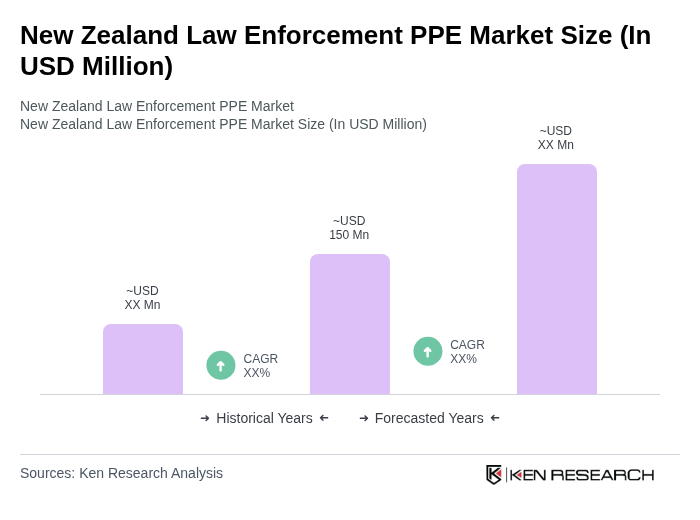
- The New Zealand Law Enforcement PPE market is valued at USD 150 million, based on a five-year historical analysis. This growth is primarily driven by increasing public safety concerns, government investments in law enforcement, and the rising need for advanced protective gear among police and security personnel. The market has seen a steady demand for high-quality personal protective equipment, which is essential for ensuring the safety of law enforcement officers in various operational scenarios.
- Key cities such as Auckland, Wellington, and Christchurch dominate the New Zealand Law Enforcement PPE market due to their significant law enforcement presence and higher population density. These urban areas have a greater need for advanced protective equipment, driven by urban crime rates and public safety initiatives. The concentration of law enforcement agencies and private security firms in these cities further enhances market growth and demand for PPE.
- In 2023, the New Zealand government implemented the Health and Safety at Work Act, which mandates that all law enforcement agencies must provide adequate personal protective equipment to their officers. This regulation aims to ensure the safety and well-being of personnel while performing their duties, thereby increasing the demand for high-quality PPE in the market.
New Zealand Law Enforcement PPE Market Segmentation
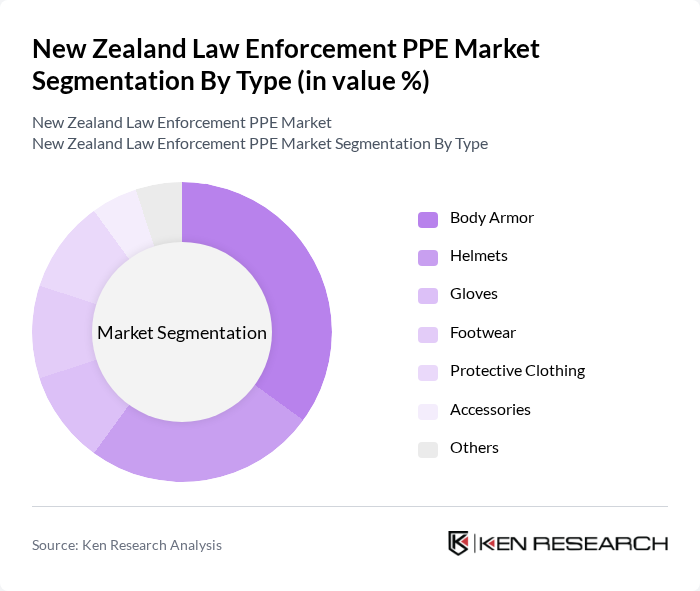
By Type:The market is segmented into various types of personal protective equipment, including body armor, helmets, gloves, footwear, protective clothing, accessories, and others. Among these, body armor and helmets are the most critical segments, as they provide essential protection against firearms and other threats faced by law enforcement personnel. The increasing focus on officer safety and the need for compliance with safety regulations have driven the demand for these protective gear types.
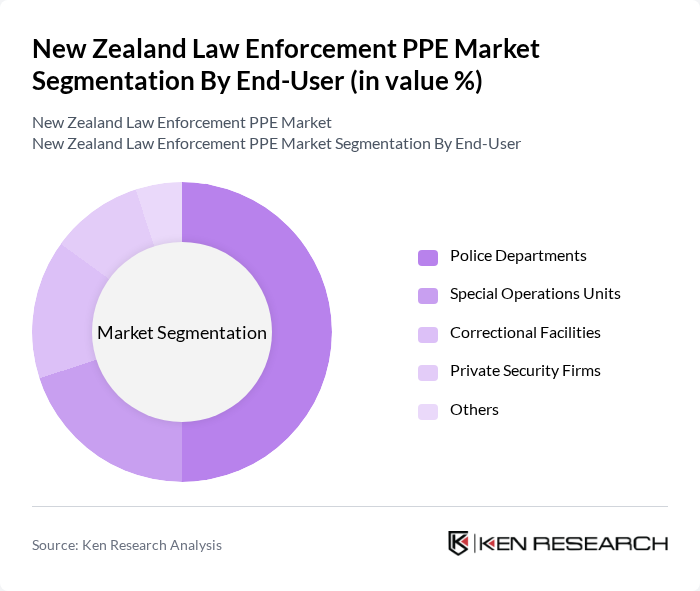
By End-User:The end-user segmentation includes police departments, special operations units, correctional facilities, private security firms, and others. Police departments represent the largest segment, as they require a wide range of PPE to ensure the safety of their officers during routine patrols and high-risk operations. The increasing focus on public safety and the need for specialized equipment in various law enforcement scenarios have contributed to the growth of this segment.
New Zealand Law Enforcement PPE Market Competitive Landscape
The New Zealand Law Enforcement PPE Market is characterized by a dynamic mix of regional and international players. Leading participants such as Pacific Helmets, Protective Technologies International, Aegis Engineering, Armoured Vehicles Australia, Safety and Security Solutions, HAZMAT Solutions, CMC Safety, New Zealand Police Supply, Tactile Solutions, MSA Safety, Honeywell Safety Products, 3M New Zealand, Avon Protection, Safariland, DuPont Personal Protection contribute to innovation, geographic expansion, and service delivery in this space.
New Zealand Law Enforcement PPE Market Industry Analysis
Growth Drivers
- Increasing Focus on Officer Safety:The New Zealand government allocated NZD 1.6 billion for law enforcement in future, emphasizing the importance of officer safety. This funding supports the procurement of advanced personal protective equipment (PPE) to mitigate risks faced by officers in the line of duty. Enhanced training programs and safety protocols further drive the demand for high-quality PPE, ensuring that officers are equipped with the best protective gear available, ultimately fostering a safer working environment.
- Rising Crime Rates Necessitating Enhanced Protective Gear:New Zealand has experienced a 12% increase in reported crime rates from 2022 to 2023, prompting law enforcement agencies to seek improved protective gear. This surge in crime has led to heightened concerns regarding officer safety, driving agencies to invest in advanced PPE solutions. The need for reliable and effective protective equipment is critical to ensure that officers can perform their duties safely and effectively in increasingly challenging environments.
- Government Funding for Law Enforcement Upgrades:In future, the New Zealand government is expected to increase its law enforcement budget by 9%, focusing on upgrading equipment and technology. This funding will facilitate the acquisition of state-of-the-art PPE, ensuring that officers have access to the latest advancements in protective gear. Such investments not only enhance officer safety but also improve overall operational efficiency, allowing law enforcement agencies to respond more effectively to emerging threats.
Market Challenges
- Budget Constraints Within Law Enforcement Agencies:Despite increased funding, many law enforcement agencies in New Zealand face budget constraints that limit their ability to procure advanced PPE. In future, it is estimated that 62% of agencies will operate under tight financial conditions, impacting their purchasing decisions. This challenge necessitates prioritization of essential equipment, often delaying the adoption of innovative protective gear that could enhance officer safety and operational effectiveness.
- Compliance with Stringent Safety Regulations:New Zealand's law enforcement agencies must adhere to strict safety regulations, which can complicate the procurement process for PPE. In future, approximately 72% of agencies will need to navigate complex compliance requirements, including material sourcing and testing standards. This challenge can lead to delays in equipment acquisition and increased costs, as agencies strive to meet regulatory demands while ensuring the safety of their officers.
New Zealand Law Enforcement PPE Market Future Outlook
The New Zealand law enforcement PPE market is poised for significant evolution, driven by technological advancements and a growing emphasis on officer safety. As agencies increasingly adopt smart PPE solutions, the integration of wearable technology will enhance situational awareness and response capabilities. Furthermore, the shift towards eco-friendly materials reflects a broader commitment to sustainability, aligning with global trends. These developments will not only improve officer safety but also foster innovation within the industry, creating a more resilient and adaptive market landscape.
Market Opportunities
- Expansion of Product Lines to Include Smart PPE:The demand for smart PPE is on the rise, with an estimated market potential of NZD 220 million by future. This presents a significant opportunity for manufacturers to innovate and develop advanced protective gear that incorporates technology, enhancing officer safety and operational efficiency.
- Partnerships with Technology Firms for Innovation:Collaborations between PPE manufacturers and technology firms can lead to groundbreaking advancements in protective gear. By leveraging expertise in materials science and wearable technology, these partnerships can create innovative solutions that address the evolving needs of law enforcement, potentially increasing market share and driving growth.
Scope of the Report
| Segment | Sub-Segments |
|---|---|
| By Type | Body Armor Helmets Gloves Footwear Protective Clothing Accessories Others |
| By End-User | Police Departments Special Operations Units Correctional Facilities Private Security Firms Others |
| By Application | Riot Control Tactical Operations Search and Rescue Daily Patrols Others |
| By Material | Kevlar Nomex Polycarbonate Steel Others |
| By Distribution Channel | Direct Sales Online Retail Distributors Government Contracts Others |
| By Region | North Island South Island Others |
| By Price Range | Budget Mid-Range Premium Others |
Key Target Audience
Investors and Venture Capitalist Firms
Government and Regulatory Bodies (e.g., New Zealand Police, Ministry of Justice)
Manufacturers and Producers
Distributors and Retailers
Law Enforcement Agencies (e.g., New Zealand Customs Service, Department of Internal Affairs)
Technology Providers
Industry Associations (e.g., New Zealand Security Association)
Financial Institutions
Players Mentioned in the Report:
Pacific Helmets
Protective Technologies International
Aegis Engineering
Armoured Vehicles Australia
Safety and Security Solutions
HAZMAT Solutions
CMC Safety
New Zealand Police Supply
Tactile Solutions
MSA Safety
Honeywell Safety Products
3M New Zealand
Avon Protection
Safariland
DuPont Personal Protection
Table of Contents
Market Assessment Phase
1. Executive Summary and Approach
2. New Zealand Law Enforcement PPE Market Overview
2.1 Key Insights and Strategic Recommendations
2.2 New Zealand Law Enforcement PPE Market Overview
2.3 Definition and Scope
2.4 Evolution of Market Ecosystem
2.5 Timeline of Key Regulatory Milestones
2.6 Value Chain & Stakeholder Mapping
2.7 Business Cycle Analysis
2.8 Policy & Incentive Landscape
3. New Zealand Law Enforcement PPE Market Analysis
3.1 Growth Drivers
3.1.1 Increasing focus on officer safety
3.1.2 Rising crime rates necessitating enhanced protective gear
3.1.3 Government funding for law enforcement upgrades
3.1.4 Technological advancements in PPE materials
3.2 Market Challenges
3.2.1 Budget constraints within law enforcement agencies
3.2.2 Compliance with stringent safety regulations
3.2.3 Limited awareness of advanced PPE options
3.2.4 Supply chain disruptions affecting availability
3.3 Market Opportunities
3.3.1 Expansion of product lines to include smart PPE
3.3.2 Partnerships with technology firms for innovation
3.3.3 Increased demand for eco-friendly materials
3.3.4 Training programs to enhance user adoption
3.4 Market Trends
3.4.1 Growing emphasis on ergonomic designs
3.4.2 Integration of wearable technology in PPE
3.4.3 Shift towards modular PPE systems
3.4.4 Rising popularity of custom-fit solutions
3.5 Government Regulation
3.5.1 Compliance with New Zealand safety standards
3.5.2 Regulations on material sourcing and sustainability
3.5.3 Guidelines for PPE usage in law enforcement
3.5.4 Funding regulations for law enforcement equipment
4. SWOT Analysis
5. Stakeholder Analysis
6. Porter's Five Forces Analysis
7. New Zealand Law Enforcement PPE Market Market Size, 2019-2024
7.1 By Value
7.2 By Volume
7.3 By Average Selling Price
8. New Zealand Law Enforcement PPE Market Segmentation
8.1 By Type
8.1.1 Body Armor
8.1.2 Helmets
8.1.3 Gloves
8.1.4 Footwear
8.1.5 Protective Clothing
8.1.6 Accessories
8.1.7 Others
8.2 By End-User
8.2.1 Police Departments
8.2.2 Special Operations Units
8.2.3 Correctional Facilities
8.2.4 Private Security Firms
8.2.5 Others
8.3 By Application
8.3.1 Riot Control
8.3.2 Tactical Operations
8.3.3 Search and Rescue
8.3.4 Daily Patrols
8.3.5 Others
8.4 By Material
8.4.1 Kevlar
8.4.2 Nomex
8.4.3 Polycarbonate
8.4.4 Steel
8.4.5 Others
8.5 By Distribution Channel
8.5.1 Direct Sales
8.5.2 Online Retail
8.5.3 Distributors
8.5.4 Government Contracts
8.5.5 Others
8.6 By Region
8.6.1 North Island
8.6.2 South Island
8.6.3 Others
8.7 By Price Range
8.7.1 Budget
8.7.2 Mid-Range
8.7.3 Premium
8.7.4 Others
9. New Zealand Law Enforcement PPE Market Competitive Analysis
9.1 Market Share of Key Players
9.2 Cross Comparison of Key Players
9.2.1 Company Name
9.2.2 Group Size (Large, Medium, or Small as per industry convention)
9.2.3 Revenue Growth Rate
9.2.4 Market Penetration Rate
9.2.5 Customer Retention Rate
9.2.6 Product Quality Index
9.2.7 Pricing Strategy
9.2.8 Distribution Efficiency
9.2.9 Innovation Rate
9.2.10 Customer Satisfaction Score
9.3 SWOT Analysis of Top Players
9.4 Pricing Analysis
9.5 Detailed Profile of Major Companies
9.5.1 Pacific Helmets
9.5.2 Protective Technologies International
9.5.3 Aegis Engineering
9.5.4 Armoured Vehicles Australia
9.5.5 Safety and Security Solutions
9.5.6 HAZMAT Solutions
9.5.7 CMC Safety
9.5.8 New Zealand Police Supply
9.5.9 Tactile Solutions
9.5.10 MSA Safety
9.5.11 Honeywell Safety Products
9.5.12 3M New Zealand
9.5.13 Avon Protection
9.5.14 Safariland
9.5.15 DuPont Personal Protection
10. New Zealand Law Enforcement PPE Market End-User Analysis
10.1 Procurement Behavior of Key Ministries
10.1.1 Budget Allocation Trends
10.1.2 Procurement Processes
10.1.3 Supplier Selection Criteria
10.1.4 Contract Duration Preferences
10.2 Corporate Spend on Infrastructure & Energy
10.2.1 Investment in Safety Equipment
10.2.2 Budgeting for Training Programs
10.2.3 Funding for Technological Upgrades
10.2.4 Expenditure on Maintenance and Repairs
10.3 Pain Point Analysis by End-User Category
10.3.1 Equipment Durability Concerns
10.3.2 Need for Customization
10.3.3 Challenges in Training and Adoption
10.3.4 Budget Constraints
10.4 User Readiness for Adoption
10.4.1 Awareness of New Technologies
10.4.2 Training Needs Assessment
10.4.3 Feedback Mechanisms
10.4.4 Adoption Barriers
10.5 Post-Deployment ROI and Use Case Expansion
10.5.1 Performance Metrics
10.5.2 User Feedback and Adjustments
10.5.3 Long-term Cost Savings
10.5.4 Expansion into New Use Cases
11. New Zealand Law Enforcement PPE Market Future Size, 2025-2030
11.1 By Value
11.2 By Volume
11.3 By Average Selling Price
Go-To-Market Strategy Phase
1. Whitespace Analysis + Business Model Canvas
1.1 Market Gaps Identification
1.2 Business Model Development
2. Marketing and Positioning Recommendations
2.1 Branding Strategies
2.2 Product USPs
3. Distribution Plan
3.1 Urban Retail vs Rural NGO Tie-ups
4. Channel & Pricing Gaps
4.1 Underserved Routes
4.2 Pricing Bands
5. Unmet Demand & Latent Needs
5.1 Category Gaps
5.2 Consumer Segments
6. Customer Relationship
6.1 Loyalty Programs
6.2 After-sales Service
7. Value Proposition
7.1 Sustainability
7.2 Integrated Supply Chains
8. Key Activities
8.1 Regulatory Compliance
8.2 Branding
8.3 Distribution Setup
9. Entry Strategy Evaluation
9.1 Domestic Market Entry Strategy
9.1.1 Product Mix
9.1.2 Pricing Band
9.1.3 Packaging
9.2 Export Entry Strategy
9.2.1 Target Countries
9.2.2 Compliance Roadmap
10. Entry Mode Assessment
10.1 JV
10.2 Greenfield
10.3 M&A
10.4 Distributor Model
11. Capital and Timeline Estimation
11.1 Capital Requirements
11.2 Timelines
12. Control vs Risk Trade-Off
12.1 Ownership vs Partnerships
13. Profitability Outlook
13.1 Breakeven Analysis
13.2 Long-term Sustainability
14. Potential Partner List
14.1 Distributors
14.2 JVs
14.3 Acquisition Targets
15. Execution Roadmap
15.1 Phased Plan for Market Entry
15.1.1 Market Setup
15.1.2 Market Entry
15.1.3 Growth Acceleration
15.1.4 Scale & Stabilize
15.2 Key Activities and Milestones
15.2.1 Milestone Planning
15.2.2 Activity Tracking
Research Methodology
Phase 1: Approach1
Desk Research
- Analysis of government reports and publications on law enforcement and public safety
- Review of industry white papers and market analysis reports specific to PPE in New Zealand
- Examination of trade associations' data and statistics related to PPE usage in law enforcement
Primary Research
- Interviews with procurement officers from New Zealand law enforcement agencies
- Surveys conducted with PPE manufacturers and suppliers operating in the region
- Field interviews with frontline law enforcement personnel regarding PPE effectiveness and needs
Validation & Triangulation
- Cross-validation of findings through multiple data sources, including government and industry reports
- Triangulation of qualitative insights from interviews with quantitative data from surveys
- Sanity checks performed by consulting with a panel of industry experts and stakeholders
Phase 2: Market Size Estimation1
Top-down Assessment
- Estimation of total law enforcement budget allocations for PPE across New Zealand
- Analysis of historical spending trends on PPE by law enforcement agencies
- Incorporation of projected growth rates based on emerging safety regulations and standards
Bottom-up Modeling
- Collection of data on unit sales and pricing from leading PPE suppliers in New Zealand
- Estimation of demand based on the number of active law enforcement personnel and their PPE requirements
- Volume x cost analysis to determine the overall market size for various PPE categories
Forecasting & Scenario Analysis
- Multi-factor regression analysis incorporating factors such as crime rates and public safety initiatives
- Scenario modeling based on potential changes in government funding and policy shifts
- Development of baseline, optimistic, and pessimistic forecasts through 2030
Phase 3: CATI Sample Composition1
| Scope Item/Segment | Sample Size | Target Respondent Profiles |
|---|---|---|
| Urban Police Departments | 100 | Chief Officers, Procurement Managers |
| Rural Law Enforcement Agencies | 75 | Operations Supervisors, Safety Officers |
| Specialized Units (SWAT, K9) | 50 | Unit Leaders, Tactical Officers |
| Emergency Services Collaboration | 60 | Emergency Response Coordinators, Training Officers |
| PPE Suppliers and Distributors | 80 | Sales Managers, Product Development Leads |
Frequently Asked Questions
What is the current value of the New Zealand Law Enforcement PPE market?
The New Zealand Law Enforcement PPE market is valued at approximately USD 150 million, reflecting a steady demand for high-quality personal protective equipment essential for the safety of law enforcement officers in various operational scenarios.
What factors are driving growth in the New Zealand Law Enforcement PPE market?
Which cities are the largest markets for Law Enforcement PPE in New Zealand?
What recent legislation has impacted the New Zealand Law Enforcement PPE market?
Other Regional/Country Reports
Other Adjacent Reports
Malaysia Military PPE Market
Brazil Firefighter PPE Market
Kuwait Industrial Safety Equipment Market
UAE Tactical Gear Market
India Ballistic Protection Market Outlook to 2021 - Rising Defence Expenditure and Growing Exports to Shape the FutureQatar Security Technology Market
Bahrain Emergency Response Equipment Market
Germany Correctional Facility Equipment Market
Vietnam Hazmat Safety Market
US MEA 8x8 Armored Vehicle Market Size Share Growth Drivers Trends Opportunities & Forecast 2025–2030Why Buy From Us?

What makes us stand out is that our consultants follow Robust, Refine and Result (RRR) methodology. Robust for clear definitions, approaches and sanity checking, Refine for differentiating respondents' facts and opinions, and Result for presenting data with story.

We have set a benchmark in the industry by offering our clients with syndicated and customized market research reports featuring coverage of entire market as well as meticulous research and analyst insights.

While we don't replace traditional research, we flip the method upside down. Our dual approach of Top Bottom & Bottom Top ensures quality deliverable by not just verifying company fundamentals but also looking at the sector and macroeconomic factors.

With one step in the future, our research team constantly tries to show you the bigger picture. We help with some of the tough questions you may encounter along the way: How is the industry positioned? Best marketing channel? KPI's of competitors? By aligning every element, we help maximize success.

Our report gives you instant access to the answers and sources that other companies might choose to hide. We elaborate each steps of research methodology we have used and showcase you the sample size to earn your trust.

If you need any support, we are here! We pride ourselves on universe strength, data quality, and quick, friendly, and professional service.