About the Report
Base Year 2024US MEA 8x8 Armored Vehicle Market Overview
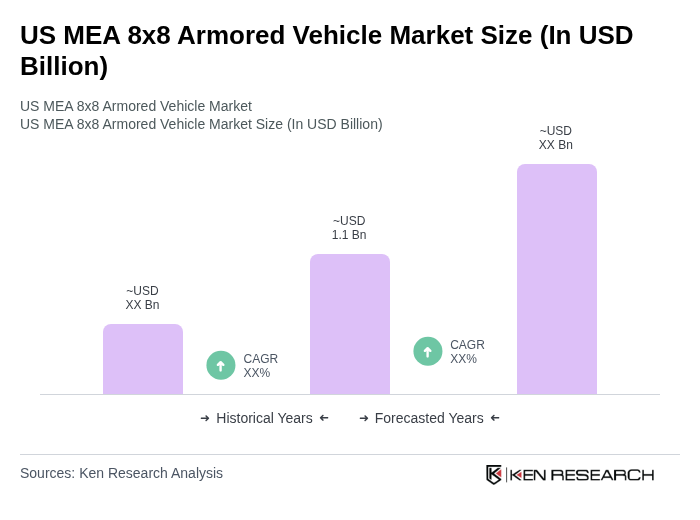
- The US MEA 8x8 Armored Vehicle Market is valued at USD 1.1 billion, based on a five-year historical analysis, aligned with the broader MEA 8x8 armored vehicle market size reported for the region. This growth is primarily driven by increasing defense budgets, modernization of military fleets, and rising geopolitical tensions that necessitate enhanced military capabilities, as reflected in higher regional armored vehicle procurement. The demand for advanced armored vehicles is further fueled by the need for versatile platforms that can perform multiple roles in various operational environments, including peacekeeping, counterinsurgency, and border security missions.
- Key players in this market include the United States, Canada, and Mexico within the broader North American armored vehicle ecosystem, with the US being the dominant force due to its significant defense spending and advanced technological capabilities. The presence of major defense contractors and a robust supply chain in these countries also contributes to their market leadership, enabling rapid innovation and deployment of advanced armored vehicles, particularly in 8x8 configurations such as armored personnel carriers and infantry fighting vehicles.
- The US government annually enacts the National Defense Authorization Act (NDAA), with the James M. Inhofe National Defense Authorization Act for Fiscal Year 2023 authorizing total national defense funding on the order of hundreds of billions of USD and emphasizing modernization of combat platforms and ground vehicles. This legislation supports the procurement of advanced military equipment, including wheeled armored vehicles, and aims to enhance military readiness and support the development of next-generation defense technologies, ensuring that the armed forces remain equipped to address emerging threats.
US MEA 8x8 Armored Vehicle Market Segmentation
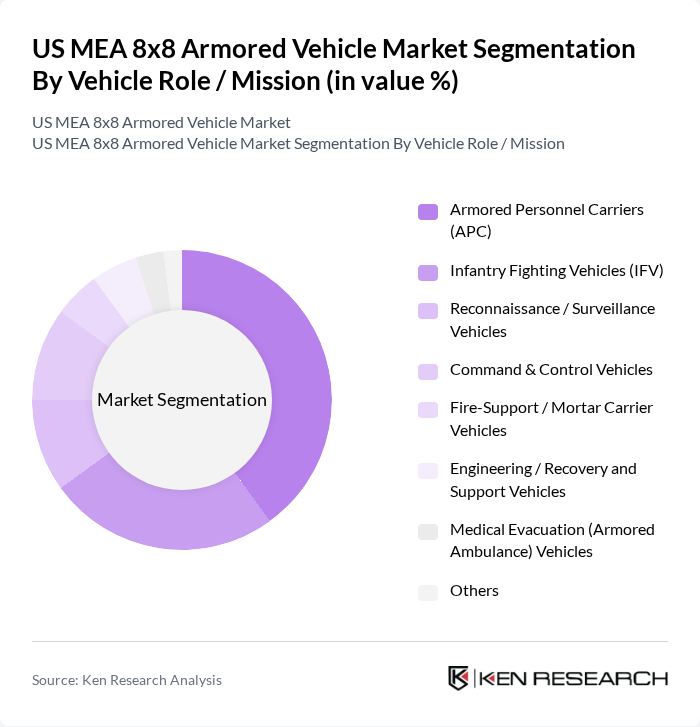
By Vehicle Role / Mission:The vehicle role or mission segmentation includes various types of armored vehicles designed for specific operational tasks. The dominant sub-segment in this category is Armored Personnel Carriers (APC), which are widely used for troop transport and protection in combat zones and internal security operations, and are recognized as a key revenue-generating category within the wider armored vehicle market. The increasing focus on troop safety, survivability against improvised explosive devices, and the need for versatile vehicles that can operate in diverse environments have led to a surge in demand for APCs. Other notable sub-segments include Infantry Fighting Vehicles (IFV) and Command & Control Vehicles, which are also gaining traction due to their critical roles in modern, network-centric warfare and combined-arms operations.
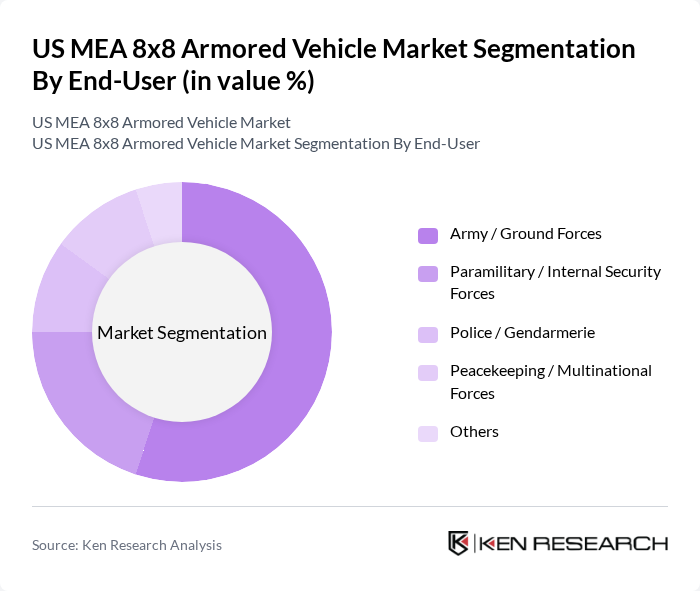
By End-User:The end-user segmentation highlights the various entities utilizing 8x8 armored vehicles, with the Army / Ground Forces being the leading segment, reflecting the fact that defense forces remain the primary buyers of armored vehicles globally. This dominance is attributed to the increasing need for ground forces to have reliable and versatile armored vehicles for combat, deterrence, and peacekeeping missions in high-threat environments. Paramilitary and Internal Security Forces also represent a significant portion of the market, driven by the need for enhanced security measures in urban environments and border security roles, while demand from Police / Gendarmerie and Peacekeeping / Multinational Forces is growing as well, reflecting the evolving security landscape and the use of wheeled armored vehicles in stabilization and UN missions.
US MEA 8x8 Armored Vehicle Market Competitive Landscape
The US MEA 8x8 Armored Vehicle Market is characterized by a dynamic mix of regional and international players. Leading participants such as General Dynamics Land Systems, BAE Systems, Oshkosh Defense, Rheinmetall, Lockheed Martin, Northrop Grumman, Textron Systems, AM General, L3Harris Technologies, Elbit Systems, Leonardo DRS, Thales Group, Navistar Defense, KNDS (KMW + Nexter Defense Systems), Iveco Defence Vehicles contribute to innovation, geographic expansion, and service delivery in this space.
US MEA 8x8 Armored Vehicle Market Industry Analysis
Growth Drivers
- Increased Defense Budgets:The US defense budget is projected to reach $895 billion in future, reflecting a 2% increase from the prior period. This rise is driven by geopolitical tensions and the need for enhanced military capabilities. The allocation for armored vehicles is expected to grow significantly, with approximately $20 billion earmarked for modernization programs. This financial commitment supports the development and procurement of advanced 8x8 armored vehicles, ensuring that military forces remain equipped to address emerging threats effectively.
- Rising Demand for Enhanced Mobility:The demand for enhanced mobility in military operations is critical, with the US Army reporting that a substantial share of its operations require rapid deployment capabilities. The 8x8 armored vehicles provide superior mobility, enabling forces to navigate diverse terrains effectively. In future, the Army plans to increase its fleet of 8x8 vehicles by 15%, reflecting a strategic shift towards more agile and versatile platforms that can adapt to various operational scenarios, thereby enhancing overall mission success.
- Technological Advancements in Armored Vehicles:The integration of cutting-edge technologies, such as advanced armor materials and autonomous systems, is transforming the armored vehicle landscape. In future, the US military is expected to invest over $5 billion in R&D for next-generation armored vehicles. This investment aims to enhance survivability and operational efficiency, with innovations like active protection systems and improved situational awareness becoming standard features. Such advancements are crucial for maintaining a tactical edge in modern warfare.
Market Challenges
- High Development and Production Costs:The development and production of 8x8 armored vehicles involve substantial financial investments, often exceeding several million USD per unit. This high cost is a significant barrier for many defense contractors, particularly smaller firms. Additionally, the rising prices of raw materials, such as steel and composites, have increased production costs by approximately 15% in the last year. These financial pressures can limit the number of contracts awarded and slow down the procurement process.
- Stringent Regulatory Compliance:Compliance with various regulatory frameworks, including the Buy American Act and export control regulations, poses challenges for manufacturers. In future, the Department of Defense is expected to enforce stricter compliance measures, which could delay project timelines and increase costs. Companies must navigate complex regulatory landscapes, which can lead to additional administrative burdens and potential penalties for non-compliance, ultimately affecting their competitiveness in the market.
US MEA 8x8 Armored Vehicle Market Future Outlook
The future of the US MEA 8x8 armored vehicle market appears promising, driven by ongoing military modernization efforts and technological innovations. As defense budgets continue to rise, manufacturers are likely to focus on developing advanced, modular designs that enhance operational flexibility. Additionally, the integration of AI and automation technologies will play a crucial role in shaping the next generation of armored vehicles, ensuring they meet the evolving demands of modern warfare while maintaining cost-effectiveness and compliance with regulatory standards.
Market Opportunities
- Expansion into Emerging Markets:Emerging markets in Asia and the Middle East present significant opportunities for US manufacturers. With defense spending in these regions projected to grow by 5% annually, there is a rising demand for advanced armored vehicles. Establishing partnerships with local governments can facilitate market entry and enhance competitiveness, allowing US firms to leverage their technological expertise in these rapidly developing defense sectors.
- Development of Hybrid and Electric Armored Vehicles:The shift towards sustainability in defense is creating opportunities for hybrid and electric armored vehicles. With the US military aiming for a 50% reduction in greenhouse gas emissions by 2030, investments in eco-friendly technologies are essential. Companies that innovate in this space can capture a growing segment of the market, aligning with government sustainability goals while enhancing operational efficiency and reducing long-term operational costs.
Scope of the Report
| Segment | Sub-Segments |
|---|---|
| By Vehicle Role / Mission | Armored Personnel Carriers (APC) Infantry Fighting Vehicles (IFV) Reconnaissance / Surveillance Vehicles Command & Control Vehicles Fire-Support / Mortar Carrier Vehicles Engineering / Recovery and Support Vehicles Medical Evacuation (Armored Ambulance) Vehicles Others |
| By End-User | Army / Ground Forces Paramilitary / Internal Security Forces Police / Gendarmerie Peacekeeping / Multinational Forces Others |
| By Protection Level (STANAG 4569) | Level 1–2 Level 3 Level 4 and Above Others |
| By Weight Class | Light (< 20 t) Medium (20–30 t) Heavy (> 30 t) Others |
| By Power Source | Diesel Hybrid-Electric Fully Electric Others |
| By Mobility / Drivetrain | High-Mobility Off-Road Amphibious-Capable Desert-Optimized Others |
| By Region | Northeast Midwest South West |
Key Target Audience
Investors and Venture Capitalist Firms
Government and Regulatory Bodies (e.g., Department of Defense, Department of Homeland Security)
Military Procurement Agencies
Defense Contractors
Law Enforcement Agencies
Emergency Response Organizations
Security and Defense Industry Associations
Financial Institutions and Investment Banks
Players Mentioned in the Report:
General Dynamics Land Systems
BAE Systems
Oshkosh Defense
Rheinmetall
Lockheed Martin
Northrop Grumman
Textron Systems
AM General
L3Harris Technologies
Elbit Systems
Leonardo DRS
Thales Group
Navistar Defense
KNDS (KMW + Nexter Defense Systems)
Iveco Defence Vehicles
Table of Contents
Market Assessment Phase
1. Executive Summary and Approach
2. US MEA 8x8 Armored Vehicle Market Overview
2.1 Key Insights and Strategic Recommendations
2.2 US MEA 8x8 Armored Vehicle Market Overview
2.3 Definition and Scope
2.4 Evolution of Market Ecosystem
2.5 Timeline of Key Regulatory Milestones
2.6 Value Chain & Stakeholder Mapping
2.7 Business Cycle Analysis
2.8 Policy & Incentive Landscape
3. US MEA 8x8 Armored Vehicle Market Analysis
3.1 Growth Drivers
3.1.1 Increased Defense Budgets
3.1.2 Rising Demand for Enhanced Mobility
3.1.3 Technological Advancements in Armored Vehicles
3.1.4 Growing Focus on Military Modernization
3.2 Market Challenges
3.2.1 High Development and Production Costs
3.2.2 Stringent Regulatory Compliance
3.2.3 Supply Chain Disruptions
3.2.4 Competition from Alternative Defense Solutions
3.3 Market Opportunities
3.3.1 Expansion into Emerging Markets
3.3.2 Partnerships with Technology Providers
3.3.3 Development of Hybrid and Electric Armored Vehicles
3.3.4 Increased Focus on Cybersecurity in Defense
3.4 Market Trends
3.4.1 Integration of AI and Automation
3.4.2 Shift Towards Modular Vehicle Designs
3.4.3 Emphasis on Sustainability and Environmental Impact
3.4.4 Growing Use of Simulation and Training Technologies
3.5 Government Regulation
3.5.1 Compliance with the Buy American Act
3.5.2 Export Control Regulations
3.5.3 Environmental Regulations for Manufacturing
3.5.4 Safety Standards for Military Vehicles
4. SWOT Analysis
5. Stakeholder Analysis
6. Porter's Five Forces Analysis
7. US MEA 8x8 Armored Vehicle Market Market Size, 2019-2024
7.1 By Value
7.2 By Volume
7.3 By Average Selling Price
8. US MEA 8x8 Armored Vehicle Market Segmentation
8.1 By Vehicle Role / Mission
8.1.1 Armored Personnel Carriers (APC)
8.1.2 Infantry Fighting Vehicles (IFV)
8.1.3 Reconnaissance / Surveillance Vehicles
8.1.4 Command & Control Vehicles
8.1.5 Fire-Support / Mortar Carrier Vehicles
8.1.6 Engineering / Recovery and Support Vehicles
8.1.7 Medical Evacuation (Armored Ambulance) Vehicles
8.1.8 Others
8.2 By End-User
8.2.1 Army / Ground Forces
8.2.2 Paramilitary / Internal Security Forces
8.2.3 Police / Gendarmerie
8.2.4 Peacekeeping / Multinational Forces
8.2.5 Others
8.3 By Protection Level (STANAG 4569)
8.3.1 Level 1–2
8.3.2 Level 3
8.3.3 Level 4 and Above
8.3.4 Others
8.4 By Weight Class
8.4.1 Light (< 20 t)
8.4.2 Medium (20–30 t)
8.4.3 Heavy (> 30 t)
8.4.4 Others
8.5 By Power Source
8.5.1 Diesel
8.5.2 Hybrid-Electric
8.5.3 Fully Electric
8.5.4 Others
8.6 By Mobility / Drivetrain
8.6.1 High-Mobility Off-Road
8.6.2 Amphibious-Capable
8.6.3 Desert-Optimized
8.6.4 Others
8.7 By Region
8.7.1 Northeast
8.7.2 Midwest
8.7.3 South
8.7.4 West
9. US MEA 8x8 Armored Vehicle Market Competitive Analysis
9.1 Market Share of Key Players
9.2 Cross Comparison of Key Players
9.2.1 Company Name
9.2.2 Group Size (Tier 1, Tier 2, Tier 3)
9.2.3 Annual Defense Revenue (USD, Latest Fiscal Year)
9.2.4 8x8 Armored Vehicle Segment Revenue (USD)
9.2.5 8x8 Armored Vehicle Order Backlog (Number of Vehicles / USD)
9.2.6 5-Year CAGR in 8x8 Armored Vehicle Revenues (%)
9.2.7 R&D Intensity (% of Revenue)
9.2.8 EBITDA Margin (%)
9.2.9 Book-to-Bill Ratio (8x8 Programs)
9.2.10 Contract Win Rate in Competitive Tenders (%)
9.2.11 Average Program Duration (Contract Award to Final Delivery, Months)
9.2.12 Geographic Revenue Diversification (Share from US / MEA / Others)
9.2.13 Installed Fleet Size (Number of 8x8 Vehicles in Service)
9.2.14 Aftermarket / Services Revenue Share (%)
9.3 SWOT Analysis of Top Players
9.4 Pricing Analysis
9.5 Detailed Profile of Major Companies
9.5.1 General Dynamics Land Systems
9.5.2 BAE Systems
9.5.3 Oshkosh Defense
9.5.4 Rheinmetall
9.5.5 Lockheed Martin
9.5.6 Northrop Grumman
9.5.7 Textron Systems
9.5.8 AM General
9.5.9 L3Harris Technologies
9.5.10 Elbit Systems
9.5.11 Leonardo DRS
9.5.12 Thales Group
9.5.13 Navistar Defense
9.5.14 KNDS (KMW + Nexter Defense Systems)
9.5.15 Iveco Defence Vehicles
10. US MEA 8x8 Armored Vehicle Market End-User Analysis
10.1 Procurement Behavior of Key Ministries
10.1.1 Defense Procurement Strategies
10.1.2 Budget Allocation Trends
10.1.3 Supplier Selection Criteria
10.1.4 Contracting Processes
10.2 Corporate Spend on Infrastructure & Energy
10.2.1 Investment in Defense Infrastructure
10.2.2 Budget Trends for Armored Vehicles
10.2.3 Corporate Partnerships and Collaborations
10.2.4 Others
10.3 Pain Point Analysis by End-User Category
10.3.1 Operational Challenges
10.3.2 Budget Constraints
10.3.3 Technology Integration Issues
10.3.4 Others
10.4 User Readiness for Adoption
10.4.1 Training and Support Needs
10.4.2 Infrastructure Readiness
10.4.3 User Feedback Mechanisms
10.4.4 Others
10.5 Post-Deployment ROI and Use Case Expansion
10.5.1 Performance Metrics
10.5.2 Cost-Benefit Analysis
10.5.3 User Experience Feedback
10.5.4 Others
11. US MEA 8x8 Armored Vehicle Market Future Size, 2025-2030
11.1 By Value
11.2 By Volume
11.3 By Average Selling Price
Go-To-Market Strategy Phase
1. Whitespace Analysis + Business Model Canvas
1.1 Market Gaps Identification
1.2 Business Model Development
2. Marketing and Positioning Recommendations
2.1 Branding Strategies
2.2 Product USPs
3. Distribution Plan
3.1 Urban Retail vs Rural NGO Tie-ups
4. Channel & Pricing Gaps
4.1 Underserved Routes
4.2 Pricing Bands
5. Unmet Demand & Latent Needs
5.1 Category Gaps
5.2 Consumer Segments
6. Customer Relationship
6.1 Loyalty Programs
6.2 After-sales Service
7. Value Proposition
7.1 Sustainability
7.2 Integrated Supply Chains
8. Key Activities
8.1 Regulatory Compliance
8.2 Branding
8.3 Distribution Setup
9. Entry Strategy Evaluation
9.1 Domestic Market Entry Strategy
9.1.1 Product Mix
9.1.2 Pricing Band
9.1.3 Packaging
9.2 Export Entry Strategy
9.2.1 Target Countries
9.2.2 Compliance Roadmap
10. Entry Mode Assessment
10.1 JV
10.2 Greenfield
10.3 M&A
10.4 Distributor Model
11. Capital and Timeline Estimation
11.1 Capital Requirements
11.2 Timelines
12. Control vs Risk Trade-Off
12.1 Ownership vs Partnerships
13. Profitability Outlook
13.1 Breakeven Analysis
13.2 Long-term Sustainability
14. Potential Partner List
14.1 Distributors
14.2 JVs
14.3 Acquisition Targets
15. Execution Roadmap
15.1 Phased Plan for Market Entry
15.1.1 Market Setup
15.1.2 Market Entry
15.1.3 Growth Acceleration
15.1.4 Scale & Stabilize
15.2 Key Activities and Milestones
15.2.1 Milestone Planning
15.2.2 Activity Tracking
Research Methodology
Phase 1: Approach1
Desk Research
- Analysis of defense procurement reports from the U.S. Department of Defense
- Review of market reports from defense industry associations and think tanks
- Examination of published articles and white papers on armored vehicle technology trends
Primary Research
- Interviews with military procurement officers and defense analysts
- Surveys with manufacturers and suppliers of armored vehicle components
- Field interviews with military personnel experienced in armored vehicle operations
Validation & Triangulation
- Cross-validation of data from multiple defense industry sources
- Triangulation of market size estimates using historical sales data and forecasts
- Sanity checks through expert panel reviews comprising military and industry veterans
Phase 2: Market Size Estimation1
Top-down Assessment
- Estimation of total defense budget allocation for armored vehicles
- Segmentation of market size by military branch and vehicle type
- Incorporation of geopolitical factors influencing defense spending
Bottom-up Modeling
- Volume estimates based on historical procurement contracts and orders
- Cost analysis of production and operational expenses for 8x8 vehicles
- Assessment of aftermarket services and maintenance revenue streams
Forecasting & Scenario Analysis
- Multi-factor regression analysis incorporating defense spending trends and technological advancements
- Scenario modeling based on potential changes in military strategy and budget allocations
- Baseline, optimistic, and pessimistic forecasts through 2035
Phase 3: CATI Sample Composition1
| Scope Item/Segment | Sample Size | Target Respondent Profiles |
|---|---|---|
| U.S. Army Procurement Officers | 60 | Defense Acquisition Managers, Program Directors |
| Defense Contractors and Suppliers | 50 | Business Development Managers, Sales Directors |
| Military Operations Personnel | 40 | Field Commanders, Tactical Operations Officers |
| Defense Analysts and Consultants | 40 | Market Analysts, Defense Policy Experts |
| Research and Development Teams | 40 | Engineers, Product Development Managers |
Frequently Asked Questions
What is the current value of the US MEA 8x8 Armored Vehicle Market?
The US MEA 8x8 Armored Vehicle Market is valued at approximately USD 1.1 billion, reflecting a significant investment in defense capabilities and modernization of military fleets in response to rising geopolitical tensions.
What factors are driving the growth of the US MEA 8x8 Armored Vehicle Market?
Who are the major players in the US MEA 8x8 Armored Vehicle Market?
What types of vehicles are included in the US MEA 8x8 Armored Vehicle Market?
Other Regional/Country Reports
Indonesia Armored Vehicle Market
Malaysia Armored Vehicle Market
KSA Armored Vehicle Market
APAC Armored Vehicle Market
Other Adjacent Reports
Mexico Armored Fighting Vehicle Market
Singapore Infantry Fighting Vehicle Market
South Korea Armored Personnel Carrier Market
Philippines Military Wheeled Vehicle Market
Malaysia Unmanned Ground Vehicle Market
South Korea Defense Electronics Market
India Ballistic Protection Market Outlook to 2021 - Rising Defence Expenditure and Growing Exports to Shape the FutureMexico Military Simulation Market
South Korea Hybrid Military Vehicle Market
Qatar Defense Manufacturing Market
Why Buy From Us?

What makes us stand out is that our consultants follow Robust, Refine and Result (RRR) methodology. Robust for clear definitions, approaches and sanity checking, Refine for differentiating respondents' facts and opinions, and Result for presenting data with story.

We have set a benchmark in the industry by offering our clients with syndicated and customized market research reports featuring coverage of entire market as well as meticulous research and analyst insights.

While we don't replace traditional research, we flip the method upside down. Our dual approach of Top Bottom & Bottom Top ensures quality deliverable by not just verifying company fundamentals but also looking at the sector and macroeconomic factors.

With one step in the future, our research team constantly tries to show you the bigger picture. We help with some of the tough questions you may encounter along the way: How is the industry positioned? Best marketing channel? KPI's of competitors? By aligning every element, we help maximize success.

Our report gives you instant access to the answers and sources that other companies might choose to hide. We elaborate each steps of research methodology we have used and showcase you the sample size to earn your trust.

If you need any support, we are here! We pride ourselves on universe strength, data quality, and quick, friendly, and professional service.