About the Report
Base Year 2024Listen to the audio summary
New Zealand Print on Demand Market Overview
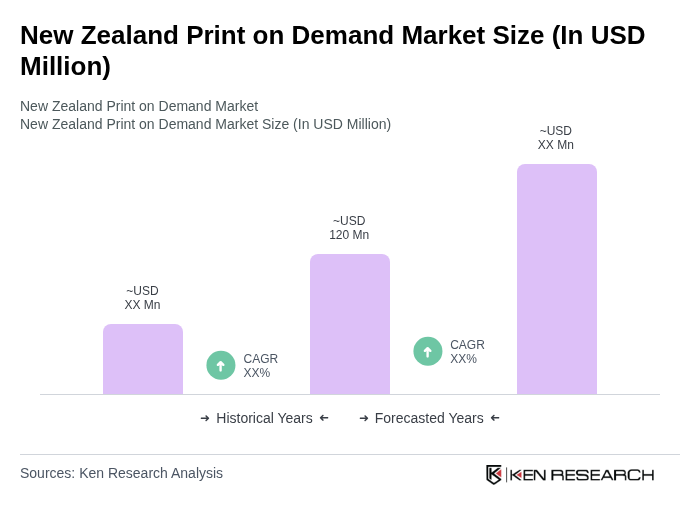
- The New Zealand Print on Demand Market is valued at USD 120 million, based on a five-year historical analysis and by applying New Zealand’s share within the global print on demand and wider printing markets to recent global market benchmarks. This growth is primarily driven by the increasing demand for personalized products, the rise of e-commerce, and the growing trend of self-publishing among creators and small businesses. The convenience of on-demand printing allows consumers to access unique and customized items without the need for large inventories, with strong traction in apparel, home décor, and accessories sold through online marketplaces and direct?to?consumer webstores.
- Auckland, Wellington, and Christchurch are the dominant cities in the New Zealand Print on Demand Market. Auckland leads due to its status as the largest city and economic hub, offering a diverse consumer base and access to major logistics networks. Wellington, as the capital, has a strong creative community and a concentration of design, media, and government-related publishing demand, while Christchurch benefits from a growing population and revitalized economy, making them key players in this market as print providers pivot toward digital, web?to?print, and customized short?run offerings.
- In 2023, the New Zealand government implemented regulations to support the print on demand industry by promoting sustainable practices through broader environmental and waste?minimisation rules that apply to printing and packaging activities. This includes incentives and compliance requirements for businesses that utilize eco-friendly materials and processes, such as obligations under the Waste Minimisation Act 2008 administered by the Ministry for the Environment and product stewardship schemes that encourage reduced waste, higher recycling content, and more sustainable substrates and inks in printed products. The initiative encourages innovation and positions New Zealand as a leader in sustainable manufacturing by steering print and packaging operators toward lower?impact supply chains and circular?economy practices.
New Zealand Print on Demand Market Segmentation
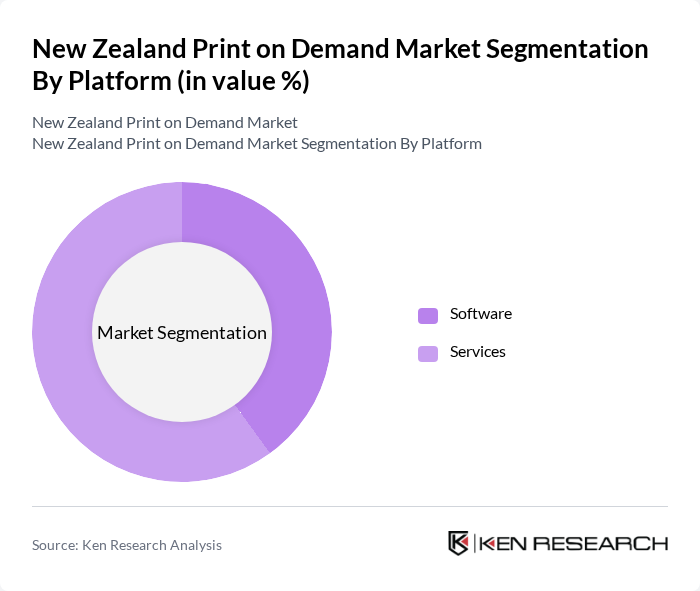
By Platform:The market is segmented into Software and Services. The Software segment includes platforms that provide tools for design, storefront integration, and order management, enabling merchants to connect e-commerce channels with print partners. The Services segment encompasses printing, customization, and fulfillment services, including on?demand production, packing, and shipping. The Services sub-segment is currently dominating the market due to the increasing reliance on third-party providers for efficient order processing, logistics management, and international dropshipping, which allows New Zealand creators and small brands to sell globally without investing in production infrastructure.
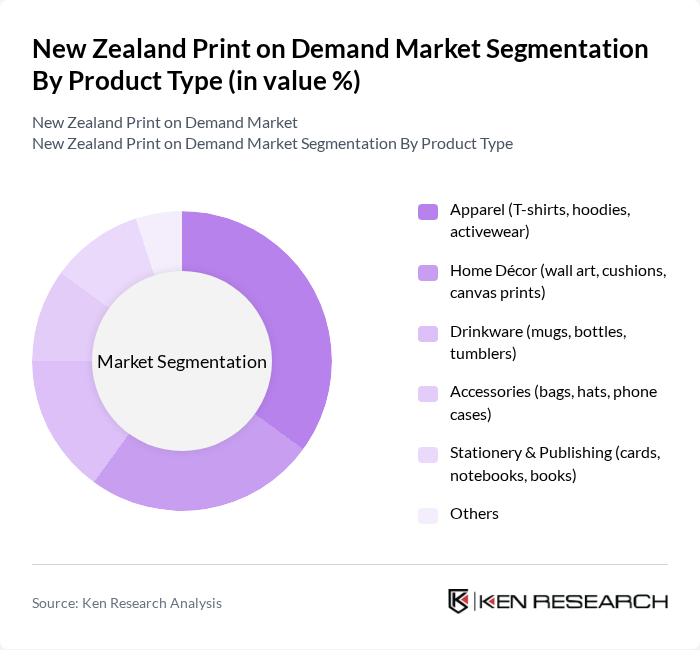
By Product Type:This segmentation includes Apparel, Home Décor, Drinkware, Accessories, Stationery & Publishing, and Others. The Apparel segment, particularly T-shirts and hoodies, is leading the market due to the high demand for personalized clothing among consumers and the growing trend of custom merchandise for events, social media creators, and brand communities, in line with global patterns where apparel accounts for the largest share of print on demand revenue. Home décor and wall art are also gaining momentum as consumers increasingly purchase custom canvas prints and posters for interior personalization, while accessories and drinkware benefit from corporate gifting and niche brand drops.
New Zealand Print on Demand Market Competitive Landscape
The New Zealand Print on Demand Market is characterized by a dynamic mix of regional and international players. Leading participants such as Printful, Redbubble, VistaPrint, Zazzle, Spring (formerly Teespring), Printify, Society6, CustomCat, Apliiq, Gooten, T-Pop, AOP+ (All Over Print), SPOD (Spreadshirt Print-On-Demand), Print Aura, Scalable Press contribute to innovation, geographic expansion, and service delivery in this space, often serving New Zealand customers via cross?border fulfillment networks integrated with global e?commerce platforms.
New Zealand Print on Demand Market Industry Analysis
Growth Drivers
- Increasing E-commerce Adoption:The New Zealand e-commerce sector is projected to reach NZD 7 billion in the future, reflecting a high single- to low double-digit increase from the previous year. This growth is driven by a surge in online shopping, with 80–90% of New Zealanders engaging in e-commerce activities. As consumers increasingly prefer online platforms for purchasing customized products, the print on demand market is poised to benefit significantly from this trend, enhancing accessibility and convenience for consumers.
- Customization Demand from Consumers:A recent survey indicated that 70% of New Zealand consumers prefer personalized products, driving demand for print on demand services. The market for customized goods is expected to grow, with an estimated value of NZD 1.2 billion in the future. This shift towards unique, tailored products aligns with consumer preferences, encouraging businesses to adopt print on demand models to meet this rising demand effectively.
- Technological Advancements in Printing:The New Zealand print industry is witnessing rapid technological advancements, with investments in digital printing technologies expected to exceed NZD 150 million in the future. Innovations such as direct-to-garment printing and 3D printing are enhancing production efficiency and quality. These advancements enable print on demand providers to offer a wider range of products, catering to diverse consumer needs while reducing turnaround times significantly.
Market Challenges
- High Competition Among Providers:The New Zealand print on demand market is characterized by intense competition, with over 200 providers vying for market share. This saturation leads to price wars, which can erode profit margins. In the future, the average profit margin for print on demand businesses is projected to decline to 15%, down from 20% in the previous year, as companies struggle to differentiate their offerings in a crowded marketplace.
- Supply Chain Disruptions:The global supply chain disruptions, exacerbated by the COVID-19 pandemic, continue to impact the New Zealand print on demand market. In the future, delays in raw material procurement are expected to increase by 25%, affecting production timelines. These disruptions can lead to customer dissatisfaction and lost sales opportunities, posing a significant challenge for businesses reliant on timely delivery of customized products.
New Zealand Print on Demand Market Future Outlook
The New Zealand print on demand market is expected to evolve significantly, driven by technological innovations and changing consumer preferences. As businesses increasingly adopt sustainable practices, the demand for eco-friendly print solutions is likely to rise. Additionally, the integration of augmented reality in product design will enhance customer engagement. Companies that leverage these trends will be well-positioned to capture market share and meet the growing expectations of environmentally conscious consumers.
Market Opportunities
- Expansion into Niche Markets:There is a growing opportunity for print on demand businesses to target niche markets, such as personalized gifts and local sports merchandise. By focusing on specific consumer segments, companies can differentiate themselves and cater to unique preferences, potentially increasing revenue streams significantly.
- Collaborations with Local Artists:Partnering with local artists presents a unique opportunity for print on demand providers to offer exclusive designs. This collaboration not only supports local talent but also attracts consumers seeking unique, culturally relevant products, enhancing brand loyalty and market presence.
Scope of the Report
| Segment | Sub-Segments |
|---|---|
| By Platform | Software Services |
| By Product Type | Apparel (T-shirts, hoodies, activewear) Home Décor (wall art, cushions, canvas prints) Drinkware (mugs, bottles, tumblers) Accessories (bags, hats, phone cases) Stationery & Publishing (cards, notebooks, books) Others |
| By Application / Use Case | Personal gifting and occasions Merchandising for creators, artists & influencers Corporate branding & promotional products On-demand publishing & self-publishing Events, tourism & local souvenirs Others |
| By Sales Channel | Brand-owned e-commerce stores Online marketplaces & print-on-demand platforms Social commerce (Instagram, Facebook, TikTok, etc.) Offline retail & print shops Others |
| By Customer Type | Individual consumers SMEs & local brands Large enterprises & institutions Creators, artists & designers Others |
| By Fulfilment Model | Local fulfilment partners (within New Zealand) Cross-border fulfilment (Australia & rest of world) Hybrid fulfilment Others |
| By Geographic Distribution (New Zealand) | Auckland Wellington Christchurch Rest of North Island Rest of South Island |
Key Target Audience
Investors and Venture Capitalist Firms
Government and Regulatory Bodies (e.g., Ministry of Business, Innovation and Employment)
Manufacturers and Producers
Distributors and Retailers
Print Service Providers
Marketing and Advertising Agencies
E-commerce Platforms
Logistics and Supply Chain Companies
Players Mentioned in the Report:
Printful
Redbubble
VistaPrint
Zazzle
Spring (formerly Teespring)
Printify
Society6
CustomCat
Apliiq
Gooten
T-Pop
AOP+ (All Over Print)
SPOD (Spreadshirt Print-On-Demand)
Print Aura
Scalable Press
Table of Contents
Market Assessment Phase
1. Executive Summary and Approach
2. New Zealand Print on Demand Market Overview
2.1 Key Insights and Strategic Recommendations
2.2 New Zealand Print on Demand Market Overview
2.3 Definition and Scope
2.4 Evolution of Market Ecosystem
2.5 Timeline of Key Regulatory Milestones
2.6 Value Chain & Stakeholder Mapping
2.7 Business Cycle Analysis
2.8 Policy & Incentive Landscape
3. New Zealand Print on Demand Market Analysis
3.1 Growth Drivers
3.1.1 Increasing E-commerce Adoption
3.1.2 Customization Demand from Consumers
3.1.3 Technological Advancements in Printing
3.1.4 Sustainability Trends in Consumer Choices
3.2 Market Challenges
3.2.1 High Competition Among Providers
3.2.2 Supply Chain Disruptions
3.2.3 Quality Control Issues
3.2.4 Limited Awareness Among Potential Users
3.3 Market Opportunities
3.3.1 Expansion into Niche Markets
3.3.2 Collaborations with Local Artists
3.3.3 Growth in Eco-friendly Products
3.3.4 Leveraging Social Media for Marketing
3.4 Market Trends
3.4.1 Rise of Subscription Models
3.4.2 Integration of Augmented Reality in Design
3.4.3 Increased Focus on Local Production
3.4.4 Personalization in Marketing Strategies
3.5 Government Regulation
3.5.1 Compliance with Environmental Standards
3.5.2 Intellectual Property Rights Protection
3.5.3 Consumer Protection Laws
3.5.4 Tax Incentives for Local Businesses
4. SWOT Analysis
5. Stakeholder Analysis
6. Porter's Five Forces Analysis
7. New Zealand Print on Demand Market Market Size, 2019-2024
7.1 By Value
7.2 By Volume
7.3 By Average Selling Price
8. New Zealand Print on Demand Market Segmentation
8.1 By Platform
8.1.1 Software
8.1.2 Services
8.2 By Product Type
8.2.1 Apparel (T-shirts, hoodies, activewear)
8.2.2 Home Décor (wall art, cushions, canvas prints)
8.2.3 Drinkware (mugs, bottles, tumblers)
8.2.4 Accessories (bags, hats, phone cases)
8.2.5 Stationery & Publishing (cards, notebooks, books)
8.2.6 Others
8.3 By Application / Use Case
8.3.1 Personal gifting and occasions
8.3.2 Merchandising for creators, artists & influencers
8.3.3 Corporate branding & promotional products
8.3.4 On-demand publishing & self-publishing
8.3.5 Events, tourism & local souvenirs
8.3.6 Others
8.4 By Sales Channel
8.4.1 Brand-owned e-commerce stores
8.4.2 Online marketplaces & print-on-demand platforms
8.4.3 Social commerce (Instagram, Facebook, TikTok, etc.)
8.4.4 Offline retail & print shops
8.4.5 Others
8.5 By Customer Type
8.5.1 Individual consumers
8.5.2 SMEs & local brands
8.5.3 Large enterprises & institutions
8.5.4 Creators, artists & designers
8.5.5 Others
8.6 By Fulfilment Model
8.6.1 Local fulfilment partners (within New Zealand)
8.6.2 Cross-border fulfilment (Australia & rest of world)
8.6.3 Hybrid fulfilment
8.6.4 Others
8.7 By Geographic Distribution (New Zealand)
8.7.1 Auckland
8.7.2 Wellington
8.7.3 Christchurch
8.7.4 Rest of North Island
8.7.5 Rest of South Island
9. New Zealand Print on Demand Market Competitive Analysis
9.1 Market Share of Key Players
9.2 Cross Comparison of Key Players
9.2.1 Company name
9.2.2 Ownership / group type (local, regional, global)
9.2.3 Revenue (NZD, latest available year)
9.2.4 3-year revenue CAGR
9.2.5 Gross margin
9.2.6 EBITDA margin
9.2.7 Average order value (AOV)
9.2.8 Orders per active customer per year
9.2.9 Customer acquisition cost (CAC)
9.2.10 Customer lifetime value (LTV)
9.2.11 LTV/CAC ratio
9.2.12 Customer retention / repeat purchase rate
9.2.13 Active customer base (number of active buyers)
9.2.14 Website traffic & conversion rate
9.2.15 On-time fulfilment rate
9.2.16 Order defect / return rate
9.2.17 Production capacity utilization
9.2.18 Share of orders shipped from within New Zealand
9.2.19 Share of revenue from New Zealand vs exports
9.2.20 Share of revenue by key product category (e.g., apparel, home décor)
9.3 SWOT Analysis of Top Players
9.4 Pricing Analysis
9.5 Detailed Profile of Major Companies
9.5.1 Printful
9.5.2 Redbubble
9.5.3 VistaPrint
9.5.4 Zazzle
9.5.5 Spring (formerly Teespring)
9.5.6 Printify
9.5.7 Society6
9.5.8 CustomCat
9.5.9 Apliiq
9.5.10 Gooten
9.5.11 T-Pop
9.5.12 AOP+ (All Over Print)
9.5.13 SPOD (Spreadshirt Print-On-Demand)
9.5.14 Print Aura
9.5.15 Scalable Press
10. New Zealand Print on Demand Market End-User Analysis
10.1 Procurement Behavior of Key Ministries
10.1.1 Budget Allocation Trends
10.1.2 Preferred Suppliers
10.1.3 Procurement Processes
10.1.4 Sustainability Considerations
10.2 Corporate Spend on Infrastructure & Energy
10.2.1 Investment in Print Solutions
10.2.2 Budgeting for Custom Products
10.2.3 Trends in Corporate Gifting
10.3 Pain Point Analysis by End-User Category
10.3.1 Quality Concerns
10.3.2 Delivery Timeliness
10.3.3 Cost Management
10.3.4 Design Limitations
10.4 User Readiness for Adoption
10.4.1 Awareness Levels
10.4.2 Technology Adoption Rates
10.4.3 Training Needs
10.5 Post-Deployment ROI and Use Case Expansion
10.5.1 Measurement of Success
10.5.2 Case Studies of Successful Implementations
10.5.3 Future Use Cases
11. New Zealand Print on Demand Market Future Size, 2025-2030
11.1 By Value
11.2 By Volume
11.3 By Average Selling Price
Go-To-Market Strategy Phase
1. Whitespace Analysis + Business Model Canvas
1.1 Market Gaps Identification
1.2 Value Proposition Development
1.3 Revenue Streams
1.4 Cost Structure Analysis
1.5 Key Partnerships
1.6 Customer Segments
1.7 Channels
2. Marketing and Positioning Recommendations
2.1 Branding Strategies
2.2 Product USPs
3. Distribution Plan
3.1 Urban Retail vs Rural NGO Tie-ups
4. Channel & Pricing Gaps
4.1 Underserved Routes
4.2 Pricing Bands
5. Unmet Demand & Latent Needs
5.1 Category Gaps
5.2 Consumer Segments
6. Customer Relationship
6.1 Loyalty Programs
6.2 After-sales Service
7. Value Proposition
7.1 Sustainability
7.2 Integrated Supply Chains
8. Key Activities
8.1 Regulatory Compliance
8.2 Branding
8.3 Distribution Setup
9. Entry Strategy Evaluation
9.1 Domestic Market Entry Strategy
9.1.1 Product Mix
9.1.2 Pricing Band
9.1.3 Packaging
9.2 Export Entry Strategy
9.2.1 Target Countries
9.2.2 Compliance Roadmap
10. Entry Mode Assessment
10.1 JV
10.2 Greenfield
10.3 M&A
10.4 Distributor Model
11. Capital and Timeline Estimation
11.1 Capital Requirements
11.2 Timelines
12. Control vs Risk Trade-Off
12.1 Ownership vs Partnerships
13. Profitability Outlook
13.1 Breakeven Analysis
13.2 Long-term Sustainability
14. Potential Partner List
14.1 Distributors
14.2 JVs
14.3 Acquisition Targets
15. Execution Roadmap
15.1 Phased Plan for Market Entry
15.1.1 Market Setup
15.1.2 Market Entry
15.1.3 Growth Acceleration
15.1.4 Scale & Stabilize
15.2 Key Activities and Milestones
15.2.1 Milestone Planning
15.2.2 Activity Tracking
Research Methodology
Phase 1: Approach1
Desk Research
- Analysis of industry reports from New Zealand's print on demand sector
- Review of government publications and statistics related to e-commerce and printing
- Examination of market trends and consumer behavior studies from local research firms
Primary Research
- Interviews with key stakeholders in the print on demand industry, including business owners and managers
- Surveys targeting end-users to understand preferences and purchasing behavior
- Focus groups with designers and artists utilizing print on demand services
Validation & Triangulation
- Cross-validation of findings through multiple data sources, including sales data and consumer feedback
- Triangulation of insights from interviews, surveys, and desk research to ensure consistency
- Sanity checks conducted through expert reviews and feedback from industry veterans
Phase 2: Market Size Estimation1
Top-down Assessment
- Estimation of market size based on national e-commerce growth rates and print industry statistics
- Segmentation of the market by product types, including apparel, home decor, and promotional items
- Incorporation of demographic data to assess potential customer bases across different regions
Bottom-up Modeling
- Collection of sales data from leading print on demand platforms operating in New Zealand
- Estimation of average order values and frequency of purchases by consumers
- Analysis of production costs and pricing strategies employed by local print providers
Forecasting & Scenario Analysis
- Development of growth projections based on historical data and emerging market trends
- Scenario analysis considering factors such as technological advancements and shifts in consumer preferences
- Creation of multiple forecasts (baseline, optimistic, and pessimistic) through 2030
Phase 3: CATI Sample Composition1
| Scope Item/Segment | Sample Size | Target Respondent Profiles |
|---|---|---|
| Small Business Owners in Print on Demand | 90 | Business Owners, Operations Managers |
| Consumers of Custom Apparel | 140 | Online Shoppers, Fashion Enthusiasts |
| Artists and Designers Using POD Services | 80 | Freelance Designers, Graphic Artists |
| Marketing Professionals in E-commerce | 70 | Marketing Managers, Brand Strategists |
| Print Service Providers | 60 | Production Managers, Sales Representatives |
Frequently Asked Questions
What is the current value of the New Zealand Print on Demand market?
The New Zealand Print on Demand market is valued at approximately USD 120 million. This valuation is based on a five-year historical analysis and reflects New Zealand's share within the global print on demand and wider printing markets.
What factors are driving growth in the New Zealand Print on Demand market?
Which cities are the key players in the New Zealand Print on Demand market?
How has the New Zealand government supported the Print on Demand industry?
Other Regional/Country Reports
Other Adjacent Reports
Malaysia Custom Apparel Market
UAE Digital Printing MarketJapan Personalized Gifts Market
Malaysia Self-Publishing Market
India Home Decor Market Outlook to 2030South Africa Sustainable Packaging MarketVietnam Fulfillment Services Market
South Africa Graphic Design Software Market
UAE Dropshipping MarketWhy Buy From Us?

What makes us stand out is that our consultants follow Robust, Refine and Result (RRR) methodology. Robust for clear definitions, approaches and sanity checking, Refine for differentiating respondents' facts and opinions, and Result for presenting data with story.

We have set a benchmark in the industry by offering our clients with syndicated and customized market research reports featuring coverage of entire market as well as meticulous research and analyst insights.

While we don't replace traditional research, we flip the method upside down. Our dual approach of Top Bottom & Bottom Top ensures quality deliverable by not just verifying company fundamentals but also looking at the sector and macroeconomic factors.

With one step in the future, our research team constantly tries to show you the bigger picture. We help with some of the tough questions you may encounter along the way: How is the industry positioned? Best marketing channel? KPI's of competitors? By aligning every element, we help maximize success.

Our report gives you instant access to the answers and sources that other companies might choose to hide. We elaborate each steps of research methodology we have used and showcase you the sample size to earn your trust.

If you need any support, we are here! We pride ourselves on universe strength, data quality, and quick, friendly, and professional service.