About the Report
Base Year 2024Thailand Print on Demand Market Overview
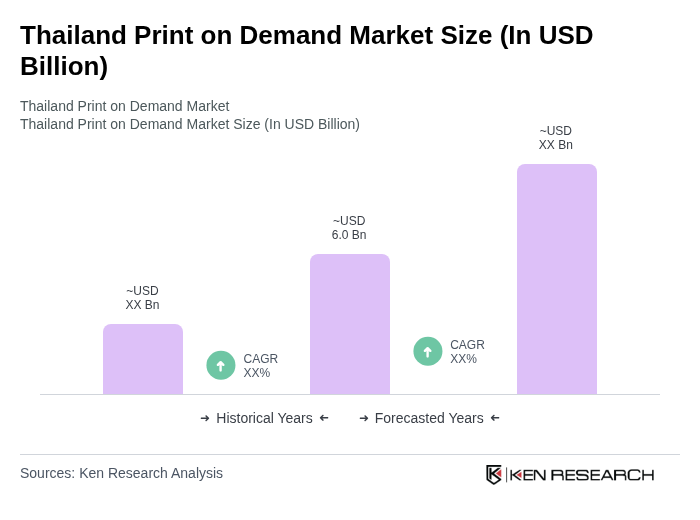
- The Thailand Print on Demand market is valued at USD 6.0 billion, based on a five-year historical analysis, aligning with regional estimates that position Thailand as one of the key emerging markets within the Asia–Pacific print on demand and digital printing ecosystem. This growth is primarily driven by the increasing demand for personalized products, the rise of e-commerce, and the growing trend of small businesses and entrepreneurs utilizing print-on-demand services to minimize inventory costs and enhance product offerings, supported by Thailand’s expanding digital printing and e-commerce infrastructure.
- Key cities such as Bangkok and Chiang Mai dominate the market due to their vibrant creative communities and strong e-commerce infrastructure. Bangkok, as the capital, serves as a hub for digital innovation and entrepreneurship, and concentrates a large share of Thailand’s online retail and startup ecosystem, while Chiang Mai attracts a growing number of artists, designers, and digital nomads, fostering a unique market for customized products and creative SMEs.
- In 2023, the Thai government implemented regulations to support the growth of the e-commerce sector, including print-on-demand services. This includes measures under the Royal Decree on the Operation of Digital Platform Services that Require Notification B.E. 2565 (2022) issued by the Office of the Consumer Protection Board and the Electronic Transactions Development Agency, which requires online platforms and sellers to register, disclose business information, and comply with consumer protection and data standards, as well as tax and business registration incentives for SMEs under the Revenue Code and the Department of Business Development’s streamlined online registration processes, aimed at encouraging entrepreneurship and innovation in the digital economy.
Thailand Print on Demand Market Segmentation
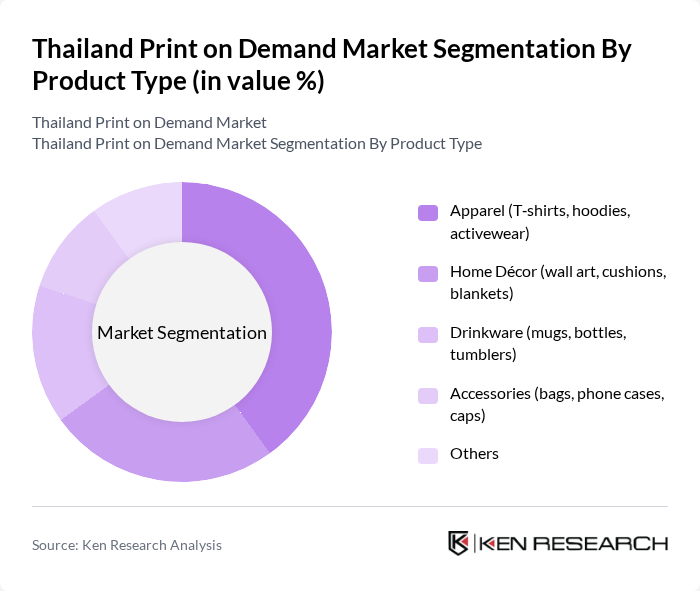
By Product Type:The product type segmentation in the Thailand Print on Demand market includes various categories such as apparel, home décor, drinkware, accessories, and others. Among these, apparel, particularly T-shirts and hoodies, dominates the market due to the high demand for personalized clothing options, consistent with global print on demand trends where apparel holds the largest share. The trend of custom apparel is driven by social media influencers, the growth of creator-led brands, and the growing popularity of unique fashion statements among consumers in Thailand’s online fashion and T?shirt segments. Home décor items are also gaining traction as consumers seek personalized touches for their living spaces, supported by the wider adoption of digital printing for short-run, customized interior products.
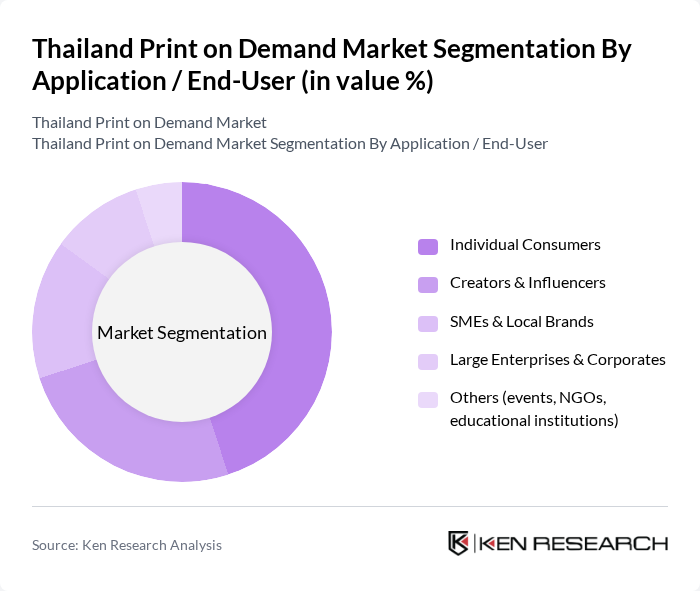
By Application / End-User:The application segmentation of the Thailand Print on Demand market includes individual consumers, creators and influencers, SMEs and local brands, large enterprises and corporates, and others. Individual consumers represent the largest segment, driven by the desire for personalized products and unique gifts, mirroring global consumer behavior in the print on demand and customized merchandise markets. Creators and influencers leverage print-on-demand services to monetize their designs and reach their audiences effectively, supported by the growth of the creator economy and integration of POD with social commerce and marketplaces. SMEs and local brands are increasingly adopting these services to enhance their product offerings without the burden of inventory management, benefiting from Thailand’s growing digital printing capabilities and government support for SME digitalization.
Thailand Print on Demand Market Competitive Landscape
The Thailand Print on Demand market is characterized by a dynamic mix of regional and international players. Leading participants such as Printful, Printify, Gelato, TeeSpring (Spring), Redbubble, Zazzle, SPOD (Spreadshirt Print On Demand), Gooten, CustomCat, AOP+ (All Over Print), T-Pop, Shirtee, Local Thailand POD / fulfillment partners, Key regional e-commerce platforms (Shopee, Lazada, etc. – POD integrated), Other Emerging POD Platforms contribute to innovation, geographic expansion, and service delivery in this space.
Thailand Print on Demand Market Industry Analysis
Growth Drivers
- Increasing E-commerce Adoption:Thailand's e-commerce market is projected to reach approximately $30 billion in future, driven by a 20% annual growth rate. This surge in online shopping is fostering demand for print on demand services, as consumers increasingly seek personalized products. The rise in internet penetration, which reached 85% in 2023, further supports this trend, enabling more consumers to access and utilize print on demand platforms for customized items.
- Customization Demand from Consumers:A significant shift towards personalization is evident, with 70% of Thai consumers expressing a preference for customized products. This trend is supported by the growing disposable income, which is expected to rise to about USD 7,800 in GDP per capita (current prices) in future. As consumers seek unique items that reflect their individuality, print on demand services are well-positioned to meet this demand, enhancing customer engagement and loyalty in the process.
- Technological Advancements in Printing:The Thai print on demand industry is benefiting from advancements in printing technology, such as digital printing and 3D printing. The market for digital printing in Thailand is anticipated to grow to $1.2 billion in future, driven by innovations that enhance quality and reduce production times. These technological improvements enable businesses to offer a wider range of customizable products, catering to the evolving preferences of consumers.
Market Challenges
- High Competition in the Market:The print on demand sector in Thailand is characterized by intense competition, with over 200 active players vying for market share. This saturation can lead to price wars, reducing profit margins for businesses. Additionally, established brands with strong customer loyalty pose a significant challenge for new entrants, making it difficult for them to gain traction in the market.
- Supply Chain Disruptions:The Thai print on demand market faces challenges related to supply chain disruptions, particularly in sourcing raw materials. In 2023, delays in material shipments increased by 15% due to global supply chain issues. These disruptions can lead to longer production times and increased costs, ultimately affecting the ability of businesses to meet customer demands promptly and efficiently.
Thailand Print on Demand Market Future Outlook
The future of the Thailand print on demand market appears promising, driven by the increasing integration of technology and consumer preferences for personalized products. As e-commerce continues to expand, businesses are likely to adopt innovative solutions to enhance customer experiences. Furthermore, the focus on sustainability and eco-friendly practices is expected to shape product offerings, aligning with global trends. Companies that leverage these developments will be better positioned to thrive in this dynamic market landscape.
Market Opportunities
- Expansion into Rural Markets:With rural areas in Thailand experiencing a 10% increase in internet access, there is a significant opportunity for print on demand services to tap into these emerging markets. By offering localized products, businesses can cater to the unique preferences of rural consumers, driving growth and expanding their customer base.
- Development of Eco-friendly Products:The demand for sustainable products is on the rise, with 70% of consumers willing to pay more for eco-friendly options. By developing and marketing eco-friendly print on demand products, businesses can attract environmentally conscious consumers, enhancing brand loyalty and potentially increasing market share in a competitive landscape.
Scope of the Report
| Segment | Sub-Segments |
|---|---|
| By Product Type | Apparel Home Décor Drinkware Accessories Others |
| By Application / End-User | Individual Consumers Creators & Influencers SMEs & Local Brands Large Enterprises & Corporates Others |
| By Sales / Business Model | Direct-to-Consumer (D2C) Stores Online Marketplaces White-Label / B2B Fulfillment Social Commerce Channels Others |
| By Platform / Integration Type | Standalone Web Platforms E-commerce Plug-ins Marketplace Integrations API-based Custom Integrations Others |
| By Printing Technology | Direct-to-Garment (DTG) Dye-Sublimation Screen Printing Digital Transfer / Heat Transfer Others |
| By Fulfilment Location | Domestic Cross-border / Imported Fulfilment Hybrid Models Others |
| By Customer Demographics | Age Group Gender Income Level Lifestyle & Interest Communities Others |
Key Target Audience
Investors and Venture Capitalist Firms
Government and Regulatory Bodies (e.g., Ministry of Commerce, Ministry of Digital Economy and Society)
Manufacturers and Producers
Distributors and Retailers
Print Service Providers
E-commerce Platforms
Marketing and Advertising Agencies
Logistics and Supply Chain Companies
Players Mentioned in the Report:
Printful
Printify
Gelato
TeeSpring (Spring)
Redbubble
Zazzle
SPOD (Spreadshirt Print On Demand)
Gooten
CustomCat
AOP+ (All Over Print)
T-Pop
Shirtee
Local Thailand POD / fulfillment partners
Key regional e-commerce platforms (Shopee, Lazada, etc. POD integrated)
Other Emerging POD Platforms
Table of Contents
Market Assessment Phase
1. Executive Summary and Approach
2. Thailand Print on Demand Market Overview
2.1 Key Insights and Strategic Recommendations
2.2 Thailand Print on Demand Market Overview
2.3 Definition and Scope
2.4 Evolution of Market Ecosystem
2.5 Timeline of Key Regulatory Milestones
2.6 Value Chain & Stakeholder Mapping
2.7 Business Cycle Analysis
2.8 Policy & Incentive Landscape
3. Thailand Print on Demand Market Analysis
3.1 Growth Drivers
3.1.1 Increasing E-commerce Adoption
3.1.2 Customization Demand from Consumers
3.1.3 Technological Advancements in Printing
3.1.4 Rise of Social Media Marketing
3.2 Market Challenges
3.2.1 High Competition in the Market
3.2.2 Supply Chain Disruptions
3.2.3 Quality Control Issues
3.2.4 Limited Awareness Among Small Businesses
3.3 Market Opportunities
3.3.1 Expansion into Rural Markets
3.3.2 Collaborations with Local Artists
3.3.3 Development of Eco-friendly Products
3.3.4 Integration of AI in Design Processes
3.4 Market Trends
3.4.1 Growth of Subscription-based Models
3.4.2 Increased Focus on Sustainability
3.4.3 Personalization in Marketing Strategies
3.4.4 Use of Augmented Reality in Shopping
3.5 Government Regulation
3.5.1 Intellectual Property Rights Enforcement
3.5.2 E-commerce Regulations
3.5.3 Tax Incentives for Startups
3.5.4 Environmental Regulations on Printing Materials
4. SWOT Analysis
5. Stakeholder Analysis
6. Porter's Five Forces Analysis
7. Thailand Print on Demand Market Market Size, 2019-2024
7.1 By Value
7.2 By Volume
7.3 By Average Selling Price
8. Thailand Print on Demand Market Segmentation
8.1 By Product Type
8.1.1 Apparel (T?shirts, hoodies, activewear)
8.1.2 Home Décor (wall art, cushions, blankets)
8.1.3 Drinkware (mugs, bottles, tumblers)
8.1.4 Accessories (bags, phone cases, caps)
8.1.5 Others
8.2 By Application / End-User
8.2.1 Individual Consumers
8.2.2 Creators & Influencers
8.2.3 SMEs & Local Brands
8.2.4 Large Enterprises & Corporates
8.2.5 Others (events, NGOs, educational institutions)
8.3 By Sales / Business Model
8.3.1 Direct-to-Consumer (D2C) Stores
8.3.2 Online Marketplaces (domestic & global)
8.3.3 White-Label / B2B Fulfillment
8.3.4 Social Commerce Channels
8.3.5 Others
8.4 By Platform / Integration Type
8.4.1 Standalone Web Platforms
8.4.2 E?commerce Plug-ins (Shopify, WooCommerce, etc.)
8.4.3 Marketplace Integrations (Lazada, Shopee, Amazon, etc.)
8.4.4 API-based Custom Integrations
8.4.5 Others
8.5 By Printing Technology
8.5.1 Direct-to-Garment (DTG)
8.5.2 Dye-Sublimation
8.5.3 Screen Printing
8.5.4 Digital Transfer / Heat Transfer
8.5.5 Others
8.6 By Fulfilment Location
8.6.1 Domestic (Thailand-based Fulfilment)
8.6.2 Cross-border / Imported Fulfilment
8.6.3 Hybrid Models
8.6.4 Others
8.7 By Customer Demographics
8.7.1 Age Group
8.7.2 Gender
8.7.3 Income Level
8.7.4 Lifestyle & Interest Communities
8.7.5 Others
9. Thailand Print on Demand Market Competitive Analysis
9.1 Market Share of Key Players
9.2 Cross Comparison of Key Players (KPIs)
9.2.1 Company Name
9.2.2 Group Size (Large, Medium, or Small as per industry convention)
9.2.3 Annual Revenue (USD Million)
9.2.4 Revenue CAGR (Last 3–5 Years)
9.2.5 Gross Margin (%)
9.2.6 EBITDA Margin (%)
9.2.7 Customer Acquisition Cost (CAC)
9.2.8 Customer Lifetime Value (CLV)
9.2.9 Customer Retention Rate (%)
9.2.10 Average Order Value (AOV)
9.2.11 Orders per Active Customer per Year
9.2.12 Fulfilment Lead Time (Average Days)
9.2.13 On?time Delivery Rate (%)
9.2.14 Product Return Rate (%)
9.2.15 Marketing Spend as % of Revenue
9.2.16 Return on Marketing Investment (ROMI)
9.2.17 Thailand/SEA Revenue Share (% of Global)
9.2.18 Market Share in Thailand (%)
9.3 SWOT Analysis of Top Players
9.4 Pricing Analysis
9.5 Detailed Profile of Major Companies
9.5.1 Printful
9.5.2 Printify
9.5.3 Gelato
9.5.4 TeeSpring (Spring)
9.5.5 Redbubble
9.5.6 Zazzle
9.5.7 SPOD (Spreadshirt Print On Demand)
9.5.8 Gooten
9.5.9 CustomCat
9.5.10 AOP+ (All Over Print)
9.5.11 T-Pop
9.5.12 Shirtee
9.5.13 Local Thailand POD / fulfillment partners
9.5.14 Key regional e-commerce platforms (Shopee, Lazada, etc. – POD integrated)
9.5.15 Other Emerging POD Platforms
10. Thailand Print on Demand Market End-User Analysis
10.1 Procurement Behavior of Key Ministries
10.1.1 Ministry of Commerce
10.1.2 Ministry of Industry
10.1.3 Ministry of Education
10.1.4 Ministry of Culture
10.2 Corporate Spend on Infrastructure & Energy
10.2.1 Corporate Marketing Budgets
10.2.2 Investment in Digital Platforms
10.3 Pain Point Analysis by End-User Category
10.3.1 Small Business Challenges
10.3.2 Consumer Preferences
10.4 User Readiness for Adoption
10.4.1 Awareness Levels
10.4.2 Technology Adoption Rates
10.5 Post-Deployment ROI and Use Case Expansion
10.5.1 Case Studies of Successful Implementations
10.5.2 Metrics for Measuring Success
11. Thailand Print on Demand Market Future Size, 2025-2030
11.1 By Value
11.2 By Volume
11.3 By Average Selling Price
Go-To-Market Strategy Phase
1. Whitespace Analysis + Business Model Canvas
1.1 Market Gaps Identification
1.2 Business Model Development
2. Marketing and Positioning Recommendations
2.1 Branding Strategies
2.2 Product USPs
3. Distribution Plan
3.1 Urban Retail Strategies
3.2 Rural NGO Tie-ups
4. Channel & Pricing Gaps
4.1 Underserved Routes
4.2 Pricing Bands
5. Unmet Demand & Latent Needs
5.1 Category Gaps
5.2 Consumer Segments
6. Customer Relationship
6.1 Loyalty Programs
6.2 After-sales Service
7. Value Proposition
7.1 Sustainability Initiatives
7.2 Integrated Supply Chains
8. Key Activities
8.1 Regulatory Compliance
8.2 Branding Efforts
8.3 Distribution Setup
9. Entry Strategy Evaluation
9.1 Domestic Market Entry Strategy
9.1.1 Product Mix
9.1.2 Pricing Band
9.1.3 Packaging Considerations
9.2 Export Entry Strategy
9.2.1 Target Countries
9.2.2 Compliance Roadmap
10. Entry Mode Assessment
10.1 Joint Ventures
10.2 Greenfield Investments
10.3 Mergers & Acquisitions
10.4 Distributor Model
11. Capital and Timeline Estimation
11.1 Capital Requirements
11.2 Timelines
12. Control vs Risk Trade-Off
12.1 Ownership Considerations
12.2 Partnerships
13. Profitability Outlook
13.1 Breakeven Analysis
13.2 Long-term Sustainability
14. Potential Partner List
14.1 Distributors
14.2 Joint Ventures
14.3 Acquisition Targets
15. Execution Roadmap
15.1 Phased Plan for Market Entry
15.1.1 Market Setup
15.1.2 Market Entry
15.1.3 Growth Acceleration
15.1.4 Scale & Stabilize
15.2 Key Activities and Milestones
15.2.1 Milestone Planning
15.2.2 Activity Tracking
Research Methodology
Phase 1: Approach1
Desk Research
- Analysis of market reports from Thai e-commerce associations and print on demand platforms
- Review of industry publications and white papers on print on demand trends in Thailand
- Examination of government statistics on small and medium enterprises (SMEs) in the printing sector
Primary Research
- Interviews with key stakeholders in the print on demand industry, including business owners and managers
- Surveys targeting customers of print on demand services to understand preferences and buying behavior
- Focus groups with designers and artists utilizing print on demand services for their products
Validation & Triangulation
- Cross-validation of findings through comparison with international print on demand market trends
- Triangulation of data from interviews, surveys, and secondary sources to ensure consistency
- Sanity checks through expert panel reviews involving industry veterans and market analysts
Phase 2: Market Size Estimation1
Top-down Assessment
- Estimation of market size based on overall e-commerce growth rates in Thailand
- Segmentation of the market by product categories such as apparel, home decor, and promotional items
- Incorporation of trends in consumer behavior towards personalized and custom products
Bottom-up Modeling
- Collection of sales data from leading print on demand companies operating in Thailand
- Estimation of average order values and frequency of purchases by consumers
- Calculation of market size based on the number of active users and their purchasing patterns
Forecasting & Scenario Analysis
- Multi-factor regression analysis incorporating variables such as internet penetration and mobile commerce growth
- Scenario planning based on potential regulatory changes affecting e-commerce and printing
- Development of baseline, optimistic, and pessimistic forecasts through 2030
Phase 3: CATI Sample Composition1
| Scope Item/Segment | Sample Size | Target Respondent Profiles |
|---|---|---|
| Small Business Owners in Print on Demand | 80 | Entrepreneurs, Business Managers |
| Consumers of Custom Apparel | 120 | Online Shoppers, Fashion Enthusiasts |
| Graphic Designers Using Print on Demand | 60 | Freelancers, Design Studio Owners |
| Marketing Professionals in E-commerce | 50 | Marketing Managers, Brand Strategists |
| Print on Demand Platform Users | 70 | Platform Users, Customer Service Representatives |
Frequently Asked Questions
What is the current value of the Thailand Print on Demand market?
The Thailand Print on Demand market is valued at approximately USD 6.0 billion, reflecting significant growth driven by increasing demand for personalized products and the rise of e-commerce, particularly in urban centers like Bangkok and Chiang Mai.
What factors are driving the growth of the Print on Demand market in Thailand?
Which cities are the main hubs for Print on Demand services in Thailand?
How has the Thai government supported the Print on Demand industry?
Other Regional/Country Reports
Other Adjacent Reports
Malaysia Custom Apparel Market
India Home Decor Market Outlook to 2030Bahrain Personalized Gifts Market
KSA 3D Printing Market Outlook to 2030Philippines Graphic Design Software Market
Germany Fulfillment Services Market
New Zealand Social Commerce Market Report Size Share Growth Drivers Trends Opportunities & Forecast 2025–2030KSA sustainable packaging market report Size, Share, Growth Drivers, Trends, Opportunities & Forecast 2025–2030Why Buy From Us?

What makes us stand out is that our consultants follow Robust, Refine and Result (RRR) methodology. Robust for clear definitions, approaches and sanity checking, Refine for differentiating respondents' facts and opinions, and Result for presenting data with story.

We have set a benchmark in the industry by offering our clients with syndicated and customized market research reports featuring coverage of entire market as well as meticulous research and analyst insights.

While we don't replace traditional research, we flip the method upside down. Our dual approach of Top Bottom & Bottom Top ensures quality deliverable by not just verifying company fundamentals but also looking at the sector and macroeconomic factors.

With one step in the future, our research team constantly tries to show you the bigger picture. We help with some of the tough questions you may encounter along the way: How is the industry positioned? Best marketing channel? KPI's of competitors? By aligning every element, we help maximize success.

Our report gives you instant access to the answers and sources that other companies might choose to hide. We elaborate each steps of research methodology we have used and showcase you the sample size to earn your trust.

If you need any support, we are here! We pride ourselves on universe strength, data quality, and quick, friendly, and professional service.