About the Report
Base Year 2024North America Architectural Coatings Market Overview
- The North America Architectural Coatings Market is valued at USD 21 billion, based on a five-year historical analysis, reflecting consolidated regional sales led by the United States. This growth is primarily driven by the increasing demand for residential and commercial construction, coupled with a rising focus on sustainable and eco-friendly products. The market is also influenced by technological advancements in coating formulations, which enhance durability and performance, including broader adoption of low- and zero-VOC water-borne systems.
- The United States, Canada, and Mexico dominate the North American Architectural Coatings Market due to their robust construction sectors and high consumer spending on home improvement; the United States accounts for roughly seventy percent of the regional market, underscoring its outsized role in demand and innovation. The U.S. is particularly significant, driven by a large population and strong economy, while Canada benefits from a growing trend in green building practices and low-VOC adoption; Mexico’s expanding urbanization and housing initiatives also support market presence.
- In 2023, the U.S. Environmental Protection Agency did not issue a new nationwide rule tightening VOC limits specifically for architectural coatings; instead, VOC limits for architectural and industrial maintenance coatings are primarily governed by long-standing federal rules and state or regional programs (notably the California Air Resources Board and Ozone Transport Commission) that have continued to drive reformulation and innovation toward lower-VOC products. According to market coverage of regulatory drivers, stricter regional VOC requirements and green building standards remain key forces pushing low-/zero-VOC coatings across North America.

North America Architectural Coatings Market Segmentation
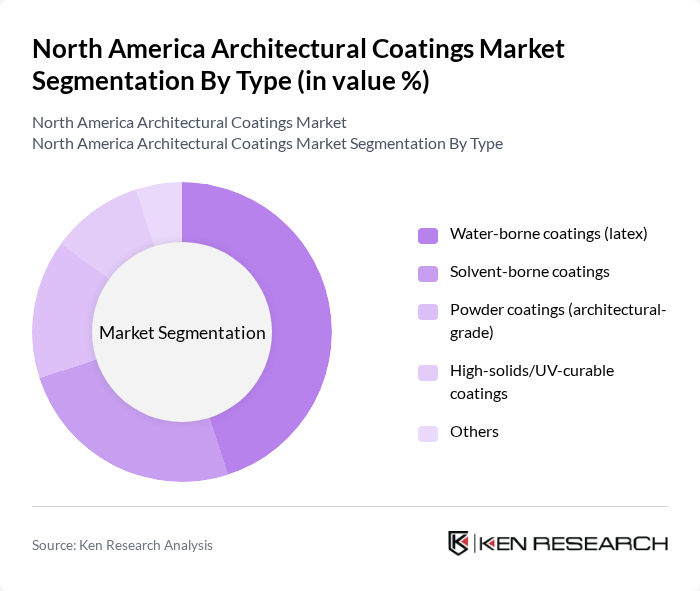
By Type:The market is segmented into various types of coatings, including water-borne coatings (latex), solvent-borne coatings, powder coatings (architectural-grade), high-solids/UV-curable coatings, and others. Among these, water-borne coatings are gaining significant traction due to their eco-friendliness and ease of application, making them the leading subsegment in the market.
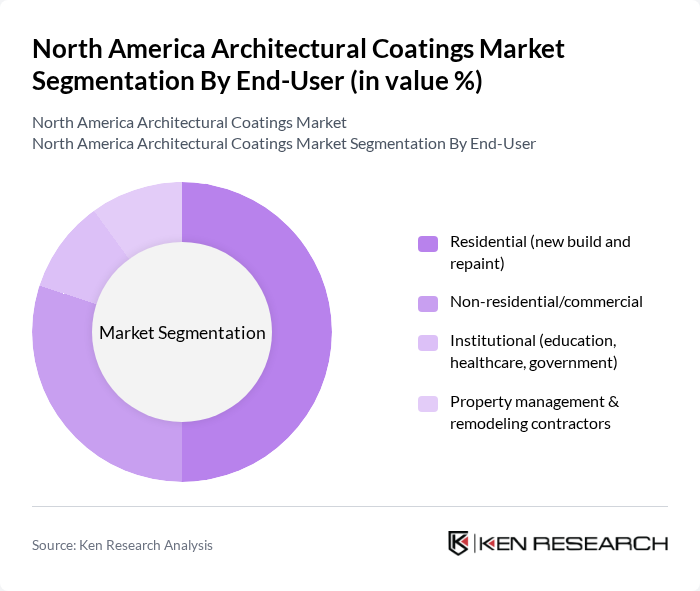
By End-User:The end-user segmentation includes residential (new build and repaint), non-residential/commercial, institutional (education, healthcare, government), and property management & remodeling contractors. The residential segment is the most significant, driven by a surge in home renovations and new constructions, reflecting changing consumer preferences towards personalized living spaces and ongoing retrofit activity.
North America Architectural Coatings Market Competitive Landscape
The North America Architectural Coatings Market is characterized by a dynamic mix of regional and international players. Leading participants such as The Sherwin-Williams Company, PPG Industries, Inc., Benjamin Moore & Co. (Berkshire Hathaway), Behr Process Corporation (Masco Corporation), RPM International Inc. (including Rust-Oleum, Zinsser), AkzoNobel N.V. (Dulux brand in Canada), Dunn-Edwards Corporation (Nippon Paint Holdings), Kelly-Moore Paints, Cloverdale Paint Inc., Nippon Paint Holdings Co., Ltd., Jotun A/S, Diamond Vogel Paints, PPG’s Valspar (now part of Sherwin-Williams) — legacy brand, MasterChem Brands LLC (KILZ), Axalta Coating Systems Ltd. (architectural powder coatings) contribute to innovation, geographic expansion, and service delivery in this space.
North America Architectural Coatings Market Industry Analysis
Growth Drivers
- Increasing Demand for Eco-Friendly Coatings:The North American market is witnessing a significant shift towards eco-friendly coatings, driven by consumer preferences for sustainable products. In future, the market for low-VOC and water-based coatings reached approximately $3.9 billion, reflecting a 15% increase from the previous year. This trend is supported by the U.S. Environmental Protection Agency's initiatives promoting green building practices, which are expected to further boost demand for environmentally friendly coatings in future.
- Growth in Residential and Commercial Construction:The construction sector in North America is projected to grow significantly, with residential construction spending expected to reach $1.2 trillion in future. This growth is fueled by low mortgage rates and increased housing demand, leading to higher consumption of architectural coatings. Additionally, commercial construction is anticipated to rise by 8% in future, further driving the demand for coatings in both sectors, thereby enhancing market opportunities.
- Technological Advancements in Coating Formulations:Innovations in coating technologies are propelling the North American architectural coatings market forward. In future, investments in R&D for advanced coatings formulations exceeded $600 million, focusing on durability and performance. These advancements include the development of self-cleaning and anti-microbial coatings, which are gaining traction in both residential and commercial applications, thus enhancing the overall market growth potential in future.
Market Challenges
- Fluctuating Raw Material Prices:The architectural coatings market faces challenges due to volatile raw material prices, particularly for key ingredients like titanium dioxide and resins. In future, the price of titanium dioxide surged by 20%, impacting production costs and profit margins for manufacturers. This volatility is expected to continue in future, posing a significant challenge for companies aiming to maintain competitive pricing while ensuring product quality.
- Stringent Environmental Regulations:Compliance with increasingly stringent environmental regulations is a major challenge for the architectural coatings industry. In future, the U.S. implemented new VOC emission standards that require manufacturers to reformulate products, leading to increased production costs. As these regulations tighten further in future, companies will need to invest in compliance measures, which may strain resources and impact market competitiveness.
North America Architectural Coatings Market Future Outlook
The North American architectural coatings market is poised for transformative growth, driven by a strong emphasis on sustainability and technological innovation. As consumer preferences shift towards eco-friendly products, manufacturers are likely to invest heavily in R&D to develop advanced formulations. Additionally, the ongoing expansion in the construction sector will create new opportunities for coatings applications. Companies that adapt to these trends and leverage digital marketing strategies will be well-positioned to capture market share in the evolving landscape of future and beyond.
Market Opportunities
- Expansion into Emerging Markets:Companies have a significant opportunity to expand into emerging markets within North America, such as Mexico and Canada, where construction activities are on the rise. With an estimated growth rate of 10% in these regions, manufacturers can tap into new customer bases and increase their market presence by offering tailored products that meet local demands.
- Development of Smart Coatings:The rise of smart coatings presents a lucrative opportunity for innovation in the architectural coatings market. With an estimated market value of $1.2 billion by future, smart coatings that offer functionalities like temperature regulation and self-healing properties are gaining traction. Companies investing in this technology can differentiate themselves and meet the growing demand for high-performance coatings in both residential and commercial sectors.
Scope of the Report
| Segment | Sub-Segments |
|---|---|
| By Type | Water-borne coatings (latex) Solvent-borne coatings Powder coatings (architectural-grade) High-solids/UV-curable coatings Others |
| By End-User | Residential (new build and repaint) Non-residential/commercial Institutional (education, healthcare, government) Property management & remodeling contractors |
| By Application | Interior wall & ceiling paints Exterior façade & siding paints Primers & sealers Wood finishes & stains Roof, masonry, and elastomeric coatings |
| By Distribution Channel | Company-owned stores (brand stores) Home improvement retail (DIY big-box) Independent dealers E-commerce/direct online Distributors/wholesale |
| By Price Range | Economy Mid-range Premium Super-premium |
| By Region | United States Canada Mexico |
| By Product Formulation (Resin) | Acrylic/latex Alkyd Epoxy Polyurethane Vinyl acetate/Vinyl acrylic (PVA/VA) Others |
Key Target Audience
Investors and Venture Capitalist Firms
Government and Regulatory Bodies (e.g., Environmental Protection Agency, Occupational Safety and Health Administration)
Manufacturers and Producers
Distributors and Retailers
Architectural Firms and Design Professionals
Construction Companies and Contractors
Industry Associations (e.g., Paint and Coatings Manufacturers Association)
Financial Institutions and Banks
Players Mentioned in the Report:
The Sherwin-Williams Company
PPG Industries, Inc.
Benjamin Moore & Co. (Berkshire Hathaway)
Behr Process Corporation (Masco Corporation)
RPM International Inc. (including Rust-Oleum, Zinsser)
AkzoNobel N.V. (Dulux brand in Canada)
Dunn-Edwards Corporation (Nippon Paint Holdings)
Kelly-Moore Paints
Cloverdale Paint Inc.
Nippon Paint Holdings Co., Ltd.
Jotun A/S
Diamond Vogel Paints
PPGs Valspar (now part of Sherwin-Williams) legacy brand
MasterChem Brands LLC (KILZ)
Axalta Coating Systems Ltd. (architectural powder coatings)
Table of Contents
Market Assessment Phase
1. Executive Summary and Approach
2. North America Architectural Coatings Market Overview
2.1 Key Insights and Strategic Recommendations
2.2 North America Architectural Coatings Market Overview
2.3 Definition and Scope
2.4 Evolution of Market Ecosystem
2.5 Timeline of Key Regulatory Milestones
2.6 Value Chain & Stakeholder Mapping
2.7 Business Cycle Analysis
2.8 Policy & Incentive Landscape
3. North America Architectural Coatings Market Analysis
3.1 Growth Drivers
3.1.1 Increasing demand for eco-friendly coatings
3.1.2 Growth in residential and commercial construction
3.1.3 Technological advancements in coating formulations
3.1.4 Rising consumer awareness regarding aesthetics
3.2 Market Challenges
3.2.1 Fluctuating raw material prices
3.2.2 Stringent environmental regulations
3.2.3 Competition from low-cost imports
3.2.4 Limited availability of skilled labor
3.3 Market Opportunities
3.3.1 Expansion into emerging markets
3.3.2 Development of smart coatings
3.3.3 Increased investment in infrastructure
3.3.4 Collaborations with technology firms
3.4 Market Trends
3.4.1 Shift towards sustainable and low-VOC products
3.4.2 Growth of online sales channels
3.4.3 Customization and personalization of coatings
3.4.4 Integration of digital technologies in marketing
3.5 Government Regulation
3.5.1 VOC emission standards
3.5.2 Safety regulations for chemical handling
3.5.3 Building codes and standards
3.5.4 Incentives for green building practices
4. SWOT Analysis
5. Stakeholder Analysis
6. Porter's Five Forces Analysis
7. North America Architectural Coatings Market Market Size, 2019-2024
7.1 By Value
7.2 By Volume
7.3 By Average Selling Price
8. North America Architectural Coatings Market Segmentation
8.1 By Type
8.1.1 Water-borne coatings (latex)
8.1.2 Solvent-borne coatings
8.1.3 Powder coatings (architectural-grade)
8.1.4 High-solids/UV-curable coatings
8.1.5 Others
8.2 By End-User
8.2.1 Residential (new build and repaint)
8.2.2 Non-residential/commercial
8.2.3 Institutional (education, healthcare, government)
8.2.4 Property management & remodeling contractors
8.3 By Application
8.3.1 Interior wall & ceiling paints
8.3.2 Exterior façade & siding paints
8.3.3 Primers & sealers
8.3.4 Wood finishes & stains
8.3.5 Roof, masonry, and elastomeric coatings
8.4 By Distribution Channel
8.4.1 Company-owned stores (brand stores)
8.4.2 Home improvement retail (DIY big-box)
8.4.3 Independent dealers
8.4.4 E-commerce/direct online
8.4.5 Distributors/wholesale
8.5 By Price Range
8.5.1 Economy
8.5.2 Mid-range
8.5.3 Premium
8.5.4 Super-premium
8.6 By Region
8.6.1 United States
8.6.2 Canada
8.6.3 Mexico
8.7 By Product Formulation (Resin)
8.7.1 Acrylic/latex
8.7.2 Alkyd
8.7.3 Epoxy
8.7.4 Polyurethane
8.7.5 Vinyl acetate/Vinyl acrylic (PVA/VA)
8.7.6 Others
9. North America Architectural Coatings Market Competitive Analysis
9.1 Market Share of Key Players
9.2 Cross Comparison of Key Players
9.2.1 Company Name
9.2.2 Architectural coatings revenue (North America)
9.2.3 YoY revenue growth (architectural segment)
9.2.4 Channel mix (% company stores vs. dealers vs. big-box)
9.2.5 Product mix (% interior vs. exterior; economy/mid/premium)
9.2.6 Low-/zero-VOC portfolio share (%)
9.2.7 R&D intensity (% of sales)
9.2.8 Average selling price (ASP) trend
9.2.9 Repaint vs. new construction exposure (%)
9.2.10 Contractor loyalty program penetration (#/members)
9.2.11 Distribution footprint (# company-owned stores, dealers)
9.2.12 Lead times/fill rate (OTIF %)
9.2.13 Brand awareness/preference index
9.2.14 ESG metrics (VOC reduction, recycled content share)
9.3 SWOT Analysis of Top Players
9.4 Pricing Analysis
9.5 Detailed Profile of Major Companies
9.5.1 The Sherwin-Williams Company
9.5.2 PPG Industries, Inc.
9.5.3 Benjamin Moore & Co. (Berkshire Hathaway)
9.5.4 Behr Process Corporation (Masco Corporation)
9.5.5 RPM International Inc. (including Rust-Oleum, Zinsser)
9.5.6 AkzoNobel N.V. (Dulux brand in Canada)
9.5.7 Dunn-Edwards Corporation (Nippon Paint Holdings)
9.5.8 Kelly-Moore Paints
9.5.9 Cloverdale Paint Inc.
9.5.10 Nippon Paint Holdings Co., Ltd.
9.5.11 Jotun A/S
9.5.12 Diamond Vogel Paints
9.5.13 PPG’s Valspar (now part of Sherwin-Williams) — legacy brand
9.5.14 MasterChem Brands LLC (KILZ)
9.5.15 Axalta Coating Systems Ltd. (architectural powder coatings)
10. North America Architectural Coatings Market End-User Analysis
10.1 Procurement Behavior of Key Ministries
10.1.1 Budget allocation trends
10.1.2 Preferred suppliers
10.1.3 Procurement cycles
10.2 Corporate Spend on Infrastructure & Energy
10.2.1 Investment in green buildings
10.2.2 Spending on renovation projects
10.2.3 Budget for maintenance and repairs
10.3 Pain Point Analysis by End-User Category
10.3.1 Quality concerns
10.3.2 Availability of products
10.3.3 Cost management
10.4 User Readiness for Adoption
10.4.1 Awareness of new products
10.4.2 Training and support needs
10.4.3 Adoption barriers
10.5 Post-Deployment ROI and Use Case Expansion
10.5.1 Performance metrics
10.5.2 Customer feedback mechanisms
10.5.3 Opportunities for upselling
11. North America Architectural Coatings Market Future Size, 2025-2030
11.1 By Value
11.2 By Volume
11.3 By Average Selling Price
Go-To-Market Strategy Phase
1. Whitespace Analysis + Business Model Canvas
1.1 Market gaps identification
1.2 Value proposition development
1.3 Revenue model exploration
1.4 Customer segmentation analysis
1.5 Competitive landscape overview
1.6 Key partnerships identification
1.7 Resource allocation strategy
2. Marketing and Positioning Recommendations
2.1 Branding strategies
2.2 Product USPs
2.3 Target audience definition
2.4 Communication channels
2.5 Promotional tactics
3. Distribution Plan
3.1 Urban retail strategies
3.2 Rural NGO tie-ups
3.3 E-commerce integration
3.4 Logistics and supply chain management
4. Channel & Pricing Gaps
4.1 Underserved routes
4.2 Pricing bands analysis
4.3 Competitor pricing strategies
4.4 Customer willingness to pay
5. Unmet Demand & Latent Needs
5.1 Category gaps
5.2 Consumer segments analysis
5.3 Product development opportunities
6. Customer Relationship
6.1 Loyalty programs
6.2 After-sales service
6.3 Customer engagement strategies
7. Value Proposition
7.1 Sustainability initiatives
7.2 Integrated supply chains
7.3 Customer-centric approaches
8. Key Activities
8.1 Regulatory compliance
8.2 Branding efforts
8.3 Distribution setup
9. Entry Strategy Evaluation
9.1 Domestic Market Entry Strategy
9.1.1 Product mix considerations
9.1.2 Pricing band analysis
9.1.3 Packaging strategies
9.2 Export Entry Strategy
9.2.1 Target countries identification
9.2.2 Compliance roadmap development
10. Entry Mode Assessment
10.1 Joint Ventures
10.2 Greenfield investments
10.3 Mergers & Acquisitions
10.4 Distributor Model
11. Capital and Timeline Estimation
11.1 Capital requirements
11.2 Timelines for market entry
12. Control vs Risk Trade-Off
12.1 Ownership considerations
12.2 Partnerships evaluation
13. Profitability Outlook
13.1 Breakeven analysis
13.2 Long-term sustainability strategies
14. Potential Partner List
14.1 Distributors
14.2 Joint Ventures
14.3 Acquisition targets
15. Execution Roadmap
15.1 Phased Plan for Market Entry
15.1.1 Market Setup
15.1.2 Market Entry
15.1.3 Growth Acceleration
15.1.4 Scale & Stabilize
15.2 Key Activities and Milestones
15.2.1 Milestone tracking
15.2.2 Activity scheduling
Research Methodology
Phase 1: Approach1
Desk Research
- Industry reports from market research firms focusing on architectural coatings
- Government publications and trade statistics from the U.S. Census Bureau and Canadian Paint and Coatings Association
- Technical papers and articles from journals related to coatings technology and applications
Primary Research
- Interviews with product managers at leading architectural coatings manufacturers
- Surveys with contractors and builders to understand purchasing behavior and preferences
- Field interviews with architects and designers to gather insights on trends and innovations
Validation & Triangulation
- Cross-validation of findings through multiple data sources, including sales data and market trends
- Triangulation of insights from primary interviews with secondary research findings
- Sanity checks conducted through expert panel reviews comprising industry veterans
Phase 2: Market Size Estimation1
Top-down Assessment
- Analysis of total market size based on national construction spending and renovation trends
- Segmentation by product type (e.g., water-based, solvent-based) and end-use applications (e.g., residential, commercial)
- Incorporation of macroeconomic indicators such as GDP growth and housing market forecasts
Bottom-up Modeling
- Volume estimates derived from sales data of key architectural coatings products
- Cost analysis based on pricing strategies of major manufacturers and distributors
- Estimation of market share for emerging players and niche products
Forecasting & Scenario Analysis
- Multi-variable regression analysis incorporating factors like environmental regulations and consumer preferences
- Scenario modeling based on potential shifts in construction activity and sustainability trends
- Development of baseline, optimistic, and pessimistic forecasts through 2030
Phase 3: CATI Sample Composition1
| Scope Item/Segment | Sample Size | Target Respondent Profiles |
|---|---|---|
| Residential Architectural Coatings | 150 | Homeowners, Contractors, Interior Designers |
| Commercial Architectural Coatings | 120 | Facility Managers, Architects, Project Managers |
| Industrial Coatings Applications | 90 | Manufacturing Engineers, Procurement Specialists |
| Eco-friendly Coatings Segment | 70 | Sustainability Officers, Product Development Managers |
| Coatings Distribution Channels | 90 | Distributors, Retail Managers, Supply Chain Analysts |
Frequently Asked Questions
What is the current value of the North America Architectural Coatings Market?
The North America Architectural Coatings Market is valued at approximately USD 21 billion, primarily driven by the robust construction sectors in the United States, Canada, and Mexico, along with a growing demand for sustainable and eco-friendly products.
Which countries dominate the North America Architectural Coatings Market?
What are the main types of architectural coatings in the market?
What factors are driving growth in the North America Architectural Coatings Market?
Other Regional/Country Reports
Indonesia Architectural Coatings Market
Malaysia Architectural Coatings Market
KSA Architectural Coatings Market
APAC Architectural Coatings Market
SEA Architectural Coatings Market
Why Buy From Us?

What makes us stand out is that our consultants follow Robust, Refine and Result (RRR) methodology. Robust for clear definitions, approaches and sanity checking, Refine for differentiating respondents' facts and opinions, and Result for presenting data with story.

We have set a benchmark in the industry by offering our clients with syndicated and customized market research reports featuring coverage of entire market as well as meticulous research and analyst insights.

While we don't replace traditional research, we flip the method upside down. Our dual approach of Top Bottom & Bottom Top ensures quality deliverable by not just verifying company fundamentals but also looking at the sector and macroeconomic factors.

With one step in the future, our research team constantly tries to show you the bigger picture. We help with some of the tough questions you may encounter along the way: How is the industry positioned? Best marketing channel? KPI's of competitors? By aligning every element, we help maximize success.

Our report gives you instant access to the answers and sources that other companies might choose to hide. We elaborate each steps of research methodology we have used and showcase you the sample size to earn your trust.

If you need any support, we are here! We pride ourselves on universe strength, data quality, and quick, friendly, and professional service.