Region:Middle East
Author(s):Rebecca
Product Code:KRAC3901
Pages:86
Published On:October 2025
 Ophthalmology Market.png "Oman Artificial Intelligence (AI) Ophthalmology Market Size")
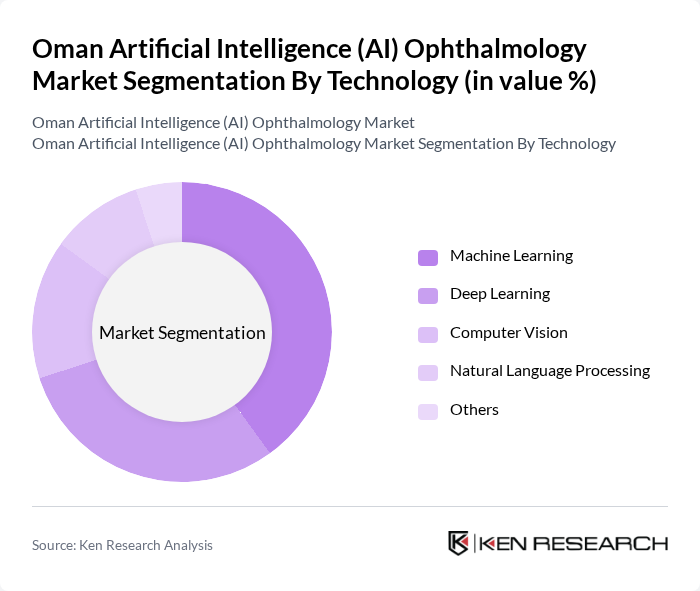
By Technology:The technology segment of the AI ophthalmology market includes advanced methodologies that enhance diagnostic and treatment processes. The key technologies are Machine Learning, Deep Learning, Computer Vision, Natural Language Processing, and Others. Machine Learning remains dominant due to its capacity to analyze large datasets and improve diagnostic accuracy, while Deep Learning is increasingly adopted for its superior performance in ophthalmic image recognition and analysis .
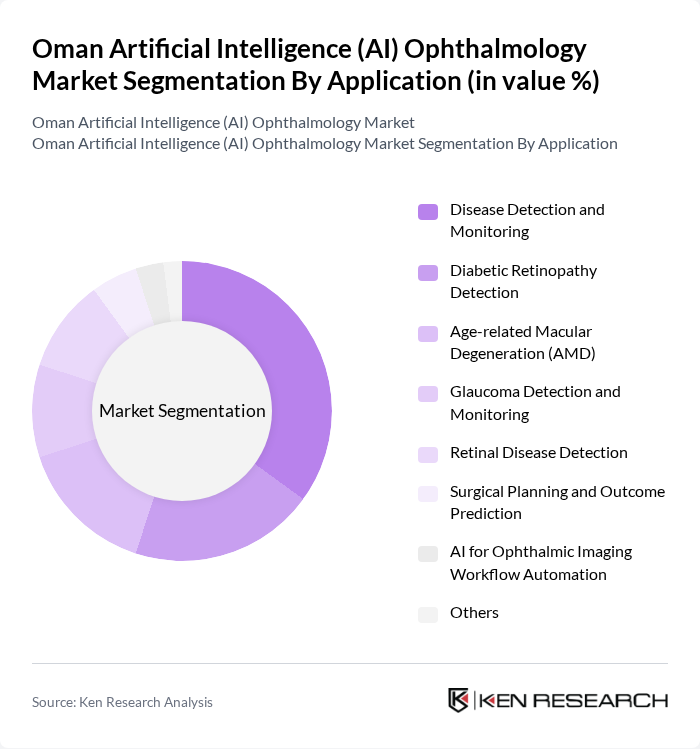
By Application:The application segment covers a range of AI uses in ophthalmology, including Disease Detection and Monitoring, Diabetic Retinopathy Detection, Age-related Macular Degeneration (AMD), Glaucoma Detection and Monitoring, Retinal Disease Detection, Surgical Planning and Outcome Prediction, AI for Ophthalmic Imaging Workflow Automation, and Others. Disease Detection and Monitoring leads due to the rising incidence of eye diseases and the critical need for timely intervention and screening, particularly for diabetic retinopathy and glaucoma .
The Oman Artificial Intelligence (AI) Ophthalmology Market is characterized by a dynamic mix of regional and international players. Leading participants such as Topcon Corporation, Carl Zeiss Meditec AG, Heidelberg Engineering GmbH, Nidek Co., Ltd., Canon Medical Systems Corporation, Eyenuk Inc., IDx Technologies Inc., Optos (Nikon Corporation), Big Vision LLC, Intalight AS, Moptim Ltd., Alcon Inc., Bausch + Lomb Corporation, Johnson & Johnson Vision Care, Inc., Oman Ministry of Health (Public Sector Initiatives) contribute to innovation, geographic expansion, and service delivery in this space.
The future of the AI ophthalmology market in Oman appears promising, driven by technological advancements and increasing healthcare investments. As the government focuses on enhancing healthcare infrastructure, the integration of AI in ophthalmology is expected to grow. Additionally, the rising awareness of AI's benefits among healthcare providers and patients will likely foster innovation and collaboration, paving the way for improved diagnostic and treatment solutions tailored to individual patient needs.
| Segment | Sub-Segments |
|---|---|
| By Technology | Machine Learning Deep Learning Computer Vision Natural Language Processing Others |
| By Application | Disease Detection and Monitoring Diabetic Retinopathy Detection Age-related Macular Degeneration (AMD) Glaucoma Detection and Monitoring Retinal Disease Detection Surgical Planning and Outcome Prediction AI for Ophthalmic Imaging Workflow Automation Others |
| By Product Type | AI-Powered OCT Systems AI Software for Retinal Imaging AI-Based Diagnostic Tools AI-Enabled Fundus Cameras Ophthalmic Imaging Workflow Software Others |
| By End-User | Hospitals Specialty Ophthalmology Clinics Academic and Research Institutions Diagnostic Centers Others |
| By Deployment Mode | On-Premise Cloud-Based Hybrid |
| By Region | Muscat Salalah Sohar Nizwa Others |
| Scope Item/Segment | Sample Size | Target Respondent Profiles |
|---|---|---|
| Ophthalmology Clinics Using AI | 40 | Ophthalmologists, Clinic Managers |
| Hospitals Implementing AI Solutions | 40 | Healthcare Administrators, IT Directors |
| Patients Receiving AI-Driven Eye Care | 120 | Patients, Caregivers |
| AI Technology Vendors in Healthcare | 40 | Product Managers, Sales Executives |
| Regulatory Bodies and Health Authorities | 40 | Policy Makers, Regulatory Officers |
The Oman Artificial Intelligence (AI) Ophthalmology Market is valued at approximately USD 35 million, reflecting a significant growth driven by the rising prevalence of eye diseases and advancements in AI-powered diagnostic technologies.

What makes us stand out is that our consultants follow Robust, Refine and Result (RRR) methodology. Robust for clear definitions, approaches and sanity checking, Refine for differentiating respondents' facts and opinions, and Result for presenting data with story.

We have set a benchmark in the industry by offering our clients with syndicated and customized market research reports featuring coverage of entire market as well as meticulous research and analyst insights.

While we don't replace traditional research, we flip the method upside down. Our dual approach of Top Bottom & Bottom Top ensures quality deliverable by not just verifying company fundamentals but also looking at the sector and macroeconomic factors.

With one step in the future, our research team constantly tries to show you the bigger picture. We help with some of the tough questions you may encounter along the way: How is the industry positioned? Best marketing channel? KPI's of competitors? By aligning every element, we help maximize success.

Our report gives you instant access to the answers and sources that other companies might choose to hide. We elaborate each steps of research methodology we have used and showcase you the sample size to earn your trust.

If you need any support, we are here! We pride ourselves on universe strength, data quality, and quick, friendly, and professional service.













