About the Report
Base Year 2024Oman Fishmeal Market Overview
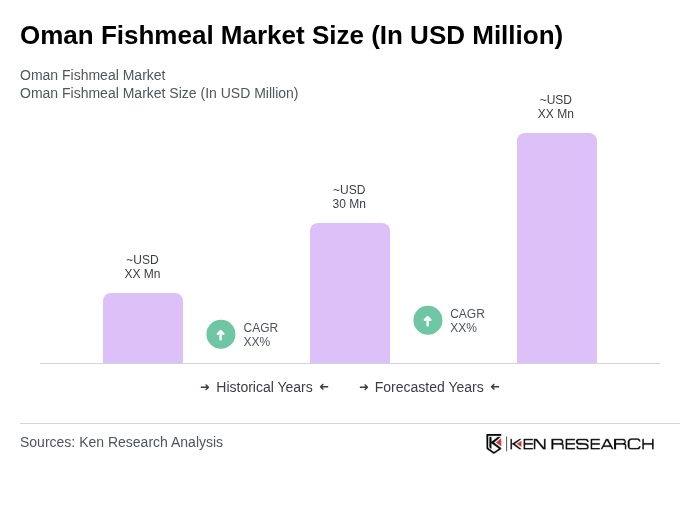
- The Oman Fishmeal Market is valued at USD 30 million, based on a five-year historical analysis. This growth is primarily driven by the increasing demand for fishmeal in aquaculture and livestock feed, as well as the rising awareness of the nutritional benefits of fishmeal in animal diets. Recent trends highlight the adoption of advanced processing technologies, a shift toward sustainable sourcing, and the integration of digital traceability platforms to ensure supply chain transparency and compliance with international standards .
- Key players in this market include Muscat Fisheries Company, Oman Fisheries Company, and Dhofar Fisheries Company. These companies dominate the market due to their established supply chains, advanced processing technologies, and strong relationships with local fishing communities, which ensure a steady supply of raw materials .
- In 2023, the Omani government implemented the Ministerial Decision No. 230/2023 issued by the Ministry of Agriculture, Fisheries and Water Resources. This regulation mandates that fishmeal producers adhere to strict environmental standards, including sustainable sourcing, waste management, and reporting requirements for raw material origins and processing volumes. The initiative aims to ensure the long-term viability of fish stocks and the overall health of marine ecosystems .
Oman Fishmeal Market Segmentation
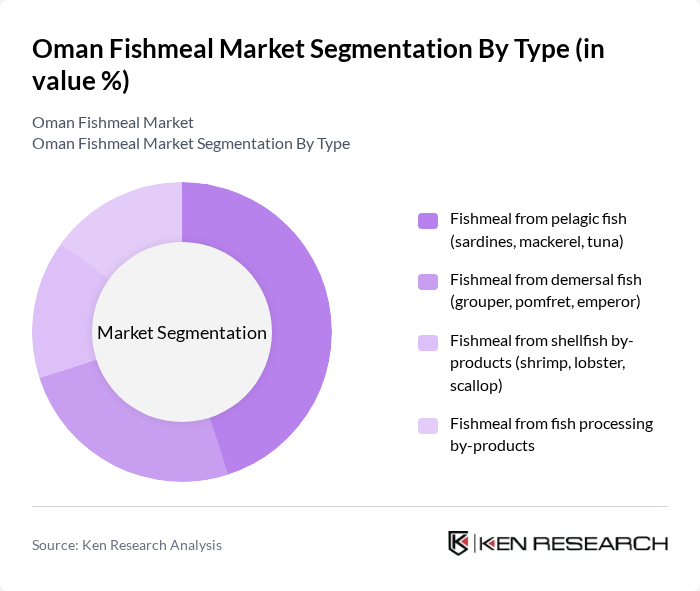
By Type:The fishmeal market can be segmented into four main types: fishmeal from pelagic fish, fishmeal from demersal fish, fishmeal from shellfish by-products, and fishmeal from fish processing by-products. Among these, fishmeal from pelagic fish, such as sardines and mackerel, is the most dominant segment due to its high protein content and widespread use in aquaculture. The increasing demand for sustainable aquaculture practices and the nutritional superiority of pelagic fishmeal have further propelled its consumption, making it a preferred choice for feed manufacturers .
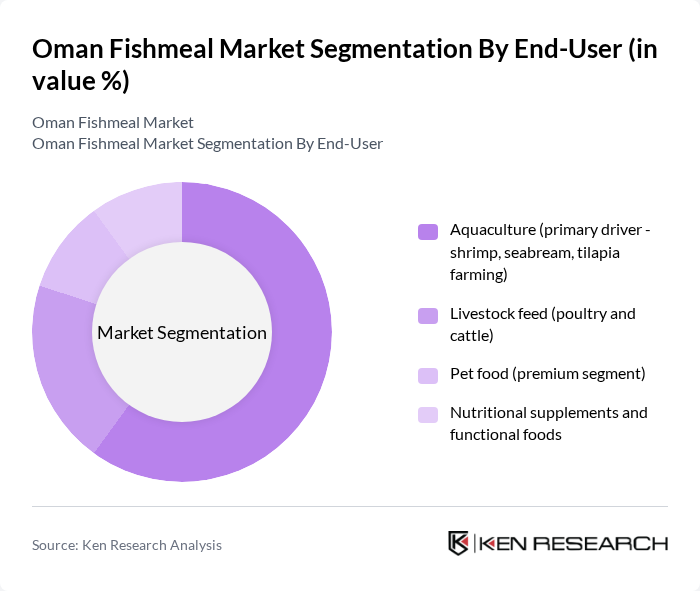
By End-User:The end-user segmentation includes aquaculture, livestock feed, pet food, and nutritional supplements. The aquaculture segment is the primary driver, particularly for shrimp and tilapia farming, as fishmeal is a crucial ingredient in feed formulations. The growing global demand for seafood and the expansion of aquaculture operations in Oman have significantly boosted the consumption of fishmeal in this sector, making it the leading end-user. Additionally, livestock feed and pet food segments are experiencing increased uptake due to the protein-rich and digestible nature of fishmeal .
Oman Fishmeal Market Competitive Landscape
The Oman Fishmeal Market is characterized by a dynamic mix of regional and international players. Leading participants such as Oman Fisheries Company, Dhofar Fisheries Company, Blue Waters Aquaculture, Duqm Fisheries and Processing Company, Muscat Fisheries Company, Al Waha Aquaculture and Fishmeal, Al Jazeera Fisheries Company, Oman Marine Products and Processing, Gulf Aquaculture and Feed Solutions, Al Batinah Fisheries and Aquaculture, Sea Harvest Oman LLC, Oman Aquaculture Development Company, Al Noor Fisheries and Processing, Al Muna Aquaculture and Feed Manufacturing, Oman Seafood Processing and Export Company contribute to innovation, geographic expansion, and service delivery in this space.
Oman Fishmeal Market Industry Analysis
Growth Drivers
- Increasing Demand for Aquaculture Feed:The aquaculture sector in Oman is projected to reach a production volume of 200,000 tons in future, driven by the rising global demand for seafood. This surge is attributed to the increasing population and dietary shifts towards protein-rich foods. Consequently, the demand for fishmeal, a critical component in aquaculture feed, is expected to rise significantly, with estimates suggesting a need for an additional 30,000 tons of fishmeal annually to meet this demand.
- Rising Health Consciousness Among Consumers:As health awareness grows, consumers are increasingly opting for seafood due to its nutritional benefits, including omega-3 fatty acids. In Oman, seafood consumption is projected to increase by 15% in future, leading to a higher demand for fishmeal as a feed ingredient. This trend is supported by government initiatives promoting seafood consumption, which further enhances the market for fishmeal as a vital resource in aquaculture and livestock feed.
- Expansion of the Fishing Industry in Oman:The fishing industry in Oman is experiencing robust growth, with production expected to reach 300,000 tons in future. This expansion is fueled by investments in fishing infrastructure and technology, which enhance catch efficiency. As the fishing industry grows, the by-products, including fishmeal, are increasingly utilized, creating a sustainable cycle that supports both the fishing and aquaculture sectors, thereby driving fishmeal demand.
Market Challenges
- Overfishing and Sustainability Concerns:Overfishing remains a significant challenge in Oman, with fish stocks declining by approximately 20% over the past decade. This decline raises sustainability concerns, prompting regulatory bodies to impose stricter fishing quotas. Such measures can limit the availability of raw materials for fishmeal production, potentially leading to supply shortages and increased production costs, which could adversely affect the market.
- Fluctuating Raw Material Prices:The prices of raw materials for fishmeal production are highly volatile, influenced by global market trends and local supply conditions. The price of fishmeal raw materials has fluctuated between USD 1,200 and USD 1,500 per ton in recent periods, creating uncertainty for producers. This volatility can impact profit margins and operational stability, making it challenging for companies to maintain consistent production levels and pricing strategies.
Oman Fishmeal Market Future Outlook
The Oman fishmeal market is poised for significant transformation, driven by a shift towards sustainable practices and technological advancements in production. As the government emphasizes sustainable fishing, companies are likely to adopt eco-friendly methods, enhancing their market appeal. Additionally, innovations in fishmeal processing technology are expected to improve efficiency and product quality, catering to the growing demand for high-quality aquaculture feed. These trends will shape the market landscape, fostering growth and sustainability in the coming years.
Market Opportunities
- Development of Value-Added Fishmeal Products:There is a growing opportunity for the development of value-added fishmeal products, such as hydrolyzed fish protein, which can cater to niche markets. This segment is expected to grow as manufacturers seek to differentiate their offerings, potentially increasing revenue streams and market share in the competitive landscape.
- Export Potential to Neighboring Countries:Oman’s strategic location provides significant export potential for fishmeal to neighboring countries, particularly in the Gulf region. With a projected increase in demand for fishmeal in these markets, Oman can leverage its production capabilities to establish itself as a key supplier, enhancing trade relations and economic growth.
Scope of the Report
| Segment | Sub-Segments |
|---|---|
| By Type | Fishmeal from pelagic fish (sardines, mackerel, tuna) Fishmeal from demersal fish (grouper, pomfret, emperor) Fishmeal from shellfish by-products (shrimp, lobster, scallop) Fishmeal from fish processing by-products |
| By End-User | Aquaculture (primary driver - shrimp, seabream, tilapia farming) Livestock feed (poultry and cattle) Pet food (premium segment) Nutritional supplements and functional foods |
| By Source | Wild-caught pelagic fish Farmed fish and shellfish Fish processing by-products and waste utilization Imported raw materials |
| By Quality Grade | Premium grade fishmeal (protein content >70%) Standard grade fishmeal (protein content 60-70%) Feed grade fishmeal (protein content <60%) Specialized grades (low ash, high digestibility) |
| By Packaging Type | Bulk packaging (20-25 MT containers) Bagged packaging (25-50 kg bags) Specialized packaging (vacuum-sealed, moisture-controlled) |
| By Distribution Channel | Direct sales to aquaculture operators Feed manufacturers and distributors Export to GCC and international markets Online B2B platforms |
| By Application | Feed for aquaculture (shrimp, fish farming) Feed for livestock (poultry, cattle) Nutritional supplements and health products Industrial applications (fertilizer, cosmetics) |
Key Target Audience
Investors and Venture Capitalist Firms
Government and Regulatory Bodies (e.g., Ministry of Agriculture, Fisheries and Water Resources)
Manufacturers and Producers of Fishmeal
Distributors and Retailers of Fishmeal Products
Exporters and Importers of Seafood Products
Aquaculture Farms and Operators
Industry Associations (e.g., Oman Fisheries Association)
Financial Institutions and Banks
Players Mentioned in the Report:
Oman Fisheries Company
Dhofar Fisheries Company
Blue Waters Aquaculture
Duqm Fisheries and Processing Company
Muscat Fisheries Company
Al Waha Aquaculture and Fishmeal
Al Jazeera Fisheries Company
Oman Marine Products and Processing
Gulf Aquaculture and Feed Solutions
Al Batinah Fisheries and Aquaculture
Sea Harvest Oman LLC
Oman Aquaculture Development Company
Al Noor Fisheries and Processing
Al Muna Aquaculture and Feed Manufacturing
Oman Seafood Processing and Export Company
Table of Contents
Market Assessment Phase
1. Executive Summary and Approach
2. Oman Fishmeal Market Overview
2.1 Key Insights and Strategic Recommendations
2.2 Oman Fishmeal Market Overview
2.3 Definition and Scope
2.4 Evolution of Market Ecosystem
2.5 Timeline of Key Regulatory Milestones
2.6 Value Chain & Stakeholder Mapping
2.7 Business Cycle Analysis
2.8 Policy & Incentive Landscape
3. Oman Fishmeal Market Analysis
3.1 Growth Drivers
3.1.1 Increasing demand for aquaculture feed
3.1.2 Rising health consciousness among consumers
3.1.3 Expansion of the fishing industry in Oman
3.1.4 Government support for sustainable fishing practices
3.2 Market Challenges
3.2.1 Overfishing and sustainability concerns
3.2.2 Fluctuating raw material prices
3.2.3 Regulatory compliance complexities
3.2.4 Competition from alternative protein sources
3.3 Market Opportunities
3.3.1 Development of value-added fishmeal products
3.3.2 Export potential to neighboring countries
3.3.3 Technological advancements in fishmeal production
3.3.4 Growing interest in organic and sustainable products
3.4 Market Trends
3.4.1 Shift towards sustainable fishing practices
3.4.2 Increasing use of fishmeal in pet food
3.4.3 Rising popularity of plant-based alternatives
3.4.4 Enhanced focus on traceability and quality assurance
3.5 Government Regulation
3.5.1 Fishing quotas and sustainability regulations
3.5.2 Import/export regulations for fishmeal
3.5.3 Environmental protection laws
3.5.4 Quality standards for fishmeal production
4. SWOT Analysis
5. Stakeholder Analysis
6. Porter's Five Forces Analysis
7. Oman Fishmeal Market Market Size, 2019-2024
7.1 By Value
7.2 By Volume
7.3 By Average Selling Price
8. Oman Fishmeal Market Segmentation
8.1 By Type
8.1.1 Fishmeal from pelagic fish (sardines, mackerel, tuna)
8.1.2 Fishmeal from demersal fish (grouper, pomfret, emperor)
8.1.3 Fishmeal from shellfish by-products (shrimp, lobster, scallop)
8.1.4 Fishmeal from fish processing by-products
8.2 By End-User
8.2.1 Aquaculture (primary driver - shrimp, seabream, tilapia farming)
8.2.2 Livestock feed (poultry and cattle)
8.2.3 Pet food (premium segment)
8.2.4 Nutritional supplements and functional foods
8.3 By Source
8.3.1 Wild-caught pelagic fish
8.3.2 Farmed fish and shellfish
8.3.3 Fish processing by-products and waste utilization
8.3.4 Imported raw materials
8.4 By Quality Grade
8.4.1 Premium grade fishmeal (protein content >70%)
8.4.2 Standard grade fishmeal (protein content 60-70%)
8.4.3 Feed grade fishmeal (protein content <60%)
8.4.4 Specialized grades (low ash, high digestibility)
8.5 By Packaging Type
8.5.1 Bulk packaging (20-25 MT containers)
8.5.2 Bagged packaging (25-50 kg bags)
8.5.3 Specialized packaging (vacuum-sealed, moisture-controlled)
8.6 By Distribution Channel
8.6.1 Direct sales to aquaculture operators
8.6.2 Feed manufacturers and distributors
8.6.3 Export to GCC and international markets
8.6.4 Online B2B platforms
8.7 By Application
8.7.1 Feed for aquaculture (shrimp, fish farming)
8.7.2 Feed for livestock (poultry, cattle)
8.7.3 Nutritional supplements and health products
8.7.4 Industrial applications (fertilizer, cosmetics)
9. Oman Fishmeal Market Competitive Analysis
9.1 Market Share of Key Players
9.2 Cross Comparison of Key Players
9.2.1 Company Name
9.2.2 Company Size Classification (Large, Medium, Small)
9.2.3 Annual Revenue Growth Rate (%)
9.2.4 Market Share & Penetration Rate (%)
9.2.5 Production Capacity (MT/annum)
9.2.6 Average Protein Content of Products (%)
9.2.7 Export Volume as % of Total Production
9.2.8 Distribution Network Reach (Domestic vs International)
9.2.9 Sustainability Certifications (MSC, ISO, etc.)
9.2.10 Technology Adoption Index (AI, Digital Twin, Automation)
9.3 SWOT Analysis of Top Players
9.4 Pricing Analysis
9.5 Detailed Profile of Major Companies
9.5.1 Oman Fisheries Company
9.5.2 Dhofar Fisheries Company
9.5.3 Blue Waters Aquaculture
9.5.4 Duqm Fisheries and Processing Company
9.5.5 Muscat Fisheries Company
9.5.6 Al Waha Aquaculture and Fishmeal
9.5.7 Al Jazeera Fisheries Company
9.5.8 Oman Marine Products and Processing
9.5.9 Gulf Aquaculture and Feed Solutions
9.5.10 Al Batinah Fisheries and Aquaculture
9.5.11 Sea Harvest Oman LLC
9.5.12 Oman Aquaculture Development Company
9.5.13 Al Noor Fisheries and Processing
9.5.14 Al Muna Aquaculture and Feed Manufacturing
9.5.15 Oman Seafood Processing and Export Company
10. Oman Fishmeal Market End-User Analysis
10.1 Procurement Behavior of Key Ministries
10.1.1 Ministry of Agriculture and Fisheries
10.1.2 Ministry of Commerce and Industry
10.1.3 Ministry of Environment and Climate Affairs
10.1.4 Others
10.2 Corporate Spend on Infrastructure & Energy
10.2.1 Investment in aquaculture facilities
10.2.2 Spending on fishmeal production technology
10.2.3 Budget allocation for sustainability initiatives
10.2.4 Others
10.3 Pain Point Analysis by End-User Category
10.3.1 Aquaculture sector challenges
10.3.2 Livestock feed quality issues
10.3.3 Regulatory compliance difficulties
10.3.4 Others
10.4 User Readiness for Adoption
10.4.1 Awareness of fishmeal benefits
10.4.2 Readiness to switch to sustainable sources
10.4.3 Training and support needs
10.4.4 Others
10.5 Post-Deployment ROI and Use Case Expansion
10.5.1 ROI from aquaculture feed
10.5.2 Use case expansion in pet food
10.5.3 Long-term sustainability benefits
10.5.4 Others
11. Oman Fishmeal Market Future Size, 2025-2030
11.1 By Value
11.2 By Volume
11.3 By Average Selling Price
Go-To-Market Strategy Phase
1. Whitespace Analysis + Business Model Canvas
1.1 Market Gaps Identification
1.2 Business Model Development
2. Marketing and Positioning Recommendations
2.1 Branding Strategies
2.2 Product USPs
3. Distribution Plan
3.1 Urban Retail vs Rural NGO Tie-ups
4. Channel & Pricing Gaps
4.1 Underserved Routes
4.2 Pricing Bands
5. Unmet Demand & Latent Needs
5.1 Category Gaps
5.2 Consumer Segments
6. Customer Relationship
6.1 Loyalty Programs
6.2 After-sales Service
7. Value Proposition
7.1 Sustainability
7.2 Integrated Supply Chains
8. Key Activities
8.1 Regulatory Compliance
8.2 Branding
8.3 Distribution Setup
9. Entry Strategy Evaluation
9.1 Domestic Market Entry Strategy
9.1.1 Product Mix
9.1.2 Pricing Band
9.1.3 Packaging
9.2 Export Entry Strategy
9.2.1 Target Countries
9.2.2 Compliance Roadmap
10. Entry Mode Assessment
10.1 JV
10.2 Greenfield
10.3 M&A
10.4 Distributor Model
11. Capital and Timeline Estimation
11.1 Capital Requirements
11.2 Timelines
12. Control vs Risk Trade-Off
12.1 Ownership vs Partnerships
13. Profitability Outlook
13.1 Breakeven Analysis
13.2 Long-term Sustainability
14. Potential Partner List
14.1 Distributors
14.2 JVs
14.3 Acquisition Targets
15. Execution Roadmap
15.1 Phased Plan for Market Entry
15.1.1 Market Setup
15.1.2 Market Entry
15.1.3 Growth Acceleration
15.1.4 Scale & Stabilize
15.2 Key Activities and Milestones
Research Methodology
Phase 1: Approach1
Desk Research
- Analysis of trade statistics from the Ministry of Agriculture and Fisheries Wealth of Oman
- Review of industry reports from the Food and Agriculture Organization (FAO) regarding fishmeal production
- Examination of market trends and forecasts from local fisheries associations and trade publications
Primary Research
- Interviews with key stakeholders in the fishmeal production sector, including manufacturers and suppliers
- Surveys conducted with fishery operators and aquaculture businesses to assess demand
- Field visits to processing plants to gather insights on production capacities and operational challenges
Validation & Triangulation
- Cross-validation of data through comparison with regional fishmeal market reports
- Triangulation of findings from primary interviews with secondary data sources
- Sanity checks performed by consulting industry experts and academic professionals in marine biology
Phase 2: Market Size Estimation1
Top-down Assessment
- Estimation of total fishmeal production based on national fish catch statistics
- Segmentation of market size by end-use applications such as aquaculture and livestock feed
- Incorporation of government policies promoting sustainable fishing practices
Bottom-up Modeling
- Volume estimates derived from production capacities of major fishmeal plants in Oman
- Cost analysis based on raw material prices and processing expenses
- Calculation of market size using production volume multiplied by average selling price
Forecasting & Scenario Analysis
- Multi-variable regression analysis incorporating factors such as global fish prices and local demand trends
- Scenario modeling based on potential regulatory changes affecting fishing quotas
- Development of baseline, optimistic, and pessimistic forecasts through 2030
Phase 3: CATI Sample Composition1
| Scope Item/Segment | Sample Size | Target Respondent Profiles |
|---|---|---|
| Fishmeal Production Facilities | 60 | Plant Managers, Production Supervisors |
| Aquaculture Feed Manufacturers | 50 | Procurement Managers, Product Development Specialists |
| Fisheries and Catching Operators | 40 | Fishery Owners, Operations Managers |
| Regulatory Bodies and Associations | 40 | Policy Makers, Industry Analysts |
| Export and Import Traders | 40 | Trade Managers, Logistics Coordinators |
Frequently Asked Questions
What is the current value of the Oman Fishmeal Market?
The Oman Fishmeal Market is valued at approximately USD 30 million, reflecting a five-year historical analysis. This valuation is driven by increasing demand for fishmeal in aquaculture and livestock feed, alongside growing awareness of its nutritional benefits.
What are the main drivers of growth in the Oman Fishmeal Market?
Who are the key players in the Oman Fishmeal Market?
What types of fishmeal are produced in Oman?
Other Regional/Country Reports
Indonesia Fishmeal Market
Malaysia Fishmeal Market
KSA Fishmeal Market
APAC Fishmeal Market
SEA Fishmeal Market
Vietnam Fishmeal Market
Other Adjacent Reports
UAE Livestock Feed Market
Vietnam Pet Food Market Outlook to 2030Vietnam Nutritional Supplements Market Outlook to 2030Qatar Fish Oil Market Size, Share, Growth Drivers, Trends, Opportunities & Forecast 2025–2030Bahrain Seafood Processing Market
Singapore Marine Ingredients MarketEgypt Animal Nutrition Market
Indonesia Feed Additives MarketPhilippines Sustainable Fisheries Market
Why Buy From Us?

What makes us stand out is that our consultants follow Robust, Refine and Result (RRR) methodology. Robust for clear definitions, approaches and sanity checking, Refine for differentiating respondents' facts and opinions, and Result for presenting data with story.

We have set a benchmark in the industry by offering our clients with syndicated and customized market research reports featuring coverage of entire market as well as meticulous research and analyst insights.

While we don't replace traditional research, we flip the method upside down. Our dual approach of Top Bottom & Bottom Top ensures quality deliverable by not just verifying company fundamentals but also looking at the sector and macroeconomic factors.

With one step in the future, our research team constantly tries to show you the bigger picture. We help with some of the tough questions you may encounter along the way: How is the industry positioned? Best marketing channel? KPI's of competitors? By aligning every element, we help maximize success.

Our report gives you instant access to the answers and sources that other companies might choose to hide. We elaborate each steps of research methodology we have used and showcase you the sample size to earn your trust.

If you need any support, we are here! We pride ourselves on universe strength, data quality, and quick, friendly, and professional service.