About the Report
Base Year 2024Listen to the audio summary
Oman Intravenous Catheters Market Overview
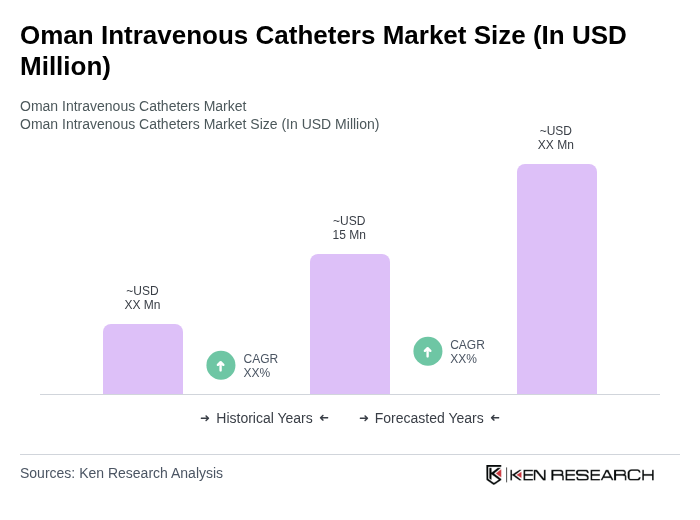
- The Oman Intravenous Catheters Market is valued at USD 15 million, based on a five-year historical analysis and proportional allocation from the Middle East catheters market size. This growth is primarily driven by the increasing prevalence of chronic diseases such as diabetes and cardiovascular conditions, a rise in surgical and minimally invasive procedures, and advancements in catheter technology including antimicrobial coatings and ultrasound-guided insertion. The demand for intravenous catheters is further supported by ongoing healthcare infrastructure modernization, government investments, and a heightened emphasis on infection control and patient safety in medical settings .
- Muscat, the capital city, remains the dominant market due to its concentration of tertiary hospitals, specialized medical centers, and advanced healthcare services. Salalah and Sohar are also significant contributors, with expanding healthcare capabilities and new hospital projects aimed at meeting the rising demand for medical services. Strategic investments in healthcare infrastructure, such as new hospital construction and digital health initiatives, reinforce the market leadership of these regions .
- The “Ministerial Decision No. 151/2023 on the Use of Safety-Engineered Medical Devices in Public Healthcare Facilities,” issued by the Ministry of Health, Oman in 2023, mandates the use of safety-engineered intravenous catheters in all public healthcare institutions. This regulation requires hospitals and clinics to procure and utilize catheters with integrated safety mechanisms to minimize needlestick injuries and enhance patient safety. Compliance is monitored through periodic audits, and non-compliance can result in procurement restrictions or administrative penalties .
Oman Intravenous Catheters Market Segmentation
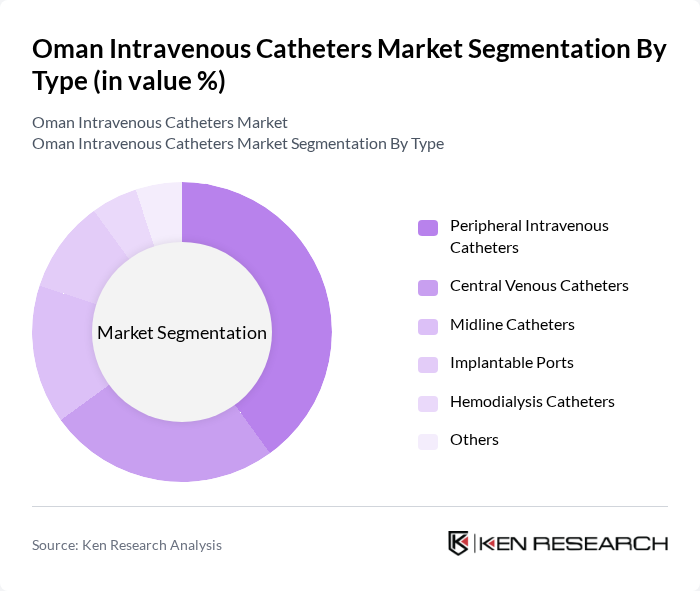
By Type:The market is segmented into Peripheral Intravenous Catheters, Central Venous Catheters, Midline Catheters, Implantable Ports, Hemodialysis Catheters, and Others. Peripheral Intravenous Catheters are the most widely used due to their ease of insertion, cost-effectiveness, and suitability for short-term therapies in emergency and inpatient settings. Central Venous Catheters are in high demand for critical care, oncology, and long-term therapies, while Midline Catheters and Implantable Ports are increasingly adopted for outpatient and home-based care, reflecting the shift toward minimally invasive and patient-centric treatment models .
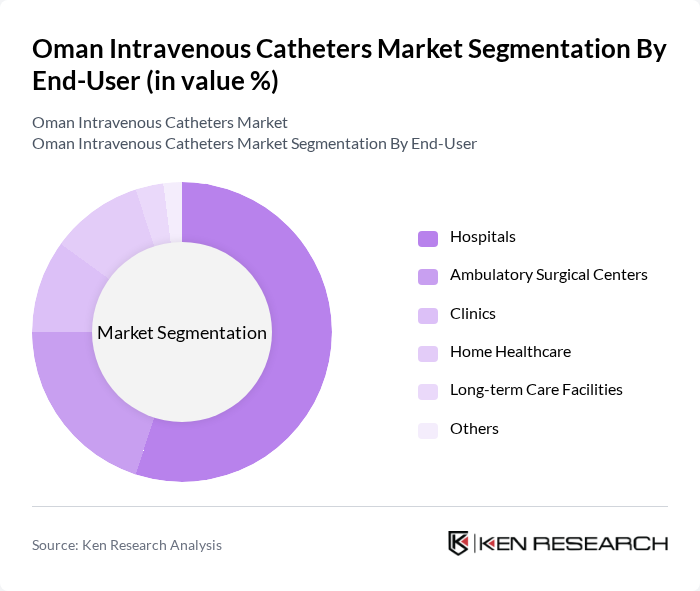
By End-User:The end-user segmentation includes Hospitals, Ambulatory Surgical Centers, Clinics, Home Healthcare, Long-term Care Facilities, and Others. Hospitals are the primary end-users, accounting for the largest share due to their role in acute care, surgery, and emergency medicine. Ambulatory Surgical Centers are experiencing robust growth as they expand advanced catheter use for outpatient procedures. The increasing adoption of home healthcare and long-term care services, driven by an aging population and chronic disease management needs, is fueling demand for catheters in non-hospital settings .
Oman Intravenous Catheters Market Competitive Landscape
The Oman Intravenous Catheters Market is characterized by a dynamic mix of regional and international players. Leading participants such as B. Braun Melsungen AG, Becton, Dickinson and Company (BD), Smiths Medical (ICU Medical, Inc.), Terumo Corporation, Teleflex Incorporated, Vygon S.A., Cook Medical, Cardinal Health, Fresenius Kabi AG, Johnson & Johnson (Ethicon), 3M Company, ConvaTec Group PLC, Halyard Health, Inc. (now part of Owens & Minor), Nipro Corporation, AngioDynamics, Inc., Argon Medical Devices, Inc., Medinova Medical Supplies LLC, Healthcare Systems EST, Hysopemedica, and Saudi Mais Co. contribute to innovation, geographic expansion, and service delivery in this space.
Oman Intravenous Catheters Market Industry Analysis
Growth Drivers
- Increasing Prevalence of Chronic Diseases:The rise in chronic diseases such as diabetes and cardiovascular conditions in Oman is a significant growth driver for the intravenous catheters market. According to the World Health Organization, approximately 30% of the Omani population suffers from chronic diseases, leading to a higher demand for intravenous therapies. This trend is expected to increase healthcare utilization, with the Ministry of Health reporting a 20% annual increase in hospital admissions related to chronic disease management, further boosting catheter usage.
- Rising Demand for Minimally Invasive Procedures:The shift towards minimally invasive procedures in Oman is propelling the intravenous catheters market. The Omani healthcare sector has seen a 25% increase in such procedures over the past three years, driven by patient preference for reduced recovery times and lower complication rates. The Ministry of Health's investment in advanced surgical technologies, amounting to OMR 12 million in future, supports this trend, enhancing the demand for innovative catheter solutions that facilitate these procedures.
- Technological Advancements in Catheter Design:Innovations in catheter technology are significantly influencing market growth in Oman. The introduction of smart catheters, which monitor patient vitals and reduce infection risks, has gained traction. In future, the Omani government allocated OMR 6 million for research and development in medical devices, fostering advancements in catheter design. This investment is expected to enhance patient outcomes and increase the adoption of advanced catheters, contributing to market expansion.
Market Challenges
- High Cost of Advanced Catheters:The high cost associated with advanced intravenous catheters poses a significant challenge in Oman. Premium catheters can range from OMR 18 to OMR 35 each, which may limit their accessibility in public healthcare settings. The Ministry of Health's budget constraints, with a healthcare expenditure of OMR 1.8 billion in future, further complicate the procurement of these advanced devices, potentially hindering market growth.
- Limited Awareness Among Healthcare Professionals:A lack of awareness and training regarding the latest catheter technologies among healthcare professionals in Oman presents a challenge. Surveys indicate that only 45% of healthcare providers are familiar with advanced catheter options. This gap in knowledge can lead to underutilization of innovative products, impacting patient care and limiting market growth. The Ministry of Health's initiatives to enhance training programs are crucial to overcoming this barrier.
Oman Intravenous Catheters Market Future Outlook
The future of the intravenous catheters market in Oman appears promising, driven by ongoing healthcare reforms and technological advancements. The government's commitment to enhancing healthcare infrastructure, with an investment of OMR 250 million in future, is expected to facilitate better access to advanced medical devices. Additionally, the increasing integration of telemedicine and home healthcare solutions will likely reshape patient management, creating new avenues for catheter utilization and improving overall healthcare delivery in the region.
Market Opportunities
- Expansion of Healthcare Infrastructure:The ongoing expansion of healthcare facilities in Oman presents a significant opportunity for the intravenous catheters market. With the government planning to build 12 new hospitals in future, the demand for medical supplies, including catheters, is expected to rise substantially, enhancing market potential.
- Development of Eco-Friendly Catheters:The growing emphasis on sustainability in healthcare offers an opportunity for the development of eco-friendly catheters. As environmental concerns rise, manufacturers focusing on biodegradable materials can tap into a niche market, appealing to healthcare providers committed to reducing their ecological footprint.
Scope of the Report
| Segment | Sub-Segments |
|---|---|
| By Type | Peripheral Intravenous Catheters Central Venous Catheters Midline Catheters Implantable Ports Hemodialysis Catheters Others |
| By End-User | Hospitals Ambulatory Surgical Centers Clinics Home Healthcare Long-term Care Facilities Others |
| By Material | Polyurethane PVC Silicone Teflon Others |
| By Application | Oncology Antibiotic Therapy Fluid and Nutrient Replacement Renal Disease Management Others |
| By Region | Muscat Salalah Sohar Nizwa Others |
| By Distribution Channel | Direct Sales Distributors Online Sales Tender/Institutional Sales Others |
| By Pricing Model | Premium Pricing Competitive Pricing Value-based Pricing Others |
Key Target Audience
Investors and Venture Capitalist Firms
Government and Regulatory Bodies (e.g., Ministry of Health, Oman Medical Specialty Board)
Manufacturers and Producers
Distributors and Retailers
Healthcare Providers (e.g., Hospitals, Clinics)
Medical Device Importers
Industry Associations (e.g., Oman Medical Association)
Financial Institutions
Players Mentioned in the Report:
B. Braun Melsungen AG
Becton, Dickinson and Company (BD)
Smiths Medical (ICU Medical, Inc.)
Terumo Corporation
Teleflex Incorporated
Vygon S.A.
Cook Medical
Cardinal Health
Fresenius Kabi AG
Johnson & Johnson (Ethicon)
3M Company
ConvaTec Group PLC
Halyard Health, Inc. (now part of Owens & Minor)
Nipro Corporation
AngioDynamics, Inc.
Argon Medical Devices, Inc.
Medinova Medical Supplies LLC
Healthcare Systems EST
Hysopemedica
Saudi Mais Co.
Table of Contents
Market Assessment Phase
1. Executive Summary and Approach
2. Oman Intravenous Catheters Market Overview
2.1 Key Insights and Strategic Recommendations
2.2 Oman Intravenous Catheters Market Overview
2.3 Definition and Scope
2.4 Evolution of Market Ecosystem
2.5 Timeline of Key Regulatory Milestones
2.6 Value Chain & Stakeholder Mapping
2.7 Business Cycle Analysis
2.8 Policy & Incentive Landscape
3. Oman Intravenous Catheters Market Analysis
3.1 Growth Drivers
3.1.1 Increasing prevalence of chronic diseases
3.1.2 Rising demand for minimally invasive procedures
3.1.3 Technological advancements in catheter design
3.1.4 Growing healthcare expenditure in Oman
3.2 Market Challenges
3.2.1 High cost of advanced catheters
3.2.2 Stringent regulatory requirements
3.2.3 Limited awareness among healthcare professionals
3.2.4 Competition from alternative therapies
3.3 Market Opportunities
3.3.1 Expansion of healthcare infrastructure
3.3.2 Increasing focus on patient safety
3.3.3 Growth in medical tourism
3.3.4 Development of eco-friendly catheters
3.4 Market Trends
3.4.1 Shift towards home healthcare solutions
3.4.2 Adoption of smart catheters
3.4.3 Integration of telemedicine in catheter management
3.4.4 Rising demand for customized catheter solutions
3.5 Government Regulation
3.5.1 Compliance with international safety standards
3.5.2 Mandatory reporting of adverse events
3.5.3 Licensing requirements for manufacturers
3.5.4 Guidelines for catheter usage in healthcare settings
4. SWOT Analysis
5. Stakeholder Analysis
6. Porter's Five Forces Analysis
7. Oman Intravenous Catheters Market Market Size, 2019-2024
7.1 By Value
7.2 By Volume
7.3 By Average Selling Price
8. Oman Intravenous Catheters Market Segmentation
8.1 By Type
8.1.1 Peripheral Intravenous Catheters
8.1.2 Central Venous Catheters
8.1.3 Midline Catheters
8.1.4 Implantable Ports
8.1.5 Hemodialysis Catheters
8.1.6 Others
8.2 By End-User
8.2.1 Hospitals
8.2.2 Ambulatory Surgical Centers
8.2.3 Clinics
8.2.4 Home Healthcare
8.2.5 Long-term Care Facilities
8.2.6 Others
8.3 By Material
8.3.1 Polyurethane
8.3.2 PVC
8.3.3 Silicone
8.3.4 Teflon
8.3.5 Others
8.4 By Application
8.4.1 Oncology
8.4.2 Antibiotic Therapy
8.4.3 Fluid and Nutrient Replacement
8.4.4 Renal Disease Management
8.4.5 Others
8.5 By Region
8.5.1 Muscat
8.5.2 Salalah
8.5.3 Sohar
8.5.4 Nizwa
8.5.5 Others
8.6 By Distribution Channel
8.6.1 Direct Sales
8.6.2 Distributors
8.6.3 Online Sales
8.6.4 Tender/Institutional Sales
8.6.5 Others
8.7 By Pricing Model
8.7.1 Premium Pricing
8.7.2 Competitive Pricing
8.7.3 Value-based Pricing
8.7.4 Others
9. Oman Intravenous Catheters Market Competitive Analysis
9.1 Market Share of Key Players
9.2 KPIs for Cross Comparison of Key Players
9.2.1 Company Name
9.2.2 Group Size (Large, Medium, or Small as per industry convention)
9.2.3 Revenue Growth Rate (Oman IV Catheters Segment)
9.2.4 Market Penetration Rate (Share of Oman Hospitals/Clinics Using Brand)
9.2.5 Customer Retention Rate (Annual Contract Renewal %)
9.2.6 Product Innovation Rate (New IV Catheter Launches per Year)
9.2.7 Distribution Coverage (Number of Regions/Institutions Served in Oman)
9.2.8 Pricing Competitiveness (Price Index vs. Market Average)
9.2.9 Regulatory Compliance Score (MOH/International Certifications)
9.2.10 Customer Satisfaction Score (Surveyed End-User Ratings)
9.3 SWOT Analysis of Top Players
9.4 Pricing Analysis
9.5 List of Major Companies
9.5.1 B. Braun Melsungen AG
9.5.2 Becton, Dickinson and Company (BD)
9.5.3 Smiths Medical (ICU Medical, Inc.)
9.5.4 Terumo Corporation
9.5.5 Teleflex Incorporated
9.5.6 Vygon S.A.
9.5.7 Cook Medical
9.5.8 Cardinal Health
9.5.9 Fresenius Kabi AG
9.5.10 Johnson & Johnson (Ethicon)
9.5.11 3M Company
9.5.12 ConvaTec Group PLC
9.5.13 Halyard Health, Inc. (now part of Owens & Minor)
9.5.14 Nipro Corporation
9.5.15 AngioDynamics, Inc.
9.5.16 Argon Medical Devices, Inc.
9.5.17 Medinova Medical Supplies LLC
9.5.18 Healthcare Systems EST
9.5.19 Hysopemedica
9.5.20 Saudi Mais Co.
10. Oman Intravenous Catheters Market End-User Analysis
10.1 Procurement Behavior of Key Ministries
10.1.1 Budget Allocation Trends
10.1.2 Decision-Making Processes
10.1.3 Supplier Selection Criteria
10.1.4 Contracting Practices
10.2 Corporate Spend on Infrastructure & Energy
10.2.1 Investment Trends in Healthcare Facilities
10.2.2 Spending on Medical Equipment
10.2.3 Budgeting for Catheter Supplies
10.2.4 Future Spending Projections
10.3 Pain Point Analysis by End-User Category
10.3.1 Challenges Faced by Hospitals
10.3.2 Issues in Home Healthcare
10.3.3 Concerns of Long-term Care Facilities
10.3.4 Others
10.4 User Readiness for Adoption
10.4.1 Training and Education Needs
10.4.2 Technology Acceptance Levels
10.4.3 Infrastructure Readiness
10.4.4 Others
10.5 Post-Deployment ROI and Use Case Expansion
10.5.1 Measurement of ROI
10.5.2 Case Studies of Successful Implementations
10.5.3 Expansion Opportunities
10.5.4 Others
11. Oman Intravenous Catheters Market Future Size, 2025-2030
11.1 By Value
11.2 By Volume
11.3 By Average Selling Price
Go-To-Market Strategy Phase
1. Whitespace Analysis + Business Model Canvas
1.1 Market Gaps Identification
1.2 Business Model Development
2. Marketing and Positioning Recommendations
2.1 Branding Strategies
2.2 Product USPs
3. Distribution Plan
3.1 Urban Retail Strategies
3.2 Rural NGO Tie-ups
4. Channel & Pricing Gaps
4.1 Underserved Routes
4.2 Pricing Bands Analysis
5. Unmet Demand & Latent Needs
5.1 Category Gaps
5.2 Consumer Segments
6. Customer Relationship
6.1 Loyalty Programs
6.2 After-sales Service
7. Value Proposition
7.1 Sustainability Initiatives
7.2 Integrated Supply Chains
8. Key Activities
8.1 Regulatory Compliance
8.2 Branding Efforts
8.3 Distribution Setup
9. Entry Strategy Evaluation
9.1 Domestic Market Entry Strategy
9.1.1 Product Mix Considerations
9.1.2 Pricing Band Strategy
9.1.3 Packaging Solutions
9.2 Export Entry Strategy
9.2.1 Target Countries Identification
9.2.2 Compliance Roadmap Development
10. Entry Mode Assessment
10.1 Joint Ventures
10.2 Greenfield Investments
10.3 Mergers & Acquisitions
10.4 Distributor Model
11. Capital and Timeline Estimation
11.1 Capital Requirements
11.2 Timelines for Implementation
12. Control vs Risk Trade-Off
12.1 Ownership Considerations
12.2 Partnerships Evaluation
13. Profitability Outlook
13.1 Breakeven Analysis
13.2 Long-term Sustainability Strategies
14. Potential Partner List
14.1 Distributors
14.2 Joint Ventures
14.3 Acquisition Targets
15. Execution Roadmap
15.1 Phased Plan for Market Entry
15.1.1 Market Setup
15.1.2 Market Entry
15.1.3 Growth Acceleration
15.1.4 Scale & Stabilize
15.2 Key Activities and Milestones
15.2.1 Milestone Planning
15.2.2 Activity Tracking
Research Methodology
Phase 1: Approach1
Desk Research
- Analysis of healthcare expenditure reports from the Ministry of Health, Oman
- Review of market reports and publications from industry associations related to medical devices
- Examination of import/export data for intravenous catheters from Oman's customs authorities
Primary Research
- Interviews with hospital procurement managers and medical supply chain professionals
- Surveys conducted with healthcare practitioners regarding catheter usage and preferences
- Field visits to hospitals and clinics to observe catheter usage and gather qualitative insights
Validation & Triangulation
- Cross-validation of findings through multiple data sources including government and industry reports
- Triangulation of primary research insights with secondary data trends
- Sanity checks through expert panel discussions with healthcare industry veterans
Phase 2: Market Size Estimation1
Top-down Assessment
- Estimation of market size based on national healthcare spending and projected growth rates
- Segmentation of the market by catheter type, including peripheral and central venous catheters
- Incorporation of demographic data to assess potential market reach and growth opportunities
Bottom-up Modeling
- Collection of sales data from leading catheter manufacturers operating in Oman
- Estimation of usage rates based on patient admission statistics and surgical procedures
- Volume and pricing analysis to derive revenue estimates for different catheter types
Forecasting & Scenario Analysis
- Multi-variable forecasting model incorporating factors such as population growth and healthcare infrastructure development
- Scenario analysis based on potential regulatory changes and technological advancements in catheter design
- Development of baseline, optimistic, and pessimistic market projections through 2030
Phase 3: CATI Sample Composition1
| Scope Item/Segment | Sample Size | Target Respondent Profiles |
|---|---|---|
| Hospital Procurement Departments | 100 | Procurement Managers, Supply Chain Coordinators |
| Healthcare Practitioners | 90 | Doctors, Nurses, Medical Technologists |
| Medical Device Distributors | 50 | Sales Managers, Distribution Coordinators |
| Regulatory Bodies | 40 | Regulatory Affairs Specialists, Compliance Officers |
| Healthcare Facility Administrators | 60 | Facility Managers, Operations Directors |
Frequently Asked Questions
What is the current value of the Oman Intravenous Catheters Market?
The Oman Intravenous Catheters Market is valued at approximately USD 15 million, reflecting a five-year historical analysis and proportional allocation from the broader Middle East catheters market size.
What factors are driving the growth of the Oman Intravenous Catheters Market?
Which cities in Oman are leading in the intravenous catheters market?
What regulations impact the use of intravenous catheters in Oman?
Other Regional/Country Reports
Indonesia Intravenous Catheters Market
Malaysia Intravenous Catheters Market
KSA Intravenous Catheters Market
APAC Intravenous Catheters Market
SEA Intravenous Catheters Market
Vietnam Intravenous Catheters Market
Other Adjacent Reports
Qatar Infusion Pumps Market
Qatar Vascular Access Devices Market Report Size, Share, Growth Drivers, Trends, Opportunities & Forecast 2025–2030APAC Medical Tubing Market Report Size Share Growth Drivers Trends Opportunities & Forecast 2025–2030Mexico Syringes and Needles Market
UAE Infection Control Products Market
Singapore Critical Care Equipment Market
Philippines Dialysis Equipment Market
UAE Oncology Devices Market
Philippines Surgical Instruments Market
Mexico Home Healthcare Devices Market
Why Buy From Us?

What makes us stand out is that our consultants follow Robust, Refine and Result (RRR) methodology. Robust for clear definitions, approaches and sanity checking, Refine for differentiating respondents' facts and opinions, and Result for presenting data with story.

We have set a benchmark in the industry by offering our clients with syndicated and customized market research reports featuring coverage of entire market as well as meticulous research and analyst insights.

While we don't replace traditional research, we flip the method upside down. Our dual approach of Top Bottom & Bottom Top ensures quality deliverable by not just verifying company fundamentals but also looking at the sector and macroeconomic factors.

With one step in the future, our research team constantly tries to show you the bigger picture. We help with some of the tough questions you may encounter along the way: How is the industry positioned? Best marketing channel? KPI's of competitors? By aligning every element, we help maximize success.

Our report gives you instant access to the answers and sources that other companies might choose to hide. We elaborate each steps of research methodology we have used and showcase you the sample size to earn your trust.

If you need any support, we are here! We pride ourselves on universe strength, data quality, and quick, friendly, and professional service.