








Ken Research Logo

Oman Lactation Support Supplements Market Report Size, Share, Growth Drivers, Trends, Opportunities & Forecast 2025–2030

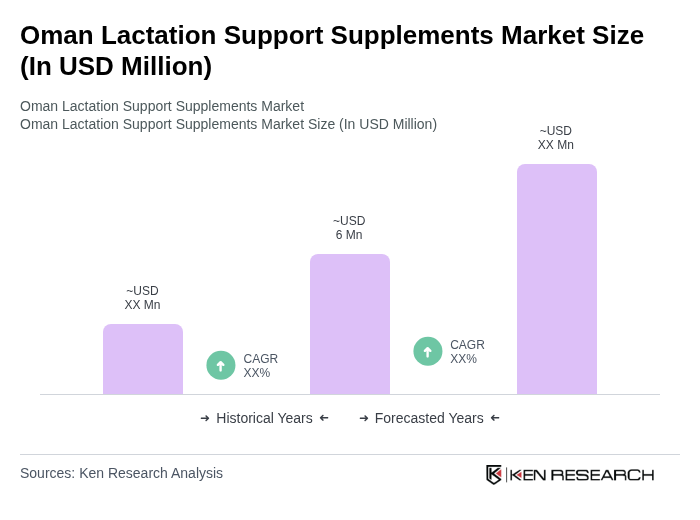
The Oman Lactation Support Supplements Market, valued at USD 6 million, grows due to rising awareness, natural product demand, and government breastfeeding promotions in key cities like Muscat.

Region:Middle East

Author(s):Shubham

Product Code:KRAD5477

Pages:84

Published On:December 2025
About the Report

Base Year 2024

Oman Lactation Support Supplements Market Overview

  • The Oman Lactation Support Supplements Market is valued at USD 6 million, based on a five-year historical analysis and benchmarking against the global lactation support supplements market size and the population share of Oman within the Middle East. This growth is primarily driven by increasing awareness of maternal health, the rising number of working mothers, and the growing emphasis on breastfeeding, supported by global and regional breastfeeding promotion initiatives. The demand for lactation support supplements has surged as more mothers seek to enhance milk production and ensure the nutritional needs of their infants are met through herbal, vitamin–mineral, and nutraceutical-based products.
  • Key cities such as Muscat and Salalah dominate the market due to their higher population density, better access to hospitals and pharmacies, and concentration of modern retail formats. The urbanization in these areas has led to a greater demand for maternal health products, including lactation supplements, as more women are becoming health-conscious, exposed to global supplement brands, and seeking products that support breastfeeding and postnatal recovery.
  • In 2023, the Omani government implemented regulations to ensure the safety and efficacy of lactation support supplements. This includes alignment with the GCC Standardization Organization framework, in particular GSO 2628/2021 “Requirements of Health and Nutritional Claims on Food,” issued by the GCC Standardization Organization, which is applied in Oman through the Ministry of Commerce, Industry and Investment Promotion and the Ministry of Health. The framework covers mandatory labeling requirements, permitted health and nutrition claims, and quality and safety criteria for food supplements, requiring manufacturers and importers of lactation support products to ensure accurate ingredient disclosure, compliance with contaminant and additive limits, and the avoidance of misleading claims for breastfeeding mothers.
Oman Lactation Support Supplements Market Size

Oman Lactation Support Supplements Market Segmentation

By Product Form:The market is segmented into various product forms, including capsules and tablets, powders and granules, liquid drops and syrups, bars, cookies, and functional foods, herbal teas and infusions, and others. This structure is consistent with the global lactation support supplements market, where tablets and capsules, powders, and liquid extracts are the dominant formats. Among these, capsules and tablets are the most popular due to their convenience, standardized dosing, and ease of consumption, particularly among busy mothers purchasing through pharmacies and modern trade channels. The demand for liquid drops and syrups is also growing, in line with global trends toward palatable, easy-to-swallow, and combination formulations, especially where products are co-positioned with infant and postnatal care ranges.
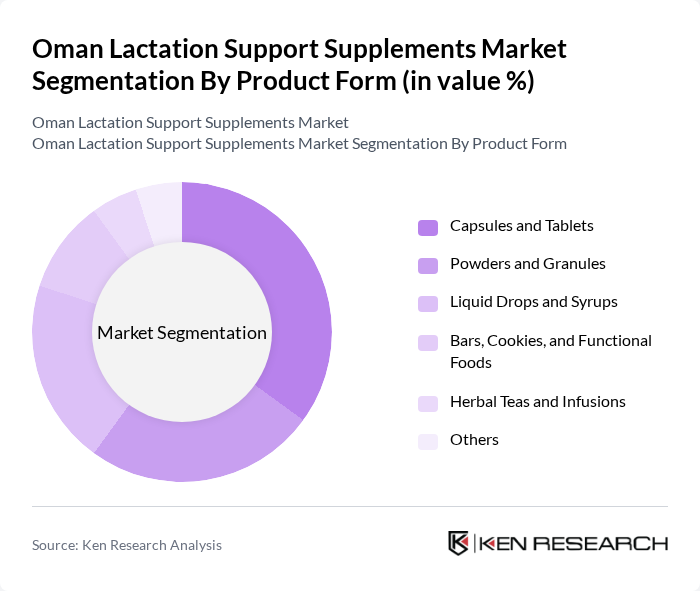
Oman Lactation Support Supplements Market segmentation by Product Form.

By Ingredient Type:The ingredient type segmentation includes single-herb galactagogues (e.g., fenugreek, moringa), multi-herb blends, vitamins & minerals, probiotic-based lactation supplements, and others. This is aligned with global ingredient patterns, where herbal galactagogues such as fenugreek, moringa, milk thistle, and fennel form the core of lactation formulations, often combined with vitamins and minerals. Single-herb galactagogues dominate the market due to their traditional use, strong consumer recognition, and evidence base from global clinical and ethnobotanical usage for enhancing milk supply. Multi-herb blends are gaining traction as they offer a holistic approach to lactation support, combining the benefits of various herbs with supportive nutrients and, increasingly, probiotics to address digestive comfort and overall maternal wellness.
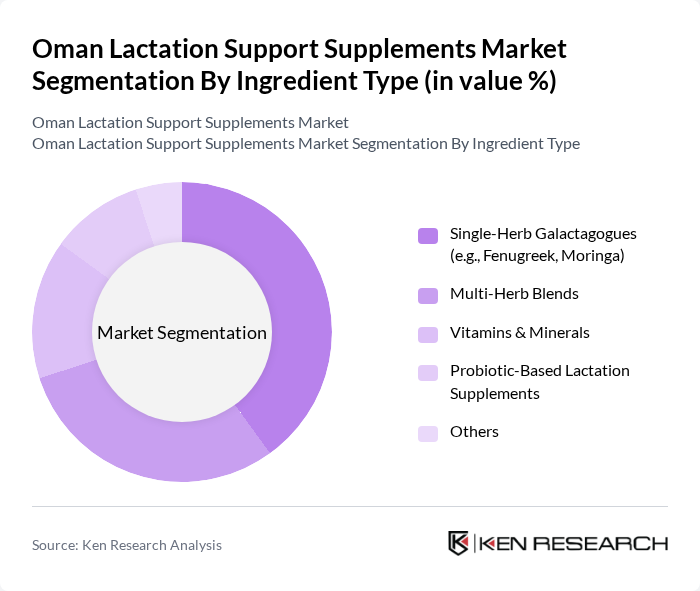
Oman Lactation Support Supplements Market segmentation by Ingredient Type.

Oman Lactation Support Supplements Market Competitive Landscape

The Oman Lactation Support Supplements Market is characterized by a dynamic mix of regional and international players. Leading participants such as Nestlé S.A. (Oman Trading Establishment – Nestlé Middle East), Abbott Laboratories (Abbott Nutrition Middle East), Danone S.A. (Nutricia Middle East & North Africa), Reckitt Benckiser Group plc (Mead Johnson Nutrition), Pfizer Inc. (Wyeth Nutrition), Bayer AG, Sanofi S.A., Himalaya Wellness Company, Dabur India Ltd., Euromedica Gulf LLC, Oman Pharmaceutical Products Co. LLC, Lifeline Pharma LLC, Life Pharmacy Group (Oman), Aster Pharmacy (Oman), Nesto Hypermarket / Lulu Group International (Mother & Baby Nutrition Range) contribute to innovation, geographic expansion, and service delivery in this space.

Nestlé S.A.

1866

Vevey, Switzerland

Abbott Laboratories

1888

Abbott Park, Illinois, USA

Danone S.A.

1919

Paris, France

Reckitt Benckiser Group plc

1823

Slough, United Kingdom

Pfizer Inc.

1849

New York City, New York, USA

Company

Establishment Year

Headquarters

Company Type (Global, Regional, or Local)

Estimated Lactation Supplement Revenue in Oman

3-Year Revenue CAGR in Oman Market

Share of Lactation Supplements in Total Maternal Nutrition Portfolio

Number of Lactation SKUs in Oman

Presence Across Channels (Hospitals, Pharmacies, Modern Trade, Online)

Oman Lactation Support Supplements Market Industry Analysis

Growth Drivers

  • Increasing Awareness of Maternal Health:The maternal health awareness in Oman has surged, with 70% of women now recognizing the importance of lactation support supplements. This shift is driven by educational campaigns from health organizations, which reported a 30% increase in maternal health workshops in future. Additionally, the World Health Organization emphasizes breastfeeding's benefits, further motivating mothers to seek nutritional support, thus propelling the lactation supplement market.
  • Rising Demand for Natural and Organic Supplements:The demand for natural and organic lactation supplements in Oman has increased significantly, with sales rising to 1.2 million units in future. This trend aligns with a broader consumer shift towards health-conscious choices, as 65% of mothers prefer organic products. The Ministry of Health's endorsement of natural ingredients has also contributed to this growth, reflecting a societal preference for safe, effective maternal health solutions.
  • Government Initiatives Promoting Breastfeeding:Oman's government has implemented various initiatives to promote breastfeeding, including the "Breastfeeding-Friendly Hospital Initiative," which has seen participation from 80% of hospitals. These efforts have led to a 25% increase in breastfeeding rates among new mothers. Such initiatives not only enhance maternal health but also drive the demand for lactation support supplements, as mothers seek to optimize their breastfeeding experience.

Market Challenges

  • Limited Availability of Quality Products:The availability of high-quality lactation support supplements in Oman remains a significant challenge, with only 40% of products meeting international quality standards. This scarcity is exacerbated by a lack of local manufacturers, leading to reliance on imports, which can be inconsistent. Consequently, many mothers are left with limited options, hindering market growth and consumer trust in available products.
  • High Competition from Alternative Products:The lactation support supplement market faces intense competition from alternative products, such as herbal teas and traditional remedies, which have been used for generations. In future, these alternatives accounted for 55% of the maternal health product market share. This competition poses a challenge for supplement manufacturers, as many consumers opt for familiar, culturally accepted solutions over newer supplement options.

Oman Lactation Support Supplements Market Future Outlook

The future of the Oman lactation support supplements market appears promising, driven by increasing consumer awareness and a growing emphasis on maternal health. As e-commerce platforms expand, accessibility to quality products will improve, fostering market growth. Additionally, collaborations with healthcare providers are expected to enhance product credibility, encouraging more mothers to consider supplements as part of their postpartum care. These trends indicate a dynamic market poised for development in the coming years.

Market Opportunities

  • Expansion of E-commerce Platforms:The rise of e-commerce in Oman presents a significant opportunity for lactation support supplement brands. With online sales projected to reach 500,000 units in future, brands can leverage digital marketing to reach a broader audience, enhancing product visibility and accessibility for mothers seeking convenient purchasing options.
  • Development of New Product Formulations:There is a growing opportunity for innovation in product formulations tailored to specific maternal needs. In future, the introduction of specialized supplements targeting issues like low milk supply or postpartum recovery could capture a larger market share, appealing to health-conscious consumers seeking personalized solutions for their lactation challenges.

Scope of the Report

SegmentSub-Segments
By Product Form

Capsules and Tablets

Powders and Granules

Liquid Drops and Syrups

Bars, Cookies, and Functional Foods

Herbal Teas and Infusions

Others

By Ingredient Type

Single-Herb Galactagogues (e.g., Fenugreek, Moringa)

Multi-Herb Blends

Vitamins & Minerals

Probiotic-Based Lactation Supplements

Others

By Consumer Profile

First-Time Mothers

Multiparous Mothers

Mothers with Identified Low Milk Supply

High-Risk or C-Section Deliveries

Others

By Distribution Channel

Hospital and Clinic Pharmacies

Community Pharmacies

Supermarkets and Hypermarkets

Online Pharmacies and E-commerce Platforms

Specialty Mother & Baby Stores

Others

By Ingredient Source

Organic

Conventional

Halal-Certified Formulations

Others

By Price Range

Value/Budget

Mid-Range

Premium/Imported

Others

By Point of Recommendation

Obstetricians & Gynecologists

Pediatricians & Neonatologists

Lactation Consultants & Midwives

Pharmacists

Self-Prescribed / Peer-Influenced

Key Target Audience

Investors and Venture Capitalist Firms

Government and Regulatory Bodies (e.g., Ministry of Health, Oman Food and Drug Authority)

Manufacturers and Producers of Lactation Support Supplements

Distributors and Retailers of Health and Wellness Products

Healthcare Professionals and Lactation Consultants

Pharmaceutical Companies

Health Insurance Providers

Industry Associations and Advocacy Groups

Players Mentioned in the Report:

Nestle S.A. (Oman Trading Establishment Nestle Middle East)

Abbott Laboratories (Abbott Nutrition Middle East)

Danone S.A. (Nutricia Middle East & North Africa)

Reckitt Benckiser Group plc (Mead Johnson Nutrition)

Pfizer Inc. (Wyeth Nutrition)

Bayer AG

Sanofi S.A.

Himalaya Wellness Company

Dabur India Ltd.

Euromedica Gulf LLC

Oman Pharmaceutical Products Co. LLC

Lifeline Pharma LLC

Life Pharmacy Group (Oman)

Aster Pharmacy (Oman)

Nesto Hypermarket / Lulu Group International (Mother & Baby Nutrition Range)

Table of Contents

Market Assessment Phase

1. Executive Summary and Approach


2. Oman Lactation Support Supplements Market Overview

2.1 Key Insights and Strategic Recommendations

2.2 Oman Lactation Support Supplements Market Overview

2.3 Definition and Scope

2.4 Evolution of Market Ecosystem

2.5 Timeline of Key Regulatory Milestones

2.6 Value Chain & Stakeholder Mapping

2.7 Business Cycle Analysis

2.8 Policy & Incentive Landscape


3. Oman Lactation Support Supplements Market Analysis

3.1 Growth Drivers

3.1.1 Increasing awareness of maternal health
3.1.2 Rising demand for natural and organic supplements
3.1.3 Government initiatives promoting breastfeeding
3.1.4 Growth in the number of working mothers

3.2 Market Challenges

3.2.1 Limited availability of quality products
3.2.2 High competition from alternative products
3.2.3 Regulatory hurdles in product approval
3.2.4 Consumer skepticism towards supplement efficacy

3.3 Market Opportunities

3.3.1 Expansion of e-commerce platforms
3.3.2 Development of new product formulations
3.3.3 Collaborations with healthcare providers
3.3.4 Increasing focus on postpartum care

3.4 Market Trends

3.4.1 Shift towards personalized nutrition
3.4.2 Growth in subscription-based models
3.4.3 Rising popularity of plant-based supplements
3.4.4 Increased investment in research and development

3.5 Government Regulation

3.5.1 Standards for nutritional labeling
3.5.2 Regulations on health claims
3.5.3 Import regulations for dietary supplements
3.5.4 Guidelines for marketing to pregnant and nursing mothers

4. SWOT Analysis


5. Stakeholder Analysis


6. Porter's Five Forces Analysis


7. Oman Lactation Support Supplements Market Market Size, 2019-2024

7.1 By Value

7.2 By Volume

7.3 By Average Selling Price


8. Oman Lactation Support Supplements Market Segmentation

8.1 By Product Form

8.1.1 Capsules and Tablets
8.1.2 Powders and Granules
8.1.3 Liquid Drops and Syrups
8.1.4 Bars, Cookies, and Functional Foods
8.1.5 Herbal Teas and Infusions
8.1.6 Others

8.2 By Ingredient Type

8.2.1 Single-Herb Galactagogues (e.g., Fenugreek, Moringa)
8.2.2 Multi-Herb Blends
8.2.3 Vitamins & Minerals
8.2.4 Probiotic-Based Lactation Supplements
8.2.5 Others

8.3 By Consumer Profile

8.3.1 First-Time Mothers
8.3.2 Multiparous Mothers
8.3.3 Mothers with Identified Low Milk Supply
8.3.4 High-Risk or C-Section Deliveries
8.3.5 Others

8.4 By Distribution Channel

8.4.1 Hospital and Clinic Pharmacies
8.4.2 Community Pharmacies
8.4.3 Supermarkets and Hypermarkets
8.4.4 Online Pharmacies and E-commerce Platforms
8.4.5 Specialty Mother & Baby Stores
8.4.6 Others

8.5 By Ingredient Source

8.5.1 Organic
8.5.2 Conventional
8.5.3 Halal-Certified Formulations
8.5.4 Others

8.6 By Price Range

8.6.1 Value/Budget
8.6.2 Mid-Range
8.6.3 Premium/Imported
8.6.4 Others

8.7 By Point of Recommendation

8.7.1 Obstetricians & Gynecologists
8.7.2 Pediatricians & Neonatologists
8.7.3 Lactation Consultants & Midwives
8.7.4 Pharmacists
8.7.5 Self-Prescribed / Peer-Influenced

9. Oman Lactation Support Supplements Market Competitive Analysis

9.1 Market Share of Key Players

9.2 Cross Comparison of Key Players

9.2.1 Company Name
9.2.2 Company Type (Global, Regional, or Local)
9.2.3 Estimated Lactation Supplement Revenue in Oman
9.2.4 3-Year Revenue CAGR in Oman Market
9.2.5 Share of Lactation Supplements in Total Maternal Nutrition Portfolio
9.2.6 Number of Lactation SKUs in Oman
9.2.7 Presence Across Channels (Hospitals, Pharmacies, Modern Trade, Online)
9.2.8 Average Price Positioning vs Market (Index)
9.2.9 Share of Online Sales in Total Oman Revenues
9.2.10 KOL / Healthcare Professional Recommendation Strength
9.2.11 Marketing & Promotion Intensity in Oman
9.2.12 Compliance and Certification Portfolio (Halal, GMP, MOH Approvals)

9.3 SWOT Analysis of Top Players

9.4 Pricing Analysis

9.5 Detailed Profile of Major Companies

9.5.1 Nestlé S.A. (Oman Trading Establishment – Nestlé Middle East)
9.5.2 Abbott Laboratories (Abbott Nutrition Middle East)
9.5.3 Danone S.A. (Nutricia Middle East & North Africa)
9.5.4 Reckitt Benckiser Group plc (Mead Johnson Nutrition)
9.5.5 Pfizer Inc. (Wyeth Nutrition)
9.5.6 Bayer AG
9.5.7 Sanofi S.A.
9.5.8 Himalaya Wellness Company
9.5.9 Dabur India Ltd.
9.5.10 Euromedica Gulf LLC
9.5.11 Oman Pharmaceutical Products Co. LLC
9.5.12 Lifeline Pharma LLC
9.5.13 Life Pharmacy Group (Oman)
9.5.14 Aster Pharmacy (Oman)
9.5.15 Nesto Hypermarket / Lulu Group International (Mother & Baby Nutrition Range)

10. Oman Lactation Support Supplements Market End-User Analysis

10.1 Procurement Behavior of Key Ministries

10.1.1 Ministry of Health
10.1.2 Ministry of Social Development
10.1.3 Ministry of Education
10.1.4 Others

10.2 Corporate Spend on Infrastructure & Energy

10.2.1 Healthcare Facilities
10.2.2 Maternity Clinics
10.2.3 NGOs
10.2.4 Others

10.3 Pain Point Analysis by End-User Category

10.3.1 New Mothers
10.3.2 Healthcare Providers
10.3.3 Retailers
10.3.4 Others

10.4 User Readiness for Adoption

10.4.1 Awareness Levels
10.4.2 Accessibility of Products
10.4.3 Affordability
10.4.4 Others

10.5 Post-Deployment ROI and Use Case Expansion

10.5.1 Effectiveness of Supplements
10.5.2 Customer Feedback Mechanisms
10.5.3 Market Expansion Opportunities
10.5.4 Others

11. Oman Lactation Support Supplements Market Future Size, 2025-2030

11.1 By Value

11.2 By Volume

11.3 By Average Selling Price


Go-To-Market Strategy Phase

1. Whitespace Analysis + Business Model Canvas

1.1 Market Gaps Identification

1.2 Business Model Development


2. Marketing and Positioning Recommendations

2.1 Branding Strategies

2.2 Product USPs


3. Distribution Plan

3.1 Urban Retail vs Rural NGO Tie-ups


4. Channel & Pricing Gaps

4.1 Underserved Routes

4.2 Pricing Bands


5. Unmet Demand & Latent Needs

5.1 Category Gaps

5.2 Consumer Segments


6. Customer Relationship

6.1 Loyalty Programs

6.2 After-Sales Service


7. Value Proposition

7.1 Sustainability

7.2 Integrated Supply Chains


8. Key Activities

8.1 Regulatory Compliance

8.2 Branding

8.3 Distribution Setup


9. Entry Strategy Evaluation

9.1 Domestic Market Entry Strategy

9.1.1 Product Mix
9.1.2 Pricing Band
9.1.3 Packaging

9.2 Export Entry Strategy

9.2.1 Target Countries
9.2.2 Compliance Roadmap

10. Entry Mode Assessment

10.1 JV

10.2 Greenfield

10.3 M&A

10.4 Distributor Model


11. Capital and Timeline Estimation

11.1 Capital Requirements

11.2 Timelines


12. Control vs Risk Trade-Off

12.1 Ownership vs Partnerships


13. Profitability Outlook

13.1 Breakeven Analysis

13.2 Long-Term Sustainability


14. Potential Partner List

14.1 Distributors

14.2 JVs

14.3 Acquisition Targets


15. Execution Roadmap

15.1 Phased Plan for Market Entry

15.1.1 Market Setup
15.1.2 Market Entry
15.1.3 Growth Acceleration
15.1.4 Scale & Stabilize

15.2 Key Activities and Milestones

15.2.1 Milestone Planning
15.2.2 Activity Tracking

Research Methodology

ApproachModellingSample

Phase 1: Approach1

Desk Research

  • Analysis of market reports from health and nutrition organizations focusing on lactation support
  • Review of academic journals and publications on maternal health and lactation supplements
  • Examination of government health statistics and demographic data relevant to breastfeeding rates in Oman

Primary Research

  • Interviews with healthcare professionals, including lactation consultants and pediatricians
  • Surveys conducted with new mothers to understand their supplement usage and preferences
  • Focus group discussions with nutritionists and dietitians specializing in maternal health

Validation & Triangulation

  • Cross-validation of findings through multiple expert interviews and consumer surveys
  • Triangulation of data from healthcare professionals, market reports, and consumer insights
  • Sanity checks through feedback from a panel of maternal health experts

Phase 2: Market Size Estimation1

Top-down Assessment

  • Estimation of the total addressable market based on national health expenditure on maternal care
  • Segmentation of the market by product type, including herbal supplements, vitamins, and minerals
  • Incorporation of trends in breastfeeding rates and maternal health initiatives in Oman

Bottom-up Modeling

  • Collection of sales data from local supplement manufacturers and distributors
  • Estimation of average pricing for lactation support supplements across various retail channels
  • Volume estimates based on consumer purchasing behavior and frequency of supplement use

Forecasting & Scenario Analysis

  • Multi-factor regression analysis incorporating demographic trends and healthcare policies
  • Scenario modeling based on potential changes in consumer awareness and health campaigns
  • Development of baseline, optimistic, and pessimistic market growth projections through 2030

Phase 3: CATI Sample Composition1

Scope Item/SegmentSample SizeTarget Respondent Profiles
Healthcare Professionals60Lactation Consultants, Pediatricians
New Mothers120Women aged 20-40, Recent Mothers
Nutritionists and Dietitians50Maternal Health Specialists, Nutrition Experts
Retailers of Lactation Supplements40Pharmacy Managers, Health Store Owners
Health Policy Makers40Government Health Officials, NGO Representatives

Frequently Asked Questions

What is the current value of the Oman Lactation Support Supplements Market?

The Oman Lactation Support Supplements Market is valued at approximately USD 6 million, reflecting a growing demand driven by increased awareness of maternal health and breastfeeding initiatives.

What factors are driving the growth of lactation support supplements in Oman?

Which cities in Oman are leading in the lactation support supplements market?

What types of products are available in the Oman Lactation Support Supplements Market?

Other Regional/Country Reports

Indonesia Lactation Support Supplements Market

Malaysia Lactation Support Supplements Market

KSA Lactation Support Supplements Market

APAC Lactation Support Supplements Market

SEA Lactation Support Supplements Market

Vietnam Lactation Support Supplements Market

Other Adjacent Reports

South Korea Prenatal Vitamins Market

Vietnam Postnatal Nutrition Market

Indonesia Infant Formula Market

Indonesia Breastfeeding Accessories Market

Oman Maternal Health Products Market

Saudi Arabia Herbal Supplements Market Outlook to 2030GCC greece nutraceuticals market report Size, Share, Growth Drivers, Trends, Opportunities & Forecast 2025–2030

Philippines Probiotics Supplements Market

Qatar Vitamin and Mineral Supplements Market

Philippines Organic Food Supplements Market

Why Buy From Us?

Refine Robust Result (RRR) Framework

What makes us stand out is that our consultants follow Robust, Refine and Result (RRR) methodology. Robust for clear definitions, approaches and sanity checking, Refine for differentiating respondents' facts and opinions, and Result for presenting data with story.

Our Reach Is Unmatched

We have set a benchmark in the industry by offering our clients with syndicated and customized market research reports featuring coverage of entire market as well as meticulous research and analyst insights.

Shifting the Research Paradigm

While we don't replace traditional research, we flip the method upside down. Our dual approach of Top Bottom & Bottom Top ensures quality deliverable by not just verifying company fundamentals but also looking at the sector and macroeconomic factors.

More Insights-Better Decisions

With one step in the future, our research team constantly tries to show you the bigger picture. We help with some of the tough questions you may encounter along the way: How is the industry positioned? Best marketing channel? KPI's of competitors? By aligning every element, we help maximize success.

Transparency and Trust

Our report gives you instant access to the answers and sources that other companies might choose to hide. We elaborate each steps of research methodology we have used and showcase you the sample size to earn your trust.

Round the Clock Support

If you need any support, we are here! We pride ourselves on universe strength, data quality, and quick, friendly, and professional service.

Why Clients Choose Us?

400000+
Reports in repository
150+
Consulting projects a year
100+
Analysts
8000+
Client Queries in 2022