Region:Middle East
Author(s):Dev
Product Code:KRAA9691
Pages:98
Published On:November 2025
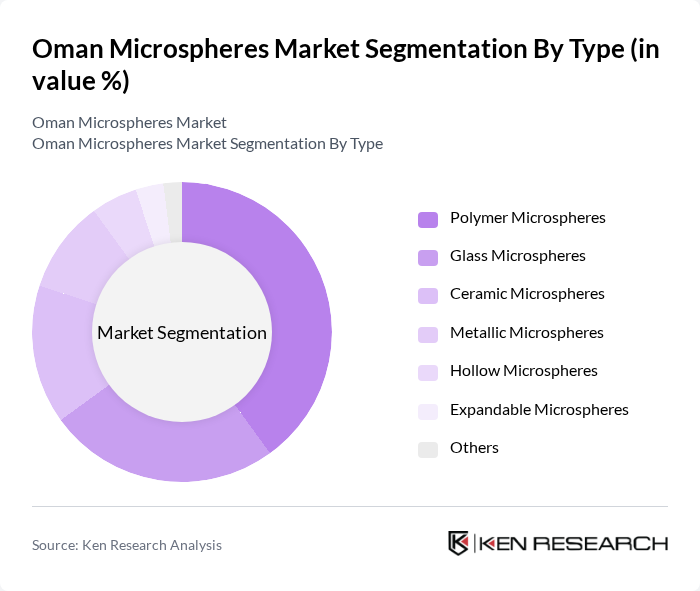
By Type:The Oman microspheres market is segmented into Polymer Microspheres, Glass Microspheres, Ceramic Microspheres, Metallic Microspheres, Hollow Microspheres, Expandable Microspheres, and Others. Polymer Microspheres continue to lead the market, driven by their versatility, chemical stability, and broad applicability in healthcare, cosmetics, and coatings. Manufacturers increasingly prefer polymer microspheres for applications requiring controlled release, improved texture, and enhanced product performance. Glass Microspheres are gaining traction in construction and automotive sectors due to their lightweight and insulating properties. Ceramic and metallic microspheres are primarily used in specialty coatings and advanced composites, while hollow and expandable microspheres support innovations in lightweight concrete and thermal insulation.
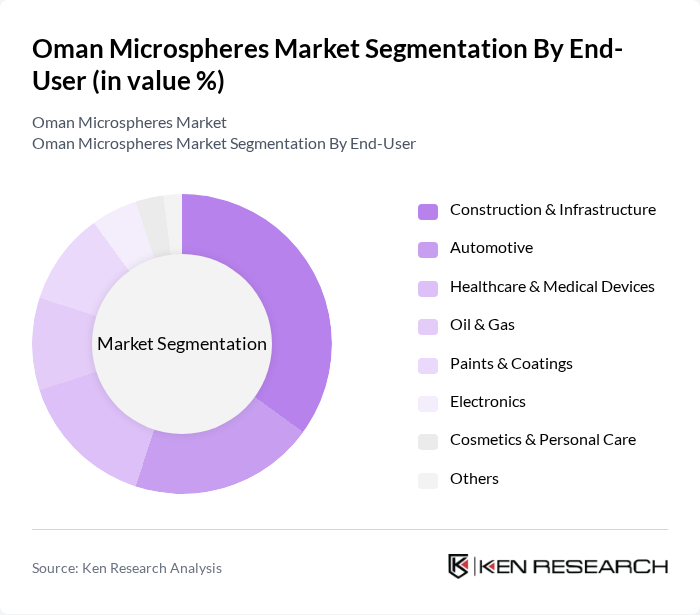
By End-User:The end-user segmentation includes Construction & Infrastructure, Automotive, Healthcare & Medical Devices, Oil & Gas, Paints & Coatings, Electronics, Cosmetics & Personal Care, and Others. The Construction & Infrastructure sector is the leading end-user, driven by the demand for lightweight, durable, and energy-efficient building materials. The automotive industry utilizes microspheres for weight reduction and improved fuel efficiency, while healthcare and medical devices benefit from microspheres in diagnostics, drug delivery, and tissue engineering. Paints & coatings, electronics, and cosmetics sectors are increasingly adopting microspheres for enhanced performance, texture, and product differentiation.
The Oman Microspheres Market is characterized by a dynamic mix of regional and international players. Leading participants such as 3M Company, AkzoNobel N.V., BASF SE, Momentive Performance Materials Inc., Dow Chemical Company, Covestro AG, Huntsman Corporation, Nouryon, Matsumoto Yushi-Seiyaku Co., Ltd., Sibelco, LyondellBasell Industries N.V., Solvay S.A., Eastman Chemical Company, Fuso Chemical Co., Ltd., Chase Corporation contribute to innovation, geographic expansion, and service delivery in this space.
The Oman microspheres market is poised for significant growth, driven by increasing applications across various sectors, particularly construction and automotive. As technological advancements continue to enhance the performance of microspheres, manufacturers are likely to explore innovative applications, further expanding market reach. Additionally, the growing emphasis on sustainability and eco-friendly materials will encourage investment in microsphere production, aligning with global trends towards greener alternatives. This dynamic environment presents a promising landscape for stakeholders in the microspheres industry.
| Segment | Sub-Segments |
|---|---|
| By Type | Polymer Microspheres Glass Microspheres Ceramic Microspheres Metallic Microspheres Hollow Microspheres Expandable Microspheres Others |
| By End-User | Construction & Infrastructure Automotive Healthcare & Medical Devices Oil & Gas Paints & Coatings Electronics Cosmetics & Personal Care Others |
| By Application | Coatings Plastics & Polymers Composites Adhesives & Sealants Medical Devices & Drug Delivery Oilfield Applications Others |
| By Distribution Channel | Direct Sales Distributors Online Sales Retail Others |
| By Region | Muscat Salalah Sohar Nizwa Duqm Others |
| By Product Form | Microsphere Powders Microsphere Suspensions Microsphere Films Others |
| By Market Segment | B2B B2C Others |
| Scope Item/Segment | Sample Size | Target Respondent Profiles |
|---|---|---|
| Pharmaceutical Applications | 100 | R&D Managers, Product Development Heads |
| Cosmetic Industry Insights | 80 | Brand Managers, Marketing Directors |
| Diagnostic Sector Utilization | 70 | Laboratory Managers, Quality Control Officers |
| Industrial Applications | 60 | Production Managers, Supply Chain Coordinators |
| Research Institutions | 40 | Academic Researchers, Industry Analysts |
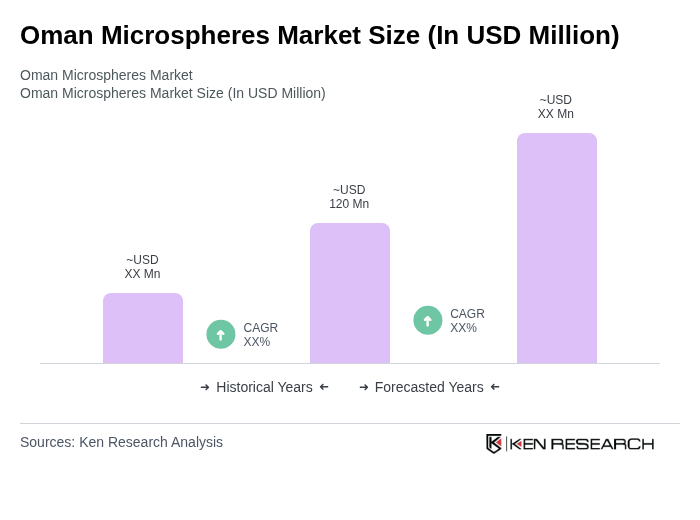
The Oman Microspheres Market is valued at approximately USD 120 million, driven by the increasing demand for lightweight materials across various sectors, including construction, automotive, healthcare, and paints & coatings.

What makes us stand out is that our consultants follow Robust, Refine and Result (RRR) methodology. Robust for clear definitions, approaches and sanity checking, Refine for differentiating respondents' facts and opinions, and Result for presenting data with story.

We have set a benchmark in the industry by offering our clients with syndicated and customized market research reports featuring coverage of entire market as well as meticulous research and analyst insights.

While we don't replace traditional research, we flip the method upside down. Our dual approach of Top Bottom & Bottom Top ensures quality deliverable by not just verifying company fundamentals but also looking at the sector and macroeconomic factors.

With one step in the future, our research team constantly tries to show you the bigger picture. We help with some of the tough questions you may encounter along the way: How is the industry positioned? Best marketing channel? KPI's of competitors? By aligning every element, we help maximize success.

Our report gives you instant access to the answers and sources that other companies might choose to hide. We elaborate each steps of research methodology we have used and showcase you the sample size to earn your trust.

If you need any support, we are here! We pride ourselves on universe strength, data quality, and quick, friendly, and professional service.













