Oman personal consumer electronics market Size, Share, Growth Drivers, Trends, Opportunities & Forecast 2025–2030

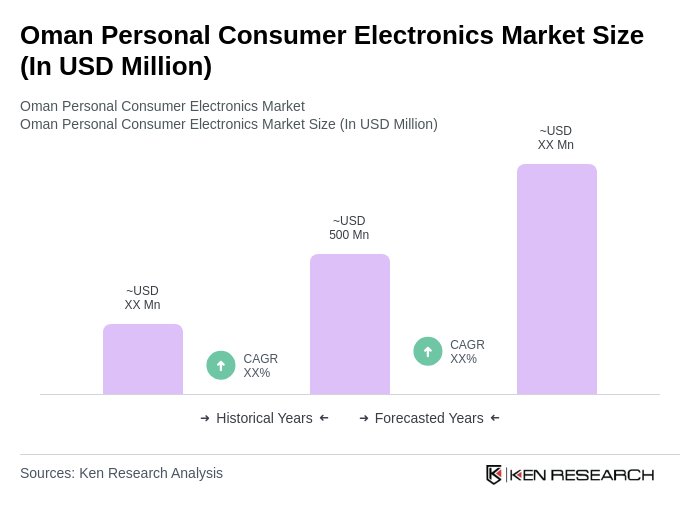
The Oman personal consumer electronics market, valued at USD 500 million, is growing due to increasing disposable incomes, e-commerce expansion, and demand for smart devices like smartphones and wearables.

Region:Middle East

Author(s):Dev

Product Code:KRAC3438

Pages:86

Published On:October 2025
About the Report

Base Year 2024

Oman Personal Consumer Electronics Market Overview

  • The Oman Personal Consumer Electronics Market is valued at USD 500 million, based on a five-year historical analysis. This growth is primarily driven by rising disposable incomes, rapid urbanization, and a tech-savvy young population. The market has seen a significant uptick in consumer electronics adoption, particularly in smartphones, smart home devices, and audio-visual products, reflecting a shift towards digital lifestyles and immersive entertainment experiences .
  • Muscat, the capital city, remains the dominant player in the market due to its advanced urban infrastructure and concentration of retail outlets. Salalah and Sohar also contribute significantly, supported by growing populations and expanding access to technology. The proliferation of major retail chains and e-commerce platforms in these regions further enhances market penetration and consumer access to a wide range of electronics .
  • In 2023, the Omani government implemented the "Energy Efficiency Labeling and Standards for Electrical Appliances Regulations, 2023" issued by the Ministry of Commerce, Industry and Investment Promotion. This regulation mandates that all electronic devices sold in Oman must meet specific energy efficiency standards, requiring manufacturers to obtain certification and display energy labels. The regulation covers product categories such as televisions, refrigerators, air conditioners, and washing machines, with compliance monitored through market inspections and penalties for non-compliance. This initiative is designed to encourage innovation in eco-friendly products and enhance sustainability in the consumer electronics sector .
Oman Personal Consumer Electronics Market Size

Oman Personal Consumer Electronics Market Segmentation

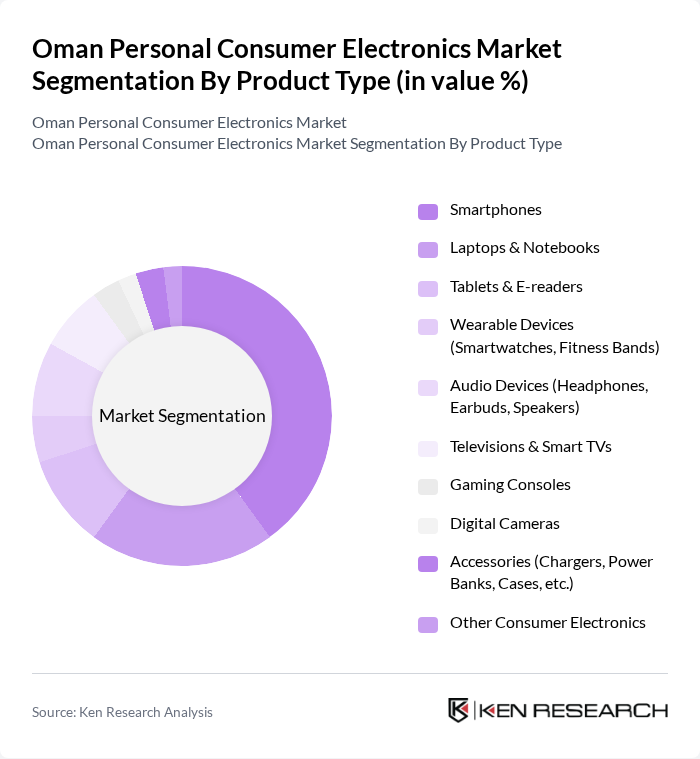
By Product Type:The product type segmentation includes smartphones, laptops & notebooks, tablets & e-readers, wearable devices, audio devices, televisions & smart TVs, gaming consoles, digital cameras, accessories, and other consumer electronics. Among these, smartphones hold the largest market share, driven by widespread adoption, integration into daily life, and consumer preferences for multifunctional devices. The market is also witnessing strong growth in smart TVs, wearable devices, and audio products, reflecting trends toward home entertainment, health monitoring, and connected lifestyles .
Oman Personal Consumer Electronics Market segmentation by Product Type.

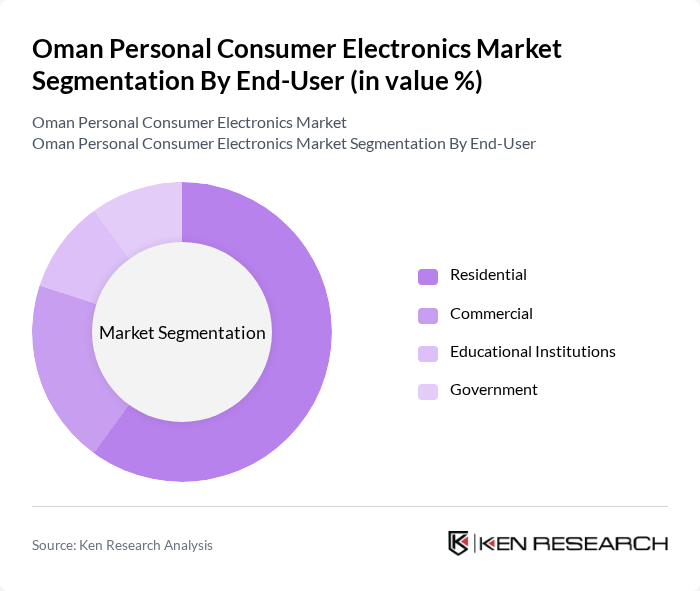
By End-User:The end-user segmentation covers residential, commercial, educational institutions, and government sectors. The residential segment leads the market, driven by demand for personal devices, smart home technologies, and home entertainment systems. Commercial and institutional demand is supported by digital transformation initiatives and increased investment in workplace technology, while government procurement focuses on modernization and public sector efficiency .
Oman Personal Consumer Electronics Market segmentation by End-User.

Oman Personal Consumer Electronics Market Competitive Landscape

The Oman Personal Consumer Electronics Market is characterized by a dynamic mix of regional and international players. Leading participants such as Samsung Electronics Co., Ltd., Apple Inc., Huawei Technologies Co., Ltd., Sony Group Corporation, LG Electronics Inc., Xiaomi Corporation, Lenovo Group Limited, Dell Technologies Inc., HP Inc., Panasonic Holdings Corporation, AsusTek Computer Inc., Microsoft Corporation, TCL Technology Group Corporation, Realme Chongqing Mobile Telecommunications Corp., Ltd., Oppo Guangdong Mobile Communications Co., Ltd., Philips (Koninklijke Philips N.V.), Geepas, Super General Company, Hisense Group, Toshiba Corporation contribute to innovation, geographic expansion, and service delivery in this space.

Samsung Electronics Co., Ltd.

1969

Seoul, South Korea

Apple Inc.

1976

Cupertino, California, USA

Huawei Technologies Co., Ltd.

1987

Shenzhen, China

Sony Group Corporation

1946

Tokyo, Japan

LG Electronics Inc.

1958

Seoul, South Korea

Company

Establishment Year

Headquarters

Group Size (Large, Medium, or Small as per industry convention)

Oman Revenue (USD million)

Revenue Growth Rate (YoY %)

Market Share (%)

Market Penetration Rate (Units Sold per 1,000 Population)

Channel Mix (Online vs Offline %)

Oman Personal Consumer Electronics Market Industry Analysis

Growth Drivers

  • Increasing Disposable Income:The average disposable income in Oman is projected to reach OMR 1,600 (approximately USD 4,160) per capita in future, reflecting a 6% increase from the previous period. This rise in income enables consumers to spend more on personal electronics, particularly smart devices. As purchasing power improves, households are more inclined to invest in high-quality electronics, driving demand for innovative products that enhance lifestyle and connectivity.
  • Rising Demand for Smart Devices:In future, the demand for smart devices in Oman is expected to increase significantly, with sales projected to exceed 1.3 million units. This surge is driven by a growing tech-savvy population, particularly among youth aged 15-34, who are increasingly adopting smartphones, tablets, and smart home devices. The integration of advanced features and connectivity options in these devices further fuels consumer interest and purchasing decisions.
  • Expansion of E-commerce Platforms:E-commerce sales in Oman are anticipated to reach OMR 360 million (approximately USD 940 million) in future, marking a 20% growth from the previous period. The proliferation of online shopping platforms has made consumer electronics more accessible, allowing consumers to compare prices and access a wider range of products. This trend is particularly beneficial for urban consumers who prefer the convenience of online shopping over traditional retail.

Market Challenges

  • High Import Tariffs on Electronics:Oman imposes import tariffs averaging 5% on consumer electronics, which can significantly increase retail prices. This tariff structure poses a challenge for both local retailers and consumers, as it limits the affordability of imported products. As a result, many consumers may opt for lower-quality alternatives or delay purchases, impacting overall market growth and profitability for businesses in the sector.
  • Intense Competition from Global Brands:The Omani consumer electronics market is characterized by fierce competition from established global brands such as Samsung, Apple, and Sony. These companies dominate market share due to their strong brand recognition and extensive product offerings. Local brands struggle to compete on quality and innovation, which can hinder their market penetration and growth potential, leading to a challenging environment for new entrants.

Oman Personal Consumer Electronics Market Future Outlook

The Oman personal consumer electronics market is poised for significant transformation in the coming years, driven by technological advancements and changing consumer preferences. The increasing adoption of smart home technologies and wearable devices will likely reshape the market landscape. Additionally, the expansion of 5G networks is expected to enhance connectivity, enabling new applications and services. As consumers become more environmentally conscious, demand for sustainable products will also rise, prompting manufacturers to innovate and adapt to these evolving trends.

Market Opportunities

  • Growth in Online Retailing:The rapid growth of online retailing presents a significant opportunity for consumer electronics brands in Oman. With e-commerce projected to account for 15% of total retail sales in future, companies can leverage digital platforms to reach a broader audience, enhance customer engagement, and streamline distribution channels, ultimately driving sales and brand loyalty.
  • Increasing Youth Population:Oman’s youth population, which constitutes over 40% of the total demographic, represents a lucrative market for personal electronics. This demographic is more inclined to adopt new technologies and trends, creating opportunities for brands to introduce innovative products tailored to their preferences. Engaging this segment through targeted marketing strategies can significantly boost market penetration and growth.

Scope of the Report

SegmentSub-Segments
By Product Type

Smartphones

Laptops & Notebooks

Tablets & E-readers

Wearable Devices (Smartwatches, Fitness Bands)

Audio Devices (Headphones, Earbuds, Speakers)

Televisions & Smart TVs

Gaming Consoles

Digital Cameras

Accessories (Chargers, Power Banks, Cases, etc.)

Other Consumer Electronics

By End-User

Residential

Commercial

Educational Institutions

Government

By Sales Channel

Online Retail

Offline Retail (Electronics Stores, Hypermarkets)

Direct Sales

Distributors & Dealers

By Price Range

Budget

Mid-Range

Premium

By Brand Loyalty

Brand Loyal Customers

Price-Sensitive Customers

First-Time Buyers

By Product Features

High-Performance Features

Eco-Friendly Features

Smart Features (IoT, AI-enabled, etc.)

By Distribution Mode

Direct Distribution

Indirect Distribution

E-commerce Platforms

Key Target Audience

Investors and Venture Capitalist Firms

Government and Regulatory Bodies (e.g., Ministry of Transport, Communications and Information Technology)

Manufacturers and Producers

Distributors and Retailers

Telecommunications Service Providers

Consumer Electronics Trade Associations

Financial Institutions

Logistics and Supply Chain Companies

Players Mentioned in the Report:

Samsung Electronics Co., Ltd.

Apple Inc.

Huawei Technologies Co., Ltd.

Sony Group Corporation

LG Electronics Inc.

Xiaomi Corporation

Lenovo Group Limited

Dell Technologies Inc.

HP Inc.

Panasonic Holdings Corporation

AsusTek Computer Inc.

Microsoft Corporation

TCL Technology Group Corporation

Realme Chongqing Mobile Telecommunications Corp., Ltd.

Oppo Guangdong Mobile Communications Co., Ltd.

Philips (Koninklijke Philips N.V.)

Geepas

Super General Company

Hisense Group

Toshiba Corporation

Table of Contents

Market Assessment Phase

1. Executive Summary and Approach


2. Oman Personal Consumer Electronics Market Overview

2.1 Key Insights and Strategic Recommendations

2.2 Oman Personal Consumer Electronics Market Overview

2.3 Definition and Scope

2.4 Evolution of Market Ecosystem

2.5 Timeline of Key Regulatory Milestones

2.6 Value Chain & Stakeholder Mapping

2.7 Business Cycle Analysis

2.8 Policy & Incentive Landscape


3. Oman Personal Consumer Electronics Market Analysis

3.1 Growth Drivers

3.1.1 Increasing disposable income
3.1.2 Rising demand for smart devices
3.1.3 Expansion of e-commerce platforms
3.1.4 Technological advancements in consumer electronics

3.2 Market Challenges

3.2.1 High import tariffs on electronics
3.2.2 Intense competition from global brands
3.2.3 Rapid technological changes
3.2.4 Limited local manufacturing capabilities

3.3 Market Opportunities

3.3.1 Growth in online retailing
3.3.2 Increasing youth population
3.3.3 Demand for eco-friendly products
3.3.4 Expansion of 5G technology

3.4 Market Trends

3.4.1 Shift towards smart home devices
3.4.2 Rise of wearable technology
3.4.3 Increasing focus on health and fitness gadgets
3.4.4 Growth of subscription-based services

3.5 Government Regulation

3.5.1 Compliance with international safety standards
3.5.2 Regulations on electronic waste management
3.5.3 Import regulations for consumer electronics
3.5.4 Incentives for local manufacturing

4. SWOT Analysis


5. Stakeholder Analysis


6. Porter's Five Forces Analysis


7. Oman Personal Consumer Electronics Market Market Size, 2019-2024

7.1 By Value

7.2 By Volume

7.3 By Average Selling Price


8. Oman Personal Consumer Electronics Market Segmentation

8.1 By Product Type

8.1.1 Smartphones
8.1.2 Laptops & Notebooks
8.1.3 Tablets & E-readers
8.1.4 Wearable Devices (Smartwatches, Fitness Bands)
8.1.5 Audio Devices (Headphones, Earbuds, Speakers)
8.1.6 Televisions & Smart TVs
8.1.7 Gaming Consoles
8.1.8 Digital Cameras
8.1.9 Accessories (Chargers, Power Banks, Cases, etc.)
8.1.10 Other Consumer Electronics

8.2 By End-User

8.2.1 Residential
8.2.2 Commercial
8.2.3 Educational Institutions
8.2.4 Government

8.3 By Sales Channel

8.3.1 Online Retail
8.3.2 Offline Retail (Electronics Stores, Hypermarkets)
8.3.3 Direct Sales
8.3.4 Distributors & Dealers

8.4 By Price Range

8.4.1 Budget
8.4.2 Mid-Range
8.4.3 Premium

8.5 By Brand Loyalty

8.5.1 Brand Loyal Customers
8.5.2 Price-Sensitive Customers
8.5.3 First-Time Buyers

8.6 By Product Features

8.6.1 High-Performance Features
8.6.2 Eco-Friendly Features
8.6.3 Smart Features (IoT, AI-enabled, etc.)

8.7 By Distribution Mode

8.7.1 Direct Distribution
8.7.2 Indirect Distribution
8.7.3 E-commerce Platforms

9. Oman Personal Consumer Electronics Market Competitive Analysis

9.1 Market Share of Key Players

9.2 Cross Comparison of Key Players

9.2.1 Company Name
9.2.2 Group Size (Large, Medium, or Small as per industry convention)
9.2.3 Oman Revenue (USD million)
9.2.4 Revenue Growth Rate (YoY %)
9.2.5 Market Share (%)
9.2.6 Market Penetration Rate (Units Sold per 1,000 Population)
9.2.7 Channel Mix (Online vs Offline %)
9.2.8 Product Portfolio Breadth (No. of Product Categories)
9.2.9 Brand Recognition Index (Survey-based Score)
9.2.10 Customer Satisfaction Index (NPS or Equivalent)
9.2.11 After-Sales Service Coverage (No. of Service Centers in Oman)
9.2.12 Average Selling Price (USD)

9.3 SWOT Analysis of Top Players

9.4 Pricing Analysis

9.5 Detailed Profile of Major Companies

9.5.1 Samsung Electronics Co., Ltd.
9.5.2 Apple Inc.
9.5.3 Huawei Technologies Co., Ltd.
9.5.4 Sony Group Corporation
9.5.5 LG Electronics Inc.
9.5.6 Xiaomi Corporation
9.5.7 Lenovo Group Limited
9.5.8 Dell Technologies Inc.
9.5.9 HP Inc.
9.5.10 Panasonic Holdings Corporation
9.5.11 AsusTek Computer Inc.
9.5.12 Microsoft Corporation
9.5.13 TCL Technology Group Corporation
9.5.14 Realme Chongqing Mobile Telecommunications Corp., Ltd.
9.5.15 Oppo Guangdong Mobile Communications Co., Ltd.
9.5.16 Philips (Koninklijke Philips N.V.)
9.5.17 Geepas
9.5.18 Super General Company
9.5.19 Hisense Group
9.5.20 Toshiba Corporation

10. Oman Personal Consumer Electronics Market End-User Analysis

10.1 Procurement Behavior of Key Ministries

10.1.1 Technology procurement policies
10.1.2 Budget allocation for electronics
10.1.3 Supplier selection criteria
10.1.4 Contract management practices

10.2 Corporate Spend on Infrastructure & Energy

10.2.1 Investment in smart technologies
10.2.2 Budget for consumer electronics
10.2.3 Spending on maintenance and upgrades

10.3 Pain Point Analysis by End-User Category

10.3.1 Budget constraints
10.3.2 Technology integration issues
10.3.3 Product reliability concerns

10.4 User Readiness for Adoption

10.4.1 Awareness of new technologies
10.4.2 Training and support needs
10.4.3 Adoption barriers

10.5 Post-Deployment ROI and Use Case Expansion

10.5.1 Measurement of ROI
10.5.2 Use case identification
10.5.3 Feedback mechanisms

11. Oman Personal Consumer Electronics Market Future Size, 2025-2030

11.1 By Value

11.2 By Volume

11.3 By Average Selling Price


Go-To-Market Strategy Phase

1. Whitespace Analysis + Business Model Canvas

1.1 Market gaps identification

1.2 Value proposition development

1.3 Revenue model exploration

1.4 Customer segment analysis

1.5 Key partnerships identification

1.6 Cost structure analysis

1.7 Competitive advantage assessment


2. Marketing and Positioning Recommendations

2.1 Branding strategies

2.2 Product USPs

2.3 Target audience segmentation

2.4 Communication strategies

2.5 Digital marketing tactics


3. Distribution Plan

3.1 Urban retail strategies

3.2 Rural NGO tie-ups

3.3 E-commerce strategies

3.4 Logistics and supply chain management


4. Channel & Pricing Gaps

4.1 Underserved routes

4.2 Pricing bands analysis

4.3 Competitor pricing comparison


5. Unmet Demand & Latent Needs

5.1 Category gaps identification

5.2 Consumer segments analysis

5.3 Product feature demands


6. Customer Relationship

6.1 Loyalty programs

6.2 After-sales service strategies

6.3 Customer feedback mechanisms


7. Value Proposition

7.1 Sustainability initiatives

7.2 Integrated supply chains

7.3 Unique selling propositions


8. Key Activities

8.1 Regulatory compliance

8.2 Branding efforts

8.3 Distribution setup


9. Entry Strategy Evaluation

9.1 Domestic Market Entry Strategy

9.1.1 Product mix considerations
9.1.2 Pricing band strategies
9.1.3 Packaging options

9.2 Export Entry Strategy

9.2.1 Target countries analysis
9.2.2 Compliance roadmap

10. Entry Mode Assessment

10.1 Joint Ventures

10.2 Greenfield investments

10.3 Mergers & Acquisitions

10.4 Distributor Model


11. Capital and Timeline Estimation

11.1 Capital requirements

11.2 Timelines for market entry


12. Control vs Risk Trade-Off

12.1 Ownership considerations

12.2 Partnerships evaluation


13. Profitability Outlook

13.1 Breakeven analysis

13.2 Long-term sustainability strategies


14. Potential Partner List

14.1 Distributors

14.2 Joint Ventures

14.3 Acquisition targets


15. Execution Roadmap

15.1 Phased Plan for Market Entry

15.1.1 Market Setup
15.1.2 Market Entry
15.1.3 Growth Acceleration
15.1.4 Scale & Stabilize

15.2 Key Activities and Milestones

15.2.1 Milestone tracking
15.2.2 Activity scheduling

Research Methodology

ApproachModellingSample

Phase 1: Approach1

Desk Research

  • Analysis of market reports from government agencies and industry associations in Oman
  • Review of consumer electronics sales data from local retailers and e-commerce platforms
  • Examination of demographic and economic indicators from national statistics databases

Primary Research

  • Interviews with key stakeholders in the consumer electronics supply chain, including distributors and retailers
  • Surveys targeting end-users to understand purchasing behavior and preferences
  • Focus group discussions with tech-savvy consumers to gauge trends and product expectations

Validation & Triangulation

  • Cross-validation of findings through multiple data sources, including sales figures and consumer feedback
  • Triangulation of insights from primary interviews with secondary data trends
  • Sanity checks conducted through expert panel reviews comprising industry veterans

Phase 2: Market Size Estimation1

Top-down Assessment

  • Estimation of total market size based on national consumer electronics expenditure
  • Segmentation of market size by product categories such as smartphones, laptops, and wearables
  • Incorporation of growth rates derived from historical sales data and economic forecasts

Bottom-up Modeling

  • Collection of sales volume data from major retailers and e-commerce platforms in Oman
  • Estimation of average selling prices across different consumer electronics categories
  • Calculation of market size based on unit sales multiplied by average prices

Forecasting & Scenario Analysis

  • Development of forecasts using time-series analysis based on historical sales data
  • Scenario modeling considering factors such as economic growth, consumer trends, and technological advancements
  • Creation of best-case, worst-case, and most-likely scenarios for market growth through 2030

Phase 3: CATI Sample Composition1

Scope Item/SegmentSample SizeTarget Respondent Profiles
Consumer Electronics Retailers100Store Managers, Sales Executives
End-User Consumer Insights120Tech Enthusiasts, General Consumers
Distributors and Wholesalers80Distribution Managers, Supply Chain Analysts
Market Trend Analysts40Market Researchers, Industry Analysts
Retail Technology Providers40Product Managers, Business Development Executives

Frequently Asked Questions

What is the current value of the Oman Personal Consumer Electronics Market?

The Oman Personal Consumer Electronics Market is valued at approximately USD 500 million, reflecting significant growth driven by rising disposable incomes, urbanization, and a tech-savvy young population increasingly adopting consumer electronics.

Which cities are the main contributors to the Oman Personal Consumer Electronics Market?

What are the key product types in the Oman Personal Consumer Electronics Market?

How has the Omani government influenced the consumer electronics market?

Other Regional/Country Reports

Indonesia Personal Consumer Electronics Market

Malaysia Personal Consumer Electronics Market

KSA Personal Consumer Electronics Market

APAC Personal Consumer Electronics Market

SEA Personal Consumer Electronics Market

Vietnam Personal Consumer Electronics Market

Other Adjacent Reports

Germany Smart Home Devices Market

Qatar Wearable Technology Market Report Size Share Growth Drivers Trends Opportunities & Forecast 2025–2030Kuwait Mobile Accessories Market Report Size Share Growth Drivers Trends Opportunities & Forecast 2025–2030

Qatar E-Commerce Retail Market

KSA Telecommunication Services Market

Oman Audio-Visual Equipment Market

Vietnam Gaming Consoles Market

Germany Computer Hardware Market

Singapore Digital Cameras Market

Mexico Energy-Efficient Appliances Market

Why Buy From Us?

Refine Robust Result (RRR) Framework

What makes us stand out is that our consultants follow Robust, Refine and Result (RRR) methodology. Robust for clear definitions, approaches and sanity checking, Refine for differentiating respondents' facts and opinions, and Result for presenting data with story.

Our Reach Is Unmatched

We have set a benchmark in the industry by offering our clients with syndicated and customized market research reports featuring coverage of entire market as well as meticulous research and analyst insights.

Shifting the Research Paradigm

While we don't replace traditional research, we flip the method upside down. Our dual approach of Top Bottom & Bottom Top ensures quality deliverable by not just verifying company fundamentals but also looking at the sector and macroeconomic factors.

More Insights-Better Decisions

With one step in the future, our research team constantly tries to show you the bigger picture. We help with some of the tough questions you may encounter along the way: How is the industry positioned? Best marketing channel? KPI's of competitors? By aligning every element, we help maximize success.

Transparency and Trust

Our report gives you instant access to the answers and sources that other companies might choose to hide. We elaborate each steps of research methodology we have used and showcase you the sample size to earn your trust.

Round the Clock Support

If you need any support, we are here! We pride ourselves on universe strength, data quality, and quick, friendly, and professional service.

Why Clients Choose Us?

400000+
Reports in repository
150+
Consulting projects a year
100+
Analysts
8000+
Client Queries in 2022








