About the Report
Base Year 2024Oman Personal Finance Software Market Overview
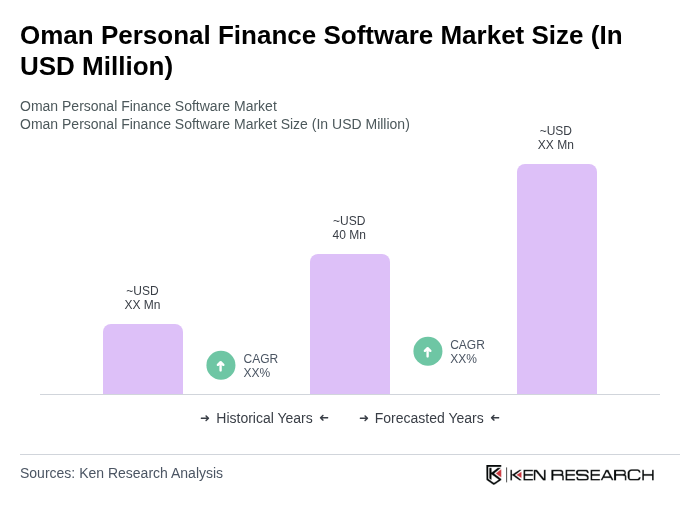
- The Oman Personal Finance Software Market is valued at USD 40 million, based on a five-year historical analysis and by benchmarking against the size of Oman’s broader enterprise software and financial software markets. This growth is primarily driven by the increasing adoption of digital financial solutions among consumers, supported by strong fintech momentum in Oman and rising internet and smartphone penetration. The demand for user-friendly applications that facilitate budgeting, savings, and investment tracking has surged, reflecting a shift towards more proactive and app-based financial planning.
- Muscat, the capital city, dominates the market due to its high concentration of expatriates and a growing middle class that seeks effective financial management tools, in line with Muscat’s status as Oman’s primary economic and financial hub. Additionally, the presence of several banks and fintech companies in the region, supported by national fintech initiatives, enhances the availability of personal finance software and related digital banking tools, making Muscat a hub for innovation and user engagement in financial technology.
- In 2023, the Omani authorities continued to advance regulations to promote financial literacy and digital banking services, building on frameworks led by the Central Bank of Oman (CBO) and national digital strategies. Key instruments include the Regulatory Sandbox Framework issued by the Central Bank of Oman and the Central Bank of Oman’s E?Payment Regulations, which set operational requirements for digital payment and fintech solutions, including governance, data security, and consumer protection obligations for licensed providers. These measures, complemented by Oman Vision 2040 digital economy and financial inclusion programs, create a more trustworthy environment for users to manage their finances digitally through bank and third?party applications.
Oman Personal Finance Software Market Segmentation
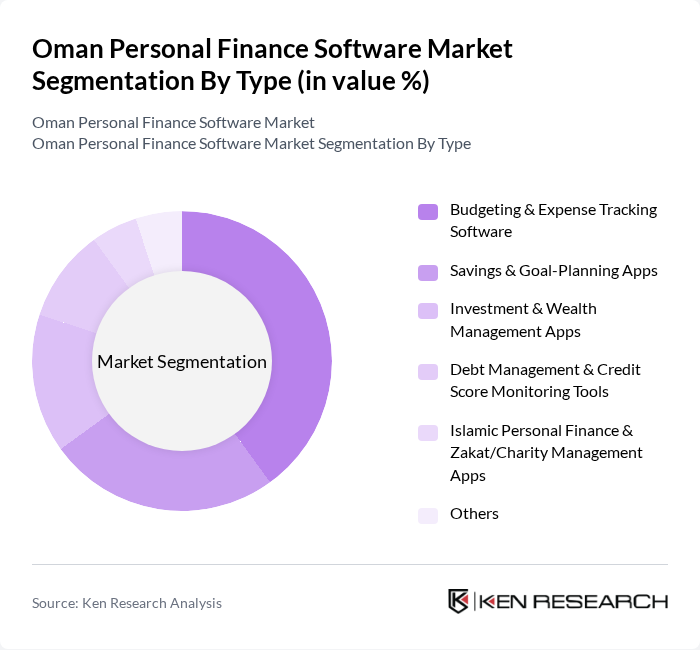
By Type:The market is segmented into various types of personal finance software, including budgeting and expense tracking software, savings and goal-planning apps, investment and wealth management apps, debt management and credit score monitoring tools, Islamic personal finance and Zakat/charity management apps, and others. This structure aligns with global personal finance software and apps markets, which commonly distinguish between budgeting, savings, investment, and debt-related tools. Among these, budgeting and expense tracking software is the most popular due to its essential role in helping users manage their daily finances effectively and its lower barrier to adoption compared with investment or advisory solutions. The increasing need for financial discipline and awareness among consumers, together with rising interest in financial literacy and money?management education, continues to drive demand for these tools.
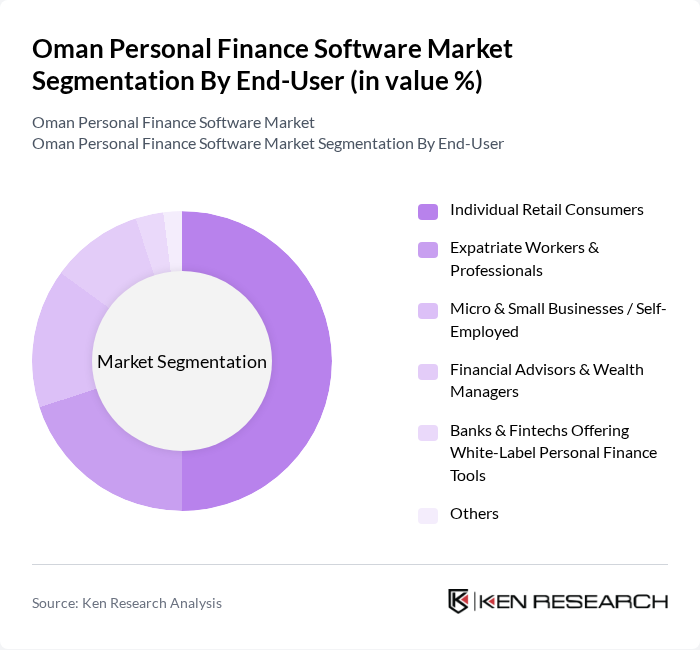
By End-User:The end-user segmentation includes individual retail consumers, expatriate workers and professionals, micro and small businesses/self-employed, financial advisors and wealth managers, banks and fintechs offering white-label personal finance tools, and others. This reflects the global pattern in which individual consumers are the primary users of personal finance software, with additional uptake among small businesses and financial institutions using embedded or white-label tools. Individual retail consumers represent the largest segment, driven by the increasing number of tech-savvy individuals seeking to manage their finances more effectively through mobile and web-based applications. The growing trend of financial independence among younger generations, combined with higher smartphone penetration and digital banking usage in Oman, further fuels this demand.
Oman Personal Finance Software Market Competitive Landscape
The Oman Personal Finance Software Market is characterized by a dynamic mix of regional and international players. Leading participants such as Intuit Inc. (Mint, Credit Karma), YNAB (You Need A Budget), Wally Global Inc. (Wally), Spendee a.s. (Spendee), Monefy LLC (Monefy), Goodbudget (Dayspring Partners), PocketGuard Inc. (PocketGuard), Emma Technologies Ltd (Emma), FMBE Fintech Ltd (Zeta), Tiller Money, Inc. (Tiller), Acorns Grow Incorporated (Acorns), BankDhofar SAOG (Omani Bank PFM & Budgeting Tools), Bank Muscat SAOG (Personal Finance & Money Management App Features), National Bank of Oman SAOG (Digital Banking & Personal Finance Tools), Oman Arab Bank SAOC (Mobile Banking with Personal Finance Features) contribute to innovation, geographic expansion, and service delivery in this space.
Oman Personal Finance Software Market Industry Analysis
Growth Drivers
- Increasing Smartphone Penetration:As of future, Oman has an estimated smartphone penetration rate of 95%, with over 5 million smartphone users. This widespread access to mobile technology facilitates the adoption of personal finance software, allowing users to manage their finances conveniently. The growth in smartphone usage is supported by a 6% annual increase in mobile subscriptions, indicating a robust infrastructure for digital financial solutions. This trend is crucial for enhancing user engagement and expanding the market.
- Rising Awareness of Personal Finance Management:In future, approximately 65% of Omani citizens are reported to actively seek personal finance management tools, reflecting a significant increase in financial literacy. Government initiatives and educational campaigns have contributed to this awareness, with over 250 workshops conducted nationwide in the past year. This growing interest in financial management is driving demand for software solutions that help users budget, save, and invest effectively, thereby fostering a more financially savvy population.
- Growth of E-commerce and Digital Payments:The e-commerce sector in Oman is projected to reach $1.5 billion in future, driven by a 25% increase in online transactions. This surge in digital payments is creating a favorable environment for personal finance software, as users require tools to track their spending and manage their finances effectively. The rise of digital wallets and payment platforms, with over 1.5 million active users, further supports the integration of personal finance solutions, enhancing user experience and financial management capabilities.
Market Challenges
- Limited Internet Connectivity in Rural Areas:Despite urban areas enjoying high-speed internet, rural regions in Oman face connectivity challenges, with only 45% of households having reliable internet access. This disparity limits the reach of personal finance software, as users in these areas struggle to utilize digital tools effectively. The lack of infrastructure hampers the growth potential of the market, as software providers must find ways to address these connectivity issues to expand their user base.
- High Competition Among Software Providers:The Omani personal finance software market is becoming increasingly saturated, with over 35 active providers competing for market share. This intense competition leads to price wars and reduced profit margins, making it challenging for new entrants to establish themselves. Additionally, established players are continuously innovating, which raises the bar for quality and features, compelling all providers to invest heavily in research and development to remain competitive in this dynamic landscape.
Oman Personal Finance Software Market Future Outlook
The future of the Oman personal finance software market appears promising, driven by technological advancements and increasing consumer demand for financial management tools. As more users seek personalized financial insights, software providers are likely to enhance their offerings with AI-driven features. Additionally, the integration of banking services into personal finance applications will streamline user experiences, making financial management more accessible. These trends indicate a robust growth trajectory for the market, with significant opportunities for innovation and expansion in the coming years.
Market Opportunities
- Integration with Banking Services:Collaborating with local banks to integrate personal finance software with banking services can enhance user experience. This integration allows users to manage their accounts, track spending, and receive tailored financial advice, potentially increasing user engagement and retention. With over 2 million bank accounts in Oman, this opportunity can significantly expand the user base for personal finance applications.
- Development of AI-Driven Financial Advisory Tools:The demand for AI-driven financial advisory tools is on the rise, with an estimated 35% of users expressing interest in automated financial advice. By leveraging AI technology, software providers can offer personalized insights and recommendations, enhancing user satisfaction. This innovation can attract a broader audience, particularly among younger demographics who prefer tech-savvy solutions for managing their finances.
Scope of the Report
| Segment | Sub-Segments |
|---|---|
| By Type | Budgeting & Expense Tracking Software Savings & Goal-Planning Apps Investment & Wealth Management Apps Debt Management & Credit Score Monitoring Tools Islamic Personal Finance & Zakat/Charity Management Apps Others |
| By End-User | Individual Retail Consumers Expatriate Workers & Professionals Micro & Small Businesses / Self-Employed Financial Advisors & Wealth Managers Banks & Fintechs Offering White-Label Personal Finance Tools Others |
| By Deployment Model | Web-Based Mobile App-Based Hybrid (Web + Mobile) Others |
| By User Demographics | Age Group (18–24, 25–34, 35–49, 50+) Income Level (Low, Middle, High) Nationality (Omani Nationals, Expatriates) Employment Status (Salaried, Self-Employed, Students, Retired) Others |
| By Geographic Distribution | Muscat Governorate Dhofar (Salalah and Surrounding Areas) Interior & Northern Governorates (e.g., Al Batinah, Ad Dakhiliyah) Remote & Rural Areas Others |
| By Payment Model | Subscription-Based (Monthly / Annual) One-Time License Purchase Freemium with In-App Purchases Ad-Supported Free Apps Others |
| By Integration Capability | Open Banking / Bank Account Aggregation Card & Wallet Integration (Debit, Credit, Prepaid, Mobile Wallets) Integration with Local Payment Systems (e.g., QR / Instant Payments) Accounting & ERP / Third-Party Software Integration Others |
Key Target Audience
Investors and Venture Capitalist Firms
Government and Regulatory Bodies (e.g., Central Bank of Oman, Ministry of Finance)
Financial Institutions
Insurance Companies
Technology Providers
Software Development Firms
Industry Associations
Retail Banks
Players Mentioned in the Report:
Intuit Inc. (Mint, Credit Karma)
YNAB (You Need A Budget)
Wally Global Inc. (Wally)
Spendee a.s. (Spendee)
Monefy LLC (Monefy)
Goodbudget (Dayspring Partners)
PocketGuard Inc. (PocketGuard)
Emma Technologies Ltd (Emma)
FMBE Fintech Ltd (Zeta)
Tiller Money, Inc. (Tiller)
Acorns Grow Incorporated (Acorns)
BankDhofar SAOG (Omani Bank PFM & Budgeting Tools)
Bank Muscat SAOG (Personal Finance & Money Management App Features)
National Bank of Oman SAOG (Digital Banking & Personal Finance Tools)
Oman Arab Bank SAOC (Mobile Banking with Personal Finance Features)
Table of Contents
Market Assessment Phase
1. Executive Summary and Approach
2. Oman Personal Finance Software Market Overview
2.1 Key Insights and Strategic Recommendations
2.2 Oman Personal Finance Software Market Overview
2.3 Definition and Scope
2.4 Evolution of Market Ecosystem
2.5 Timeline of Key Regulatory Milestones
2.6 Value Chain & Stakeholder Mapping
2.7 Business Cycle Analysis
2.8 Policy & Incentive Landscape
3. Oman Personal Finance Software Market Analysis
3.1 Growth Drivers
3.1.1 Increasing smartphone penetration
3.1.2 Rising awareness of personal finance management
3.1.3 Growth of e-commerce and digital payments
3.1.4 Government initiatives promoting financial literacy
3.2 Market Challenges
3.2.1 Limited internet connectivity in rural areas
3.2.2 High competition among software providers
3.2.3 Data privacy and security concerns
3.2.4 Lack of customization options for local users
3.3 Market Opportunities
3.3.1 Integration with banking services
3.3.2 Development of AI-driven financial advisory tools
3.3.3 Expansion into underserved demographics
3.3.4 Partnerships with educational institutions for financial literacy
3.4 Market Trends
3.4.1 Shift towards cloud-based solutions
3.4.2 Increasing use of mobile applications for finance
3.4.3 Growing demand for personalized financial insights
3.4.4 Rise of subscription-based pricing models
3.5 Government Regulation
3.5.1 Data protection regulations
3.5.2 Licensing requirements for financial software
3.5.3 Consumer protection laws
3.5.4 Tax incentives for software development
4. SWOT Analysis
5. Stakeholder Analysis
6. Porter's Five Forces Analysis
7. Oman Personal Finance Software Market Market Size, 2019-2024
7.1 By Value
7.2 By Volume
7.3 By Average Selling Price
8. Oman Personal Finance Software Market Segmentation
8.1 By Type
8.1.1 Budgeting & Expense Tracking Software
8.1.2 Savings & Goal-Planning Apps
8.1.3 Investment & Wealth Management Apps
8.1.4 Debt Management & Credit Score Monitoring Tools
8.1.5 Islamic Personal Finance & Zakat/Charity Management Apps
8.1.6 Others
8.2 By End-User
8.2.1 Individual Retail Consumers
8.2.2 Expatriate Workers & Professionals
8.2.3 Micro & Small Businesses / Self-Employed
8.2.4 Financial Advisors & Wealth Managers
8.2.5 Banks & Fintechs Offering White-Label Personal Finance Tools
8.2.6 Others
8.3 By Deployment Model
8.3.1 Web-Based
8.3.2 Mobile App-Based
8.3.3 Hybrid (Web + Mobile)
8.3.4 Others
8.4 By User Demographics
8.4.1 Age Group (18–24, 25–34, 35–49, 50+)
8.4.2 Income Level (Low, Middle, High)
8.4.3 Nationality (Omani Nationals, Expatriates)
8.4.4 Employment Status (Salaried, Self-Employed, Students, Retired)
8.4.5 Others
8.5 By Geographic Distribution
8.5.1 Muscat Governorate
8.5.2 Dhofar (Salalah and Surrounding Areas)
8.5.3 Interior & Northern Governorates (e.g., Al Batinah, Ad Dakhiliyah)
8.5.4 Remote & Rural Areas
8.5.5 Others
8.6 By Payment Model
8.6.1 Subscription-Based (Monthly / Annual)
8.6.2 One-Time License Purchase
8.6.3 Freemium with In-App Purchases
8.6.4 Ad-Supported Free Apps
8.6.5 Others
8.7 By Integration Capability
8.7.1 Open Banking / Bank Account Aggregation
8.7.2 Card & Wallet Integration (Debit, Credit, Prepaid, Mobile Wallets)
8.7.3 Integration with Local Payment Systems (e.g., QR / Instant Payments)
8.7.4 Accounting & ERP / Third-Party Software Integration
8.7.5 Others
9. Oman Personal Finance Software Market Competitive Analysis
9.1 Market Share of Key Players
9.2 Cross Comparison of Key Players
9.2.1 Company Name
9.2.2 Business Model (B2C App, Bank-Embedded PFM, SaaS to Advisors)
9.2.3 Active Users in Oman (Downloads / MAUs)
9.2.4 Monthly Recurring Revenue from Oman
9.2.5 Average Revenue Per User in Oman
9.2.6 Customer Acquisition Cost (Digital & Partnership Channels)
9.2.7 Churn Rate (User Retention at 3/6/12 Months)
9.2.8 Customer Lifetime Value
9.2.9 Localization Depth (Arabic UI, Islamic Finance Features, Local Integrations)
9.2.10 Breadth of Bank / Wallet Integrations in Oman
9.2.11 User Engagement (Sessions per User per Month, Feature Utilization)
9.2.12 Market Penetration in Target Segments (Retail, Expat, MSME)
9.3 SWOT Analysis of Top Players
9.4 Pricing Analysis
9.5 Detailed Profile of Major Companies
9.5.1 Intuit Inc. (Mint, Credit Karma)
9.5.2 YNAB (You Need A Budget)
9.5.3 Wally Global Inc. (Wally)
9.5.4 Spendee a.s. (Spendee)
9.5.5 Monefy LLC (Monefy)
9.5.6 Goodbudget (Dayspring Partners)
9.5.7 PocketGuard Inc. (PocketGuard)
9.5.8 Emma Technologies Ltd (Emma)
9.5.9 FMBE Fintech Ltd (Zeta)
9.5.10 Tiller Money, Inc. (Tiller)
9.5.11 Acorns Grow Incorporated (Acorns)
9.5.12 BankDhofar SAOG (Omani Bank PFM & Budgeting Tools)
9.5.13 Bank Muscat SAOG (Personal Finance & Money Management App Features)
9.5.14 National Bank of Oman SAOG (Digital Banking & Personal Finance Tools)
9.5.15 Oman Arab Bank SAOC (Mobile Banking with Personal Finance Features)
10. Oman Personal Finance Software Market End-User Analysis
10.1 Procurement Behavior of Key Ministries
10.1.1 Budget Allocation for Financial Software
10.1.2 Decision-Making Process
10.1.3 Vendor Selection Criteria
10.1.4 Contract Management Practices
10.2 Corporate Spend on Infrastructure & Energy
10.2.1 Investment in Financial Management Tools
10.2.2 Budgeting for Software Upgrades
10.2.3 Spending on Training and Support
10.2.4 Others
10.3 Pain Point Analysis by End-User Category
10.3.1 User Interface Challenges
10.3.2 Integration Issues with Existing Systems
10.3.3 Lack of Localized Features
10.3.4 Customer Support Limitations
10.4 User Readiness for Adoption
10.4.1 Awareness of Personal Finance Software
10.4.2 Technical Proficiency of Users
10.4.3 Willingness to Pay for Software
10.4.4 Others
10.5 Post-Deployment ROI and Use Case Expansion
10.5.1 Measurement of Financial Outcomes
10.5.2 User Feedback and Improvement Cycles
10.5.3 Expansion into New Features
10.5.4 Others
11. Oman Personal Finance Software Market Future Size, 2025-2030
11.1 By Value
11.2 By Volume
11.3 By Average Selling Price
Go-To-Market Strategy Phase
1. Whitespace Analysis + Business Model Canvas
1.1 Market Gaps Identification
1.2 Business Model Development
2. Marketing and Positioning Recommendations
2.1 Branding Strategies
2.2 Product USPs
3. Distribution Plan
3.1 Urban Retail vs Rural NGO Tie-Ups
4. Channel & Pricing Gaps
4.1 Underserved Routes
4.2 Pricing Bands
5. Unmet Demand & Latent Needs
5.1 Category Gaps
5.2 Consumer Segments
6. Customer Relationship
6.1 Loyalty Programs
6.2 After-Sales Service
7. Value Proposition
7.1 Sustainability
7.2 Integrated Supply Chains
8. Key Activities
8.1 Regulatory Compliance
8.2 Branding
8.3 Distribution Setup
9. Entry Strategy Evaluation
9.1 Domestic Market Entry Strategy
9.1.1 Product Mix
9.1.2 Pricing Band
9.1.3 Packaging
9.2 Export Entry Strategy
9.2.1 Target Countries
9.2.2 Compliance Roadmap
10. Entry Mode Assessment
10.1 JV
10.2 Greenfield
10.3 M&A
10.4 Distributor Model
11. Capital and Timeline Estimation
11.1 Capital Requirements
11.2 Timelines
12. Control vs Risk Trade-Off
12.1 Ownership vs Partnerships
13. Profitability Outlook
13.1 Breakeven Analysis
13.2 Long-Term Sustainability
14. Potential Partner List
14.1 Distributors
14.2 JVs
14.3 Acquisition Targets
15. Execution Roadmap
15.1 Phased Plan for Market Entry
15.1.1 Market Setup
15.1.2 Market Entry
15.1.3 Growth Acceleration
15.1.4 Scale & Stabilize
15.2 Key Activities and Milestones
15.2.1 Milestone Planning
15.2.2 Activity Tracking
Research Methodology
Phase 1: Approach1
Desk Research
- Analysis of existing market reports and publications on personal finance software in Oman
- Review of government financial regulations and initiatives impacting personal finance management
- Examination of demographic and economic data from national statistics agencies to understand target user profiles
Primary Research
- Interviews with financial advisors and personal finance software developers in Oman
- Surveys targeting end-users to gather insights on preferences and usage patterns
- Focus groups with potential users to discuss features and usability of personal finance software
Validation & Triangulation
- Cross-validation of findings through multiple data sources, including user feedback and expert opinions
- Triangulation of market trends with economic indicators and technology adoption rates
- Sanity checks through expert panel reviews to ensure data accuracy and relevance
Phase 2: Market Size Estimation1
Top-down Assessment
- Estimation of the total addressable market based on national financial service spending
- Segmentation of the market by user demographics, including age, income, and tech-savviness
- Incorporation of growth trends in digital banking and fintech adoption in Oman
Bottom-up Modeling
- Collection of user data from existing personal finance software applications in Oman
- Estimation of average revenue per user (ARPU) based on subscription models and service fees
- Volume estimates based on user acquisition rates and retention metrics
Forecasting & Scenario Analysis
- Multi-factor regression analysis incorporating economic growth, digital literacy, and smartphone penetration
- Scenario planning based on potential regulatory changes and shifts in consumer behavior
- Development of baseline, optimistic, and pessimistic forecasts through 2030
Phase 3: CATI Sample Composition1
| Scope Item/Segment | Sample Size | Target Respondent Profiles |
|---|---|---|
| Individual Users of Personal Finance Software | 120 | Young Professionals, Middle-Income Families |
| Small Business Owners Utilizing Financial Tools | 90 | Entrepreneurs, Small Business Managers |
| Financial Advisors and Consultants | 60 | Certified Financial Planners, Investment Advisors |
| Students and Young Adults Interested in Finance | 60 | University Students, Recent Graduates |
| Tech-Savvy Users of Financial Apps | 80 | IT Professionals, Digital Natives |
Frequently Asked Questions
What is the current value of the Oman Personal Finance Software Market?
The Oman Personal Finance Software Market is valued at approximately USD 40 million, reflecting a growing demand for digital financial solutions among consumers, driven by increased smartphone penetration and fintech adoption in the region.
What factors are driving the growth of personal finance software in Oman?
Which city in Oman has the highest demand for personal finance software?
What types of personal finance software are popular in Oman?
Other Regional/Country Reports
Indonesia Personal Finance Software Market
Malaysia Personal Finance Software Market
KSA Personal Finance Software Market
APAC Personal Finance Software Market
SEA Personal Finance Software Market
Vietnam Personal Finance Software Market
Other Adjacent Reports
Malaysia <xaiArtifact artifact_id=adj-markets-oman-pfs-2023 title=Adjacent_Markets_for_Oman_Personal_Finance_Software.txt contentType=text/plain>
Belgium Adjacent Markets to Oman Personal Finance Software
Thailand **Fintech Market**
Qatar Connection: The fintech market encompasses innovative financial technologies that personal finance software leverages for features like automated budgeting and real-time analytics. In Oman
Belgium with the fintech market expected to reach $2.8 billion by 2025
KSA it supports the development and adoption of advanced personal finance tools amid rising digital adoption
Indonesia Why Adjacent: It is adjacent due to shared technological synergies and overlapping customer bases seeking efficient digital financial management solutions
Malaysia **Digital Banking Market**
Oman Connection: Digital banking platforms often integrate personal finance management features
Mexico enabling seamless account monitoring and transaction tracking within banking apps. Omans Central Bank regulations
KSA such as the Regulatory Sandbox
Philippines promote this integration
Philippines enhancing user access to comprehensive financial services
Japan Why Adjacent: The adjacency arises from common technologies and customer segments
Germany with both markets benefiting from increased smartphone penetration and digital financial inclusion initiatives
Vietnam **Mobile Payment Market**
Vietnam Connection: Mobile payment solutions connect with personal finance software to provide instant expense tracking and payment integrations
Germany crucial for managing daily finances. In Oman
Philippines the surge in digital payments
Germany with over 1.5 million active users
Singapore drives demand for such interconnected tools
Why Buy From Us?

What makes us stand out is that our consultants follow Robust, Refine and Result (RRR) methodology. Robust for clear definitions, approaches and sanity checking, Refine for differentiating respondents' facts and opinions, and Result for presenting data with story.

We have set a benchmark in the industry by offering our clients with syndicated and customized market research reports featuring coverage of entire market as well as meticulous research and analyst insights.

While we don't replace traditional research, we flip the method upside down. Our dual approach of Top Bottom & Bottom Top ensures quality deliverable by not just verifying company fundamentals but also looking at the sector and macroeconomic factors.

With one step in the future, our research team constantly tries to show you the bigger picture. We help with some of the tough questions you may encounter along the way: How is the industry positioned? Best marketing channel? KPI's of competitors? By aligning every element, we help maximize success.

Our report gives you instant access to the answers and sources that other companies might choose to hide. We elaborate each steps of research methodology we have used and showcase you the sample size to earn your trust.

If you need any support, we are here! We pride ourselves on universe strength, data quality, and quick, friendly, and professional service.