About the Report
Base Year 2024Oman Sparkling Coffee Market Overview
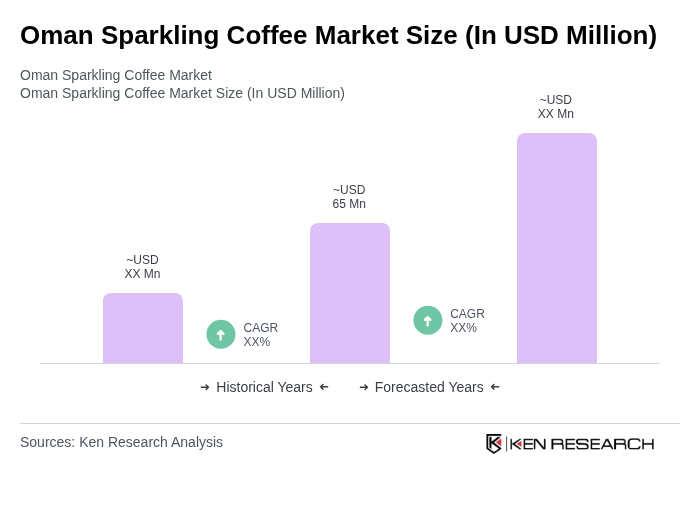
- The Oman Sparkling Coffee Market is valued at USD 65 million, based on a five-year historical analysis. This growth is primarily driven by rising consumer demand for ready-to-drink coffee and functional beverages among younger consumers, coupled with a rising trend towards healthier beverage options including organic and natural caffeine sources. The market has seen a surge in demand for sparkling coffee as a refreshing alternative to traditional coffee drinks, appealing to health-conscious consumers seeking unique flavor experiences.
- Key cities such as Muscat and Salalah dominate the market due to their vibrant café culture and high tourist footfall. Muscat, being the capital, serves as a hub for international brands and local cafés with high population density, urbanization, and concentration of young professionals, while Salalah attracts tourists with its unique offerings. The combination of urbanization and a growing coffee culture in these cities significantly contributes to the market's expansion.
- The Ministerial Decision No. 97/2022 issued by the Ministry of Agriculture, Fisheries and Water Resources governs the standards for coffee and coffee products in Oman. This regulation sets quality specifications, contamination limits, and labeling requirements for coffee beverages, mandating compliance for all imported and locally produced items to ensure safety and support local production initiatives.
Oman Sparkling Coffee Market Segmentation
By Type:The market is segmented into flavored sparkling coffee, unsweetened sparkling coffee, organic sparkling coffee, and others. Flavored sparkling coffee is gaining traction due to its diverse taste profiles, appealing to a wide range of consumers. Unsweetened variants cater to health-conscious individuals, while organic options attract environmentally aware consumers. The "others" category includes niche products that are emerging in the market.
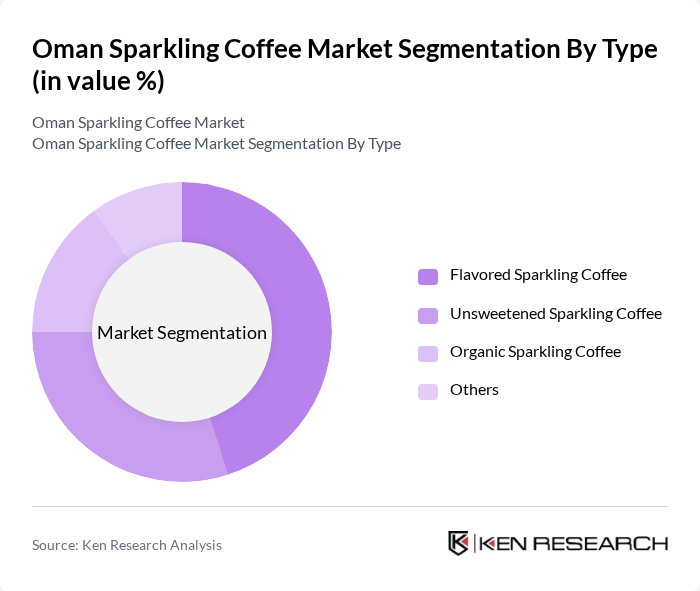
The flavored sparkling coffee segment is currently leading the market, driven by consumer preferences for innovative and diverse flavor profiles. This trend is particularly popular among younger demographics who seek unique beverage experiences. The rise of social media and influencer marketing has further propelled the popularity of flavored options, making them a staple in cafés and retail outlets.
By End-User:The market is segmented into retail consumers, cafés and restaurants, online retailers, and others. Retail consumers are increasingly purchasing sparkling coffee for home consumption, while cafés and restaurants serve as significant distribution points. Online retailers are gaining traction due to the convenience of home delivery, especially post-pandemic.
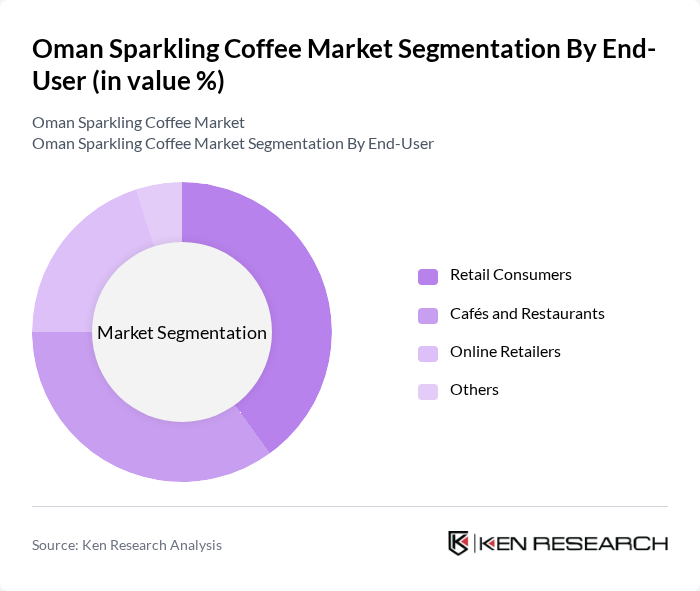
The retail consumers segment is currently the largest, driven by the growing trend of home consumption of specialty beverages. The convenience of purchasing sparkling coffee through supermarkets and convenience stores has made it a popular choice among consumers. Cafés and restaurants also play a crucial role in promoting sparkling coffee, often introducing new flavors and combinations to attract customers.
Oman Sparkling Coffee Market Competitive Landscape
The Oman Sparkling Coffee Market is characterized by a dynamic mix of regional and international players. Leading participants such as Al Marai, Nespresso, Starbucks, Lavazza, Illy, Costa Coffee, Dunkin' Donuts, Peet's Coffee, Tim Hortons, Blue Bottle Coffee, Stumptown Coffee Roasters, Death Wish Coffee, Chameleon Cold-Brew, RISE Brewing Co., Nitro Cold Brew contribute to innovation, geographic expansion, and service delivery in this space.
Oman Sparkling Coffee Market Industry Analysis
Growth Drivers
- Increasing Consumer Interest in Innovative Beverages:The Oman beverage market is witnessing a significant shift, with innovative drinks like sparkling coffee gaining traction. In future, the beverage sector is projected to grow by 6.5%, driven by a consumer base eager for unique flavors and experiences. The rise of social media platforms has further fueled this trend, with over 75% of consumers expressing interest in trying new beverage concepts, indicating a robust market for sparkling coffee.
- Rising Health Consciousness Among Consumers:Health trends are reshaping consumer preferences, with a notable increase in demand for beverages perceived as healthier alternatives. In Oman, the health and wellness market is expected to reach $1.4 billion in future, reflecting a 10% annual growth rate. Sparkling coffee, often marketed as a low-calorie, antioxidant-rich option, aligns perfectly with this trend, appealing to health-conscious consumers seeking refreshing yet beneficial drinks.
- Expansion of Café Culture in Urban Areas:The café culture in Oman is rapidly evolving, particularly in urban centers like Muscat, where the number of cafés has increased by 20% over the past two years. This growth is supported by a young population, with 65% of Omanis aged under 30, who are more inclined to explore trendy beverage options. The rise of specialty coffee shops creates a favorable environment for introducing sparkling coffee, enhancing its visibility and accessibility.
Market Challenges
- High Competition from Traditional Coffee and Tea:The Oman beverage market is dominated by traditional coffee and tea, which account for approximately 70% of the total beverage consumption. This stronghold presents a significant challenge for sparkling coffee, as established brands benefit from brand loyalty and consumer familiarity. The entrenched market presence of these beverages makes it difficult for new entrants to gain market share, necessitating innovative marketing strategies to attract consumers.
- Limited Consumer Awareness of Sparkling Coffee:Despite the growing interest in innovative beverages, consumer awareness of sparkling coffee remains low in Oman. A recent survey indicated that only 35% of consumers are familiar with sparkling coffee, highlighting a critical barrier to market penetration. This lack of awareness necessitates substantial investment in marketing and education to inform potential customers about the unique benefits and flavors of sparkling coffee, which could hinder growth in the short term.
Oman Sparkling Coffee Market Future Outlook
The future of the Oman sparkling coffee market appears promising, driven by evolving consumer preferences and a growing café culture. As health-conscious consumers increasingly seek innovative beverage options, sparkling coffee is well-positioned to capture market share. Additionally, the integration of technology in marketing strategies, such as social media campaigns and e-commerce platforms, will enhance product visibility. Collaborations with local cafés and restaurants will further solidify its presence, creating a vibrant market landscape for sparkling coffee in the coming years.
Market Opportunities
- Potential for Product Diversification:There is a significant opportunity for product diversification within the sparkling coffee segment. By introducing flavors that cater to local tastes, such as cardamom or saffron-infused variants, brands can attract a broader consumer base. This strategy could potentially increase sales by 25% as consumers seek unique and culturally relevant beverage options.
- Expansion into Health-Focused Retail Channels:The growing trend towards health and wellness presents an opportunity for sparkling coffee brands to expand into health-focused retail channels. Collaborating with health food stores and fitness centers can enhance brand visibility and attract health-conscious consumers. This approach could lead to a 20% increase in market penetration, tapping into a demographic increasingly prioritizing health in their beverage choices.
Scope of the Report
| Segment | Sub-Segments |
|---|---|
| By Type | Flavored Sparkling Coffee Unsweetened Sparkling Coffee Organic Sparkling Coffee Others |
| By End-User | Retail Consumers Cafés and Restaurants Online Retailers Others |
| By Packaging Type | Cans Bottles Tetra Packs Others |
| By Distribution Channel | Supermarkets and Hypermarkets Convenience Stores E-commerce Platforms Others |
| By Flavor Profile | Coffee with Citrus Notes Coffee with Chocolate Notes Coffee with Spice Notes Others |
| By Price Range | Premium Mid-Range Budget Others |
| By Consumer Demographics | Age Group (18-24, 25-34, 35-44, 45+) Gender Income Level Others |
Key Target Audience
Investors and Venture Capitalist Firms
Government and Regulatory Bodies (e.g., Ministry of Commerce, Ministry of Agriculture and Fisheries)
Manufacturers and Producers
Distributors and Retailers
Food and Beverage Importers
Hospitality Industry Stakeholders (e.g., Hotels, Cafés)
Market Analysts and Industry Experts
Packaging and Equipment Suppliers
Players Mentioned in the Report:
Al Marai
Nespresso
Starbucks
Lavazza
Illy
Costa Coffee
Dunkin' Donuts
Peet's Coffee
Tim Hortons
Blue Bottle Coffee
Stumptown Coffee Roasters
Death Wish Coffee
Chameleon Cold-Brew
RISE Brewing Co.
Nitro Cold Brew
Table of Contents
Market Assessment Phase
1. Executive Summary and Approach
2. Oman Sparkling Coffee Market Overview
2.1 Key Insights and Strategic Recommendations
2.2 Oman Sparkling Coffee Market Overview
2.3 Definition and Scope
2.4 Evolution of Market Ecosystem
2.5 Timeline of Key Regulatory Milestones
2.6 Value Chain & Stakeholder Mapping
2.7 Business Cycle Analysis
2.8 Policy & Incentive Landscape
3. Oman Sparkling Coffee Market Analysis
3.1 Growth Drivers
3.1.1 Increasing consumer interest in innovative beverages
3.1.2 Rising health consciousness among consumers
3.1.3 Expansion of café culture in urban areas
3.1.4 Growth in e-commerce and online beverage sales
3.2 Market Challenges
3.2.1 High competition from traditional coffee and tea
3.2.2 Limited consumer awareness of sparkling coffee
3.2.3 Regulatory hurdles in beverage production
3.2.4 Fluctuating raw material prices
3.3 Market Opportunities
3.3.1 Potential for product diversification
3.3.2 Collaborations with local cafes and restaurants
3.3.3 Expansion into health-focused retail channels
3.3.4 Growing demand for ready-to-drink beverages
3.4 Market Trends
3.4.1 Increasing popularity of cold brew and sparkling variants
3.4.2 Shift towards sustainable and eco-friendly packaging
3.4.3 Rise of artisanal and craft beverage brands
3.4.4 Integration of technology in beverage marketing
3.5 Government Regulation
3.5.1 Food safety standards for beverage production
3.5.2 Labeling requirements for health claims
3.5.3 Import regulations for coffee beans
3.5.4 Tax incentives for local beverage manufacturers
4. SWOT Analysis
5. Stakeholder Analysis
6. Porter's Five Forces Analysis
7. Oman Sparkling Coffee Market Market Size, 2019-2024
7.1 By Value
7.2 By Volume
7.3 By Average Selling Price
8. Oman Sparkling Coffee Market Segmentation
8.1 By Type
8.1.1 Flavored Sparkling Coffee
8.1.2 Unsweetened Sparkling Coffee
8.1.3 Organic Sparkling Coffee
8.1.4 Others
8.2 By End-User
8.2.1 Retail Consumers
8.2.2 Cafés and Restaurants
8.2.3 Online Retailers
8.2.4 Others
8.3 By Packaging Type
8.3.1 Cans
8.3.2 Bottles
8.3.3 Tetra Packs
8.3.4 Others
8.4 By Distribution Channel
8.4.1 Supermarkets and Hypermarkets
8.4.2 Convenience Stores
8.4.3 E-commerce Platforms
8.4.4 Others
8.5 By Flavor Profile
8.5.1 Coffee with Citrus Notes
8.5.2 Coffee with Chocolate Notes
8.5.3 Coffee with Spice Notes
8.5.4 Others
8.6 By Price Range
8.6.1 Premium
8.6.2 Mid-Range
8.6.3 Budget
8.6.4 Others
8.7 By Consumer Demographics
8.7.1 Age Group (18-24, 25-34, 35-44, 45+)
8.7.2 Gender
8.7.3 Income Level
8.7.4 Others
9. Oman Sparkling Coffee Market Competitive Analysis
9.1 Market Share of Key Players
9.2 Cross Comparison of Key Players
9.2.1 Company Name
9.2.2 Group Size (Large, Medium, or Small as per industry convention)
9.2.3 Revenue Growth Rate
9.2.4 Market Penetration Rate
9.2.5 Customer Retention Rate
9.2.6 Pricing Strategy
9.2.7 Brand Recognition Score
9.2.8 Distribution Network Efficiency
9.2.9 Product Innovation Rate
9.2.10 Customer Satisfaction Index
9.3 SWOT Analysis of Top Players
9.4 Pricing Analysis
9.5 Detailed Profile of Major Companies
9.5.1 Al Marai
9.5.2 Nespresso
9.5.3 Starbucks
9.5.4 Lavazza
9.5.5 Illy
9.5.6 Costa Coffee
9.5.7 Dunkin' Donuts
9.5.8 Peet's Coffee
9.5.9 Tim Hortons
9.5.10 Blue Bottle Coffee
9.5.11 Stumptown Coffee Roasters
9.5.12 Death Wish Coffee
9.5.13 Chameleon Cold-Brew
9.5.14 RISE Brewing Co.
9.5.15 Nitro Cold Brew
10. Oman Sparkling Coffee Market End-User Analysis
10.1 Procurement Behavior of Key Ministries
10.1.1 Ministry of Health
10.1.2 Ministry of Commerce
10.1.3 Ministry of Education
10.1.4 Others
10.2 Corporate Spend on Infrastructure & Energy
10.2.1 Corporate Cafeterias
10.2.2 Event Management Companies
10.2.3 Hospitality Sector
10.2.4 Others
10.3 Pain Point Analysis by End-User Category
10.3.1 Quality Consistency
10.3.2 Supply Chain Reliability
10.3.3 Pricing Fluctuations
10.3.4 Others
10.4 User Readiness for Adoption
10.4.1 Awareness Levels
10.4.2 Trial Willingness
10.4.3 Feedback Mechanisms
10.4.4 Others
10.5 Post-Deployment ROI and Use Case Expansion
10.5.1 Performance Metrics
10.5.2 Customer Feedback Integration
10.5.3 Market Expansion Opportunities
10.5.4 Others
11. Oman Sparkling Coffee Market Future Size, 2025-2030
11.1 By Value
11.2 By Volume
11.3 By Average Selling Price
Go-To-Market Strategy Phase
1. Whitespace Analysis + Business Model Canvas
1.1 Market Gaps Identification
1.2 Value Proposition Development
1.3 Revenue Streams Analysis
1.4 Cost Structure Evaluation
1.5 Key Partnerships Exploration
1.6 Customer Segmentation
1.7 Channels of Distribution
2. Marketing and Positioning Recommendations
2.1 Branding Strategies
2.2 Product USPs
2.3 Target Audience Identification
2.4 Marketing Channels Selection
2.5 Promotional Strategies
2.6 Customer Engagement Tactics
2.7 Performance Metrics
3. Distribution Plan
3.1 Urban Retail Strategies
3.2 Rural NGO Tie-ups
3.3 Online Distribution Channels
3.4 Logistics and Supply Chain Management
3.5 Inventory Management
3.6 Distribution Partnerships
3.7 Performance Tracking
4. Channel & Pricing Gaps
4.1 Underserved Routes
4.2 Pricing Bands Analysis
4.3 Competitor Pricing Strategies
4.4 Consumer Price Sensitivity
4.5 Value Perception
4.6 Pricing Adjustments
4.7 Performance Metrics
5. Unmet Demand & Latent Needs
5.1 Category Gaps
5.2 Consumer Segments Analysis
5.3 Product Development Opportunities
5.4 Market Entry Strategies
5.5 Performance Metrics
5.6 Feedback Mechanisms
5.7 Future Trends
6. Customer Relationship
6.1 Loyalty Programs
6.2 After-sales Service
6.3 Customer Feedback Systems
6.4 Engagement Strategies
6.5 Performance Metrics
6.6 Brand Advocacy
6.7 Community Building
7. Value Proposition
7.1 Sustainability Initiatives
7.2 Integrated Supply Chains
7.3 Unique Selling Points
7.4 Customer-Centric Approach
7.5 Performance Metrics
7.6 Brand Positioning
7.7 Market Differentiation
8. Key Activities
8.1 Regulatory Compliance
8.2 Branding Initiatives
8.3 Distribution Setup
8.4 Marketing Campaigns
8.5 Performance Metrics
8.6 Stakeholder Engagement
8.7 Continuous Improvement
9. Entry Strategy Evaluation
9.1 Domestic Market Entry Strategy
9.1.1 Product Mix
9.1.2 Pricing Band
9.1.3 Packaging
9.2 Export Entry Strategy
9.2.1 Target Countries
9.2.2 Compliance Roadmap
10. Entry Mode Assessment
10.1 Joint Ventures
10.2 Greenfield Investments
10.3 Mergers & Acquisitions
10.4 Distributor Model
10.5 Performance Metrics
10.6 Risk Assessment
10.7 Strategic Fit
11. Capital and Timeline Estimation
11.1 Capital Requirements
11.2 Timelines
11.3 Funding Sources
11.4 Financial Projections
11.5 Performance Metrics
11.6 Risk Management
11.7 Contingency Planning
12. Control vs Risk Trade-Off
12.1 Ownership vs Partnerships
12.2 Risk Mitigation Strategies
12.3 Performance Metrics
12.4 Strategic Alignment
12.5 Long-term Vision
12.6 Stakeholder Considerations
12.7 Decision Framework
13. Profitability Outlook
13.1 Breakeven Analysis
13.2 Long-term Sustainability
13.3 Financial Health Indicators
13.4 Market Positioning
13.5 Performance Metrics
13.6 Strategic Recommendations
13.7 Future Growth Potential
14. Potential Partner List
14.1 Distributors
14.2 Joint Ventures
14.3 Acquisition Targets
14.4 Strategic Alliances
14.5 Performance Metrics
14.6 Partnership Evaluation Criteria
14.7 Long-term Collaboration Opportunities
15. Execution Roadmap
15.1 Phased Plan for Market Entry
15.1.1 Market Setup
15.1.2 Market Entry
15.1.3 Growth Acceleration
15.1.4 Scale & Stabilize
15.2 Key Activities and Milestones
15.2.1 Initial Launch Activities
15.2.2 Mid-term Evaluation
15.2.3 Long-term Growth Strategies
Research Methodology
Phase 1: Approach1
Desk Research
- Analysis of market reports from local and international coffee associations
- Review of government publications on beverage regulations and import/export data
- Examination of consumer behavior studies and market trends in Oman
Primary Research
- Interviews with coffee importers and distributors operating in Oman
- Surveys conducted with local cafes and restaurants serving sparkling coffee
- Focus group discussions with consumers to gauge preferences and trends
Validation & Triangulation
- Cross-validation of findings with industry expert opinions and market analysts
- Triangulation of data from trade publications, consumer surveys, and sales data
- Sanity checks through feedback from local coffee industry stakeholders
Phase 2: Market Size Estimation1
Top-down Assessment
- Estimation of total beverage market size in Oman and its growth rate
- Segmentation of sparkling coffee within the broader coffee market
- Analysis of demographic trends influencing coffee consumption patterns
Bottom-up Modeling
- Collection of sales data from key retailers and coffee shops in Oman
- Estimation of average price points for sparkling coffee products
- Volume estimates based on consumer purchasing behavior and frequency
Forecasting & Scenario Analysis
- Multi-variable forecasting using economic indicators and consumer trends
- Scenario analysis based on potential market disruptions and regulatory changes
- Development of baseline, optimistic, and pessimistic market growth scenarios through 2030
Phase 3: CATI Sample Composition1
| Scope Item/Segment | Sample Size | Target Respondent Profiles |
|---|---|---|
| Retail Coffee Outlets | 75 | Café Owners, Baristas, Retail Managers |
| Consumer Preferences | 120 | Regular Coffee Drinkers, Sparkling Coffee Enthusiasts |
| Importers and Distributors | 45 | Supply Chain Managers, Product Managers |
| Market Analysts | 30 | Industry Experts, Market Researchers |
| Food and Beverage Regulatory Bodies | 20 | Regulatory Officers, Compliance Managers |
Frequently Asked Questions
What is the current value of the Oman Sparkling Coffee Market?
The Oman Sparkling Coffee Market is valued at approximately USD 65 million, reflecting a growing consumer demand for ready-to-drink coffee and functional beverages, particularly among younger demographics seeking healthier and innovative drink options.
What factors are driving the growth of the Oman Sparkling Coffee Market?
Which cities are the main hubs for sparkling coffee in Oman?
What types of sparkling coffee are available in Oman?
Other Regional/Country Reports
Other Adjacent Reports
Egypt Ready-to-Drink Beverage Market
UAE Functional Beverage MarketVietnam Organic Beverage Market
Brazil Flavored Beverage Market
Asia Pacific Energy Drink Market Size, Share & Forecast, By Product Type, Price Tier & Distribution Channel, 2025–2032Brazil Sparkling Beverage Market
Global Cold Brew Coffee Market Size, Share & Forecast, By Product Type, Packaging Format, Distribution Channel & Geography, 2026–2032Belgium Nitro Coffee Market
Middle East Specialty Coffee Market Size, Share & Forecast, By Product Type, Price Tier, Customer Type & Distribution Channel, 2025-2032Why Buy From Us?

What makes us stand out is that our consultants follow Robust, Refine and Result (RRR) methodology. Robust for clear definitions, approaches and sanity checking, Refine for differentiating respondents' facts and opinions, and Result for presenting data with story.

We have set a benchmark in the industry by offering our clients with syndicated and customized market research reports featuring coverage of entire market as well as meticulous research and analyst insights.

While we don't replace traditional research, we flip the method upside down. Our dual approach of Top Bottom & Bottom Top ensures quality deliverable by not just verifying company fundamentals but also looking at the sector and macroeconomic factors.

With one step in the future, our research team constantly tries to show you the bigger picture. We help with some of the tough questions you may encounter along the way: How is the industry positioned? Best marketing channel? KPI's of competitors? By aligning every element, we help maximize success.

Our report gives you instant access to the answers and sources that other companies might choose to hide. We elaborate each steps of research methodology we have used and showcase you the sample size to earn your trust.

If you need any support, we are here! We pride ourselves on universe strength, data quality, and quick, friendly, and professional service.