Philippines Atomic Absorption Spectrometer Market Size, Share, Growth Drivers, Trends, Opportunities & Forecast 2025–2030

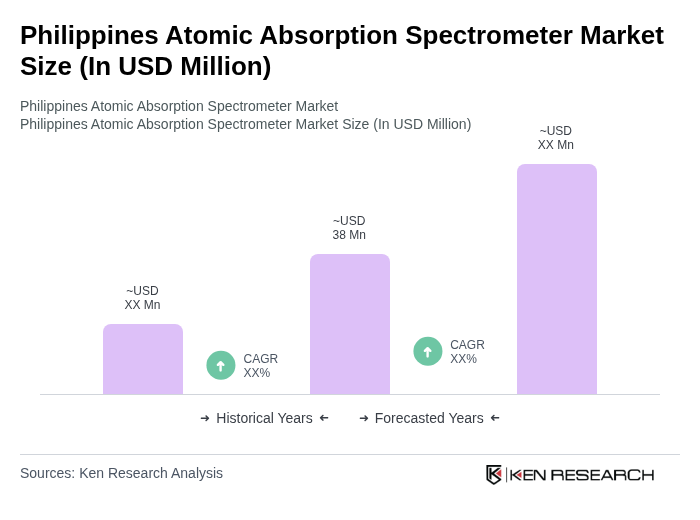
The Philippines Atomic Absorption Spectrometer market, valued at USD 38 million, grows due to regulatory compliance, technological innovations, and demand in key sectors like pharma and environment.

Region:Asia

Author(s):Dev

Product Code:KRAE3805

Pages:91

Published On:March 2026
About the Report

Base Year 2024

Philippines Atomic Absorption Spectrometer Market Overview

  • The Philippines Atomic Absorption Spectrometer market is valued at approximately USD 38 million, based on a five-year historical analysis. This growth is primarily driven by the increasing demand for analytical testing in various sectors, including pharmaceuticals, environmental monitoring, and food safety. The rising awareness of quality control and regulatory compliance has further propelled the adoption of atomic absorption spectrometers in laboratories across the country. Advanced technological innovations in AAS instruments, including automation and miniaturization, are enhancing analytical efficiency and accuracy across laboratory operations.
  • Metro Manila, Cebu, and Davao are the dominant regions in the Philippines Atomic Absorption Spectrometer market. Metro Manila, being the capital, hosts a significant number of research institutions and laboratories, while Cebu and Davao are emerging hubs for industrial and environmental testing. The concentration of educational and research facilities in these areas fosters innovation and demand for advanced analytical instruments. The Asia-Pacific region, where the Philippines is located, is witnessing rapid growth driven by industrialization, urbanization, and increasing investments in infrastructure development and pharmaceutical manufacturing.
  • The Philippine government has implemented regulations to enhance laboratory standards, including the Department of Health's Administrative Order No. 2018-0012, issued in 2018, which mandates the use of accredited laboratories for testing and analysis. This regulation establishes compliance requirements for laboratory accreditation and quality assurance protocols, ensuring the accuracy and reliability of laboratory results. The regulatory framework has increased the demand for advanced analytical equipment, including atomic absorption spectrometers, as laboratories seek to meet stringent accreditation standards and maintain operational compliance.
Philippines Atomic Absorption Spectrometer Market Size

Philippines Atomic Absorption Spectrometer Market Segmentation

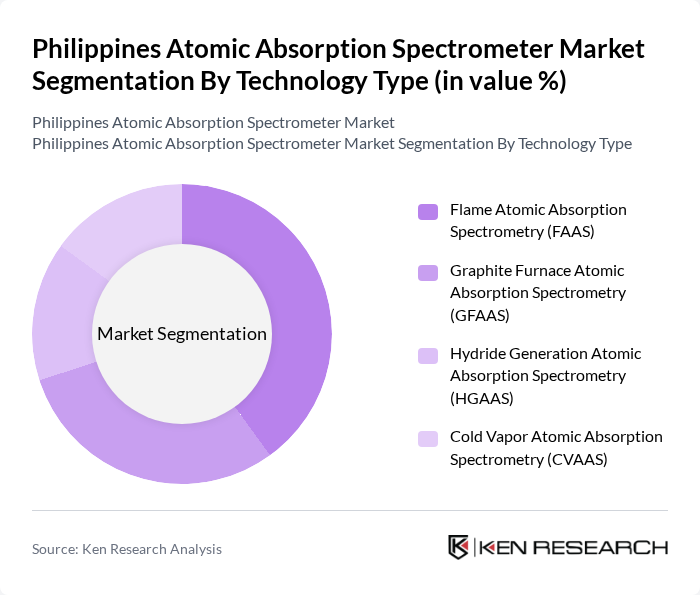
By Technology Type:

Philippines Atomic Absorption Spectrometer Market segmentation by Technology Type.

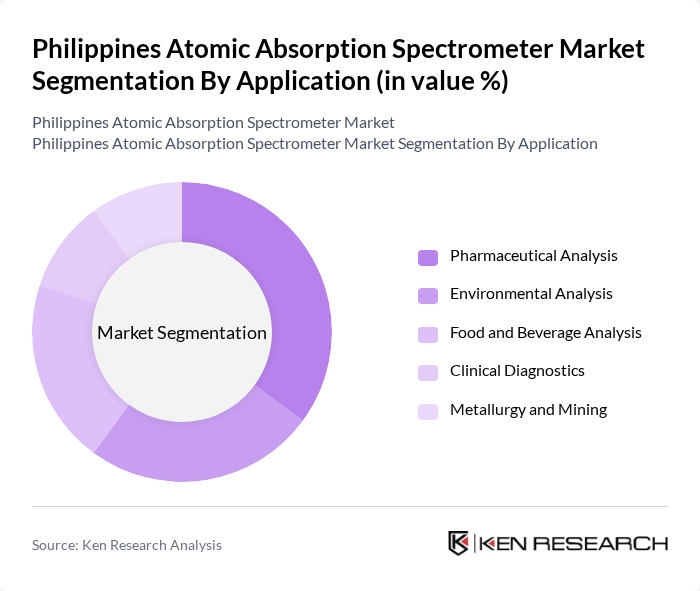
By Application:

Philippines Atomic Absorption Spectrometer Market segmentation by Application.

Philippines Atomic Absorption Spectrometer Market Competitive Landscape

The Philippines Atomic Absorption Spectrometer Market is characterized by a dynamic mix of regional and international players. Leading participants such as PerkinElmer, Inc., Agilent Technologies, Inc., Thermo Fisher Scientific Inc., Hitachi High-Technologies Corporation, GBC Scientific Equipment, Analytik Jena AG, Shimadzu Corporation, Horiba, Ltd., Spectro Analytical Instruments GmbH, SPECTRO Analytical Instruments, Labomed, Inc., Buck Scientific, Jasco, Inc., Eppendorf AG, Mettler Toledo contribute to innovation, geographic expansion, and service delivery in this space.

PerkinElmer, Inc.

1937

Waltham, Massachusetts, USA

Agilent Technologies, Inc.

1999

Santa Clara, California, USA

Thermo Fisher Scientific Inc.

2006

Waltham, Massachusetts, USA

Hitachi High-Technologies Corporation

1900

Tokyo, Japan

GBC Scientific Equipment

1985

Victoria, Australia

Company

Establishment Year

Headquarters

Market Revenue (USD Million)

Year-over-Year Revenue Growth Rate (%)

Market Share (%)

Geographic Presence (Number of Countries)

Product Portfolio Breadth (Number of AAS Types Offered)

R&D Investment as % of Revenue

Philippines Atomic Absorption Spectrometer Market Industry Analysis

Growth Drivers

  • Increasing Demand for Environmental Monitoring:The Philippines has seen a significant rise in environmental monitoring activities, driven by a growing population of approximately 115 million in future. The Department of Environment and Natural Resources (DENR) reported a 20% increase in environmental assessments since 2020, necessitating advanced analytical tools like atomic absorption spectrometers. This demand is further fueled by the country's commitment to achieving Sustainable Development Goals (SDGs), particularly in clean water and air quality monitoring.
  • Growth in the Pharmaceutical and Food Industries:The pharmaceutical sector in the Philippines is projected to reach PHP 110 billion in future, reflecting a 15% growth from previous year. This expansion is accompanied by stringent quality control measures, increasing the need for precise analytical instruments. Similarly, the food industry, valued at PHP 1.6 trillion, is under pressure to comply with food safety regulations, driving demand for atomic absorption spectrometers to ensure product safety and quality.
  • Advancements in Analytical Technology:The Philippines is experiencing rapid technological advancements in analytical methods, with investments in research and development expected to exceed PHP 12 billion in future. This growth is fostering innovation in atomic absorption spectrometry, enhancing the accuracy and efficiency of these instruments. As laboratories adopt cutting-edge technologies, the demand for modern spectrometers is anticipated to rise, supporting various sectors including environmental, pharmaceutical, and food safety.

Market Challenges

  • High Initial Investment Costs:The high initial costs associated with acquiring atomic absorption spectrometers can be a significant barrier for many laboratories in the Philippines. With prices ranging from PHP 1 million to PHP 5 million, smaller institutions may struggle to justify these expenditures. This financial hurdle is compounded by limited funding opportunities, particularly in public sector laboratories, which can hinder the adoption of advanced analytical technologies.
  • Limited Awareness Among Potential Users:Despite the benefits of atomic absorption spectrometers, there remains a notable lack of awareness among potential users in the Philippines. A survey conducted by the Philippine Society of Chemistry indicated that over 60% of small to medium-sized enterprises (SMEs) are unaware of the capabilities and advantages of these instruments. This knowledge gap can lead to underutilization of available technology, limiting market growth and innovation.

Philippines Atomic Absorption Spectrometer Market Future Outlook

The future of the atomic absorption spectrometer market in the Philippines appears promising, driven by increasing regulatory demands and technological advancements. As environmental monitoring becomes more critical, laboratories are expected to invest in modern analytical tools. Additionally, the integration of artificial intelligence in spectrometry is likely to enhance data analysis capabilities, making these instruments more accessible and efficient. The focus on food safety and quality assurance will further propel market growth, creating a robust landscape for innovation and collaboration.

Market Opportunities

  • Expansion in Research and Development Sectors:The Philippine government has allocated PHP 6 billion for R&D initiatives in future, promoting innovation in analytical technologies. This funding presents opportunities for partnerships between private companies and research institutions, enhancing the development and application of atomic absorption spectrometers in various fields, including environmental science and pharmaceuticals.
  • Collaborations with Educational Institutions:Collaborations between manufacturers and educational institutions can foster knowledge transfer and skill development. With over 2,200 higher education institutions in the Philippines, partnerships can enhance training programs in analytical chemistry, increasing the skilled workforce capable of utilizing atomic absorption spectrometers effectively, thus driving market growth.

Scope of the Report

SegmentSub-Segments
By Technology Type

Flame Atomic Absorption Spectrometry (FAAS)

Graphite Furnace Atomic Absorption Spectrometry (GFAAS)

Hydride Generation Atomic Absorption Spectrometry (HGAAS)

Cold Vapor Atomic Absorption Spectrometry (CVAAS)

By Application

Pharmaceutical Analysis

Environmental Analysis

Food and Beverage Analysis

Clinical Diagnostics

Metallurgy and Mining

By End-Use Industry

Pharmaceuticals

Environmental Testing

Food and Beverage

Mining and Metallurgy

Academic Research

By Region

Luzon

Visayas

Mindanao

Key Target Audience

Investors and Venture Capitalist Firms

Government and Regulatory Bodies (e.g., Department of Science and Technology, Environmental Management Bureau)

Manufacturers and Producers of Atomic Absorption Spectrometers

Distributors and Retailers of Laboratory Equipment

Quality Control and Assurance Laboratories

Pharmaceutical and Chemical Companies

Environmental Testing Agencies

Mining and Metallurgical Companies

Players Mentioned in the Report:

PerkinElmer, Inc.

Agilent Technologies, Inc.

Thermo Fisher Scientific Inc.

Hitachi High-Technologies Corporation

GBC Scientific Equipment

Analytik Jena AG

Shimadzu Corporation

Horiba, Ltd.

Spectro Analytical Instruments GmbH

SPECTRO Analytical Instruments

Labomed, Inc.

Buck Scientific

Jasco, Inc.

Eppendorf AG

Mettler Toledo

Table of Contents

Market Assessment Phase

1. Executive Summary and Approach


2. Philippines Atomic Absorption Spectrometer Market Overview

2.1 Key Insights and Strategic Recommendations

2.2 Philippines Atomic Absorption Spectrometer Market Overview

2.3 Definition and Scope

2.4 Evolution of Market Ecosystem

2.5 Timeline of Key Regulatory Milestones

2.6 Value Chain & Stakeholder Mapping

2.7 Business Cycle Analysis

2.8 Policy & Incentive Landscape


3. Philippines Atomic Absorption Spectrometer Market Analysis

3.1 Growth Drivers

3.1.1 Increasing demand for environmental monitoring
3.1.2 Growth in the pharmaceutical and food industries
3.1.3 Advancements in analytical technology
3.1.4 Government initiatives for quality control

3.2 Market Challenges

3.2.1 High initial investment costs
3.2.2 Limited awareness among potential users
3.2.3 Regulatory compliance complexities
3.2.4 Competition from alternative analytical methods

3.3 Market Opportunities

3.3.1 Expansion in research and development sectors
3.3.2 Increasing focus on food safety regulations
3.3.3 Collaborations with educational institutions
3.3.4 Technological innovations in spectrometry

3.4 Market Trends

3.4.1 Rising adoption of portable spectrometers
3.4.2 Integration of AI in analytical processes
3.4.3 Shift towards eco-friendly analytical solutions
3.4.4 Growth in online sales channels

3.5 Government Regulation

3.5.1 Compliance with environmental standards
3.5.2 Quality assurance regulations in laboratories
3.5.3 Import/export regulations for analytical equipment
3.5.4 Safety standards for laboratory operations

4. SWOT Analysis


5. Stakeholder Analysis


6. Porter's Five Forces Analysis


7. Philippines Atomic Absorption Spectrometer Market Market Size, 2019-2024

7.1 By Value

7.2 By Volume

7.3 By Average Selling Price


8. Philippines Atomic Absorption Spectrometer Market Segmentation

8.1 By Technology Type

8.1.1 Flame Atomic Absorption Spectrometry (FAAS)
8.1.2 Graphite Furnace Atomic Absorption Spectrometry (GFAAS)
8.1.3 Hydride Generation Atomic Absorption Spectrometry (HGAAS)
8.1.4 Cold Vapor Atomic Absorption Spectrometry (CVAAS)

8.2 By Application

8.2.1 Pharmaceutical Analysis
8.2.2 Environmental Analysis
8.2.3 Food and Beverage Analysis
8.2.4 Clinical Diagnostics
8.2.5 Metallurgy and Mining

8.3 By End-Use Industry

8.3.1 Pharmaceuticals
8.3.2 Environmental Testing
8.3.3 Food and Beverage
8.3.4 Mining and Metallurgy
8.3.5 Academic Research

8.4 By Region

8.4.1 Luzon
8.4.2 Visayas
8.4.3 Mindanao

9. Philippines Atomic Absorption Spectrometer Market Competitive Analysis

9.1 Market Share of Key Players

9.2 Cross Comparison of Key Players

9.2.1 Company Name
9.2.2 Market Revenue (USD Million)
9.2.3 Year-over-Year Revenue Growth Rate (%)
9.2.4 Market Share (%)
9.2.5 Geographic Presence (Number of Countries)
9.2.6 Product Portfolio Breadth (Number of AAS Types Offered)
9.2.7 R&D Investment as % of Revenue
9.2.8 Customer Retention Rate (%)
9.2.9 Average Selling Price per Unit (USD)
9.2.10 Brand Recognition Index (1-10 Scale)

9.3 SWOT Analysis of Top Players

9.4 Pricing Analysis

9.5 Detailed Profile of Major Companies

9.5.1 PerkinElmer, Inc.
9.5.2 Agilent Technologies, Inc.
9.5.3 Thermo Fisher Scientific Inc.
9.5.4 Hitachi High-Technologies Corporation
9.5.5 GBC Scientific Equipment
9.5.6 Analytik Jena AG
9.5.7 Shimadzu Corporation
9.5.8 Horiba, Ltd.
9.5.9 Spectro Analytical Instruments GmbH
9.5.10 SPECTRO Analytical Instruments
9.5.11 Labomed, Inc.
9.5.12 Buck Scientific
9.5.13 Jasco, Inc.
9.5.14 Eppendorf AG
9.5.15 Mettler Toledo

10. Philippines Atomic Absorption Spectrometer Market End-User Analysis

10.1 Procurement Behavior of Key Ministries

10.1.1 Budget Allocation Trends
10.1.2 Decision-Making Processes
10.1.3 Preferred Suppliers
10.1.4 Procurement Timelines

10.2 Corporate Spend on Infrastructure & Energy

10.2.1 Investment Priorities
10.2.2 Budget Trends
10.2.3 Key Projects

10.3 Pain Point Analysis by End-User Category

10.3.1 Common Challenges Faced
10.3.2 Support Needs

10.4 User Readiness for Adoption

10.4.1 Training Requirements
10.4.2 Technology Acceptance Levels

10.5 Post-Deployment ROI and Use Case Expansion

10.5.1 Performance Metrics
10.5.2 Future Use Cases

11. Philippines Atomic Absorption Spectrometer Market Future Size, 2025-2030

11.1 By Value

11.2 By Volume

11.3 By Average Selling Price


Go-To-Market Strategy Phase

1. Whitespace Analysis + Business Model Canvas

1.1 Market Gaps Identification

1.2 Business Model Development


2. Marketing and Positioning Recommendations

2.1 Branding Strategies

2.2 Product USPs


3. Distribution Plan

3.1 Urban Retail vs Rural NGO Tie-ups


4. Channel & Pricing Gaps

4.1 Underserved Routes

4.2 Pricing Bands


5. Unmet Demand & Latent Needs

5.1 Category Gaps

5.2 Consumer Segments


6. Customer Relationship

6.1 Loyalty Programs

6.2 After-sales Service


7. Value Proposition

7.1 Sustainability

7.2 Integrated Supply Chains


8. Key Activities

8.1 Regulatory Compliance

8.2 Branding

8.3 Distribution Setup


9. Entry Strategy Evaluation

9.1 Domestic Market Entry Strategy

9.1.1 Product Mix
9.1.2 Pricing Band
9.1.3 Packaging

9.2 Export Entry Strategy

9.2.1 Target Countries
9.2.2 Compliance Roadmap

10. Entry Mode Assessment

10.1 JV

10.2 Greenfield

10.3 M&A

10.4 Distributor Model


11. Capital and Timeline Estimation

11.1 Capital Requirements

11.2 Timelines


12. Control vs Risk Trade-Off

12.1 Ownership vs Partnerships


13. Profitability Outlook

13.1 Breakeven Analysis

13.2 Long-term Sustainability


14. Potential Partner List

14.1 Distributors

14.2 JVs

14.3 Acquisition Targets


15. Execution Roadmap

15.1 Phased Plan for Market Entry

15.1.1 Market Setup
15.1.2 Market Entry
15.1.3 Growth Acceleration
15.1.4 Scale & Stabilize

15.2 Key Activities and Milestones

15.2.1 Milestone Tracking

Research Methodology

ApproachModellingSample

Phase 1: Approach1

Desk Research

  • Analysis of market reports from industry associations and government publications
  • Review of academic journals and articles focusing on atomic absorption spectroscopy applications
  • Compilation of trade statistics and import/export data specific to atomic absorption spectrometers in the Philippines

Primary Research

  • Interviews with laboratory managers and technicians in academic and industrial settings
  • Surveys targeting procurement officers in pharmaceutical and environmental testing sectors
  • Field visits to research institutions and universities utilizing atomic absorption spectrometers

Validation & Triangulation

  • Cross-validation of findings with multiple industry experts to ensure accuracy
  • Triangulation of data from primary interviews and secondary sources to confirm trends
  • Sanity checks through feedback from a panel of experts in analytical chemistry

Phase 2: Market Size Estimation1

Top-down Assessment

  • Estimation of market size based on national laboratory equipment spending trends
  • Segmentation by end-user industries such as pharmaceuticals, environmental monitoring, and food safety
  • Incorporation of government funding and initiatives for scientific research and development

Bottom-up Modeling

  • Collection of sales data from leading suppliers of atomic absorption spectrometers in the Philippines
  • Estimation of unit sales based on laboratory needs and equipment replacement cycles
  • Analysis of pricing strategies and average selling prices across different segments

Forecasting & Scenario Analysis

  • Utilization of historical growth rates to project future market trends through 2030
  • Scenario analysis based on potential regulatory changes affecting laboratory practices
  • Development of optimistic, pessimistic, and baseline forecasts considering technological advancements

Phase 3: CATI Sample Composition1

Scope Item/SegmentSample SizeTarget Respondent Profiles
Pharmaceutical Laboratories45Laboratory Managers, Quality Control Analysts
Environmental Testing Facilities38Environmental Scientists, Lab Technicians
Academic Research Institutions42Research Professors, Graduate Students
Food Safety Testing Labs35Food Safety Inspectors, Laboratory Supervisors
Industrial Manufacturing Quality Control40Quality Assurance Managers, Production Engineers

Frequently Asked Questions

What is the current market size of the Philippines Atomic Absorption Spectrometer market?

The Philippines Atomic Absorption Spectrometer market is valued at approximately USD 38 million, reflecting a growing demand for analytical testing in sectors such as pharmaceuticals, environmental monitoring, and food safety.

What are the key growth drivers for the Atomic Absorption Spectrometer market in the Philippines?

Which regions in the Philippines dominate the Atomic Absorption Spectrometer market?

What regulatory frameworks impact the Atomic Absorption Spectrometer market in the Philippines?

Why Buy From Us?

Refine Robust Result (RRR) Framework

What makes us stand out is that our consultants follow Robust, Refine and Result (RRR) methodology. Robust for clear definitions, approaches and sanity checking, Refine for differentiating respondents' facts and opinions, and Result for presenting data with story.

Our Reach Is Unmatched

We have set a benchmark in the industry by offering our clients with syndicated and customized market research reports featuring coverage of entire market as well as meticulous research and analyst insights.

Shifting the Research Paradigm

While we don't replace traditional research, we flip the method upside down. Our dual approach of Top Bottom & Bottom Top ensures quality deliverable by not just verifying company fundamentals but also looking at the sector and macroeconomic factors.

More Insights-Better Decisions

With one step in the future, our research team constantly tries to show you the bigger picture. We help with some of the tough questions you may encounter along the way: How is the industry positioned? Best marketing channel? KPI's of competitors? By aligning every element, we help maximize success.

Transparency and Trust

Our report gives you instant access to the answers and sources that other companies might choose to hide. We elaborate each steps of research methodology we have used and showcase you the sample size to earn your trust.

Round the Clock Support

If you need any support, we are here! We pride ourselves on universe strength, data quality, and quick, friendly, and professional service.

Why Clients Choose Us?

400000+
Reports in repository
150+
Consulting projects a year
100+
Analysts
8000+
Client Queries in 2022