Philippines Attention Deficit Hyperactivity Disorder (ADHD) Market

The Philippines ADHD market, valued at USD 65 million, is growing due to increased awareness, diagnoses, and government initiatives like the Mental Health Act for better mental health access.

Region:Asia

Author(s):Geetanshi

Product Code:KRAD4090

Pages:98

Published On:December 2025

About the Report

Base Year 2024

Philippines Attention Deficit Hyperactivity Disorder (ADHD) Market Overview

  • The Philippines Attention Deficit Hyperactivity Disorder (ADHD) market is valued at USD 65 million, based on a five-year historical analysis. This growth is primarily driven by increasing awareness of mental health issues, the rising prevalence of ADHD diagnoses, and the expansion of treatment options available to patients. The market is also supported by the growing acceptance of ADHD as a legitimate medical condition, leading to more individuals seeking help and treatment.
  • Metro Manila, Cebu, and Davao are the dominant cities in the Philippines ADHD market due to their higher population density and better access to healthcare facilities. These urban areas have a concentration of specialized clinics and healthcare professionals, which facilitates the diagnosis and treatment of ADHD. Additionally, the presence of educational institutions in these regions contributes to the demand for ADHD-related services and support.
  • In 2023, the Philippine government implemented the Mental Health Act, which mandates the integration of mental health services into primary healthcare. This regulation aims to improve access to mental health care, including ADHD treatment, by ensuring that mental health services are available in community health centers and hospitals. The act emphasizes the importance of early diagnosis and intervention, which is crucial for managing ADHD effectively.
Philippines Attention Deficit Hyperactivity Disorder (ADHD) Market Size

Philippines Attention Deficit Hyperactivity Disorder (ADHD) Market Segmentation

By Drug Type:The drug type segmentation includes various treatment options for ADHD, which are crucial for managing symptoms effectively. The subsegments include Stimulant Medications, Non-Stimulant Medications, Digital Therapeutics, Behavioral Therapy, and Educational Support Programs. Stimulant medications, particularly those based on methylphenidate and amphetamines, dominate the market due to their proven efficacy and widespread acceptance among healthcare providers. Non-stimulant options are gaining traction as alternatives for patients who may not respond well to stimulants. Digital therapeutics and mobile applications are emerging as innovative solutions, providing additional support for patients and caregivers.
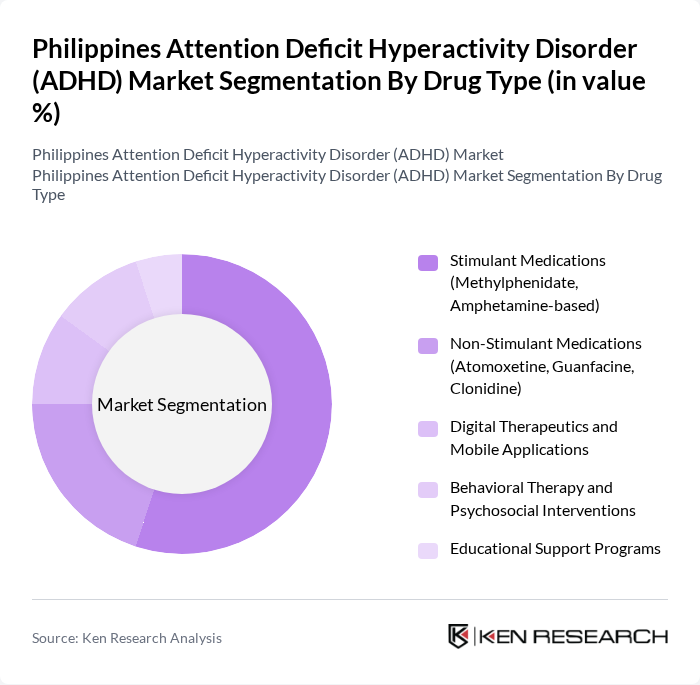
Philippines Attention Deficit Hyperactivity Disorder (ADHD) Market segmentation by Drug Type.

By Patient Demographics:This segmentation focuses on the different age groups and demographics affected by ADHD. The subsegments include Pediatric (Children 4-12 years), Adolescents (13-17 years), Adults (18+ years), Parents and Caregivers, and Educators and School Personnel. The pediatric demographic is the largest segment, as ADHD is most commonly diagnosed in children. However, there is a growing recognition of ADHD in adolescents and adults, leading to increased demand for tailored treatment options. Support services for parents and caregivers are also essential, as they play a critical role in managing the condition.
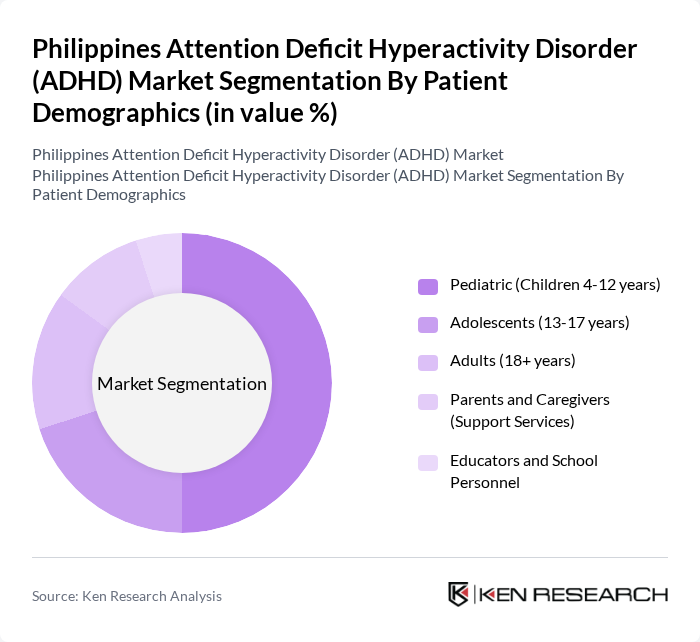
Philippines Attention Deficit Hyperactivity Disorder (ADHD) Market segmentation by Patient Demographics.

Philippines Attention Deficit Hyperactivity Disorder (ADHD) Market Competitive Landscape

The Philippines Attention Deficit Hyperactivity Disorder (ADHD) Market is characterized by a dynamic mix of regional and international players. Leading participants such as Novartis Philippines Corporation, Pfizer Philippines Inc., Eli Lilly and Company Philippines, Johnson & Johnson Philippines, Sanofi Pasteur Philippines, GlaxoSmithKline Philippines, AstraZeneca Philippines Inc., Merck Sharp & Dohme (MSD) Philippines, United Laboratories (Unilab) - ADHD Division, Zuellig Pharma Corporation, Healthway Medical Corporation, The Medical City, St. Luke's Medical Center, Asian Hospital and Medical Center, Philippine Children's Medical Center (PCMC) contribute to innovation, geographic expansion, and service delivery in this space.

Novartis Philippines Corporation

1996

Taguig City, Philippines

Pfizer Philippines Inc.

1952

Makati City, Philippines

Eli Lilly and Company Philippines

1994

Taguig City, Philippines

Johnson & Johnson Philippines

1930

Paranaque City, Philippines

Sanofi Pasteur Philippines

1994

Taguig City, Philippines

Company

Establishment Year

Headquarters

Company Size Classification (Large, Medium, or Small)

Revenue Growth Rate (Year-over-Year %)

Market Penetration Rate in Philippines (%)

Patient Retention Rate (%)

Pricing Strategy (Premium, Mid-Range, Budget)

Product Portfolio Diversification Index

Philippines Attention Deficit Hyperactivity Disorder (ADHD) Market Industry Analysis

Growth Drivers

  • Increasing Awareness and Diagnosis of ADHD:The Philippines has seen a significant rise in ADHD awareness, with the Department of Health reporting a 30% increase in diagnosed cases from 2020 to 2023. This surge is attributed to educational campaigns and improved access to information, leading to better recognition of symptoms among parents and educators. As of the future, approximately 1.5 million children are estimated to be diagnosed with ADHD, driving demand for specialized services and treatment options.
  • Rising Demand for ADHD Treatment Options:The demand for ADHD treatment options in the Philippines is escalating, with a reported 40% increase in prescriptions for ADHD medications from 2021 to 2023. This trend is fueled by a growing understanding of ADHD's impact on academic performance and social interactions. In the future, the market for ADHD treatments is projected to exceed PHP 2 billion, reflecting the urgent need for effective management solutions among affected families.
  • Government Initiatives for Mental Health:The Philippine government has prioritized mental health, allocating PHP 1.5 billion in the future for mental health programs, including ADHD awareness and treatment initiatives. The implementation of the Mental Health Act has facilitated better access to mental health services, with over 200 community-based mental health facilities established nationwide. These initiatives are crucial in addressing the growing needs of individuals with ADHD and enhancing overall mental health support.

Market Challenges

  • Stigma Associated with Mental Health Disorders:Despite increasing awareness, stigma surrounding ADHD remains a significant barrier in the Philippines. A 2023 survey indicated that 60% of parents still hesitate to seek help due to fear of judgment. This stigma can lead to delayed diagnoses and inadequate treatment, ultimately affecting the quality of life for individuals with ADHD. Addressing this challenge is essential for improving access to necessary care and support.
  • Limited Access to Specialized Care:Access to specialized ADHD care is limited, particularly in rural areas of the Philippines. As of 2023, only 15% of healthcare facilities offer specialized ADHD services, leaving many families without adequate support. The shortage of trained professionals exacerbates this issue, with only 1,000 certified child psychiatrists available nationwide. This gap in services poses a significant challenge for effective ADHD management and treatment.

Philippines Attention Deficit Hyperactivity Disorder (ADHD) Market Future Outlook

The future of the ADHD market in the Philippines appears promising, driven by ongoing government support and increasing public awareness. As mental health initiatives gain momentum, the integration of technology in treatment, such as telehealth services, is expected to enhance accessibility. Furthermore, the collaboration between healthcare providers and educational institutions will likely foster early diagnosis and intervention, ultimately improving outcomes for children with ADHD. Continued investment in research will also play a crucial role in developing innovative treatment options.

Market Opportunities

  • Development of Innovative Treatment Solutions:There is a significant opportunity for the development of innovative treatment solutions tailored to the unique needs of Filipino patients. With an increasing focus on personalized medicine, companies can explore new therapeutic approaches, including digital therapeutics and behavioral interventions, to enhance treatment efficacy and patient engagement.
  • Growth of Telehealth Services:The rise of telehealth services presents a valuable opportunity to improve access to ADHD care, especially in underserved areas. By leveraging technology, healthcare providers can offer remote consultations and follow-ups, making it easier for families to access specialized care without the burden of travel, thus improving treatment adherence and outcomes.

Scope of the Report

SegmentSub-Segments
By Drug Type

Stimulant Medications (Methylphenidate, Amphetamine-based)

Non-Stimulant Medications (Atomoxetine, Guanfacine, Clonidine)

Digital Therapeutics and Mobile Applications

Behavioral Therapy and Psychosocial Interventions

Educational Support Programs

By Patient Demographics

Pediatric (Children 4-12 years)

Adolescents (13-17 years)

Adults (18+ years)

Parents and Caregivers (Support Services)

Educators and School Personnel

By Geographic Region

Luzon (Metro Manila, Calabarzon, Cagayan Valley)

Visayas (Cebu, Iloilo, Bacolod)

Mindanao (Davao, Cagayan de Oro, General Santos)

By Distribution Channel

Hospital Pharmacies

Retail Pharmacies

Specialty Clinics and Diagnostic Centers

Telehealth Platforms

Educational Institutions

By Treatment Setting

Outpatient Clinics

Hospitals and Medical Centers

Home-Based Care and Telemedicine

Schools and Educational Settings

Community Health Centers

By Treatment Approach

Pharmacological Treatment

Psychosocial and Behavioral Treatment

Combined Pharmacological and Behavioral Treatment

Complementary and Alternative Therapies

By Insurance Coverage

PhilHealth Coverage (Public Insurance)

Private Health Insurance Plans

Out-of-Pocket Payment

Government Assistance Programs

Key Target Audience

Investors and Venture Capitalist Firms

Government and Regulatory Bodies (e.g., Department of Health, Food and Drug Administration)

Pharmaceutical Manufacturers

Medical Device Manufacturers

Healthcare Providers and Clinics

Non-Governmental Organizations (NGOs) focused on mental health

Insurance Companies

Pharmacy Chains and Retail Pharmacies

Players Mentioned in the Report:

Novartis Philippines Corporation

Pfizer Philippines Inc.

Eli Lilly and Company Philippines

Johnson & Johnson Philippines

Sanofi Pasteur Philippines

GlaxoSmithKline Philippines

AstraZeneca Philippines Inc.

Merck Sharp & Dohme (MSD) Philippines

United Laboratories (Unilab) - ADHD Division

Zuellig Pharma Corporation

Healthway Medical Corporation

The Medical City

St. Luke's Medical Center

Asian Hospital and Medical Center

Philippine Children's Medical Center (PCMC)

Table of Contents

Market Assessment Phase

1. Executive Summary and Approach


2. Philippines Attention Deficit Hyperactivity Disorder (ADHD) Market Overview

2.1 Key Insights and Strategic Recommendations

2.2 Philippines Attention Deficit Hyperactivity Disorder (ADHD) Market Overview

2.3 Definition and Scope

2.4 Evolution of Market Ecosystem

2.5 Timeline of Key Regulatory Milestones

2.6 Value Chain & Stakeholder Mapping

2.7 Business Cycle Analysis

2.8 Policy & Incentive Landscape


3. Philippines Attention Deficit Hyperactivity Disorder (ADHD) Market Analysis

3.1 Growth Drivers

3.1.1 Increasing Awareness and Diagnosis of ADHD
3.1.2 Rising Demand for ADHD Treatment Options
3.1.3 Government Initiatives for Mental Health
3.1.4 Expansion of Healthcare Infrastructure

3.2 Market Challenges

3.2.1 Stigma Associated with Mental Health Disorders
3.2.2 Limited Access to Specialized Care
3.2.3 High Cost of Treatment
3.2.4 Inadequate Training for Healthcare Professionals

3.3 Market Opportunities

3.3.1 Development of Innovative Treatment Solutions
3.3.2 Growth of Telehealth Services
3.3.3 Increasing Investment in Mental Health Research
3.3.4 Collaboration with Educational Institutions

3.4 Market Trends

3.4.1 Shift Towards Personalized Medicine
3.4.2 Integration of Technology in Treatment
3.4.3 Focus on Holistic Approaches
3.4.4 Rising Popularity of Non-Pharmacological Interventions

3.5 Government Regulation

3.5.1 Implementation of Mental Health Act
3.5.2 Regulation of ADHD Medications
3.5.3 Guidelines for ADHD Diagnosis and Treatment
3.5.4 Support for Mental Health Programs

4. SWOT Analysis


5. Stakeholder Analysis


6. Porter's Five Forces Analysis


7. Philippines Attention Deficit Hyperactivity Disorder (ADHD) Market Market Size, 2019-2024

7.1 By Value

7.2 By Volume

7.3 By Average Selling Price


8. Philippines Attention Deficit Hyperactivity Disorder (ADHD) Market Segmentation

8.1 By Drug Type

8.1.1 Stimulant Medications (Methylphenidate, Amphetamine-based)
8.1.2 Non-Stimulant Medications (Atomoxetine, Guanfacine, Clonidine)
8.1.3 Digital Therapeutics and Mobile Applications
8.1.4 Behavioral Therapy and Psychosocial Interventions
8.1.5 Educational Support Programs

8.2 By Patient Demographics

8.2.1 Pediatric (Children 4-12 years)
8.2.2 Adolescents (13-17 years)
8.2.3 Adults (18+ years)
8.2.4 Parents and Caregivers (Support Services)
8.2.5 Educators and School Personnel

8.3 By Geographic Region

8.3.1 Luzon (Metro Manila, Calabarzon, Cagayan Valley)
8.3.2 Visayas (Cebu, Iloilo, Bacolod)
8.3.3 Mindanao (Davao, Cagayan de Oro, General Santos)

8.4 By Distribution Channel

8.4.1 Hospital Pharmacies
8.4.2 Retail Pharmacies
8.4.3 Specialty Clinics and Diagnostic Centers
8.4.4 Telehealth Platforms
8.4.5 Educational Institutions

8.5 By Treatment Setting

8.5.1 Outpatient Clinics
8.5.2 Hospitals and Medical Centers
8.5.3 Home-Based Care and Telemedicine
8.5.4 Schools and Educational Settings
8.5.5 Community Health Centers

8.6 By Treatment Approach

8.6.1 Pharmacological Treatment
8.6.2 Psychosocial and Behavioral Treatment
8.6.3 Combined Pharmacological and Behavioral Treatment
8.6.4 Complementary and Alternative Therapies

8.7 By Insurance Coverage

8.7.1 PhilHealth Coverage (Public Insurance)
8.7.2 Private Health Insurance Plans
8.7.3 Out-of-Pocket Payment
8.7.4 Government Assistance Programs

9. Philippines Attention Deficit Hyperactivity Disorder (ADHD) Market Competitive Analysis

9.1 Market Share of Key Players

9.2 Cross Comparison of Key Players

9.2.1 Company Name
9.2.2 Company Size Classification (Large, Medium, or Small)
9.2.3 Revenue Growth Rate (Year-over-Year %)
9.2.4 Market Penetration Rate in Philippines (%)
9.2.5 Patient Retention Rate (%)
9.2.6 Pricing Strategy (Premium, Mid-Range, Budget)
9.2.7 Product Portfolio Diversification Index
9.2.8 Brand Awareness Score (Philippines Market)
9.2.9 Distribution Network Coverage (Urban/Rural %)
9.2.10 Healthcare Provider Satisfaction Rating

9.3 SWOT Analysis of Top Players

9.4 Pricing Analysis

9.5 Detailed Profile of Major Companies

9.5.1 Novartis Philippines Corporation
9.5.2 Pfizer Philippines Inc.
9.5.3 Eli Lilly and Company Philippines
9.5.4 Johnson & Johnson Philippines
9.5.5 Sanofi Pasteur Philippines
9.5.6 GlaxoSmithKline Philippines
9.5.7 AstraZeneca Philippines Inc.
9.5.8 Merck Sharp & Dohme (MSD) Philippines
9.5.9 United Laboratories (Unilab) - ADHD Division
9.5.10 Zuellig Pharma Corporation
9.5.11 Healthway Medical Corporation
9.5.12 The Medical City
9.5.13 St. Luke's Medical Center
9.5.14 Asian Hospital and Medical Center
9.5.15 Philippine Children's Medical Center (PCMC)

10. Philippines Attention Deficit Hyperactivity Disorder (ADHD) Market End-User Analysis

10.1 Procurement Behavior of Key Ministries

10.1.1 Department of Health Initiatives
10.1.2 Budget Allocation for Mental Health Programs
10.1.3 Collaboration with NGOs and Mental Health Organizations
10.1.4 Public Awareness Campaigns

10.2 Corporate Spend on Infrastructure & Health Services

10.2.1 Investment in Mental Health Facilities
10.2.2 Funding for ADHD Diagnostic and Treatment Programs
10.2.3 Partnerships with Educational Institutions

10.3 Pain Point Analysis by End-User Category

10.3.1 Challenges Faced by Parents and Families
10.3.2 Issues in School Settings and Educational Support
10.3.3 Barriers to Accessing Diagnosis and Treatment

10.4 User Readiness for Adoption

10.4.1 Awareness of ADHD Treatments and Options
10.4.2 Acceptance of Digital Health and Telehealth Solutions

10.5 Post-Deployment ROI and Use Case Expansion

10.5.1 Evaluation of Treatment Effectiveness and Outcomes
10.5.2 Long-term Benefits of Early Intervention and Diagnosis

11. Philippines Attention Deficit Hyperactivity Disorder (ADHD) Market Future Size, 2025-2030

11.1 By Value

11.2 By Volume

11.3 By Average Selling Price


Go-To-Market Strategy Phase

1. Whitespace Analysis + Business Model Canvas

1.1 Market Gaps Identification

1.2 Business Model Development


2. Marketing and Positioning Recommendations

2.1 Branding Strategies

2.2 Product USPs


3. Distribution Plan

3.1 Urban Retail Strategies

3.2 Rural NGO Tie-ups


4. Channel & Pricing Gaps

4.1 Underserved Routes

4.2 Pricing Bands


5. Unmet Demand & Latent Needs

5.1 Category Gaps

5.2 Consumer Segments


6. Customer Relationship

6.1 Loyalty Programs

6.2 After-sales Service


7. Value Proposition

7.1 Sustainability

7.2 Integrated Supply Chains


8. Key Activities

8.1 Regulatory Compliance

8.2 Branding

8.3 Distribution Setup


9. Entry Strategy Evaluation

9.1 Domestic Market Entry Strategy

9.1.1 Product Mix
9.1.2 Pricing Band
9.1.3 Packaging

9.2 Export Entry Strategy

9.2.1 Target Countries
9.2.2 Compliance Roadmap

10. Entry Mode Assessment

10.1 JV

10.2 Greenfield

10.3 M&A

10.4 Distributor Model


11. Capital and Timeline Estimation

11.1 Capital Requirements

11.2 Timelines


12. Control vs Risk Trade-Off

12.1 Ownership vs Partnerships


13. Profitability Outlook

13.1 Breakeven Analysis

13.2 Long-term Sustainability


14. Potential Partner List

14.1 Distributors

14.2 JVs

14.3 Acquisition Targets


15. Execution Roadmap

15.1 Phased Plan for Market Entry

15.1.1 Market Setup
15.1.2 Market Entry

Frequently Asked Questions

What is the current value of the ADHD market in the Philippines?

The Philippines Attention Deficit Hyperactivity Disorder (ADHD) market is valued at approximately USD 65 million, reflecting a significant increase due to rising awareness, prevalence of diagnoses, and expanding treatment options available to patients.

Which cities in the Philippines have the highest demand for ADHD services?

What recent legislation has impacted ADHD treatment in the Philippines?

What are the main treatment options available for ADHD in the Philippines?

Other Regional/Country Reports

US Attention Deficit Hyperactivity Disorder (ADHD) Market

Indonesia Attention Deficit Hyperactivity Disorder (ADHD) Market

Malaysia Attention Deficit Hyperactivity Disorder (ADHD) Market

KSA Attention Deficit Hyperactivity Disorder (ADHD) Market

APAC Attention Deficit Hyperactivity Disorder (ADHD) Market

SEA Attention Deficit Hyperactivity Disorder (ADHD) Market

Other Adjacent Reports

Kuwait Mental Health Services Market

Philippines Pediatric Neurology Market

Mexico Psychiatric Pharmaceuticals Market

South Korea Behavioral Therapy Market

Thailand Digital Therapeutics Market

Oman Telehealth Services Market

Thailand Educational Support Programs Market

Indonesia Child Psychology Market

Malaysia Neurodevelopmental Disorders Market

Thailand Adult ADHD Treatment Market

Why Buy From Us?

Refine Robust Result (RRR) Framework

What makes us stand out is that our consultants follow Robust, Refine and Result (RRR) methodology. Robust for clear definitions, approaches and sanity checking, Refine for differentiating respondents' facts and opinions, and Result for presenting data with story.

Our Reach Is Unmatched

We have set a benchmark in the industry by offering our clients with syndicated and customized market research reports featuring coverage of entire market as well as meticulous research and analyst insights.

Shifting the Research Paradigm

While we don't replace traditional research, we flip the method upside down. Our dual approach of Top Bottom & Bottom Top ensures quality deliverable by not just verifying company fundamentals but also looking at the sector and macroeconomic factors.

More Insights-Better Decisions

With one step in the future, our research team constantly tries to show you the bigger picture. We help with some of the tough questions you may encounter along the way: How is the industry positioned? Best marketing channel? KPI's of competitors? By aligning every element, we help maximize success.

Transparency and Trust

Our report gives you instant access to the answers and sources that other companies might choose to hide. We elaborate each steps of research methodology we have used and showcase you the sample size to earn your trust.

Round the Clock Support

If you need any support, we are here! We pride ourselves on universe strength, data quality, and quick, friendly, and professional service.

Why Clients Choose Us?

400000+
Reports in repository
150+
Consulting projects a year
100+
Analysts
8000+
Client Queries in 2022








