About the Report
Base Year 2024Listen to the audio summary
Philippines Automotive Sun Visor Market Overview
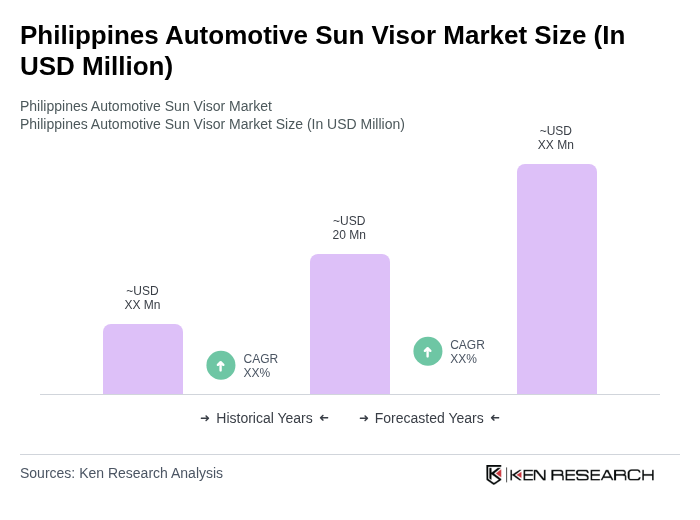
- The Philippines Automotive Sun Visor Market is valued at USD 20 million, based on a five-year historical analysis. This growth is primarily driven by the increasing demand for passenger vehicles, rising awareness of vehicle safety and comfort features, and the integration of advanced sun visor technologies such as smart and LCD variants. The market is further supported by the expansion of local manufacturing and continued imports to meet diverse consumer needs.
- Metro Manila, Cebu, and Davao are the dominant cities in the Philippines Automotive Sun Visor Market. Metro Manila, as the capital, hosts a high concentration of automotive manufacturers and consumers, while Cebu and Davao act as key regional hubs for automotive sales and services. The ongoing urbanization and robust economic growth in these metropolitan areas significantly contribute to market expansion, with rising vehicle ownership and dealership networks.
- In 2023, the Philippine government implemented the Motor Vehicle Development Program under the Board of Investments (BOI), as stipulated in Executive Order No. 182, Series of 2015, which aims to enhance local automotive manufacturing capabilities. This program provides fiscal and non-fiscal incentives for manufacturers to increase local production of automotive components, including sun visors, thereby reducing reliance on imports and promoting job creation within the automotive sector.
Philippines Automotive Sun Visor Market Segmentation
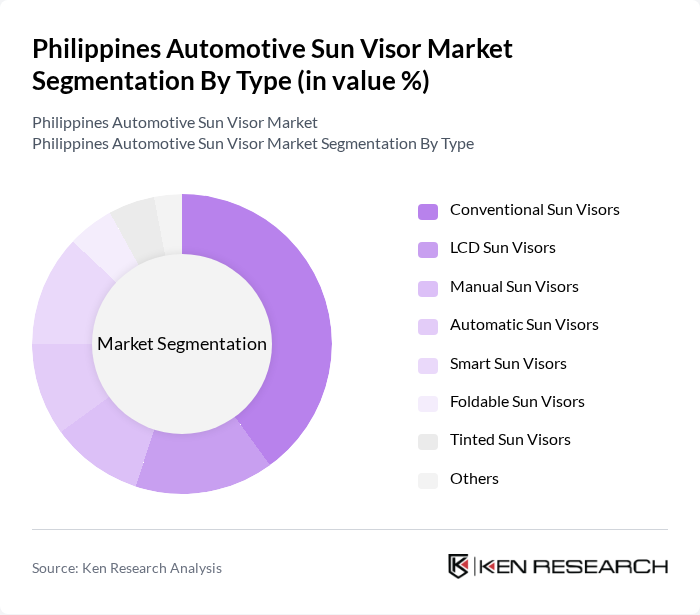
By Type:The market is segmented into Conventional Sun Visors, LCD Sun Visors, Manual Sun Visors, Automatic Sun Visors, Smart Sun Visors, Foldable Sun Visors, Tinted Sun Visors, and Others. Conventional Sun Visors hold the largest share due to their cost-effectiveness and widespread use in standard passenger and commercial vehicles. However, demand for Smart Sun Visors and LCD Sun Visors is increasing, driven by consumer preference for advanced features such as integrated displays, adaptive glare protection, and connectivity options.
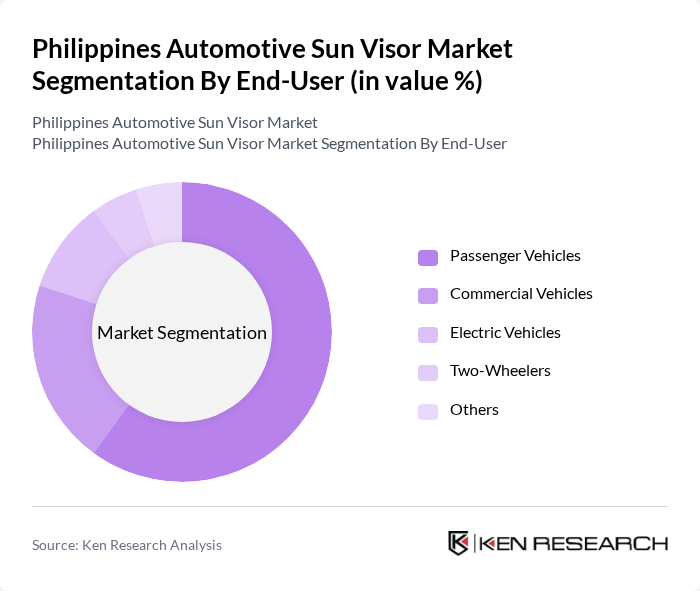
By End-User:The end-user segmentation includes Passenger Vehicles, Commercial Vehicles, Electric Vehicles, Two-Wheelers, and Others. Passenger Vehicles account for the largest share, reflecting the growing middle-class population and increased personal vehicle ownership in urban centers. The Electric Vehicles segment is expanding rapidly, as manufacturers focus on integrating advanced sun visor technologies to enhance safety and comfort in new energy vehicles.
Philippines Automotive Sun Visor Market Competitive Landscape
The Philippines Automotive Sun Visor Market is characterized by a dynamic mix of regional and international players. Leading participants such as Toyota Motor Philippines Corporation, Mitsubishi Motors Philippines Corporation, Honda Cars Philippines, Inc., Isuzu Philippines Corporation, Ford Motor Company Philippines, Inc., Nissan Philippines, Inc., Suzuki Philippines, Inc., Hyundai Motor Philippines, Inc., Kia Philippines, Inc., Changan Motor Philippines, Inc., Foton Motor Philippines, Inc., BAIC Philippines (Universal Motors Corporation), JAC Motors Philippines, MG Philippines (The Covenant Car Company, Inc.), Geely Philippines (Sojitz G Auto Philippines Corporation), Grupo Antolin, Kasai Kogyo Co., Ltd., Irvin Automotive Products, Inc., Nifco Inc., Gentex Corporation contribute to innovation, geographic expansion, and service delivery in this space.
Philippines Automotive Sun Visor Market Industry Analysis
Growth Drivers
- Increasing Vehicle Production:The Philippines automotive sector is projected to produce approximately 350,000 vehicles in future, reflecting a 10% increase from the previous year. This surge in production is driven by government initiatives aimed at boosting local manufacturing, such as the Comprehensive Automotive Resurgence Strategy (CARS) program. As vehicle production rises, the demand for automotive components, including sun visors, is expected to grow significantly, providing a robust market opportunity for manufacturers.
- Rising Consumer Awareness about Vehicle Safety:With road safety becoming a priority, consumer awareness regarding vehicle safety features is increasing. In future, it is estimated that 75% of consumers will prioritize safety features when purchasing vehicles. This trend is leading to a higher demand for advanced sun visors that offer enhanced safety features, such as UV protection and glare reduction, thereby driving market growth in the automotive sun visor segment.
- Growth in the Automotive Aftermarket:The automotive aftermarket in the Philippines is expected to reach PHP 120 billion (approximately USD 2.2 billion) in future, growing at a steady pace. This growth is fueled by an increasing number of vehicles on the road, which creates a demand for replacement parts and accessories, including sun visors. As vehicle owners seek to enhance their vehicles, the aftermarket presents a significant opportunity for sun visor manufacturers to expand their product offerings.
Market Challenges
- High Competition from Low-Cost Imports:The Philippine automotive sun visor market faces intense competition from low-cost imports, particularly from countries like China and Vietnam. In future, it is estimated that imports will account for 45% of the market share, putting pressure on local manufacturers to reduce costs while maintaining quality. This competition can hinder the growth of domestic producers, making it challenging to capture market share effectively.
- Fluctuating Raw Material Prices:The automotive industry is significantly affected by the volatility of raw material prices, particularly plastics and textiles used in sun visor production. In future, the price of polypropylene is projected to rise by 20%, impacting production costs. This fluctuation can lead to increased prices for consumers and reduced profit margins for manufacturers, posing a challenge to maintaining competitive pricing in the market.
Philippines Automotive Sun Visor Market Future Outlook
The Philippines automotive sun visor market is poised for growth, driven by increasing vehicle production and heightened consumer safety awareness. As the market evolves, manufacturers are likely to focus on integrating smart technologies and eco-friendly materials into their products. Additionally, the expansion of online retail channels will facilitate greater accessibility for consumers, enhancing market penetration. Overall, the future landscape appears promising, with opportunities for innovation and collaboration within the automotive sector.
Market Opportunities
- Expansion of Electric Vehicle Market:The electric vehicle (EV) market in the Philippines is expected to grow significantly, with projections indicating that EV sales could reach 60,000 units in future. This growth presents an opportunity for sun visor manufacturers to develop specialized products tailored for EVs, enhancing their market presence and catering to environmentally conscious consumers.
- Increasing Demand for Customized Automotive Accessories:As consumers seek personalization in their vehicles, the demand for customized automotive accessories, including sun visors, is on the rise. In future, it is anticipated that the customization segment will grow by 25%, providing manufacturers with the chance to offer unique designs and features that cater to individual preferences, thereby expanding their customer base.
Scope of the Report
| Segment | Sub-Segments |
|---|---|
| By Type | Conventional Sun Visors LCD Sun Visors Manual Sun Visors Automatic Sun Visors Smart Sun Visors Foldable Sun Visors Tinted Sun Visors Others |
| By End-User | Passenger Vehicles Commercial Vehicles Electric Vehicles Two-Wheelers Others |
| By Material | Fabric Plastic Composite Materials Metal Others |
| By Distribution Channel | OEM (Original Equipment Manufacturer) Aftermarket Online Retail Offline Retail Direct Sales Others |
| By Vehicle Type | SUVs Sedans Hatchbacks Light Commercial Vehicles (LCVs) Heavy Commercial Vehicles (HCVs) Others |
| By Region | Luzon Visayas Mindanao Others |
| By Price Range | Budget Mid-Range Premium Others |
Key Target Audience
Investors and Venture Capitalist Firms
Government and Regulatory Bodies (e.g., Department of Trade and Industry, Department of Transportation)
Automotive Manufacturers and Producers
Automotive Parts Distributors and Retailers
Automotive Aftermarket Service Providers
Technology Providers for Automotive Accessories
Industry Associations (e.g., Chamber of Automotive Manufacturers of the Philippines, Philippine Automotive Competitiveness Council)
Financial Institutions and Banks
Players Mentioned in the Report:
Toyota Motor Philippines Corporation
Mitsubishi Motors Philippines Corporation
Honda Cars Philippines, Inc.
Isuzu Philippines Corporation
Ford Motor Company Philippines, Inc.
Nissan Philippines, Inc.
Suzuki Philippines, Inc.
Hyundai Motor Philippines, Inc.
Kia Philippines, Inc.
Changan Motor Philippines, Inc.
Foton Motor Philippines, Inc.
BAIC Philippines (Universal Motors Corporation)
JAC Motors Philippines
MG Philippines (The Covenant Car Company, Inc.)
Geely Philippines (Sojitz G Auto Philippines Corporation)
Grupo Antolin
Kasai Kogyo Co., Ltd.
Irvin Automotive Products, Inc.
Nifco Inc.
Gentex Corporation
Table of Contents
Market Assessment Phase
1. Executive Summary and Approach
2. Philippines Automotive Sun Visor Market Overview
2.1 Key Insights and Strategic Recommendations
2.2 Philippines Automotive Sun Visor Market Overview
2.3 Definition and Scope
2.4 Evolution of Market Ecosystem
2.5 Timeline of Key Regulatory Milestones
2.6 Value Chain & Stakeholder Mapping
2.7 Business Cycle Analysis
2.8 Policy & Incentive Landscape
3. Philippines Automotive Sun Visor Market Analysis
3.1 Growth Drivers
3.1.1 Increasing vehicle production in the Philippines
3.1.2 Rising consumer awareness about vehicle safety
3.1.3 Growth in the automotive aftermarket
3.1.4 Technological advancements in sun visor materials
3.2 Market Challenges
3.2.1 High competition from low-cost imports
3.2.2 Fluctuating raw material prices
3.2.3 Regulatory compliance costs
3.2.4 Limited consumer awareness of premium products
3.3 Market Opportunities
3.3.1 Expansion of electric vehicle market
3.3.2 Increasing demand for customized automotive accessories
3.3.3 Growth in online retail channels
3.3.4 Partnerships with automotive manufacturers
3.4 Market Trends
3.4.1 Shift towards eco-friendly materials
3.4.2 Integration of smart technology in sun visors
3.4.3 Customization and personalization trends
3.4.4 Increasing focus on aesthetic appeal
3.5 Government Regulation
3.5.1 Standards for automotive safety features
3.5.2 Environmental regulations on materials used
3.5.3 Import tariffs on automotive components
3.5.4 Incentives for local manufacturing
4. SWOT Analysis
5. Stakeholder Analysis
6. Porter's Five Forces Analysis
7. Philippines Automotive Sun Visor Market Market Size, 2019-2024
7.1 By Value
7.2 By Volume
7.3 By Average Selling Price
8. Philippines Automotive Sun Visor Market Segmentation
8.1 By Type
8.1.1 Conventional Sun Visors
8.1.2 LCD Sun Visors
8.1.3 Manual Sun Visors
8.1.4 Automatic Sun Visors
8.1.5 Smart Sun Visors
8.1.6 Foldable Sun Visors
8.1.7 Tinted Sun Visors
8.1.8 Others
8.2 By End-User
8.2.1 Passenger Vehicles
8.2.2 Commercial Vehicles
8.2.3 Electric Vehicles
8.2.4 Two-Wheelers
8.2.5 Others
8.3 By Material
8.3.1 Fabric
8.3.2 Plastic
8.3.3 Composite Materials
8.3.4 Metal
8.3.5 Others
8.4 By Distribution Channel
8.4.1 OEM (Original Equipment Manufacturer)
8.4.2 Aftermarket
8.4.3 Online Retail
8.4.4 Offline Retail
8.4.5 Direct Sales
8.4.6 Others
8.5 By Vehicle Type
8.5.1 SUVs
8.5.2 Sedans
8.5.3 Hatchbacks
8.5.4 Light Commercial Vehicles (LCVs)
8.5.5 Heavy Commercial Vehicles (HCVs)
8.5.6 Others
8.6 By Region
8.6.1 Luzon
8.6.2 Visayas
8.6.3 Mindanao
8.6.4 Others
8.7 By Price Range
8.7.1 Budget
8.7.2 Mid-Range
8.7.3 Premium
8.7.4 Others
9. Philippines Automotive Sun Visor Market Competitive Analysis
9.1 Market Share of Key Players
9.2 Cross Comparison of Key Players
9.2.1 Company Name
9.2.2 Group Size (Large, Medium, or Small as per industry convention)
9.2.3 Revenue (USD, latest fiscal year)
9.2.4 Revenue Growth Rate (%)
9.2.5 Market Share (%) in Philippines Automotive Sun Visor Market
9.2.6 Market Penetration Rate (number of OEM/aftermarket partnerships)
9.2.7 Product Portfolio Breadth (number of SKUs or product variants)
9.2.8 Product Quality Index (based on warranty claims/returns or third-party ratings)
9.2.9 Distribution Network Coverage (number of dealers/outlets nationwide)
9.2.10 Pricing Strategy (average price positioning: budget, mid-range, premium)
9.2.11 Brand Recognition Score (survey-based or market study)
9.2.12 Innovation Rate (number of new product launches/patents per year)
9.3 SWOT Analysis of Top Players
9.4 Pricing Analysis
9.5 Detailed Profile of Major Companies
9.5.1 Toyota Motor Philippines Corporation
9.5.2 Mitsubishi Motors Philippines Corporation
9.5.3 Honda Cars Philippines, Inc.
9.5.4 Isuzu Philippines Corporation
9.5.5 Ford Motor Company Philippines, Inc.
9.5.6 Nissan Philippines, Inc.
9.5.7 Suzuki Philippines, Inc.
9.5.8 Hyundai Motor Philippines, Inc.
9.5.9 Kia Philippines, Inc.
9.5.10 Changan Motor Philippines, Inc.
9.5.11 Foton Motor Philippines, Inc.
9.5.12 BAIC Philippines (Universal Motors Corporation)
9.5.13 JAC Motors Philippines
9.5.14 MG Philippines (The Covenant Car Company, Inc.)
9.5.15 Geely Philippines (Sojitz G Auto Philippines Corporation)
9.5.16 Grupo Antolin
9.5.17 Kasai Kogyo Co., Ltd.
9.5.18 Irvin Automotive Products, Inc.
9.5.19 Nifco Inc.
9.5.20 Gentex Corporation
10. Philippines Automotive Sun Visor Market End-User Analysis
10.1 Procurement Behavior of Key Ministries
10.1.1 Government vehicle procurement policies
10.1.2 Budget allocation for automotive accessories
10.1.3 Supplier selection criteria
10.1.4 Contract management practices
10.2 Corporate Spend on Infrastructure & Energy
10.2.1 Investment in fleet upgrades
10.2.2 Budget for safety features
10.2.3 Expenditure on aftermarket products
10.2.4 Others
10.3 Pain Point Analysis by End-User Category
10.3.1 Quality concerns
10.3.2 Availability of parts
10.3.3 Pricing issues
10.3.4 Others
10.4 User Readiness for Adoption
10.4.1 Awareness of new technologies
10.4.2 Willingness to pay for premium products
10.4.3 Adoption of online purchasing
10.4.4 Others
10.5 Post-Deployment ROI and Use Case Expansion
10.5.1 Performance metrics tracking
10.5.2 Customer feedback mechanisms
10.5.3 Opportunities for upselling
10.5.4 Others
11. Philippines Automotive Sun Visor Market Future Size, 2025-2030
11.1 By Value
11.2 By Volume
11.3 By Average Selling Price
Go-To-Market Strategy Phase
1. Whitespace Analysis + Business Model Canvas
1.1 Market Gaps Identification
1.2 Value Proposition Development
1.3 Revenue Streams Analysis
1.4 Cost Structure Evaluation
1.5 Key Partnerships Exploration
1.6 Customer Segmentation
1.7 Channels of Distribution
2. Marketing and Positioning Recommendations
2.1 Branding strategies
2.2 Product USPs
3. Distribution Plan
3.1 Urban retail vs rural NGO tie-ups
4. Channel & Pricing Gaps
4.1 Underserved routes
4.2 Pricing bands
5. Unmet Demand & Latent Needs
5.1 Category gaps
5.2 Consumer segments
6. Customer Relationship
6.1 Loyalty programs
6.2 After-sales service
7. Value Proposition
7.1 Sustainability
7.2 Integrated supply chains
8. Key Activities
8.1 Regulatory compliance
8.2 Branding
8.3 Distribution setup
9. Entry Strategy Evaluation
9.1 Domestic Market Entry Strategy
9.1.1 Product mix
9.1.2 Pricing band
9.1.3 Packaging
9.2 Export Entry Strategy
9.2.1 Target countries
9.2.2 Compliance roadmap
10. Entry Mode Assessment
10.1 JV
10.2 Greenfield
10.3 M&A
10.4 Distributor Model
11. Capital and Timeline Estimation
11.1 Capital requirements
11.2 Timelines
12. Control vs Risk Trade-Off
12.1 Ownership vs Partnerships
13. Profitability Outlook
13.1 Breakeven analysis
13.2 Long-term sustainability
14. Potential Partner List
14.1 Distributors
14.2 JVs
14.3 Acquisition targets
15. Execution Roadmap
15.1 Phased Plan for Market Entry
15.1.1 Market Setup
15.1.2 Market Entry
15.1.3 Growth Acceleration
15.1.4 Scale & Stabilize
15.2 Key Activities and Milestones
15.2.1 Milestone Planning
15.2.2 Activity Tracking
Research Methodology
Phase 1: Approach1
Desk Research
- Industry reports from automotive associations and market research firms
- Government publications on automotive regulations and standards in the Philippines
- Analysis of import/export data related to automotive components and accessories
Primary Research
- Interviews with automotive manufacturers and suppliers in the Philippines
- Surveys targeting automotive retailers and distributors
- Field interviews with automotive design engineers and product managers
Validation & Triangulation
- Cross-validation of data from multiple industry sources and expert opinions
- Triangulation of market trends with historical sales data and consumer behavior
- Sanity checks through feedback from industry panels and focus groups
Phase 2: Market Size Estimation1
Top-down Assessment
- Estimation of total automotive market size in the Philippines as a baseline
- Segmentation of the sun visor market by vehicle type and consumer demographics
- Incorporation of growth rates from related automotive accessory markets
Bottom-up Modeling
- Volume estimates based on production data from local automotive manufacturers
- Cost analysis of sun visor production and pricing strategies
- Estimation of market share for key players based on sales data
Forecasting & Scenario Analysis
- Multi-factor regression analysis considering economic indicators and automotive trends
- Scenario modeling based on potential regulatory changes and consumer preferences
- Development of baseline, optimistic, and pessimistic market forecasts through 2030
Phase 3: CATI Sample Composition1
| Scope Item/Segment | Sample Size | Target Respondent Profiles |
|---|---|---|
| Automotive Manufacturers | 45 | Product Development Managers, Procurement Officers |
| Automotive Retailers | 40 | Store Managers, Sales Executives |
| Automotive Component Suppliers | 42 | Supply Chain Managers, Quality Assurance Leads |
| Consumer Insights | 150 | Car Owners, Automotive Enthusiasts |
| Industry Experts | 50 | Automotive Analysts, Market Researchers |
Frequently Asked Questions
What is the current value of the Philippines Automotive Sun Visor Market?
The Philippines Automotive Sun Visor Market is valued at approximately USD 20 million, reflecting a five-year historical analysis. This growth is driven by increasing demand for passenger vehicles and advancements in sun visor technologies.
Which cities dominate the Philippines Automotive Sun Visor Market?
What government initiatives support the automotive industry in the Philippines?
What types of sun visors are available in the Philippines market?
Other Regional/Country Reports
Indonesia Automotive Sun Visor Market
Malaysia Automotive Sun Visor Market
KSA Automotive Sun Visor Market
APAC Automotive Sun Visor Market
SEA Automotive Sun Visor Market
Vietnam Automotive Sun Visor Market
Other Adjacent Reports
Mexico Automotive Mirror Market
Malaysia Vehicle Lighting Market
Belgium Automotive Seating Market
UAE Car Interior Accessories Market
Indonesia Automotive HVAC Market
Oman Vehicle Safety Systems Market
Kuwait Automotive Electronics (ECUs, Sensors, Controllers) Market Size, Share, Growth Drivers, Trends, Opportunities, Competitive Landscape & Forecast 2025–2030Indonesia Car Window Tinting Market
Egypt Head-Up Display Market
Saudi Arabia smart glass market size, share, growth drivers, trends, opportunities & forecast 2025–2030Why Buy From Us?

What makes us stand out is that our consultants follow Robust, Refine and Result (RRR) methodology. Robust for clear definitions, approaches and sanity checking, Refine for differentiating respondents' facts and opinions, and Result for presenting data with story.

We have set a benchmark in the industry by offering our clients with syndicated and customized market research reports featuring coverage of entire market as well as meticulous research and analyst insights.

While we don't replace traditional research, we flip the method upside down. Our dual approach of Top Bottom & Bottom Top ensures quality deliverable by not just verifying company fundamentals but also looking at the sector and macroeconomic factors.

With one step in the future, our research team constantly tries to show you the bigger picture. We help with some of the tough questions you may encounter along the way: How is the industry positioned? Best marketing channel? KPI's of competitors? By aligning every element, we help maximize success.

Our report gives you instant access to the answers and sources that other companies might choose to hide. We elaborate each steps of research methodology we have used and showcase you the sample size to earn your trust.

If you need any support, we are here! We pride ourselves on universe strength, data quality, and quick, friendly, and professional service.