Ken Research Logo

Philippines construction equipment market analysis size, share, growth drivers, trends, opportunities & forecast 2025–2030

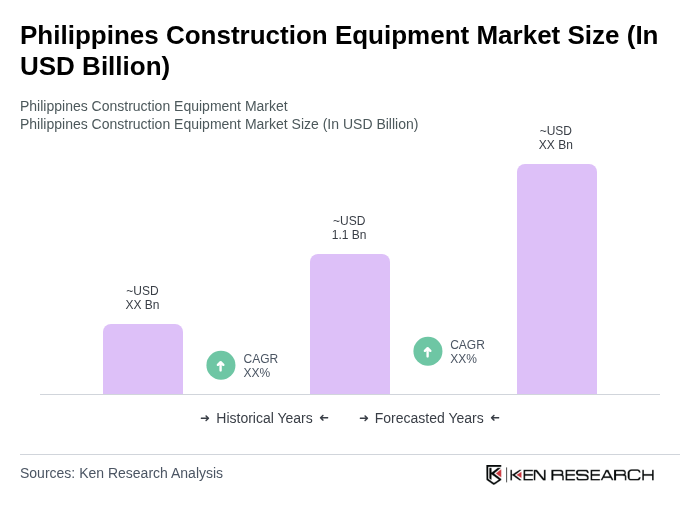
The Philippines construction equipment market is valued at USD 1.1 billion, fueled by rapid urbanization and major infrastructure developments in regions like Metro Manila.

Region:Asia

Author(s):Dev

Product Code:KRAC8658

Pages:98

Published On:November 2025
About the Report

Base Year 2024

Philippines Construction Equipment Market Overview

  • The Philippines Construction Equipment Market is valued at USD 1.1 billion, based on a five-year historical analysis. This growth is primarily driven by rapid urbanization, large-scale infrastructure development, and government initiatives aimed at enhancing the country's construction capabilities. Increasing demand for construction equipment is fueled by ongoing projects in transportation, housing, and commercial sectors, as well as the adoption of advanced technologies such as GPS tracking, automation, and artificial intelligence to improve efficiency and sustainability .
  • Metro Manila, Cebu, and Davao are the dominant regions in the Philippines Construction Equipment Market. Metro Manila leads due to its status as the economic and political center, attracting significant investments in infrastructure. Cebu and Davao follow closely, benefiting from regional development initiatives and growing urbanization, which drive the demand for construction equipment in these areas .
  • The Philippine government continues to implement major infrastructure programs, including the "Build, Build, Build" initiative and its successor "Build Better More". These programs are supported by substantial budget allocations—recently estimated at approximately USD 9 billion—for projects such as roads, bridges, and public transport systems. This sustained investment stimulates demand for construction equipment and enhances the overall market landscape. The regulatory framework guiding these projects is set forth in the "Revised Implementing Rules and Regulations of Republic Act No. 9184 (Government Procurement Reform Act), 2016" issued by the Government Procurement Policy Board, which governs procurement, compliance, and operational standards for public infrastructure projects .
Philippines Construction Equipment Market Size

Philippines Construction Equipment Market Segmentation

By Type:The construction equipment market can be segmented into various types, including excavators, backhoe loaders, wheeled loaders, bulldozers, motor graders, cranes, forklifts & telescopic handlers, road rollers, asphalt pavers, dump trucks & tippers, concrete mixers & pumps, aerial platforms, and others. Each type serves specific functions in construction and infrastructure projects, with varying demand based on project requirements. The market is witnessing increased adoption of electric and hybrid equipment, as well as automation and safety features, in response to evolving environmental standards and operational efficiency demands .
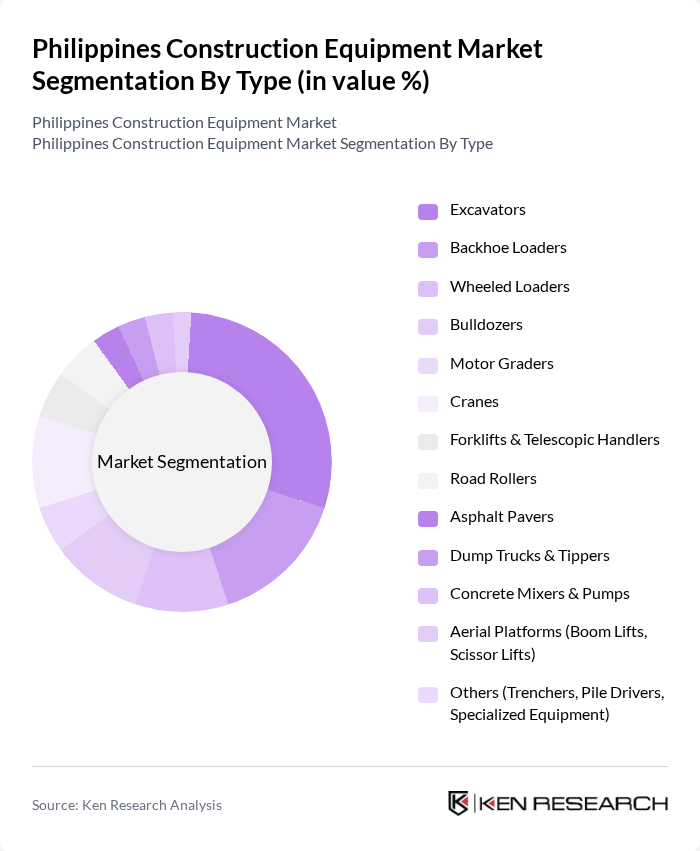
Philippines Construction Equipment Market segmentation by Type.

By End-User:The end-user segmentation includes construction (residential, commercial, infrastructure), mining, manufacturing, utilities & power generation, municipal corporations & waste management, oil & gas, and others. The construction sector is the largest end-user, driven by ongoing infrastructure projects and urban development, while mining and utilities also contribute significantly to the demand for construction equipment. The market is also benefiting from the expansion of mining and tourism infrastructure, as well as increased private sector investments in real estate and commercial projects .
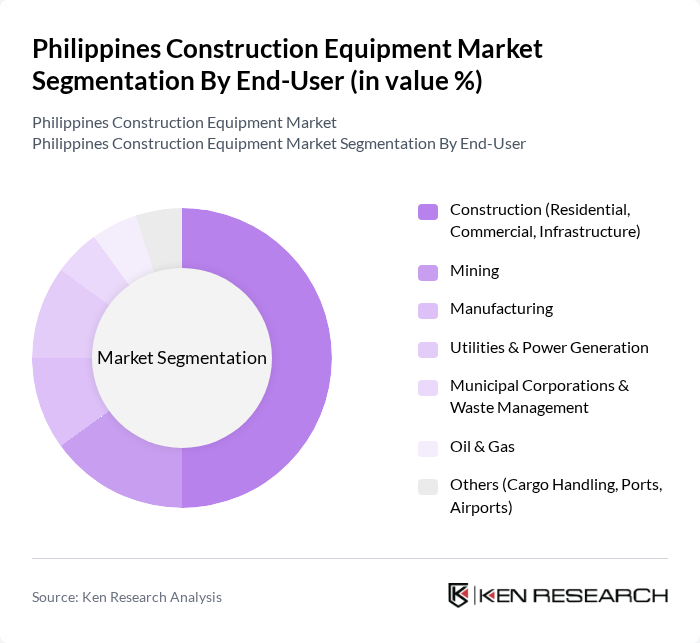
Philippines Construction Equipment Market segmentation by End-User.

Philippines Construction Equipment Market Competitive Landscape

The Philippines Construction Equipment Market is characterized by a dynamic mix of regional and international players. Leading participants such as Caterpillar Inc., Komatsu Ltd., Hitachi Construction Machinery Co., Ltd., Volvo Construction Equipment, JCB, Doosan Infracore, Liebherr Group, SANY Group, XCMG, Hyundai Construction Equipment, CASE Construction Equipment, Kubota Corporation, Bobcat Company, Yanmar Holdings Co., Ltd., Tadano Ltd., Manitou Group, SDLG (Shandong Lingong Construction Machinery), LiuGong Machinery Co., Ltd. contribute to innovation, geographic expansion, and service delivery in this space .

Caterpillar Inc.

1925

Irving, Texas, USA

Komatsu Ltd.

1921

Tokyo, Japan

Hitachi Construction Machinery Co., Ltd.

1970

Tokyo, Japan

Volvo Construction Equipment

1832

Gothenburg, Sweden

JCB

1945

Rocester, England

Company

Establishment Year

Headquarters

Group Size (Large, Medium, or Small as per industry convention)

Revenue (Philippines Construction Equipment Segment)

Market Share (Philippines Construction Equipment Market)

Product Portfolio Breadth (Number of Equipment Types Offered)

Distribution Network Strength (Number of Dealerships/Branches)

After-Sales Service Coverage (Service Centers, Response Time)

Philippines Construction Equipment Market Industry Analysis

Growth Drivers

  • Increasing Infrastructure Development:The Philippine government allocated approximately PHP 1.2 trillion (USD 21 billion) for infrastructure projects in future, focusing on roads, bridges, and public transport systems. This investment aims to enhance connectivity and stimulate economic growth, driving demand for construction equipment. The ongoing "Build, Build, Build" program is expected to create thousands of jobs, further boosting the construction sector and increasing the need for advanced machinery and equipment.
  • Urbanization and Population Growth:The Philippines is experiencing rapid urbanization, with urban areas projected to house approximately 52% of the population in future, up from 47% previously. This urban influx necessitates significant construction activities, including residential, commercial, and infrastructure projects. The population is expected to reach about 117 million in future, increasing housing demand and driving the need for construction equipment to support these developments, particularly in metropolitan areas like Metro Manila.
  • Government Investment in Public Works:The Philippine government is committed to investing in public works, with public spending estimated at PHP 1.2 trillion (USD 21 billion) in future. This investment is aimed at improving public infrastructure, including schools, hospitals, and transportation systems. Such initiatives are expected to create a robust demand for construction equipment, as contractors and developers seek to meet the government's ambitious infrastructure goals and enhance public services.

Market Challenges

  • High Initial Capital Investment:The construction equipment market in the Philippines faces challenges due to the high initial capital investment required for purchasing machinery. For instance, the cost of heavy equipment like excavators can range from PHP 3 million to PHP 10 million (USD 53,000 to USD 177,000). This financial barrier limits access for small and medium-sized enterprises (SMEs), which struggle to compete with larger firms that can afford such investments, potentially stifling market growth.
  • Regulatory Compliance Issues:The construction equipment sector is burdened by complex regulatory compliance requirements, including environmental and safety standards. In future, the government is expected to enforce stricter regulations, which may require additional investments in equipment modifications and training. Non-compliance can lead to hefty fines, project delays, and reputational damage, creating a challenging environment for construction firms and impacting their operational efficiency and profitability.

Philippines Construction Equipment Market Future Outlook

The Philippines construction equipment market is poised for significant growth, driven by ongoing infrastructure projects and urbanization trends. As the government continues to prioritize public works, the demand for advanced machinery will likely increase. Additionally, the adoption of eco-friendly and automated construction technologies is expected to reshape the industry landscape. Companies that invest in innovative solutions and comply with regulatory standards will be better positioned to capitalize on emerging opportunities in this dynamic market.

Market Opportunities

  • Expansion of Renewable Energy Projects:The Philippine government aims to increase renewable energy capacity to approximately 15,000 MW in future, creating opportunities for construction equipment suppliers. This growth will require specialized machinery for solar, wind, and hydroelectric projects, driving demand for innovative equipment solutions that meet sustainability standards and enhance operational efficiency.
  • Growth in Private Sector Construction:With private sector investments estimated at PHP 800 billion (USD 14 billion) in future, there is a significant opportunity for construction equipment providers. This growth is driven by rising consumer confidence and demand for residential and commercial properties, necessitating a diverse range of construction machinery to support various projects across the country.

Scope of the Report

SegmentSub-Segments
By Type

Excavators

Backhoe Loaders

Wheeled Loaders

Bulldozers

Motor Graders

Cranes

Forklifts & Telescopic Handlers

Road Rollers

Asphalt Pavers

Dump Trucks & Tippers

Concrete Mixers & Pumps

Aerial Platforms (Boom Lifts, Scissor Lifts)

Others (Trenchers, Pile Drivers, Specialized Equipment)

By End-User

Construction (Residential, Commercial, Infrastructure)

Mining

Manufacturing

Utilities & Power Generation

Municipal Corporations & Waste Management

Oil & Gas

Others (Cargo Handling, Ports, Airports)

By Region

Luzon

Visayas

Mindanao

By Application

Excavation and Mining

Lifting and Material Handling

Earth Moving

Road Construction

Building Construction

Demolition

Transportation

Others

By Investment Source

Domestic Investment

Foreign Direct Investment (FDI)

Public-Private Partnerships (PPP)

Government Funding

By Policy Support

Subsidies for Equipment Purchase

Tax Exemptions

Grants for Infrastructure Projects

Others

By Technology

Conventional Equipment

Electric Equipment

Hybrid Equipment

Smart Equipment (Telematics, Automation)

Others

Key Target Audience

Investors and Venture Capitalist Firms

Government and Regulatory Bodies (e.g., Department of Public Works and Highways, Department of Trade and Industry)

Manufacturers and Producers

Distributors and Retailers

Construction Companies and Contractors

Real Estate Developers

Industry Associations (e.g., Philippine Constructors Association)

Financial Institutions

Players Mentioned in the Report:

Caterpillar Inc.

Komatsu Ltd.

Hitachi Construction Machinery Co., Ltd.

Volvo Construction Equipment

JCB

Doosan Infracore

Liebherr Group

SANY Group

XCMG

Hyundai Construction Equipment

CASE Construction Equipment

Kubota Corporation

Bobcat Company

Yanmar Holdings Co., Ltd.

Tadano Ltd.

Manitou Group

SDLG (Shandong Lingong Construction Machinery)

LiuGong Machinery Co., Ltd.

Table of Contents

Market Assessment Phase

1. Executive Summary and Approach


2. Philippines Construction Equipment Market Overview

2.1 Key Insights and Strategic Recommendations

2.2 Philippines Construction Equipment Market Overview

2.3 Definition and Scope

2.4 Evolution of Market Ecosystem

2.5 Timeline of Key Regulatory Milestones

2.6 Value Chain & Stakeholder Mapping

2.7 Business Cycle Analysis

2.8 Policy & Incentive Landscape


3. Philippines Construction Equipment Market Analysis

3.1 Growth Drivers

3.1.1 Increasing Infrastructure Development
3.1.2 Urbanization and Population Growth
3.1.3 Government Investment in Public Works
3.1.4 Technological Advancements in Equipment

3.2 Market Challenges

3.2.1 High Initial Capital Investment
3.2.2 Regulatory Compliance Issues
3.2.3 Fluctuating Raw Material Prices
3.2.4 Limited Access to Financing

3.3 Market Opportunities

3.3.1 Expansion of Renewable Energy Projects
3.3.2 Growth in Private Sector Construction
3.3.3 Adoption of Rental Equipment Services
3.3.4 Development of Smart Construction Technologies

3.4 Market Trends

3.4.1 Shift Towards Eco-Friendly Equipment
3.4.2 Increasing Use of Automation and Robotics
3.4.3 Rise of Modular Construction Techniques
3.4.4 Focus on Safety and Compliance Standards

3.5 Government Regulation

3.5.1 Environmental Compliance Regulations
3.5.2 Safety Standards for Construction Equipment
3.5.3 Tax Incentives for Equipment Purchases
3.5.4 Import Tariffs on Construction Machinery

4. SWOT Analysis


5. Stakeholder Analysis


6. Porter's Five Forces Analysis


7. Philippines Construction Equipment Market Market Size, 2019-2024

7.1 By Value

7.2 By Volume

7.3 By Average Selling Price


8. Philippines Construction Equipment Market Segmentation

8.1 By Type

8.1.1 Excavators
8.1.2 Backhoe Loaders
8.1.3 Wheeled Loaders
8.1.4 Bulldozers
8.1.5 Motor Graders
8.1.6 Cranes
8.1.7 Forklifts & Telescopic Handlers
8.1.8 Road Rollers
8.1.9 Asphalt Pavers
8.1.10 Dump Trucks & Tippers
8.1.11 Concrete Mixers & Pumps
8.1.12 Aerial Platforms (Boom Lifts, Scissor Lifts)
8.1.13 Others (Trenchers, Pile Drivers, Specialized Equipment)

8.2 By End-User

8.2.1 Construction (Residential, Commercial, Infrastructure)
8.2.2 Mining
8.2.3 Manufacturing
8.2.4 Utilities & Power Generation
8.2.5 Municipal Corporations & Waste Management
8.2.6 Oil & Gas
8.2.7 Others (Cargo Handling, Ports, Airports)

8.3 By Region

8.3.1 Luzon
8.3.2 Visayas
8.3.3 Mindanao

8.4 By Application

8.4.1 Excavation and Mining
8.4.2 Lifting and Material Handling
8.4.3 Earth Moving
8.4.4 Road Construction
8.4.5 Building Construction
8.4.6 Demolition
8.4.7 Transportation
8.4.8 Others

8.5 By Investment Source

8.5.1 Domestic Investment
8.5.2 Foreign Direct Investment (FDI)
8.5.3 Public-Private Partnerships (PPP)
8.5.4 Government Funding

8.6 By Policy Support

8.6.1 Subsidies for Equipment Purchase
8.6.2 Tax Exemptions
8.6.3 Grants for Infrastructure Projects
8.6.4 Others

8.7 By Technology

8.7.1 Conventional Equipment
8.7.2 Electric Equipment
8.7.3 Hybrid Equipment
8.7.4 Smart Equipment (Telematics, Automation)
8.7.5 Others

9. Philippines Construction Equipment Market Competitive Analysis

9.1 Market Share of Key Players

9.2 Cross Comparison of Key Players

9.2.1 Company Name
9.2.2 Group Size (Large, Medium, or Small as per industry convention)
9.2.3 Revenue (Philippines Construction Equipment Segment)
9.2.4 Market Share (Philippines Construction Equipment Market)
9.2.5 Product Portfolio Breadth (Number of Equipment Types Offered)
9.2.6 Distribution Network Strength (Number of Dealerships/Branches)
9.2.7 After-Sales Service Coverage (Service Centers, Response Time)
9.2.8 Equipment Utilization Rate
9.2.9 Pricing Strategy (Premium, Value, Economy)
9.2.10 Average Order Value
9.2.11 Return on Investment (ROI)
9.2.12 Customer Satisfaction Score (NPS or Equivalent)
9.2.13 Local Market Adaptation (Product Customization, Local Sourcing)

9.3 SWOT Analysis of Top Players

9.4 Pricing Analysis

9.5 Detailed Profile of Major Companies

9.5.1 Caterpillar Inc.
9.5.2 Komatsu Ltd.
9.5.3 Hitachi Construction Machinery Co., Ltd.
9.5.4 Volvo Construction Equipment
9.5.5 JCB
9.5.6 Doosan Infracore
9.5.7 Liebherr Group
9.5.8 SANY Group
9.5.9 XCMG
9.5.10 Hyundai Construction Equipment
9.5.11 CASE Construction Equipment
9.5.12 Kubota Corporation
9.5.13 Bobcat Company
9.5.14 Yanmar Holdings Co., Ltd.
9.5.15 Tadano Ltd.
9.5.16 Manitou Group
9.5.17 SDLG (Shandong Lingong Construction Machinery)
9.5.18 LiuGong Machinery Co., Ltd.

10. Philippines Construction Equipment Market End-User Analysis

10.1 Procurement Behavior of Key Ministries

10.1.1 Ministry of Public Works and Highways
10.1.2 Department of Transportation
10.1.3 Department of Energy
10.1.4 Local Government Units

10.2 Corporate Spend on Infrastructure & Energy

10.2.1 Major Construction Firms
10.2.2 Energy Sector Investments
10.2.3 Public Infrastructure Projects

10.3 Pain Point Analysis by End-User Category

10.3.1 Construction Firms
10.3.2 Government Agencies
10.3.3 Private Developers

10.4 User Readiness for Adoption

10.4.1 Training and Skill Development
10.4.2 Technology Adoption Rates

10.5 Post-Deployment ROI and Use Case Expansion

10.5.1 Performance Metrics
10.5.2 Case Studies of Successful Deployments

11. Philippines Construction Equipment Market Future Size, 2025-2030

11.1 By Value

11.2 By Volume

11.3 By Average Selling Price


Go-To-Market Strategy Phase

1. Whitespace Analysis + Business Model Canvas

1.1 Market Gaps Identification

1.2 Business Model Development


2. Marketing and Positioning Recommendations

2.1 Branding Strategies

2.2 Product USPs


3. Distribution Plan

3.1 Urban Retail vs Rural NGO Tie-ups


4. Channel & Pricing Gaps

4.1 Underserved Routes

4.2 Pricing Bands


5. Unmet Demand & Latent Needs

5.1 Category Gaps

5.2 Consumer Segments


6. Customer Relationship

6.1 Loyalty Programs

6.2 After-sales Service


7. Value Proposition

7.1 Sustainability

7.2 Integrated Supply Chains


8. Key Activities

8.1 Regulatory Compliance

8.2 Branding

8.3 Distribution Setup


9. Entry Strategy Evaluation

9.1 Domestic Market Entry Strategy

9.1.1 Product Mix
9.1.2 Pricing Band
9.1.3 Packaging

9.2 Export Entry Strategy

9.2.1 Target Countries
9.2.2 Compliance Roadmap

10. Entry Mode Assessment

10.1 Joint Ventures

10.2 Greenfield Investments

10.3 Mergers & Acquisitions

10.4 Distributor Model


11. Capital and Timeline Estimation

11.1 Capital Requirements

11.2 Timelines


12. Control vs Risk Trade-Off

12.1 Ownership vs Partnerships


13. Profitability Outlook

13.1 Breakeven Analysis

13.2 Long-term Sustainability


14. Potential Partner List

14.1 Distributors

14.2 Joint Ventures

14.3 Acquisition Targets


15. Execution Roadmap

15.1 Phased Plan for Market Entry

15.1.1 Market Setup
15.1.2 Market Entry
15.1.3 Growth Acceleration
15.1.4 Scale & Stabilize

15.2 Key Activities and Milestones

15.2.1 Milestone Planning

Research Methodology

ApproachModellingSample

Phase 1: Approach1

Desk Research

  • Analysis of industry reports from government agencies such as the Philippine Statistics Authority (PSA)
  • Review of construction equipment import/export data from the Bureau of Customs
  • Examination of market trends and forecasts from trade associations like the Philippine Constructors Association

Primary Research

  • Interviews with key stakeholders including construction project managers and equipment rental companies
  • Surveys targeting construction firms to gather insights on equipment usage and preferences
  • Field visits to construction sites to observe equipment deployment and operational challenges

Validation & Triangulation

  • Cross-validation of findings through multiple data sources including trade publications and market surveys
  • Triangulation of qualitative insights from interviews with quantitative data from surveys
  • Sanity checks conducted through expert panel reviews comprising industry veterans

Phase 2: Market Size Estimation1

Top-down Assessment

  • Estimation of total market size based on national construction spending and infrastructure projects
  • Segmentation of the market by equipment type, including heavy machinery, tools, and rental services
  • Incorporation of government infrastructure programs and their projected impact on equipment demand

Bottom-up Modeling

  • Collection of sales data from leading construction equipment distributors and manufacturers
  • Estimation of rental market size based on average rental rates and utilization rates
  • Volume and revenue projections based on historical growth rates and emerging trends

Forecasting & Scenario Analysis

  • Multi-factor regression analysis incorporating GDP growth, urbanization rates, and construction activity
  • Scenario modeling based on potential changes in government policy and infrastructure investment
  • Development of baseline, optimistic, and pessimistic forecasts through 2030

Phase 3: CATI Sample Composition1

Scope Item/SegmentSample SizeTarget Respondent Profiles
Heavy Machinery Usage120Construction Managers, Equipment Operators
Rental Equipment Insights85Rental Company Owners, Fleet Managers
Construction Project Trends95Project Engineers, Site Supervisors
Market Demand for Tools70Procurement Officers, Tool Suppliers
Government Infrastructure Programs75Policy Makers, Urban Planners

Frequently Asked Questions

What is the current value of the Philippines Construction Equipment Market?

The Philippines Construction Equipment Market is valued at approximately USD 1.1 billion, driven by rapid urbanization, infrastructure development, and government initiatives aimed at enhancing construction capabilities across the country.

What are the key drivers of growth in the Philippines Construction Equipment Market?

Which regions dominate the Philippines Construction Equipment Market?

What types of construction equipment are most commonly used in the Philippines?

Other Regional/Country Reports

Indonesia Construction Equipment Market Analysis

Malaysia Construction Equipment Market Analysis

KSA Construction Equipment Market Analysis

APAC Construction Equipment Market Analysis

SEA Construction Equipment Market Analysis

Vietnam Construction Equipment Market Analysis

Other Adjacent Reports

India Construction Materials Market Outlook to 2030

Singapore Heavy Equipment Rental Market

Global Mining Equipment Market

Vietnam Infrastructure Financing Market

South Korea Real Estate Development Market

Brazil Construction Software Market

Brazil Safety Equipment Market

KSA Renewable Energy Construction Market

Egypt Civil Engineering Services Market

Saudi Arabia Building Automation Systems Market Size, Share, Trends & Forecast 2025–2030

Why Buy From Us?

Refine Robust Result (RRR) Framework

What makes us stand out is that our consultants follow Robust, Refine and Result (RRR) methodology. Robust for clear definitions, approaches and sanity checking, Refine for differentiating respondents' facts and opinions, and Result for presenting data with story.

Our Reach Is Unmatched

We have set a benchmark in the industry by offering our clients with syndicated and customized market research reports featuring coverage of entire market as well as meticulous research and analyst insights.

Shifting the Research Paradigm

While we don't replace traditional research, we flip the method upside down. Our dual approach of Top Bottom & Bottom Top ensures quality deliverable by not just verifying company fundamentals but also looking at the sector and macroeconomic factors.

More Insights-Better Decisions

With one step in the future, our research team constantly tries to show you the bigger picture. We help with some of the tough questions you may encounter along the way: How is the industry positioned? Best marketing channel? KPI's of competitors? By aligning every element, we help maximize success.

Transparency and Trust

Our report gives you instant access to the answers and sources that other companies might choose to hide. We elaborate each steps of research methodology we have used and showcase you the sample size to earn your trust.

Round the Clock Support

If you need any support, we are here! We pride ourselves on universe strength, data quality, and quick, friendly, and professional service.

Why Clients Choose Us?

400000+
Reports in repository
150+
Consulting projects a year
100+
Analysts
8000+
Client Queries in 2022








