About the Report
Base Year 2024Philippines Earth Observation Market Overview
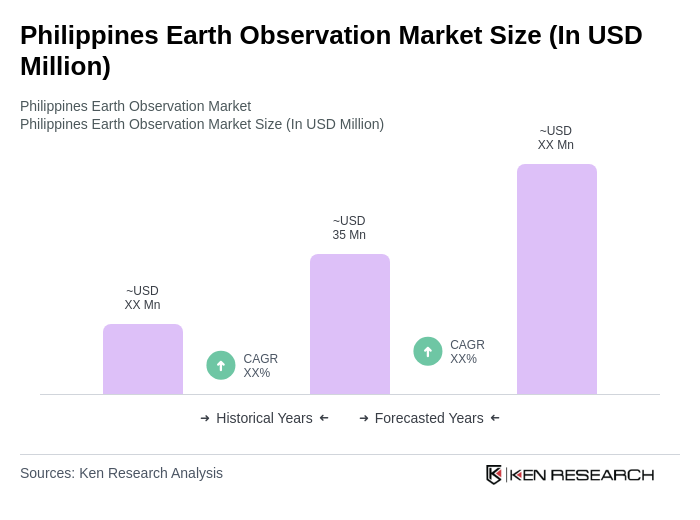
- The Philippines Earth Observation Market is valued at USD 35 million, based on a five-year historical analysis. This growth is primarily driven by increasing demand for satellite data in various sectors, including agriculture, urban planning, and disaster management. The government's commitment to enhancing its space capabilities and the rising awareness of the benefits of Earth observation technologies have significantly contributed to this market expansion. The Philippine Space Agency's initiative to launch earth observation satellites like MULA demonstrates the nation's advancing capabilities in space technology and remote sensing applications.
- Key players in this market include Metro Manila, Cebu, and Davao. Metro Manila dominates due to its status as the capital and economic hub, attracting investments in technology and infrastructure. Cebu and Davao are also significant due to their growing urbanization and development projects, which require advanced Earth observation data for effective planning and management. The government has expanded its Public-Private Partnership pipeline to 230 projects worth approximately USD 44.7 billion, creating substantial opportunities for Earth observation applications in infrastructure development and urban monitoring.
- The Philippine Space Act, Republic Act No. 11363, enacted in 2019 by the Congress of the Philippines, establishes a comprehensive framework for the development and utilization of space resources in the country. This legislation created the Philippine Space Agency (PhilSA) as the central government agency responsible for space science and technology development. The Act mandates the agency to formulate policies, coordinate space-related activities, and promote the peaceful use of outer space for national development. It specifically outlines requirements for satellite data acquisition, space technology research and development, and the establishment of ground receiving stations for Earth observation capabilities. The regulation encourages the application of Earth observation technologies across critical sectors including environmental monitoring, disaster risk reduction and management, agricultural productivity assessment, maritime domain awareness, and climate change adaptation, thereby fostering systematic growth in the Earth observation market through institutional capacity building and strategic partnerships with international space agencies.
Philippines Earth Observation Market Segmentation
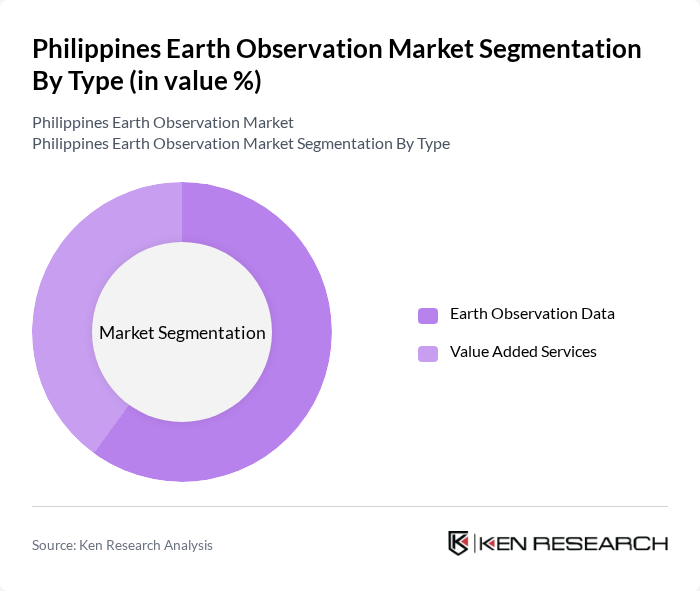
By Type:The market can be segmented into Earth Observation Data and Value Added Services. Earth Observation Data includes raw satellite imagery and data collected from various sources through remote sensing technologies and direct-contact sensors, while Value Added Services encompass the processing, analysis, and interpretation of this data to provide actionable insights for end-users across sectors such as disaster management, environmental monitoring, and agricultural planning.
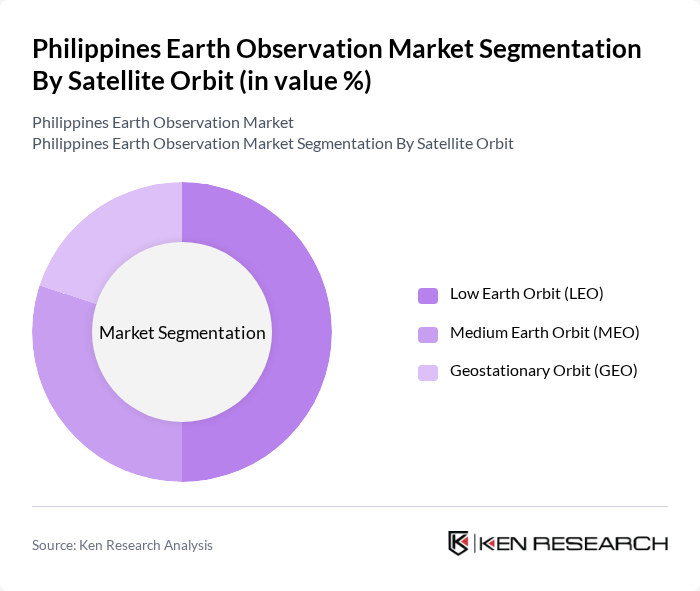
By Satellite Orbit:The market is also categorized by satellite orbit, which includes Low Earth Orbit (LEO), Medium Earth Orbit (MEO), and Geostationary Orbit (GEO). Each orbit type serves different applications, with LEO being preferred for high-resolution imagery and real-time data collection due to its proximity to Earth's surface, while GEO is utilized for continuous monitoring of specific areas, particularly beneficial for weather forecasting and climate monitoring applications that require constant surveillance of geographic regions.
Philippines Earth Observation Market Competitive Landscape
The Philippines Earth Observation Market is characterized by a dynamic mix of regional and international players. Leading participants such as Philippine Space Agency (PhilSA), National Mapping and Resource Information Authority (NAMRIA), DOST-Advanced Science and Technology Institute (DOST-ASTI), Philippine Atmospheric, Geophysical and Astronomical Services Administration (PAGASA), Space Technology and Applications Mastery, Innovation and Advancement (STAMINA4Space), Airbus Defence and Space, Maxar Technologies, Planet Labs PBC, Spire Global, Inc., Geo-Informatics and Space Technology Development Agency (GISTDA), Remote Sensing Solutions Inc. (RSSI), Philippine National Oil Company (PNOC), University of the Philippines - Diliman, Ateneo de Manila University, De La Salle University, University of Santo Tomas, Mindanao State University, Philippine Institute of Volcanology and Seismology (PHIVOLCS) contribute to innovation, geographic expansion, and service delivery in this space.
Philippines Earth Observation Market Industry Analysis
Growth Drivers
- Increasing Demand for Environmental Monitoring:The Philippines faces significant environmental challenges, including deforestation and climate change. In future, the country is projected to allocate approximately PHP 1.5 billion (USD 27 million) for environmental monitoring initiatives. This funding will enhance the use of Earth Observation (EO) technologies to track changes in land use and natural resources, thereby driving demand for EO services. The urgency for accurate data to inform policy decisions further propels this growth.
- Government Initiatives for Disaster Management:The Philippine government has prioritized disaster risk reduction, with an estimated PHP 3 billion (USD 54 million) budgeted for disaster management programs in future. This includes the integration of EO data to improve early warning systems and response strategies. The increasing frequency of natural disasters, such as typhoons and earthquakes, necessitates advanced monitoring solutions, thereby boosting the demand for EO technologies in disaster management.
- Advancements in Satellite Technology:The Philippines is witnessing rapid advancements in satellite technology, with the launch of new satellites expected to increase from 2 to 5 in future. These satellites will enhance data resolution and frequency, providing more accurate and timely information for various applications. The government’s investment of approximately PHP 1 billion (USD 18 million) in satellite development will further stimulate the EO market, enabling better resource management and environmental monitoring.
Market Challenges
- High Initial Investment Costs:The high costs associated with establishing Earth Observation systems pose a significant barrier to entry. Initial investments for satellite launches and ground infrastructure can exceed PHP 2 billion (USD 36 million). This financial burden limits participation from smaller firms and local governments, hindering the overall growth of the EO market. As a result, many potential users may opt for less expensive alternatives, stifling innovation and development.
- Limited Awareness Among Potential Users:Despite the benefits of Earth Observation technologies, awareness remains low among potential users, particularly in local government units and small enterprises. A recent survey indicated that only 30% of local officials are familiar with EO applications. This lack of understanding restricts market penetration and adoption, as many stakeholders are unaware of how EO can enhance decision-making and operational efficiency in various sectors.
Philippines Earth Observation Market Future Outlook
The Philippines Earth Observation market is poised for significant growth, driven by increasing environmental concerns and government initiatives. As the country invests in advanced satellite technologies and integrates EO data into disaster management, the demand for these services will likely rise. Furthermore, the collaboration between public and private sectors will enhance innovation, leading to more localized solutions. The focus on sustainable development goals will also encourage the adoption of EO technologies across various industries, ensuring a robust market trajectory in the coming years.
Market Opportunities
- Expansion of Smart City Initiatives:The Philippine government plans to invest PHP 10 billion (USD 180 million) in smart city projects in future. This investment will create opportunities for integrating Earth Observation data into urban planning and management, enhancing efficiency and sustainability in urban environments.
- Growth in Climate Change Research:With climate change becoming a pressing issue, funding for research is expected to reach PHP 5 billion (USD 90 million) in future. This growth will drive demand for Earth Observation data to support climate modeling and impact assessments, creating a significant market opportunity for EO service providers.
Scope of the Report
| Segment | Sub-Segments |
|---|---|
| By Type | Earth Observation Data Value Added Services |
| By Satellite Orbit | Low Earth Orbit (LEO) Medium Earth Orbit (MEO) Geostationary Orbit (GEO) |
| By End-Use Application | Urban Development and Cultural Heritage Agriculture Climate Services Energy and Raw Materials Infrastructure Others |
| By Data Source | Government Satellites Commercial Satellites Open Source Data |
| By Service Type | Data Acquisition Data Processing Data Analysis |
| By Investment Source | Public Funding Private Investment International Grants |
| By Policy Support | Government Subsidies Tax Incentives Research Grants |
Key Target Audience
Investors and Venture Capitalist Firms
Government and Regulatory Bodies (e.g., Department of Science and Technology, National Mapping and Resource Information Authority)
Environmental NGOs and Conservation Organizations
Agricultural Agencies (e.g., Department of Agriculture)
Disaster Management Authorities (e.g., National Disaster Risk Reduction and Management Council)
Urban Planning and Development Agencies (e.g., Housing and Land Use Regulatory Board)
Telecommunications and IT Companies
Energy and Utility Companies
Players Mentioned in the Report:
Philippine Space Agency (PhilSA)
National Mapping and Resource Information Authority (NAMRIA)
DOST-Advanced Science and Technology Institute (DOST-ASTI)
Philippine Atmospheric, Geophysical and Astronomical Services Administration (PAGASA)
Space Technology and Applications Mastery, Innovation and Advancement (STAMINA4Space)
Airbus Defence and Space
Maxar Technologies
Planet Labs PBC
Spire Global, Inc.
Geo-Informatics and Space Technology Development Agency (GISTDA)
Remote Sensing Solutions Inc. (RSSI)
Philippine National Oil Company (PNOC)
University of the Philippines - Diliman
Ateneo de Manila University
De La Salle University
University of Santo Tomas
Mindanao State University
Philippine Institute of Volcanology and Seismology (PHIVOLCS)
Table of Contents
Market Assessment Phase
1. Executive Summary and Approach
2. Philippines Earth Observation Market Overview
2.1 Key Insights and Strategic Recommendations
2.2 Philippines Earth Observation Market Overview
2.3 Definition and Scope
2.4 Evolution of Market Ecosystem
2.5 Timeline of Key Regulatory Milestones
2.6 Value Chain & Stakeholder Mapping
2.7 Business Cycle Analysis
2.8 Policy & Incentive Landscape
3. Philippines Earth Observation Market Analysis
3.1 Growth Drivers
3.1.1 Increasing demand for environmental monitoring
3.1.2 Government initiatives for disaster management
3.1.3 Advancements in satellite technology
3.1.4 Rising applications in agriculture and forestry
3.2 Market Challenges
3.2.1 High initial investment costs
3.2.2 Limited awareness among potential users
3.2.3 Regulatory hurdles
3.2.4 Data privacy concerns
3.3 Market Opportunities
3.3.1 Expansion of smart city initiatives
3.3.2 Collaborations with international organizations
3.3.3 Growth in climate change research
3.3.4 Development of localized solutions
3.4 Market Trends
3.4.1 Increasing use of AI and machine learning
3.4.2 Integration of Earth Observation data with IoT
3.4.3 Focus on sustainable development goals
3.4.4 Rise of public-private partnerships
3.5 Government Regulation
3.5.1 National policy on space development
3.5.2 Environmental protection laws
3.5.3 Data sharing regulations
3.5.4 Licensing requirements for satellite operations
4. SWOT Analysis
5. Stakeholder Analysis
6. Porter's Five Forces Analysis
7. Philippines Earth Observation Market Market Size, 2019-2024
7.1 By Value
7.2 By Volume
7.3 By Average Selling Price
8. Philippines Earth Observation Market Segmentation
8.1 By Type
8.1.1 Earth Observation Data
8.1.2 Value Added Services
8.2 By Satellite Orbit
8.2.1 Low Earth Orbit (LEO)
8.2.2 Medium Earth Orbit (MEO)
8.2.3 Geostationary Orbit (GEO)
8.3 By End-Use Application
8.3.1 Urban Development and Cultural Heritage
8.3.2 Agriculture
8.3.3 Climate Services
8.3.4 Energy and Raw Materials
8.3.5 Infrastructure
8.3.6 Others
8.4 By Data Source
8.4.1 Government Satellites
8.4.2 Commercial Satellites
8.4.3 Open Source Data
8.5 By Service Type
8.5.1 Data Acquisition
8.5.2 Data Processing
8.5.3 Data Analysis
8.6 By Investment Source
8.6.1 Public Funding
8.6.2 Private Investment
8.6.3 International Grants
8.7 By Policy Support
8.7.1 Government Subsidies
8.7.2 Tax Incentives
8.7.3 Research Grants
9. Philippines Earth Observation Market Competitive Analysis
9.1 Market Share of Key Players
9.2 KPIs for Cross Comparison of Key Players
9.2.1 Company Name
9.2.2 Group Size (Large, Medium, or Small)
9.2.3 Annual Revenue (USD)
9.2.4 Revenue Growth Rate (%)
9.2.5 Market Penetration (Philippines EO Market Share %)
9.2.6 Number of EO Satellites/Assets Deployed
9.2.7 Data Delivery Latency (Hours/Days)
9.2.8 Number of Local Partnerships/Projects
9.2.9 Customer Segments Served (e.g., government, agriculture, energy)
9.2.10 Innovation Index (Patents, New Services, R&D Spend)
9.2.11 Customer Satisfaction Score (NPS or Equivalent)
9.2.12 Average Contract Value (USD)
9.3 SWOT Analysis of Top Players
9.4 Pricing Analysis
9.5 Detailed Profile of Major Companies
9.5.1 Philippine Space Agency (PhilSA)
9.5.2 National Mapping and Resource Information Authority (NAMRIA)
9.5.3 DOST-Advanced Science and Technology Institute (DOST-ASTI)
9.5.4 Philippine Atmospheric, Geophysical and Astronomical Services Administration (PAGASA)
9.5.5 Space Technology and Applications Mastery, Innovation and Advancement (STAMINA4Space)
9.5.6 Airbus Defence and Space
9.5.7 Maxar Technologies
9.5.8 Planet Labs PBC
9.5.9 Spire Global, Inc.
9.5.10 Geo-Informatics and Space Technology Development Agency (GISTDA)
9.5.11 Remote Sensing Solutions Inc. (RSSI)
9.5.12 Philippine National Oil Company (PNOC)
9.5.13 University of the Philippines - Diliman
9.5.14 Ateneo de Manila University
9.5.15 De La Salle University
9.5.16 University of Santo Tomas
9.5.17 Mindanao State University
9.5.18 Philippine Institute of Volcanology and Seismology (PHIVOLCS)
10. Philippines Earth Observation Market End-User Analysis
10.1 Procurement Behavior of Key Ministries
10.1.1 Department of Environment and Natural Resources
10.1.2 Department of Agriculture
10.1.3 Department of Science and Technology
10.1.4 National Disaster Risk Reduction and Management Council
10.2 Corporate Spend on Infrastructure & Energy
10.2.1 Investment in satellite technology
10.2.2 Budget allocation for environmental monitoring
10.2.3 Funding for disaster preparedness initiatives
10.3 Pain Point Analysis by End-User Category
10.3.1 Data accessibility issues
10.3.2 Integration challenges with existing systems
10.3.3 High operational costs
10.4 User Readiness for Adoption
10.4.1 Awareness of Earth Observation benefits
10.4.2 Training and capacity building needs
10.5 Post-Deployment ROI and Use Case Expansion
10.5.1 Evaluation of project outcomes
10.5.2 Identification of new applications
11. Philippines Earth Observation Market Future Size, 2025-2030
11.1 By Value
11.2 By Volume
11.3 By Average Selling Price
Go-To-Market Strategy Phase
1. Whitespace Analysis + Business Model Canvas
1.1 Market Gaps Identification
1.2 Value Proposition Development
1.3 Revenue Streams Analysis
1.4 Cost Structure Evaluation
1.5 Key Partnerships Exploration
1.6 Customer Segmentation
1.7 Channels and Customer Relationships
2. Marketing and Positioning Recommendations
2.1 Branding Strategies
2.2 Product USPs
3. Distribution Plan
3.1 Urban Retail Strategies
3.2 Rural NGO Tie-ups
4. Channel & Pricing Gaps
4.1 Underserved Routes
4.2 Pricing Bands
5. Unmet Demand & Latent Needs
5.1 Category Gaps
5.2 Consumer Segments
6. Customer Relationship
6.1 Loyalty Programs
6.2 After-sales Service
7. Value Proposition
7.1 Sustainability
7.2 Integrated Supply Chains
8. Key Activities
8.1 Regulatory Compliance
8.2 Branding
8.3 Distribution Setup
9. Entry Strategy Evaluation
9.1 Domestic Market Entry Strategy
9.1.1 Product Mix
9.1.2 Pricing Band
9.1.3 Packaging
9.2 Export Entry Strategy
9.2.1 Target Countries
9.2.2 Compliance Roadmap
10. Entry Mode Assessment
10.1 Joint Ventures
10.2 Greenfield Investments
10.3 Mergers & Acquisitions
10.4 Distributor Model
11. Capital and Timeline Estimation
11.1 Capital Requirements
11.2 Timelines
12. Control vs Risk Trade-Off
12.1 Ownership vs Partnerships
13. Profitability Outlook
13.1 Breakeven Analysis
13.2 Long-term Sustainability
14. Potential Partner List
14.1 Distributors
14.2 Joint Ventures
14.3 Acquisition Targets
15. Execution Roadmap
15.1 Phased Plan for Market Entry
15.1.1 Market Setup
15.1.2 Market Entry
15.1.3 Growth Acceleration
15.1.4 Scale & Stabilize
15.2 Key Activities and Milestones
15.2.1 Activity Planning
15.2.2 Milestone Tracking
Research Methodology
Phase 1: Approach1
Desk Research
- Analysis of satellite data availability and usage statistics from government agencies
- Review of academic publications and white papers on Earth observation technologies
- Examination of market reports and industry analyses from relevant trade associations
Primary Research
- Interviews with key stakeholders in the Philippine government’s environmental agencies
- Surveys with private sector companies utilizing Earth observation data for agriculture and disaster management
- Focus groups with academic experts in remote sensing and geospatial analysis
Validation & Triangulation
- Cross-validation of findings through multiple data sources including government reports and industry insights
- Triangulation of qualitative insights from interviews with quantitative data from surveys
- Sanity checks conducted through expert panel reviews to ensure data reliability
Phase 2: Market Size Estimation1
Top-down Assessment
- Estimation of market size based on national budget allocations for Earth observation initiatives
- Analysis of growth trends in sectors such as agriculture, forestry, and disaster response
- Incorporation of international funding and partnerships in Earth observation projects
Bottom-up Modeling
- Collection of data on service pricing from leading Earth observation service providers
- Estimation of market demand based on user adoption rates across various sectors
- Volume x pricing model to calculate potential revenue streams from satellite data services
Forecasting & Scenario Analysis
- Multi-factor regression analysis incorporating economic growth, technological advancements, and regulatory changes
- Scenario planning based on potential shifts in government policy and environmental priorities
- Development of baseline, optimistic, and pessimistic market projections through 2030
Phase 3: CATI Sample Composition1
| Scope Item/Segment | Sample Size | Target Respondent Profiles |
|---|---|---|
| Agricultural Monitoring Services | 100 | Agronomists, Farm Managers |
| Disaster Management Applications | 80 | Emergency Response Coordinators, Local Government Officials |
| Environmental Monitoring Programs | 70 | Environmental Scientists, Policy Makers |
| Urban Planning and Development | 50 | Urban Planners, City Officials |
| Climate Change Research Initiatives | 90 | Climate Researchers, NGO Representatives |
Frequently Asked Questions
What is the current value of the Philippines Earth Observation Market?
The Philippines Earth Observation Market is valued at approximately USD 35 million, reflecting a five-year historical analysis. This growth is driven by increasing demand for satellite data across various sectors, including agriculture, urban planning, and disaster management.
What are the key drivers of growth in the Philippines Earth Observation Market?
Which regions in the Philippines are leading in Earth Observation applications?
What is the role of the Philippine Space Agency (PhilSA) in the Earth Observation Market?
Other Regional/Country Reports
Indonesia Earth Observation Market
Malaysia Earth Observation Market
KSA Earth Observation Market
APAC Earth Observation Market
SEA Earth Observation Market
Vietnam Earth Observation Market
Other Adjacent Reports
Japan Satellite Technology Market
Thailand Remote Sensing Market
Vietnam Geospatial Data Analytics Market
Kuwait Disaster Management Solutions Market
Indonesia Environmental Monitoring Market Size, Share & Forecast, By Monitoring Type, Component & End-Use Industry, 2025-2032North America Precision Agriculture Market Outlook to 2030: Size, Share, Growth and TrendsSouth Korea Urban Planning and Development Market
South Korea Climate Change Adaptation Market
Germany Maritime Domain Awareness Market
Brazil Defense Surveillance Market
Why Buy From Us?

What makes us stand out is that our consultants follow Robust, Refine and Result (RRR) methodology. Robust for clear definitions, approaches and sanity checking, Refine for differentiating respondents' facts and opinions, and Result for presenting data with story.

We have set a benchmark in the industry by offering our clients with syndicated and customized market research reports featuring coverage of entire market as well as meticulous research and analyst insights.

While we don't replace traditional research, we flip the method upside down. Our dual approach of Top Bottom & Bottom Top ensures quality deliverable by not just verifying company fundamentals but also looking at the sector and macroeconomic factors.

With one step in the future, our research team constantly tries to show you the bigger picture. We help with some of the tough questions you may encounter along the way: How is the industry positioned? Best marketing channel? KPI's of competitors? By aligning every element, we help maximize success.

Our report gives you instant access to the answers and sources that other companies might choose to hide. We elaborate each steps of research methodology we have used and showcase you the sample size to earn your trust.

If you need any support, we are here! We pride ourselves on universe strength, data quality, and quick, friendly, and professional service.