About the Report
Base Year 2024Listen to the audio summary
Philippines EMEA Surgical Microscopes Market Overview
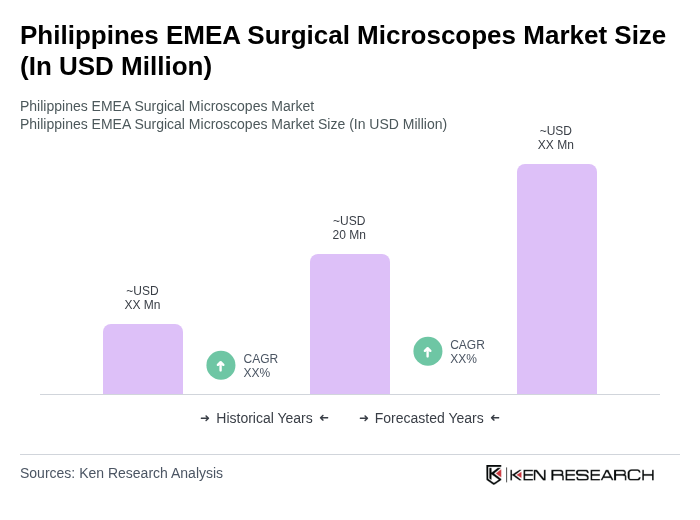
- The Philippines EMEA Surgical Microscopes Market is valued at USD 20 million, based on a five-year historical analysis. This growth is primarily driven by advancements in medical technology, increasing healthcare expenditure, and a rising demand for minimally invasive surgical procedures, trends that are consistent with the global surgical microscopes market expansion. The integration of digital technologies in surgical microscopes, including 3D visualization, fluorescence-guided imaging, and digital documentation, has enhanced their functionality and is supporting greater adoption in neurosurgery, ophthalmology, ENT, spine, and other microsurgical specialties.
- Metro Manila, Cebu, and Davao are the dominant regions in the Philippines EMEA Surgical Microscopes Market. Metro Manila, being the capital, hosts a significant number of tertiary and specialty hospitals and healthcare facilities equipped with advanced surgical technologies, supported by higher healthcare spending and concentration of private hospital groups. Cebu and Davao are also emerging as healthcare hubs, with increasing investments in medical infrastructure, growth of private hospitals, and a growing population seeking quality healthcare services, which collectively contribute to rising demand for surgical operating microscopes in these regions.
- The Government of the Philippines enacted Republic Act No. 11223, known as the Universal Health Care Act, in 2019, administered primarily by the Department of Health and the Philippine Health Insurance Corporation, to ensure that all Filipinos are automatically enrolled into the National Health Insurance Program and have access to quality and affordable health services. This regulation promotes health system integration, strategic health technology investments, and expanded benefits, which in turn encourage public and private providers to procure advanced medical equipment, including surgical microscopes, to improve surgical capacity, quality of care, and patient outcomes across the country.
Philippines EMEA Surgical Microscopes Market Segmentation
By Mounting Type:
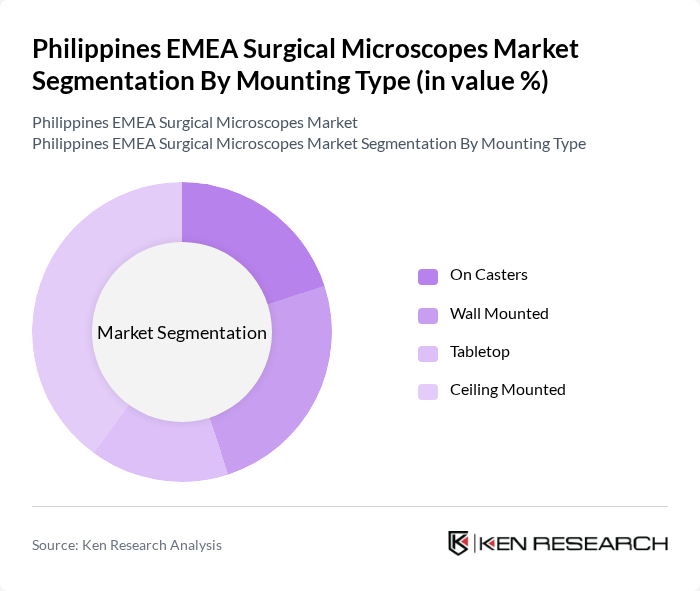
The mounting type of surgical microscopes significantly influences their usability and application in various surgical settings. The subsegments include On Casters, Wall Mounted, Tabletop, and Ceiling Mounted systems, which align with the typical product segmentation used in the global surgical microscope market. Among these, Ceiling Mounted systems dominate the market due to their space-saving design, improved ergonomics, and flexibility in positioning, which are crucial in modern operating rooms where multiple imaging and surgical devices must be integrated around the patient. The demand for these systems is driven by the need for efficient workflow, unobstructed floor space, and better accessibility during complex surgical procedures in neurosurgery, spine, and advanced ophthalmic surgeries.
By Technology / Optical System:
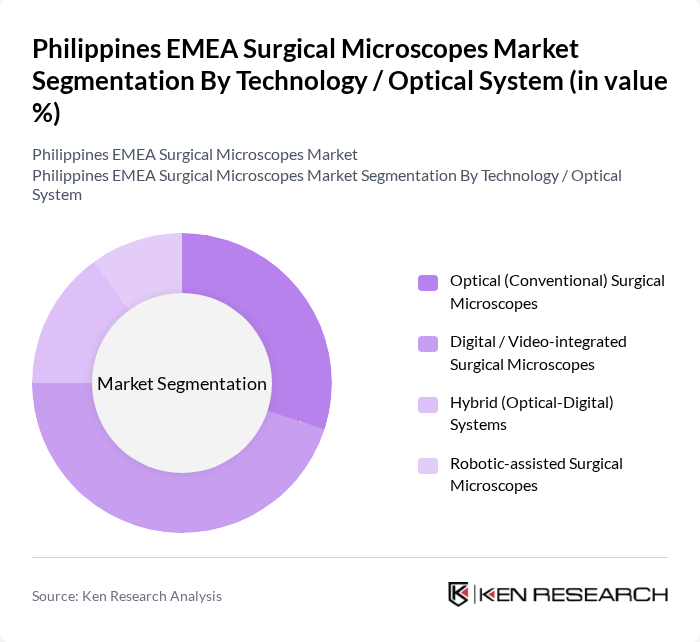
This segmentation includes Optical (Conventional) Surgical Microscopes, Digital / Video-integrated Surgical Microscopes, Hybrid (Optical-Digital) Systems, and Robotic-assisted Surgical Microscopes. Digital / Video-integrated Surgical Microscopes are leading the market due to their enhanced imaging capabilities, integration with digital platforms, and compatibility with 3D and high-definition visualization, which facilitate better surgical precision, teaching, and documentation. The trend towards minimally invasive and image-guided surgeries, including in neurosurgery, ophthalmology, ENT, and spine, further propels the adoption of these advanced systems, while hybrid optical-digital platforms and emerging robotic-assisted microscopes are gaining traction in high-complexity centers.
Philippines EMEA Surgical Microscopes Market Competitive Landscape
The Philippines EMEA Surgical Microscopes Market is characterized by a dynamic mix of regional and international players. Leading participants such as Carl Zeiss Meditec AG, Leica Microsystems (Danaher Corporation), Olympus Corporation, Nikon Corporation, Haag-Streit Surgical GmbH, Topcon Corporation, Alcon Inc., Hoya Corporation (Pentax Medical), Seiler Instrument Inc., Takagi Seiko Co., Ltd., Mizuho Medical Co., Ltd., ARRI Medical, Prescott’s Inc., Global Surgical Corporation, Other Emerging and Local Manufacturers / Distributors contribute to innovation, geographic expansion, and service delivery in this space, in line with their global presence in neurosurgical, ophthalmic, ENT, and dental surgical microscope segments.
Philippines EMEA Surgical Microscopes Market Industry Analysis
Growth Drivers
- Increasing Demand for Minimally Invasive Surgeries:The Philippines has seen a significant rise in minimally invasive surgeries, with an increase of approximately 15% annually. This trend is driven by patient preference for reduced recovery times and lower complication rates. The Department of Health reported that over 220,000 minimally invasive procedures were performed in future, highlighting the growing acceptance of these techniques. This surge directly correlates with the demand for advanced surgical microscopes, which enhance precision and outcomes in such surgeries.
- Technological Advancements in Surgical Microscopy:The surgical microscopy sector is experiencing rapid technological advancements, with innovations such as high-definition imaging and 3D visualization. In future, the introduction of AI-assisted surgical microscopes improved diagnostic accuracy by 30%. The Philippine healthcare sector is increasingly adopting these technologies, with investments in surgical equipment rising to PHP 6 billion. This trend is expected to continue, as hospitals seek to enhance surgical capabilities and improve patient outcomes through advanced tools.
- Rising Prevalence of Neurological Disorders:The Philippines is witnessing a concerning rise in neurological disorders, with the World Health Organization estimating that 1 in 8 Filipinos will be affected by conditions such as stroke and epilepsy by future. This increase has led to a higher demand for specialized surgical procedures, necessitating the use of advanced surgical microscopes. The healthcare system is responding with targeted investments, allocating approximately PHP 4 billion towards neurosurgery facilities and equipment to address this growing health crisis.
Market Challenges
- High Cost of Surgical Microscopes:The high cost of surgical microscopes remains a significant barrier to widespread adoption in the Philippines. Prices for advanced models can exceed PHP 2.5 million, making them inaccessible for many healthcare facilities, particularly in rural areas. This financial constraint limits the ability of hospitals to upgrade their equipment, thereby hindering the overall growth of the surgical microscopy market. As a result, many facilities continue to rely on outdated technology, impacting surgical outcomes.
- Limited Access to Advanced Healthcare Facilities:Access to advanced healthcare facilities is uneven across the Philippines, with urban centers like Metro Manila having significantly better resources than rural areas. According to the Philippine Statistics Authority, only 35% of hospitals in rural regions are equipped with modern surgical microscopes. This disparity creates a challenge in providing equitable healthcare services, as patients in underserved areas may not receive the same quality of surgical care, limiting the overall market potential for surgical microscopes.
Philippines EMEA Surgical Microscopes Market Future Outlook
The future of the surgical microscopes market in the Philippines appears promising, driven by ongoing advancements in technology and increasing healthcare investments. As the government aims to enhance healthcare infrastructure, the integration of digital solutions and AI in surgical procedures is expected to gain traction. Furthermore, the rising awareness of advanced surgical techniques among healthcare professionals will likely lead to greater adoption of innovative surgical microscopes, ultimately improving patient outcomes and expanding market reach across the nation.
Market Opportunities
- Expansion of Healthcare Infrastructure:The Philippine government is investing heavily in healthcare infrastructure, with a budget allocation of PHP 12 billion for new hospitals and clinics in underserved areas. This expansion presents a significant opportunity for surgical microscope manufacturers to penetrate new markets and provide advanced surgical solutions, ultimately improving healthcare access and quality across the nation.
- Increasing Adoption of Telemedicine:The rise of telemedicine in the Philippines, with a projected growth rate of 30% in future, offers a unique opportunity for surgical microscope companies. By integrating telemedicine with surgical procedures, healthcare providers can enhance remote consultations and training, leading to increased demand for advanced surgical microscopes that facilitate these innovative practices and improve patient care.
Scope of the Report
| Segment | Sub-Segments |
|---|---|
| By Mounting Type | On Casters Wall Mounted Tabletop Ceiling Mounted |
| By Technology / Optical System | Optical (Conventional) Surgical Microscopes Digital / Video-integrated Surgical Microscopes Hybrid (Optical-Digital) Systems Robotic-assisted Surgical Microscopes |
| By Application | Neurosurgery and Spine Surgery ENT Surgery Ophthalmology Dentistry Gynecology and Urology Plastic & Reconstructive Surgery Oncology and Other Surgeries |
| By End-User | Hospitals Physician Clinics Ambulatory Surgical Centers Specialized Eye & ENT Centers Other End-Users |
| By Procurement Channel | Direct Sales from Manufacturers Local Distributors / Dealers Group Purchasing Organizations (GPOs) Online and Tender-based Procurement |
| By Price Band | Premium Systems Mid-range Systems Economy / Entry-level Systems |
| By Region (Philippines) | Luzon Visayas Mindanao |
Key Target Audience
Investors and Venture Capitalist Firms
Government and Regulatory Bodies (e.g., Department of Health, Food and Drug Administration)
Manufacturers and Producers
Distributors and Retailers
Healthcare Providers and Hospitals
Medical Device Importers
Industry Associations (e.g., Philippine Medical Device Industry Association)
Financial Institutions
Players Mentioned in the Report:
Carl Zeiss Meditec AG
Leica Microsystems (Danaher Corporation)
Olympus Corporation
Nikon Corporation
Haag-Streit Surgical GmbH
Topcon Corporation
Alcon Inc.
Hoya Corporation (Pentax Medical)
Seiler Instrument Inc.
Takagi Seiko Co., Ltd.
Mizuho Medical Co., Ltd.
ARRI Medical
Prescotts Inc.
Global Surgical Corporation
Other Emerging and Local Manufacturers / Distributors
Table of Contents
Market Assessment Phase
1. Executive Summary and Approach
2. Philippines EMEA Surgical Microscopes Market Overview
2.1 Key Insights and Strategic Recommendations
2.2 Philippines EMEA Surgical Microscopes Market Overview
2.3 Definition and Scope
2.4 Evolution of Market Ecosystem
2.5 Timeline of Key Regulatory Milestones
2.6 Value Chain & Stakeholder Mapping
2.7 Business Cycle Analysis
2.8 Policy & Incentive Landscape
3. Philippines EMEA Surgical Microscopes Market Analysis
3.1 Growth Drivers
3.1.1 Increasing demand for minimally invasive surgeries
3.1.2 Technological advancements in surgical microscopy
3.1.3 Rising prevalence of neurological disorders
3.1.4 Growth in healthcare expenditure
3.2 Market Challenges
3.2.1 High cost of surgical microscopes
3.2.2 Limited access to advanced healthcare facilities
3.2.3 Shortage of trained professionals
3.2.4 Regulatory hurdles in medical device approvals
3.3 Market Opportunities
3.3.1 Expansion of healthcare infrastructure
3.3.2 Increasing adoption of telemedicine
3.3.3 Collaborations with educational institutions
3.3.4 Growing awareness of advanced surgical techniques
3.4 Market Trends
3.4.1 Shift towards digital and robotic-assisted surgeries
3.4.2 Integration of AI in surgical procedures
3.4.3 Rising demand for portable surgical microscopes
3.4.4 Focus on patient-centric healthcare solutions
3.5 Government Regulation
3.5.1 Compliance with FDA regulations
3.5.2 Implementation of quality control standards
3.5.3 Licensing requirements for medical devices
3.5.4 Guidelines for clinical trials and research
4. SWOT Analysis
5. Stakeholder Analysis
6. Porter's Five Forces Analysis
7. Philippines EMEA Surgical Microscopes Market Market Size, 2019-2024
7.1 By Value
7.2 By Volume
7.3 By Average Selling Price
8. Philippines EMEA Surgical Microscopes Market Segmentation
8.1 By Mounting Type
8.1.1 On Casters
8.1.2 Wall Mounted
8.1.3 Tabletop
8.1.4 Ceiling Mounted
8.2 By Technology / Optical System
8.2.1 Optical (Conventional) Surgical Microscopes
8.2.2 Digital / Video-integrated Surgical Microscopes
8.2.3 Hybrid (Optical-Digital) Systems
8.2.4 Robotic-assisted Surgical Microscopes
8.3 By Application
8.3.1 Neurosurgery and Spine Surgery
8.3.2 ENT Surgery
8.3.3 Ophthalmology
8.3.4 Dentistry
8.3.5 Gynecology and Urology
8.3.6 Plastic & Reconstructive Surgery
8.3.7 Oncology and Other Surgeries
8.4 By End-User
8.4.1 Hospitals
8.4.2 Physician Clinics
8.4.3 Ambulatory Surgical Centers
8.4.4 Specialized Eye & ENT Centers
8.4.5 Other End-Users
8.5 By Procurement Channel
8.5.1 Direct Sales from Manufacturers
8.5.2 Local Distributors / Dealers
8.5.3 Group Purchasing Organizations (GPOs)
8.5.4 Online and Tender-based Procurement
8.6 By Price Band
8.6.1 Premium Systems
8.6.2 Mid-range Systems
8.6.3 Economy / Entry-level Systems
8.7 By Region (Philippines)
8.7.1 Luzon
8.7.2 Visayas
8.7.3 Mindanao
9. Philippines EMEA Surgical Microscopes Market Competitive Analysis
9.1 Market Share of Key Players
9.2 Cross Comparison of Key Players
9.2.1 Company Name
9.2.2 Global Surgical Microscopes Revenue (USD Million)
9.2.3 Philippines Revenue / Install Base
9.2.4 3-year CAGR in Surgical Microscopes Segment
9.2.5 Market Share in EMEA vs. Philippines
9.2.6 Average Selling Price Positioning (Premium / Mid / Economy)
9.2.7 R&D Intensity (% of Revenue)
9.2.8 New Product Launches (Last 3 Years)
9.2.9 Installed Base Growth per Year (Units)
9.2.10 Service Network Coverage (Cities / Sites Served)
9.2.11 Tender Win Rate (% of Eligible Public Tenders)
9.2.12 EBITDA Margin – Surgical Microscopes Business (where available)
9.3 SWOT Analysis of Top Players
9.4 Pricing Analysis
9.5 Detailed Profile of Major Companies
9.5.1 Carl Zeiss Meditec AG
9.5.2 Leica Microsystems (Danaher Corporation)
9.5.3 Olympus Corporation
9.5.4 Nikon Corporation
9.5.5 Haag-Streit Surgical GmbH
9.5.6 Topcon Corporation
9.5.7 Alcon Inc.
9.5.8 Hoya Corporation (Pentax Medical)
9.5.9 Seiler Instrument Inc.
9.5.10 Takagi Seiko Co., Ltd.
9.5.11 Mizuho Medical Co., Ltd.
9.5.12 ARRI Medical
9.5.13 Prescott’s Inc.
9.5.14 Global Surgical Corporation
9.5.15 Other Emerging and Local Manufacturers / Distributors
10. Philippines EMEA Surgical Microscopes Market End-User Analysis
10.1 Procurement Behavior of Key Ministries
10.1.1 Budget Allocation Trends
10.1.2 Decision-Making Processes
10.1.3 Supplier Selection Criteria
10.1.4 Contract Management Practices
10.2 Corporate Spend on Infrastructure & Energy
10.2.1 Investment Priorities
10.2.2 Funding Sources
10.2.3 Project Management Approaches
10.2.4 Cost-Benefit Analysis
10.3 Pain Point Analysis by End-User Category
10.3.1 Challenges in Procurement
10.3.2 Operational Inefficiencies
10.3.3 Technology Adoption Barriers
10.3.4 Regulatory Compliance Issues
10.4 User Readiness for Adoption
10.4.1 Training and Support Needs
10.4.2 Infrastructure Readiness
10.4.3 Attitudes Towards New Technologies
10.4.4 Financial Readiness
10.5 Post-Deployment ROI and Use Case Expansion
10.5.1 Performance Metrics
10.5.2 User Feedback Mechanisms
10.5.3 Scalability Considerations
10.5.4 Long-term Value Assessment
11. Philippines EMEA Surgical Microscopes Market Future Size, 2025-2030
11.1 By Value
11.2 By Volume
11.3 By Average Selling Price
Go-To-Market Strategy Phase
1. Whitespace Analysis + Business Model Canvas
1.1 Market Gaps Identification
1.2 Value Proposition Development
1.3 Revenue Streams Analysis
1.4 Cost Structure Evaluation
1.5 Key Partnerships Exploration
2. Marketing and Positioning Recommendations
2.1 Branding Strategies
2.2 Product USPs
2.3 Target Market Segmentation
2.4 Communication Strategies
2.5 Digital Marketing Approaches
3. Distribution Plan
3.1 Urban Retail Strategies
3.2 Rural NGO Tie-ups
3.3 E-commerce Integration
3.4 Logistics and Supply Chain Management
3.5 Distribution Channel Optimization
4. Channel & Pricing Gaps
4.1 Underserved Routes
4.2 Pricing Bands Analysis
4.3 Competitor Pricing Strategies
4.4 Customer Willingness to Pay
4.5 Value-Based Pricing Models
5. Unmet Demand & Latent Needs
5.1 Category Gaps Identification
5.2 Consumer Segments Analysis
5.3 Emerging Trends Exploration
5.4 Future Demand Projections
5.5 Innovation Opportunities
6. Customer Relationship
6.1 Loyalty Programs Development
6.2 After-sales Service Strategies
6.3 Customer Feedback Mechanisms
6.4 Relationship Management Tools
6.5 Community Engagement Initiatives
7. Value Proposition
7.1 Sustainability Initiatives
7.2 Integrated Supply Chains
7.3 Customer-Centric Innovations
7.4 Competitive Differentiation
7.5 Long-term Value Creation
8. Key Activities
8.1 Regulatory Compliance
8.2 Branding Initiatives
8.3 Distribution Setup
8.4 Training and Development Programs
8.5 Performance Monitoring
9. Entry Strategy Evaluation
9.1 Domestic Market Entry Strategy
9.1.1 Product Mix Considerations
9.1.2 Pricing Band Selection
9.1.3 Packaging Strategies
9.2 Export Entry Strategy
9.2.1 Target Countries Identification
9.2.2 Compliance Roadmap Development
10. Entry Mode Assessment
10.1 Joint Ventures
10.2 Greenfield Investments
10.3 Mergers & Acquisitions
10.4 Distributor Model Evaluation
10.5 Risk Assessment
11. Capital and Timeline Estimation
11.1 Capital Requirements Analysis
11.2 Timelines for Market Entry
11.3 Financial Projections
11.4 Resource Allocation
11.5 Milestone Tracking
12. Control vs Risk Trade-Off
12.1 Ownership Considerations
12.2 Partnership Opportunities
12.3 Risk Mitigation Strategies
12.4 Control Mechanisms
12.5 Long-term Strategic Planning
13. Profitability Outlook
13.1 Breakeven Analysis
13.2 Long-term Sustainability Strategies
13.3 Profit Margin Projections
13.4 Cost Management Approaches
13.5 Revenue Growth Strategies
14. Potential Partner List
14.1 Distributors Identification
14.2 Joint Venture Opportunities
14.3 Acquisition Targets
14.4 Strategic Alliances
14.5 Partnership Evaluation Criteria
15. Execution Roadmap
15.1 Phased Plan for Market Entry
15.1.1 Market Setup
15.1.2 Market Entry
15.1.3 Growth Acceleration
15.1.4 Scale & Stabilize
15.2 Key Activities and Milestones
15.2.1 Activity Planning
15.2.2 Milestone Tracking
15.2.3 Performance Evaluation
15.2.4 Adjustment Strategies
Research Methodology
Phase 1: Approach1
Desk Research
- Analysis of industry reports from healthcare associations and medical device organizations in the Philippines
- Review of government publications and healthcare expenditure reports from the Department of Health
- Examination of academic journals and articles focusing on surgical technologies and market trends
Primary Research
- Interviews with surgeons and medical professionals specializing in neurosurgery and ophthalmology
- Surveys conducted with hospital procurement managers and medical equipment distributors
- Field visits to hospitals and surgical centers to gather insights on equipment usage and preferences
Validation & Triangulation
- Cross-validation of data through multiple sources including industry reports and expert opinions
- Triangulation of findings from primary interviews with secondary data trends
- Sanity checks through expert panel discussions with key opinion leaders in the surgical field
Phase 2: Market Size Estimation1
Top-down Assessment
- Estimation of the surgical microscopes market size based on national healthcare spending and surgical procedure volumes
- Segmentation of the market by application areas such as neurosurgery, ophthalmology, and ENT
- Incorporation of growth rates from historical data and projected healthcare trends in the Philippines
Bottom-up Modeling
- Collection of sales data from leading surgical microscope manufacturers operating in the Philippines
- Estimation of market share based on unit sales and revenue figures from key players
- Volume and pricing analysis based on procurement data from hospitals and clinics
Forecasting & Scenario Analysis
- Development of forecasts using time-series analysis and market growth drivers
- Scenario modeling based on potential regulatory changes and technological advancements
- Creation of baseline, optimistic, and pessimistic market scenarios through 2030
Phase 3: CATI Sample Composition1
| Scope Item/Segment | Sample Size | Target Respondent Profiles |
|---|---|---|
| Neurosurgery Equipment Usage | 60 | Neurosurgeons, Hospital Administrators |
| Ophthalmology Surgical Practices | 55 | Ophthalmologists, Clinic Managers |
| ENT Surgical Equipment Insights | 45 | ENT Surgeons, Medical Device Buyers |
| Hospital Procurement Strategies | 50 | Procurement Officers, Supply Chain Managers |
| Market Trends in Surgical Technologies | 40 | Healthcare Analysts, Medical Equipment Consultants |
Frequently Asked Questions
What is the current value of the Philippines EMEA Surgical Microscopes Market?
The Philippines EMEA Surgical Microscopes Market is valued at approximately USD 20 million, reflecting a five-year historical analysis. This growth is attributed to advancements in medical technology and increasing healthcare expenditure.
What factors are driving the growth of surgical microscopes in the Philippines?
Which regions in the Philippines are leading in the surgical microscopes market?
What are the main types of surgical microscopes available in the market?
Other Regional/Country Reports
Other Adjacent Reports
Vietnam Surgical Instruments Market
Global minimally invasive surgery market report size, share, growth drivers, trends, opportunities & forecast 2025–2030Thailand Neurosurgery Devices Market
Middle East Ophthalmology Devices Market Size, Share, Growth Drivers, Trends, Opportunities & Forecast 2025–2030UAE ENT Devices Market Report Size Share Growth Drivers Trends Opportunities & Forecast 2025–2030Thailand Spine Surgery Devices Market
Philippines Medical Imaging Market Size, Share & Forecast, By Product Type, Technology & End User, 2025-2032UAE Surgical Robotics Market
APAC Operating Room Equipment Market Report Size Share Growth Drivers Trends Opportunities & Forecast 2025–2030Thailand Healthcare Infrastructure Market
Why Buy From Us?

What makes us stand out is that our consultants follow Robust, Refine and Result (RRR) methodology. Robust for clear definitions, approaches and sanity checking, Refine for differentiating respondents' facts and opinions, and Result for presenting data with story.

We have set a benchmark in the industry by offering our clients with syndicated and customized market research reports featuring coverage of entire market as well as meticulous research and analyst insights.

While we don't replace traditional research, we flip the method upside down. Our dual approach of Top Bottom & Bottom Top ensures quality deliverable by not just verifying company fundamentals but also looking at the sector and macroeconomic factors.

With one step in the future, our research team constantly tries to show you the bigger picture. We help with some of the tough questions you may encounter along the way: How is the industry positioned? Best marketing channel? KPI's of competitors? By aligning every element, we help maximize success.

Our report gives you instant access to the answers and sources that other companies might choose to hide. We elaborate each steps of research methodology we have used and showcase you the sample size to earn your trust.

If you need any support, we are here! We pride ourselves on universe strength, data quality, and quick, friendly, and professional service.