About the Report
Base Year 2024Philippines Grain Processing Equipment Market Overview
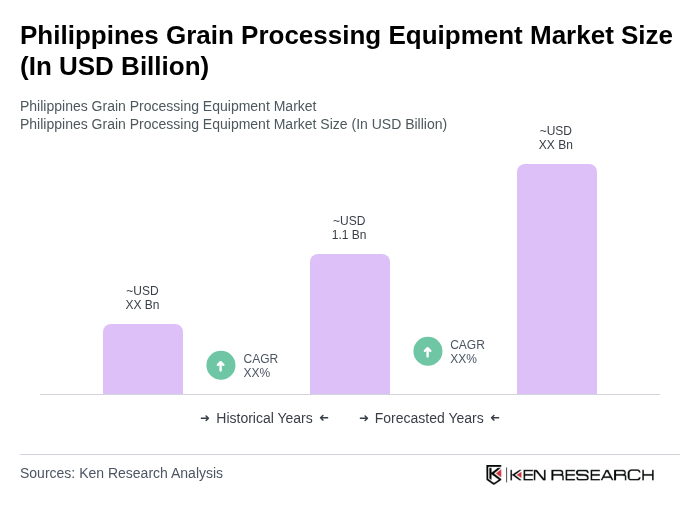
- The Philippines Grain Processing Equipment Market is valued at USD 1.1 billion, based on a five-year historical analysis and benchmarking against the global grain processing equipment market and the scale of the domestic grain mill products industry. This growth is primarily driven by the increasing demand for processed food products, rising population, and the need for efficient grain handling and storage solutions. The market is also supported by advancements in technology and automation in grain processing, such as higher-efficiency milling lines, computerized cleaning and sorting, and IoT?enabled storage and handling systems, which enhance productivity, improve yield, and reduce operational costs.
- Key cities such as Manila, Cebu, and Davao dominate the market due to their strategic locations, robust infrastructure, and concentration of food processing industries. Manila serves as the economic hub and hosts major flour mills and food manufacturers, while Cebu and Davao are vital for agricultural production, port logistics, and distribution, making them critical nodes for investment in rice mills, feed mills, and associated grain processing equipment.
- The Rice Tariffication Law (Republic Act No. 11203), implemented by the Philippine government in 2019 and fully operational in subsequent years, liberalizes rice imports by replacing quantitative restrictions with tariffs and establishes the Rice Competitiveness Enhancement Fund (RCEF) to finance farm mechanization, seed development, credit, and extension services. This regulation encourages investments in modern grain processing technologies and infrastructure—including dryers, mechanical rice mills, and post?harvest equipment—thereby supporting demand for advanced grain processing machinery and equipment in the country.
Philippines Grain Processing Equipment Market Segmentation
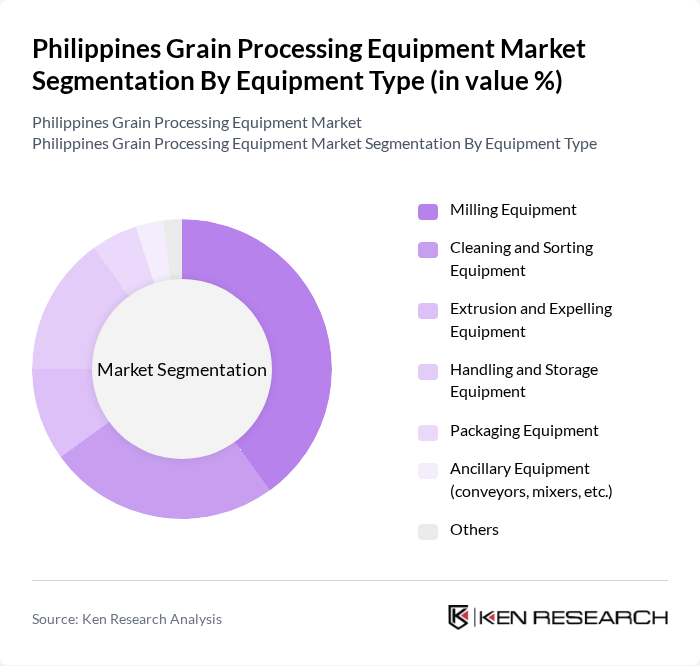
By Equipment Type:The equipment type segmentation includes various categories essential for grain processing. The dominant sub-segment is Milling Equipment, which is crucial for converting raw grains into flour, meal, and other value?added products and reflects the global pattern where milling equipment holds the largest share of grain processing equipment demand. This segment is driven by the high demand for flour and grain-based ingredients in the food industry, particularly for bread, noodles, snacks, and pastries, supported by the expanding grain mill products market in the Philippines. Cleaning and Sorting Equipment follows closely, as it ensures the quality and safety of grains before processing by removing impurities and contaminants, in line with tighter food safety and mycotoxin standards. The trend towards automation is also influencing the growth of Automatic Handling and Storage Equipment, including conveyors, silos, and automated loading systems, which enhances efficiency, reduces grain loss, and lowers labor costs, especially in larger commercial mills and feed plants.
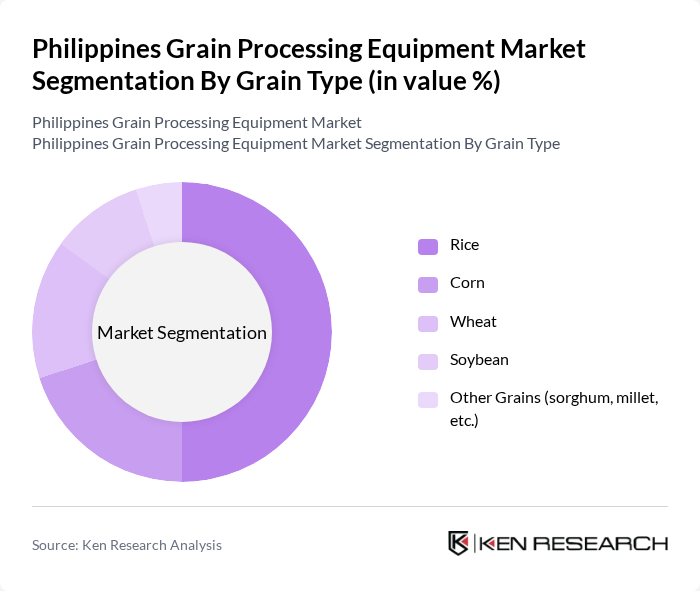
By Grain Type:The grain type segmentation highlights the various grains processed using specialized equipment. Rice is the leading sub-segment, reflecting its status as the primary staple food in the Philippines and the country’s position among the world’s largest rice producers and consumers, which sustains strong demand for rice milling, drying, and polishing equipment. The demand for rice processing equipment is driven by the need for efficient milling, grading, and packaging solutions to handle both domestic production and imported rice flows under the Rice Tariffication Law. Corn follows as the second most significant grain type, primarily used for animal feed and processed food products, supporting investments in feed milling and associated grinding, mixing, and pelleting equipment. Wheat and soybean are also notable, with increasing interest in wheat-based bakery and noodle products and soy as a protein source in feed and food, further driving the need for specialized milling, cleaning, and oilseed processing equipment for these imported grains.
Philippines Grain Processing Equipment Market Competitive Landscape
The Philippines Grain Processing Equipment Market is characterized by a dynamic mix of regional and international players. Leading participants such as Bühler Group, Satake Corporation (Satake Philippines), Alapala, GEA Group AG (Golfetto Sangati), PETKUS Technologie GmbH, Cargill Philippines, Inc., Philippine Foremost Milling Corporation, San Miguel Foods, Inc., Universal Robina Corporation, Vitarich Corporation, Bounty Agro Ventures, Inc., Del Monte Philippines, Inc., AgriNurture, Inc., RFM Corporation, Selected Local Grain Mill and Rice Mill Equipment Manufacturers contribute to innovation, geographic expansion, and service delivery in this space.
Philippines Grain Processing Equipment Market Industry Analysis
Growth Drivers
- Increasing Demand for Processed Grains:The Philippines has seen a significant rise in the demand for processed grains, with consumption reaching approximately 8 million metric tons in future. This surge is driven by urbanization and changing dietary preferences, as more consumers opt for ready-to-eat products. The Philippine Statistics Authority reported a 5% annual increase in processed grain consumption, indicating a robust market for grain processing equipment to meet this growing demand.
- Technological Advancements in Processing Equipment:The grain processing sector is experiencing rapid technological advancements, with investments in modern equipment increasing by 15% in future. Innovations such as automated milling systems and energy-efficient machinery are enhancing productivity and reducing operational costs. The Department of Agriculture has noted that these advancements are crucial for improving the competitiveness of local grain processors, thereby driving the demand for new processing equipment.
- Government Support for Agricultural Modernization:The Philippine government has allocated approximately PHP 10 billion (around USD 200 million) for agricultural modernization initiatives in future. This funding aims to enhance grain processing capabilities and improve infrastructure. Programs such as the Agricultural Competitiveness Enhancement Fund are designed to support local farmers and processors, fostering a favorable environment for the growth of the grain processing equipment market.
Market Challenges
- High Initial Investment Costs:The high initial investment required for modern grain processing equipment poses a significant challenge for local processors. Equipment costs can range from PHP 1 million to PHP 5 million (USD 20,000 to USD 100,000), making it difficult for small-scale farmers to upgrade their facilities. This financial barrier limits access to advanced technology, hindering productivity and competitiveness in the market.
- Limited Access to Financing for Small-Scale Farmers:Many small-scale farmers in the Philippines struggle to secure financing for purchasing grain processing equipment. According to the Bangko Sentral ng Pilipinas, only 30% of small farmers have access to formal credit. This lack of financial support restricts their ability to invest in necessary technology, ultimately affecting their operational efficiency and market participation.
Philippines Grain Processing Equipment Market Future Outlook
The future of the Philippines grain processing equipment market appears promising, driven by ongoing technological innovations and increasing consumer demand for processed grains. As the government continues to invest in agricultural modernization, local processors are likely to adopt more advanced equipment. Additionally, the growing trend towards sustainability and organic products will further shape the market landscape, encouraging investments in eco-friendly processing technologies and practices.
Market Opportunities
- Expansion of E-Commerce in Agricultural Products:The rise of e-commerce platforms in the Philippines presents a significant opportunity for grain processors. With online sales of agricultural products projected to reach PHP 5 billion (USD 100 million) by future, processors can leverage digital channels to reach a broader customer base, enhancing their market presence and sales potential.
- Growing Interest in Organic Grain Processing:There is an increasing consumer preference for organic products, with the organic food market in the Philippines valued at approximately PHP 3 billion (USD 60 million) in future. This trend offers grain processors the opportunity to invest in organic processing technologies, catering to health-conscious consumers and potentially increasing profit margins through premium pricing.
Scope of the Report
| Segment | Sub-Segments |
|---|---|
| By Equipment Type | Milling Equipment Cleaning and Sorting Equipment Extrusion and Expelling Equipment Handling and Storage Equipment Packaging Equipment Ancillary Equipment (conveyors, mixers, etc.) Others |
| By Grain Type | Rice Corn Wheat Soybean Other Grains (sorghum, millet, etc.) |
| By Mode of Operation | Manual Semi-Automatic Automatic |
| By Application | Food Processing (flour, noodles, bakery, snacks) Animal Feed Production Seed Processing and Conditioning Industrial and Biofuel Applications Others |
| By End-User | Grain Milling Companies Integrated Food and Beverage Manufacturers Animal Feed Manufacturers Farmer Cooperatives and Aggregators Government and Institutional Buyers Others |
| By Region | Luzon Visayas Mindanao |
Key Target Audience
Investors and Venture Capitalist Firms
Government and Regulatory Bodies (e.g., Department of Agriculture, Bureau of Agricultural and Fisheries Standards)
Manufacturers and Producers
Distributors and Retailers
Food Processing Companies
Equipment Suppliers and Manufacturers
Industry Associations (e.g., Philippine Association of Food Technologists)
Financial Institutions
Players Mentioned in the Report:
Buhler Group
Satake Corporation (Satake Philippines)
Alapala
GEA Group AG (Golfetto Sangati)
PETKUS Technologie GmbH
Cargill Philippines, Inc.
Philippine Foremost Milling Corporation
San Miguel Foods, Inc.
Universal Robina Corporation
Vitarich Corporation
Bounty Agro Ventures, Inc.
Del Monte Philippines, Inc.
AgriNurture, Inc.
RFM Corporation
Selected Local Grain Mill and Rice Mill Equipment Manufacturers
Table of Contents
Market Assessment Phase
1. Executive Summary and Approach
2. Philippines Grain Processing Equipment Market Overview
2.1 Key Insights and Strategic Recommendations
2.2 Philippines Grain Processing Equipment Market Overview
2.3 Definition and Scope
2.4 Evolution of Market Ecosystem
2.5 Timeline of Key Regulatory Milestones
2.6 Value Chain & Stakeholder Mapping
2.7 Business Cycle Analysis
2.8 Policy & Incentive Landscape
3. Philippines Grain Processing Equipment Market Analysis
3.1 Growth Drivers
3.1.1 Increasing demand for processed grains
3.1.2 Technological advancements in processing equipment
3.1.3 Government support for agricultural modernization
3.1.4 Rising consumer preference for convenience foods
3.2 Market Challenges
3.2.1 High initial investment costs
3.2.2 Limited access to financing for small-scale farmers
3.2.3 Competition from imported equipment
3.2.4 Regulatory compliance complexities
3.3 Market Opportunities
3.3.1 Expansion of e-commerce in agricultural products
3.3.2 Growing interest in organic grain processing
3.3.3 Development of sustainable processing technologies
3.3.4 Partnerships with local cooperatives
3.4 Market Trends
3.4.1 Shift towards automation in grain processing
3.4.2 Increasing focus on food safety and quality
3.4.3 Adoption of energy-efficient processing solutions
3.4.4 Rise in demand for gluten-free and specialty grains
3.5 Government Regulation
3.5.1 Implementation of food safety standards
3.5.2 Subsidies for local grain processing initiatives
3.5.3 Environmental regulations on waste management
3.5.4 Import tariffs on foreign grain processing equipment
4. SWOT Analysis
5. Stakeholder Analysis
6. Porter's Five Forces Analysis
7. Philippines Grain Processing Equipment Market Market Size, 2019-2024
7.1 By Value
7.2 By Volume
7.3 By Average Selling Price
8. Philippines Grain Processing Equipment Market Segmentation
8.1 By Equipment Type
8.1.1 Milling Equipment
8.1.2 Cleaning and Sorting Equipment
8.1.3 Extrusion and Expelling Equipment
8.1.4 Handling and Storage Equipment
8.1.5 Packaging Equipment
8.1.6 Ancillary Equipment (conveyors, mixers, etc.)
8.1.7 Others
8.2 By Grain Type
8.2.1 Rice
8.2.2 Corn
8.2.3 Wheat
8.2.4 Soybean
8.2.5 Other Grains (sorghum, millet, etc.)
8.3 By Mode of Operation
8.3.1 Manual
8.3.2 Semi-Automatic
8.3.3 Automatic
8.4 By Application
8.4.1 Food Processing (flour, noodles, bakery, snacks)
8.4.2 Animal Feed Production
8.4.3 Seed Processing and Conditioning
8.4.4 Industrial and Biofuel Applications
8.4.5 Others
8.5 By End-User
8.5.1 Grain Milling Companies
8.5.2 Integrated Food and Beverage Manufacturers
8.5.3 Animal Feed Manufacturers
8.5.4 Farmer Cooperatives and Aggregators
8.5.5 Government and Institutional Buyers
8.5.6 Others
8.6 By Region
8.6.1 Luzon
8.6.2 Visayas
8.6.3 Mindanao
9. Philippines Grain Processing Equipment Market Competitive Analysis
9.1 Market Share of Key Players
9.2 Cross Comparison of Key Players
9.2.1 Company Name
9.2.2 Group Size (large, medium, or small as per industry convention)
9.2.3 Philippines Grain Processing Equipment Revenue (PHP / USD)
9.2.4 3-Year CAGR in Philippines Grain Processing Equipment Revenue
9.2.5 EBITDA Margin from Grain Processing Equipment Business
9.2.6 Market Share in Philippines Grain Processing Equipment Market (%)
9.2.7 Installed Base of Grain Processing Lines in the Philippines (number of lines)
9.2.8 Order Backlog / New Order Intake (annual, value)
9.2.9 Average Selling Price Band by Key Product Category
9.2.10 R&D Intensity (% of revenue spent on product development)
9.2.11 CAPEX Intensity (% of revenue invested in capacity and localization)
9.2.12 Philippines Coverage (number of provinces / key hubs served)
9.2.13 Key Local Partnerships / Distributors
9.2.14 After-Sales Service Network Coverage (service centers, engineers)
9.2.15 Share of Revenue from Aftermarket & Services (%)
9.3 SWOT Analysis of Top Players
9.4 Pricing Analysis
9.5 Detailed Profile of Major Companies
9.5.1 Bühler Group
9.5.2 Satake Corporation (Satake Philippines)
9.5.3 Alapala
9.5.4 GEA Group AG (Golfetto Sangati)
9.5.5 PETKUS Technologie GmbH
9.5.6 Cargill Philippines, Inc.
9.5.7 Philippine Foremost Milling Corporation
9.5.8 San Miguel Foods, Inc.
9.5.9 Universal Robina Corporation
9.5.10 Vitarich Corporation
9.5.11 Bounty Agro Ventures, Inc.
9.5.12 Del Monte Philippines, Inc.
9.5.13 AgriNurture, Inc.
9.5.14 RFM Corporation
9.5.15 Selected Local Grain Mill and Rice Mill Equipment Manufacturers
10. Philippines Grain Processing Equipment Market End-User Analysis
10.1 Procurement Behavior of Key Ministries
10.1.1 Ministry of Agriculture
10.1.2 Department of Trade and Industry
10.1.3 Department of Science and Technology
10.2 Corporate Spend on Infrastructure & Energy
10.2.1 Investment in Processing Facilities
10.2.2 Budget Allocation for Equipment Upgrades
10.3 Pain Point Analysis by End-User Category
10.3.1 Smallholder Farmers
10.3.2 Large Agricultural Enterprises
10.4 User Readiness for Adoption
10.4.1 Training and Support Needs
10.4.2 Technology Acceptance Levels
10.5 Post-Deployment ROI and Use Case Expansion
10.5.1 Performance Metrics Tracking
10.5.2 Future Investment Plans
11. Philippines Grain Processing Equipment Market Future Size, 2025-2030
11.1 By Value
11.2 By Volume
11.3 By Average Selling Price
Go-To-Market Strategy Phase
1. Whitespace Analysis + Business Model Canvas
1.1 Market Gaps Identification
1.2 Business Model Development
2. Marketing and Positioning Recommendations
2.1 Branding Strategies
2.2 Product USPs
3. Distribution Plan
3.1 Urban Retail Strategies
3.2 Rural NGO Tie-ups
4. Channel & Pricing Gaps
4.1 Underserved Routes
4.2 Pricing Bands
5. Unmet Demand & Latent Needs
5.1 Category Gaps
5.2 Consumer Segments
6. Customer Relationship
6.1 Loyalty Programs
6.2 After-sales Service
7. Value Proposition
7.1 Sustainability Initiatives
7.2 Integrated Supply Chains
8. Key Activities
8.1 Regulatory Compliance
8.2 Branding Efforts
8.3 Distribution Setup
9. Entry Strategy Evaluation
9.1 Domestic Market Entry Strategy
9.1.1 Product Mix Considerations
9.1.2 Pricing Band Strategy
9.1.3 Packaging Innovations
9.2 Export Entry Strategy
9.2.1 Target Countries Identification
9.2.2 Compliance Roadmap Development
10. Entry Mode Assessment
10.1 Joint Ventures
10.2 Greenfield Investments
10.3 Mergers & Acquisitions
10.4 Distributor Model
11. Capital and Timeline Estimation
11.1 Capital Requirements
11.2 Timelines for Implementation
12. Control vs Risk Trade-Off
12.1 Ownership Considerations
12.2 Partnerships Evaluation
13. Profitability Outlook
13.1 Breakeven Analysis
13.2 Long-term Sustainability Strategies
14. Potential Partner List
14.1 Distributors
14.2 Joint Ventures
14.3 Acquisition Targets
15. Execution Roadmap
15.1 Phased Plan for Market Entry
15.1.1 Market Setup
15.1.2 Market Entry
15.1.3 Growth Acceleration
15.1.4 Scale & Stabilize
15.2 Key Activities and Milestones
15.2.1 Milestone Tracking
15.2.2 Activity Scheduling
Research Methodology
Phase 1: Approach1
Desk Research
- Industry reports from the Philippine Statistics Authority and relevant agricultural agencies
- Market analysis publications from trade associations such as the Philippine Chamber of Commerce
- Academic journals and white papers focusing on grain processing technologies and market trends
Primary Research
- Interviews with key stakeholders in grain processing equipment manufacturing
- Surveys conducted with grain mill operators and agricultural equipment distributors
- Field visits to processing plants to gather firsthand insights on equipment usage and needs
Validation & Triangulation
- Cross-validation of data through multiple sources including government publications and industry reports
- Triangulation of findings from primary interviews with secondary data trends
- Sanity checks through expert panels comprising industry veterans and academic experts
Phase 2: Market Size Estimation1
Top-down Assessment
- Analysis of national grain production statistics to estimate equipment demand
- Segmentation of the market by grain type and processing method
- Incorporation of government agricultural policies and initiatives affecting grain processing
Bottom-up Modeling
- Collection of sales data from leading grain processing equipment manufacturers
- Estimation of market size based on unit sales and average selling prices
- Volume estimates derived from operational capacities of existing processing facilities
Forecasting & Scenario Analysis
- Multi-variable forecasting models considering factors like population growth and dietary changes
- Scenario analysis based on potential shifts in agricultural policy and technology adoption rates
- Development of baseline, optimistic, and pessimistic market growth projections through 2030
Phase 3: CATI Sample Composition1
| Scope Item/Segment | Sample Size | Target Respondent Profiles |
|---|---|---|
| Grain Processing Equipment Manufacturers | 120 | Product Managers, Sales Directors |
| Grain Mill Operators | 90 | Operations Managers, Plant Supervisors |
| Agricultural Equipment Distributors | 70 | Sales Representatives, Distribution Managers |
| Government Agricultural Agencies | 50 | Policy Makers, Agricultural Analysts |
| Research Institutions Focused on Agriculture | 40 | Research Scientists, Agricultural Economists |
Frequently Asked Questions
What is the current value of the Philippines Grain Processing Equipment Market?
The Philippines Grain Processing Equipment Market is valued at approximately USD 1.1 billion, reflecting a robust growth driven by increasing demand for processed food products and advancements in technology and automation in grain processing.
What factors are driving the growth of the grain processing equipment market in the Philippines?
Which cities are the main hubs for grain processing equipment in the Philippines?
How has the Rice Tariffication Law impacted the grain processing equipment market?
Other Regional/Country Reports
Indonesia Grain Processing Equipment Market
Malaysia Grain Processing Equipment Market
KSA Grain Processing Equipment Market
APAC Grain Processing Equipment Market
SEA Grain Processing Equipment Market
Vietnam Grain Processing Equipment Market
Other Adjacent Reports
Brazil Animal Feed Processing Market
Qatar Flour Milling Equipment Market
Indonesia Rice Milling Equipment Market
Singapore Grain Storage Equipment Market
South Korea Drying Equipment Market
Philippines Cleaning and Sorting Equipment Market
KSA Oilseed Processing Equipment Market
Malaysia Packaging Machinery Market
Why Buy From Us?

What makes us stand out is that our consultants follow Robust, Refine and Result (RRR) methodology. Robust for clear definitions, approaches and sanity checking, Refine for differentiating respondents' facts and opinions, and Result for presenting data with story.

We have set a benchmark in the industry by offering our clients with syndicated and customized market research reports featuring coverage of entire market as well as meticulous research and analyst insights.

While we don't replace traditional research, we flip the method upside down. Our dual approach of Top Bottom & Bottom Top ensures quality deliverable by not just verifying company fundamentals but also looking at the sector and macroeconomic factors.

With one step in the future, our research team constantly tries to show you the bigger picture. We help with some of the tough questions you may encounter along the way: How is the industry positioned? Best marketing channel? KPI's of competitors? By aligning every element, we help maximize success.

Our report gives you instant access to the answers and sources that other companies might choose to hide. We elaborate each steps of research methodology we have used and showcase you the sample size to earn your trust.

If you need any support, we are here! We pride ourselves on universe strength, data quality, and quick, friendly, and professional service.