Philippines hydrogel market report size, share, growth drivers, trends, opportunities & forecast 2025–2030

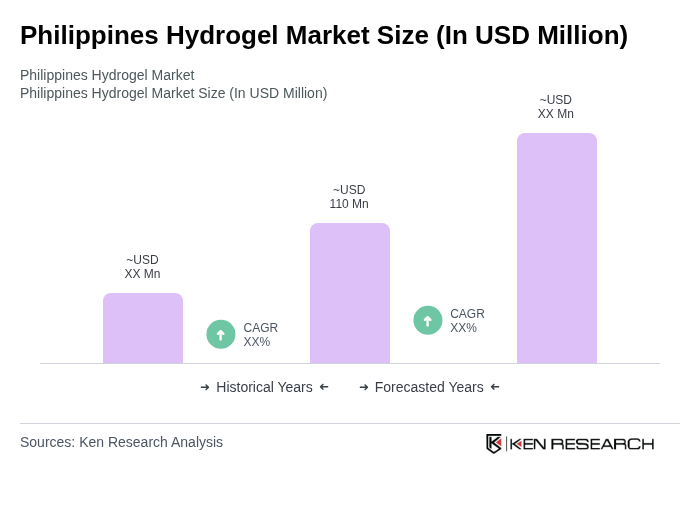
The Philippines Hydrogel Market, valued at USD 110 million, is growing due to applications in healthcare, agriculture, and personal care, with key regions like Metro Manila leading the expansion.

Region:Asia

Author(s):Dev

Product Code:KRAA9687

Pages:86

Published On:November 2025
About the Report

Base Year 2024

Philippines Hydrogel Market Overview

  • The Philippines Hydrogel Market is valued at USD 110 million, based on a five-year historical analysis. This growth is primarily driven by the increasing demand for hydrogels in healthcare applications, particularly in wound care and drug delivery systems, alongside the rising adoption of hydrogels in agriculture for soil conditioning and water retention. Recent trends highlight the expansion of hydrogels in personal care, hygiene products, and advanced agricultural solutions, reflecting broader regional growth in Asia-Pacific markets .
  • Metro Manila, Cebu, and Davao are the dominant regions in the Philippines Hydrogel Market. Metro Manila leads due to its concentration of healthcare facilities and research institutions, while Cebu and Davao benefit from their strategic locations for agricultural activities and distribution networks, enhancing market accessibility. These regions also serve as key hubs for medical device importation and distribution .
  • The Philippine government has implemented regulations to promote the use of biocompatible materials in medical applications. This includes the Department of Health Administrative Order No. 2019-0001, issued by the Department of Health, which mandates that all medical-grade hydrogels must comply with Philippine FDA safety and efficacy standards, ensuring products are safe for patient use and meet international health requirements. The order covers product registration, labeling, and post-market surveillance for medical devices containing hydrogels .
Philippines Hydrogel Market Size

Philippines Hydrogel Market Segmentation

By Type:The hydrogel market can be segmented into four main types: Natural Hydrogels, Synthetic Hydrogels, Hybrid Hydrogels, and Superabsorbent Polymers. Natural Hydrogels, such as alginate and chitosan, are gaining traction due to their biocompatibility and biodegradability, with increased adoption in wound care and tissue engineering. Synthetic Hydrogels, including polyacrylate and polyacrylamide, dominate the market due to their versatility, stability, and broad application in medical and agricultural sectors. Hybrid Hydrogels combine the benefits of both natural and synthetic materials, supporting advanced drug delivery and regenerative medicine. Superabsorbent Polymers are primarily used in hygiene products and agriculture, driven by demand for water retention solutions and personal care items. The increasing demand for advanced wound care products, drug delivery systems, and sustainable agricultural inputs is driving the growth of these segments .
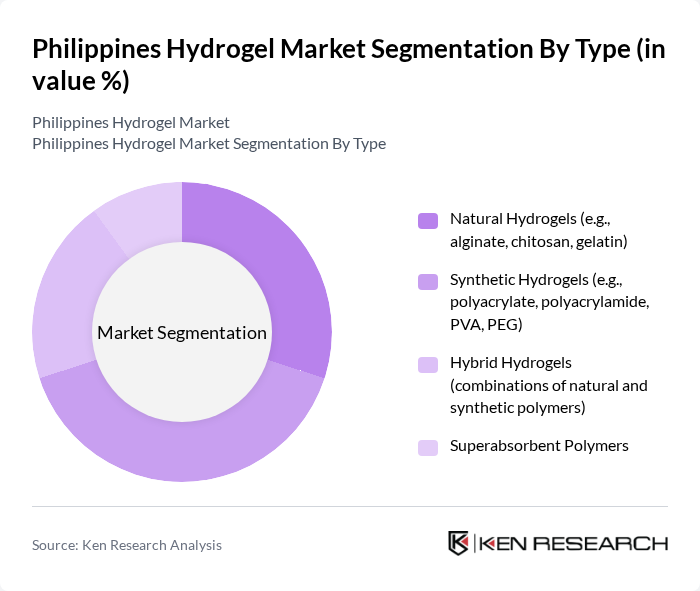
Philippines Hydrogel Market segmentation by Type.

By End-User:The hydrogel market is segmented by end-user into Healthcare, Agriculture, Cosmetics & Personal Care, Industrial, Food Industry, and Others. The Healthcare sector is the largest consumer of hydrogels, driven by the increasing need for advanced wound care products, drug delivery systems, and medical devices. Agriculture is also a significant segment, utilizing hydrogels for soil conditioning, water retention, and crop management, with growing adoption of biodegradable hydrogels for sustainable farming. The Cosmetics & Personal Care segment is expanding due to the rising demand for hydrating skincare and hygiene products. Industrial applications, including water treatment and smart packaging, are growing as hydrogels offer innovative solutions for moisture control and environmental remediation. The Food Industry leverages hydrogels for edible coatings and packaging, while other sectors utilize hydrogels in niche applications such as biosensors and controlled release systems .
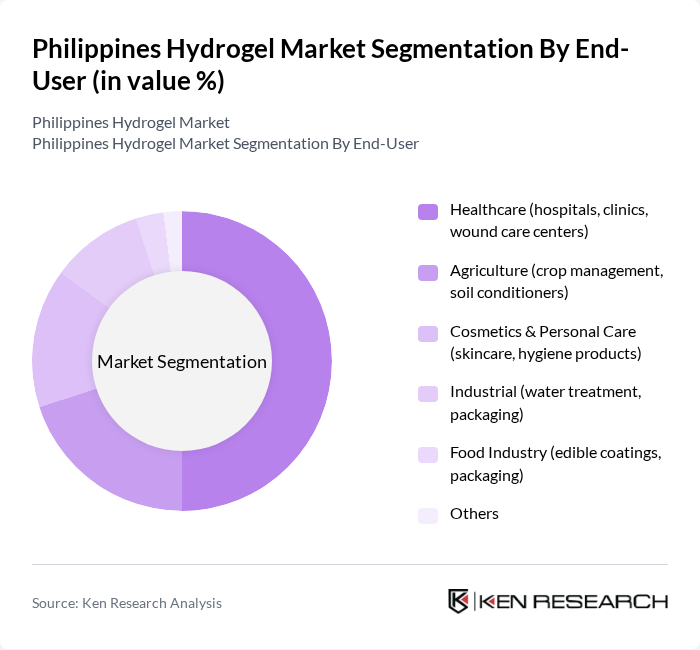
Philippines Hydrogel Market segmentation by End-User.

Philippines Hydrogel Market Competitive Landscape

The Philippines Hydrogel Market is characterized by a dynamic mix of regional and international players. Leading participants such as Union Chemical Philippines Inc., Chemrez Technologies Inc., Dow Philippines (Dow Chemical Company), Evonik Philippines Inc., BASF Philippines Inc., JG Summit Petrochemicals Group, 3M Philippines, Henkel Philippines, MedAsia Medical Products Corporation, Cardinal Health Philippines, Johnson & Johnson Philippines, Unilab (United Laboratories Inc.), Metro Drug Inc., Philippine Medical Supplies, SuySing Commercial Corporation contribute to innovation, geographic expansion, and service delivery in this space.

Union Chemical Philippines Inc.

1995

Quezon City, Philippines

Chemrez Technologies Inc.

1998

Pasig City, Philippines

Dow Philippines (Dow Chemical Company)

1965

Taguig City, Philippines

Evonik Philippines Inc.

2000

Pasig City, Philippines

BASF Philippines Inc.

1994

Manila, Philippines

Company

Establishment Year

Headquarters

Group Size (Large, Medium, or Small as per industry convention)

Revenue Growth Rate (annual % growth in hydrogel segment)

Market Penetration Rate (share of hydrogel sales in Philippines market)

Product Portfolio Breadth (number of hydrogel SKUs/applications)

R&D Intensity (R&D spend as % of hydrogel revenue)

Regulatory Compliance Score (FDA/DOH certifications, audit results)

Philippines Hydrogel Market Industry Analysis

Growth Drivers

  • Increasing Demand for Wound Care Products:The Philippines has seen a significant rise in the demand for wound care products, driven by an aging population and increasing incidences of chronic wounds. In future, the healthcare expenditure is projected to reach approximately PHP 1.5 trillion, with wound care accounting for a substantial portion. This growth is further supported by the increasing prevalence of diabetes, which affects around 5.5 million Filipinos, necessitating advanced wound care solutions like hydrogels.
  • Rising Applications in Agriculture:The agricultural sector in the Philippines is increasingly adopting hydrogels for soil moisture retention and crop yield enhancement. In future, the agricultural output is expected to grow by 4.0%, with hydrogels playing a crucial role in improving water efficiency. The government’s push for sustainable farming practices, alongside a projected increase in agricultural investments to PHP 350 billion, is likely to further drive the demand for hydrogels in this sector.
  • Growth in the Cosmetic and Personal Care Industry:The cosmetic and personal care market in the Philippines is anticipated to reach PHP 250 billion in future, with hydrogels being increasingly utilized in skincare products. The rising consumer awareness regarding skin health and the demand for innovative beauty solutions are propelling this trend. Additionally, the growth of e-commerce platforms is facilitating the distribution of hydrogel-based products, further enhancing market penetration in this segment.

Market Challenges

  • High Production Costs:The production of hydrogels involves complex processes and high-quality raw materials, leading to elevated production costs. In future, the average cost of hydrogel production is estimated to be around PHP 1,800 per kilogram, which can limit market accessibility for smaller manufacturers. This challenge is compounded by fluctuating raw material prices, which can impact overall profitability and market competitiveness.
  • Limited Awareness Among End-Users:Despite the benefits of hydrogels, there remains a significant knowledge gap among end-users, particularly in rural areas. In future, it is estimated that only 35% of healthcare professionals in the Philippines are fully aware of hydrogel applications. This lack of awareness can hinder the adoption of hydrogel products, affecting market growth and limiting the potential customer base for manufacturers.

Philippines Hydrogel Market Future Outlook

The Philippines hydrogel market is poised for significant growth, driven by advancements in technology and increasing applications across various sectors. The integration of smart technology into hydrogel products is expected to enhance functionality, catering to the evolving needs of consumers. Additionally, the shift towards biodegradable hydrogels aligns with global sustainability trends, presenting opportunities for innovation. As the healthcare sector expands and consumer awareness increases, the market is likely to witness a robust transformation, fostering new product developments and market entrants.

Market Opportunities

  • Expansion in the Healthcare Sector:The ongoing expansion of the healthcare sector in the Philippines, with a projected growth rate of 6% in future, presents a significant opportunity for hydrogel manufacturers. Increased investments in healthcare infrastructure and services will likely drive demand for advanced wound care and medical applications, positioning hydrogels as essential components in modern healthcare solutions.
  • Increasing Investment in R&D:The Philippine government is expected to allocate PHP 15 billion towards research and development in future, fostering innovation in materials science. This investment will likely enhance the development of new hydrogel formulations, improving their efficacy and expanding their applications. Collaborations between academic institutions and industry players can further accelerate advancements, creating a competitive edge in the hydrogel market.

Scope of the Report

SegmentSub-Segments
By Type

Natural Hydrogels (e.g., alginate, chitosan, gelatin)

Synthetic Hydrogels (e.g., polyacrylate, polyacrylamide, PVA, PEG)

Hybrid Hydrogels (combinations of natural and synthetic polymers)

Superabsorbent Polymers

By End-User

Healthcare (hospitals, clinics, wound care centers)

Agriculture (crop management, soil conditioners)

Cosmetics & Personal Care (skincare, hygiene products)

Industrial (water treatment, packaging)

Food Industry (edible coatings, packaging)

Others

By Application

Wound Care & Dressings

Drug Delivery Systems

Tissue Engineering & Regenerative Medicine

Contact Lenses

Agriculture (water retention, soil improvement)

Hygiene Products (diapers, sanitary pads)

Others

By Formulation

Injectable Hydrogels

Topical Hydrogels

Implantable Hydrogels

Sheet & Film Hydrogels

Others

By Distribution Channel

Online Retail

Offline Retail (pharmacies, specialty stores)

Direct Sales (B2B, institutional)

Others

By Region

Luzon

Visayas

Mindanao

By Policy Support

Government Subsidies

Tax Incentives

Research Grants

Others

Key Target Audience

Investors and Venture Capitalist Firms

Government and Regulatory Bodies (e.g., Department of Health, Department of Trade and Industry)

Manufacturers and Producers

Distributors and Retailers

Pharmaceutical Companies

Medical Device Manufacturers

Agricultural Technology Firms

Biotechnology Companies

Players Mentioned in the Report:

Union Chemical Philippines Inc.

Chemrez Technologies Inc.

Dow Philippines (Dow Chemical Company)

Evonik Philippines Inc.

BASF Philippines Inc.

JG Summit Petrochemicals Group

3M Philippines

Henkel Philippines

MedAsia Medical Products Corporation

Cardinal Health Philippines

Johnson & Johnson Philippines

Unilab (United Laboratories Inc.)

Metro Drug Inc.

Philippine Medical Supplies

SuySing Commercial Corporation

Table of Contents

Market Assessment Phase

1. Executive Summary and Approach


2. Philippines Hydrogel Market Overview

2.1 Key Insights and Strategic Recommendations

2.2 Philippines Hydrogel Market Overview

2.3 Definition and Scope

2.4 Evolution of Market Ecosystem

2.5 Timeline of Key Regulatory Milestones

2.6 Value Chain & Stakeholder Mapping

2.7 Business Cycle Analysis

2.8 Policy & Incentive Landscape


3. Philippines Hydrogel Market Analysis

3.1 Growth Drivers

3.1.1 Increasing demand for wound care products
3.1.2 Rising applications in agriculture
3.1.3 Growth in the cosmetic and personal care industry
3.1.4 Advancements in hydrogel technology

3.2 Market Challenges

3.2.1 High production costs
3.2.2 Limited awareness among end-users
3.2.3 Regulatory hurdles
3.2.4 Competition from alternative materials

3.3 Market Opportunities

3.3.1 Expansion in the healthcare sector
3.3.2 Increasing investment in R&D
3.3.3 Growing demand for eco-friendly products
3.3.4 Potential in emerging markets

3.4 Market Trends

3.4.1 Shift towards biodegradable hydrogels
3.4.2 Integration of smart technology in hydrogels
3.4.3 Customization of hydrogel products
3.4.4 Rise in online sales channels

3.5 Government Regulation

3.5.1 Compliance with FDA regulations
3.5.2 Environmental protection laws
3.5.3 Standards for medical devices
3.5.4 Import/export regulations

4. SWOT Analysis


5. Stakeholder Analysis


6. Porter's Five Forces Analysis


7. Philippines Hydrogel Market Market Size, 2019-2024

7.1 By Value

7.2 By Volume

7.3 By Average Selling Price


8. Philippines Hydrogel Market Segmentation

8.1 By Type

8.1.1 Natural Hydrogels (e.g., alginate, chitosan, gelatin)
8.1.2 Synthetic Hydrogels (e.g., polyacrylate, polyacrylamide, PVA, PEG)
8.1.3 Hybrid Hydrogels (combinations of natural and synthetic polymers)
8.1.4 Superabsorbent Polymers

8.2 By End-User

8.2.1 Healthcare (hospitals, clinics, wound care centers)
8.2.2 Agriculture (crop management, soil conditioners)
8.2.3 Cosmetics & Personal Care (skincare, hygiene products)
8.2.4 Industrial (water treatment, packaging)
8.2.5 Food Industry (edible coatings, packaging)
8.2.6 Others

8.3 By Application

8.3.1 Wound Care & Dressings
8.3.2 Drug Delivery Systems
8.3.3 Tissue Engineering & Regenerative Medicine
8.3.4 Contact Lenses
8.3.5 Agriculture (water retention, soil improvement)
8.3.6 Hygiene Products (diapers, sanitary pads)
8.3.7 Others

8.4 By Formulation

8.4.1 Injectable Hydrogels
8.4.2 Topical Hydrogels
8.4.3 Implantable Hydrogels
8.4.4 Sheet & Film Hydrogels
8.4.5 Others

8.5 By Distribution Channel

8.5.1 Online Retail
8.5.2 Offline Retail (pharmacies, specialty stores)
8.5.3 Direct Sales (B2B, institutional)
8.5.4 Others

8.6 By Region

8.6.1 Luzon
8.6.2 Visayas
8.6.3 Mindanao

8.7 By Policy Support

8.7.1 Government Subsidies
8.7.2 Tax Incentives
8.7.3 Research Grants
8.7.4 Others

9. Philippines Hydrogel Market Competitive Analysis

9.1 Market Share of Key Players

9.2 Cross Comparison of Key Players

9.2.1 Company Name
9.2.2 Group Size (Large, Medium, or Small as per industry convention)
9.2.3 Revenue Growth Rate (annual % growth in hydrogel segment)
9.2.4 Market Penetration Rate (share of hydrogel sales in Philippines market)
9.2.5 Product Portfolio Breadth (number of hydrogel SKUs/applications)
9.2.6 R&D Intensity (R&D spend as % of hydrogel revenue)
9.2.7 Regulatory Compliance Score (FDA/DOH certifications, audit results)
9.2.8 Distribution Network Coverage (number of retail/institutional outlets served)
9.2.9 Brand Recognition (survey-based or market share proxy)
9.2.10 Customer Satisfaction Score (Net Promoter Score, CSAT, or equivalent)

9.3 SWOT Analysis of Top Players

9.4 Pricing Analysis

9.5 Detailed Profile of Major Companies

9.5.1 Union Chemical Philippines Inc.
9.5.2 Chemrez Technologies Inc.
9.5.3 Dow Philippines (Dow Chemical Company)
9.5.4 Evonik Philippines Inc.
9.5.5 BASF Philippines Inc.
9.5.6 JG Summit Petrochemicals Group
9.5.7 3M Philippines
9.5.8 Henkel Philippines
9.5.9 MedAsia Medical Products Corporation
9.5.10 Cardinal Health Philippines
9.5.11 Johnson & Johnson Philippines
9.5.12 Unilab (United Laboratories Inc.)
9.5.13 Metro Drug Inc.
9.5.14 Philippine Medical Supplies
9.5.15 SuySing Commercial Corporation

10. Philippines Hydrogel Market End-User Analysis

10.1 Procurement Behavior of Key Ministries

10.1.1 Ministry of Health
10.1.2 Department of Agriculture
10.1.3 Department of Trade and Industry
10.1.4 Others

10.2 Corporate Spend on Infrastructure & Energy

10.2.1 Healthcare Sector Investments
10.2.2 Agricultural Development Funding
10.2.3 Cosmetic Industry Expenditures
10.2.4 Others

10.3 Pain Point Analysis by End-User Category

10.3.1 Healthcare Providers
10.3.2 Farmers
10.3.3 Cosmetic Manufacturers
10.3.4 Others

10.4 User Readiness for Adoption

10.4.1 Awareness Levels
10.4.2 Training and Support Needs
10.4.3 Financial Readiness
10.4.4 Others

10.5 Post-Deployment ROI and Use Case Expansion

10.5.1 ROI Measurement Techniques
10.5.2 Case Studies of Successful Implementations
10.5.3 Future Use Case Opportunities
10.5.4 Others

11. Philippines Hydrogel Market Future Size, 2025-2030

11.1 By Value

11.2 By Volume

11.3 By Average Selling Price


Go-To-Market Strategy Phase

1. Whitespace Analysis + Business Model Canvas

1.1 Market Gaps Identification

1.2 Business Model Development


2. Marketing and Positioning Recommendations

2.1 Branding Strategies

2.2 Product USPs


3. Distribution Plan

3.1 Urban Retail vs Rural NGO Tie-ups


4. Channel & Pricing Gaps

4.1 Underserved Routes

4.2 Pricing Bands


5. Unmet Demand & Latent Needs

5.1 Category Gaps

5.2 Consumer Segments


6. Customer Relationship

6.1 Loyalty Programs

6.2 After-sales Service


7. Value Proposition

7.1 Sustainability

7.2 Integrated Supply Chains


8. Key Activities

8.1 Regulatory Compliance

8.2 Branding

8.3 Distribution Setup


9. Entry Strategy Evaluation

9.1 Domestic Market Entry Strategy

9.1.1 Product Mix
9.1.2 Pricing Band
9.1.3 Packaging

9.2 Export Entry Strategy

9.2.1 Target Countries
9.2.2 Compliance Roadmap

10. Entry Mode Assessment

10.1 JV

10.2 Greenfield

10.3 M&A

10.4 Distributor Model


11. Capital and Timeline Estimation

11.1 Capital Requirements

11.2 Timelines


12. Control vs Risk Trade-Off

12.1 Ownership vs Partnerships


13. Profitability Outlook

13.1 Breakeven Analysis

13.2 Long-term Sustainability


14. Potential Partner List

14.1 Distributors

14.2 JVs

14.3 Acquisition Targets


15. Execution Roadmap

15.1 Phased Plan for Market Entry

15.1.1 Market Setup
15.1.2 Market Entry
15.1.3 Growth Acceleration
15.1.4 Scale & Stabilize

15.2 Key Activities and Milestones

15.2.1 Milestone Planning
15.2.2 Activity Tracking

Research Methodology

ApproachModellingSample

Phase 1: Approach1

Desk Research

  • Analysis of industry reports from local and international market research firms
  • Review of government publications and trade statistics from the Philippine Statistics Authority
  • Examination of academic journals and articles focusing on hydrogel applications and innovations

Primary Research

  • Interviews with key stakeholders in the hydrogel manufacturing sector, including CEOs and R&D heads
  • Surveys conducted with end-users in healthcare, agriculture, and cosmetics industries
  • Focus group discussions with industry experts and academic researchers specializing in hydrogels

Validation & Triangulation

  • Cross-validation of data through multiple sources, including trade associations and market players
  • Triangulation of findings from primary interviews and secondary data sources
  • Sanity checks performed by a panel of experts in polymer science and market analysis

Phase 2: Market Size Estimation1

Top-down Assessment

  • Estimation of the hydrogel market size based on national healthcare expenditure and agricultural spending
  • Segmentation of the market by application areas such as wound care, agriculture, and personal care
  • Incorporation of growth trends in biotechnology and sustainable materials influencing hydrogel demand

Bottom-up Modeling

  • Collection of production data from leading hydrogel manufacturers in the Philippines
  • Estimation of market size based on unit sales and average selling prices across different applications
  • Analysis of import and export data to gauge market dynamics and local production capabilities

Forecasting & Scenario Analysis

  • Utilization of time-series analysis to project future market growth based on historical data
  • Scenario modeling based on potential regulatory changes and technological advancements in hydrogel production
  • Development of best-case, worst-case, and most-likely scenarios through 2030

Phase 3: CATI Sample Composition1

Scope Item/SegmentSample SizeTarget Respondent Profiles
Healthcare Applications100Medical Device Manufacturers, Hospital Procurement Officers
Agricultural Uses80Agronomists, Crop Scientists, Agricultural Product Distributors
Cosmetic Industry70Product Development Managers, Cosmetic Chemists
Research & Development50University Researchers, Polymer Scientists
Industrial Applications90Manufacturing Engineers, Supply Chain Managers

Frequently Asked Questions

What is the current value of the Philippines Hydrogel Market?

The Philippines Hydrogel Market is valued at approximately USD 110 million, reflecting a five-year historical analysis. This growth is driven by increasing demand in healthcare, agriculture, and personal care sectors.

What are the main applications of hydrogels in the Philippines?

Which regions in the Philippines dominate the hydrogel market?

What types of hydrogels are available in the Philippines?

Other Regional/Country Reports

Indonesia Hydrogel Market

Malaysia Hydrogel Market

KSA Hydrogel Market

APAC Hydrogel Market

SEA Hydrogel Market

Vietnam Hydrogel Market

Other Adjacent Reports

Vietnam Wound Care Products Market

Indonesia Drug Delivery Systems Market

Singapore Soil Conditioning Market

Bahrain Water Retention Solutions Market

UAE Skincare Products Market

Egypt Hygiene Products Market

Oman Water Treatment Market

Qatar smart packaging market size, share, growth drivers, trends, opportunities & forecast 2025–2030

South Africa Edible Coatings Market

India Biosensors Market Outlook to 2030

Why Buy From Us?

Refine Robust Result (RRR) Framework

What makes us stand out is that our consultants follow Robust, Refine and Result (RRR) methodology. Robust for clear definitions, approaches and sanity checking, Refine for differentiating respondents' facts and opinions, and Result for presenting data with story.

Our Reach Is Unmatched

We have set a benchmark in the industry by offering our clients with syndicated and customized market research reports featuring coverage of entire market as well as meticulous research and analyst insights.

Shifting the Research Paradigm

While we don't replace traditional research, we flip the method upside down. Our dual approach of Top Bottom & Bottom Top ensures quality deliverable by not just verifying company fundamentals but also looking at the sector and macroeconomic factors.

More Insights-Better Decisions

With one step in the future, our research team constantly tries to show you the bigger picture. We help with some of the tough questions you may encounter along the way: How is the industry positioned? Best marketing channel? KPI's of competitors? By aligning every element, we help maximize success.

Transparency and Trust

Our report gives you instant access to the answers and sources that other companies might choose to hide. We elaborate each steps of research methodology we have used and showcase you the sample size to earn your trust.

Round the Clock Support

If you need any support, we are here! We pride ourselves on universe strength, data quality, and quick, friendly, and professional service.

Why Clients Choose Us?

400000+
Reports in repository
150+
Consulting projects a year
100+
Analysts
8000+
Client Queries in 2022








