About the Report
Base Year 2024Listen to the audio summary
Philippines Opioid Market Overview
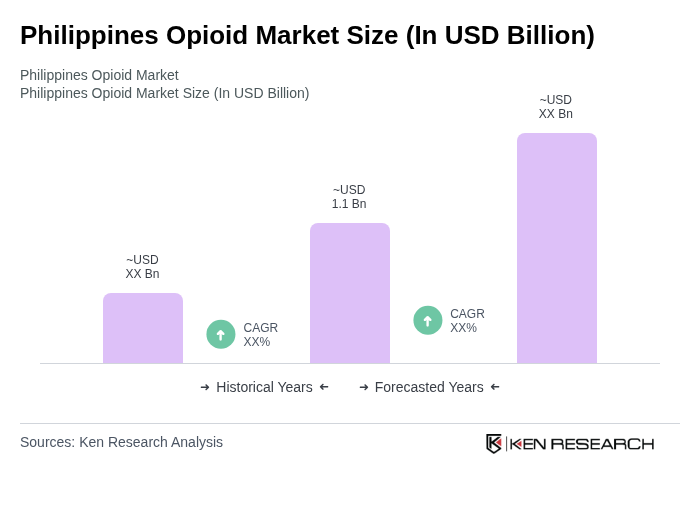
- The Philippines Opioid Market is valued at USD 1.1 billion, based on a five-year historical analysis, aligning with the country’s share of the Asia-Pacific and global opioids market as reported by leading industry analyses. This growth is primarily driven by the increasing prevalence of chronic pain conditions and cancer, with Philippine data showing a significant burden of chronic pain and under-treated cancer pain. The market is also influenced by the rising emphasis on pain management, gradual improvement in access to opioid analgesics, and ongoing professional education for clinicians on appropriate opioid use in palliative and chronic pain care.
- Metro Manila, Cebu, and Davao are the dominant cities in the Philippines Opioid Market. Metro Manila, as the National Capital Region, has the highest concentration of tertiary hospitals, specialty cancer centers, and large private hospital networks, which are the primary prescribers and dispensers of opioid analgesics. Cebu and Davao serve as key distribution and service hubs in the Visayas and Mindanao, supported by expanding hospital capacity, regional cancer and surgical centers, and the presence of pharmaceutical distributors, all of which strengthen opioid availability for legitimate medical use.
- The Philippine government has implemented Republic Act No. 9165, the Comprehensive Dangerous Drugs Act of 2002, which regulates the use of opioids as dangerous drugs. This legislation, enforced by agencies such as the Dangerous Drugs Board and the Philippine Drug Enforcement Agency, sets requirements for special prescribing forms, license-to-purchase, secure storage, record-keeping, and reporting for controlled medicines, including opioid analgesics used for pain and palliative care. It establishes operational guidelines for prescribing, dispensing, and monitoring opioid medications, thereby promoting responsible use in pain management while aiming to prevent diversion and misuse.
Philippines Opioid Market Segmentation
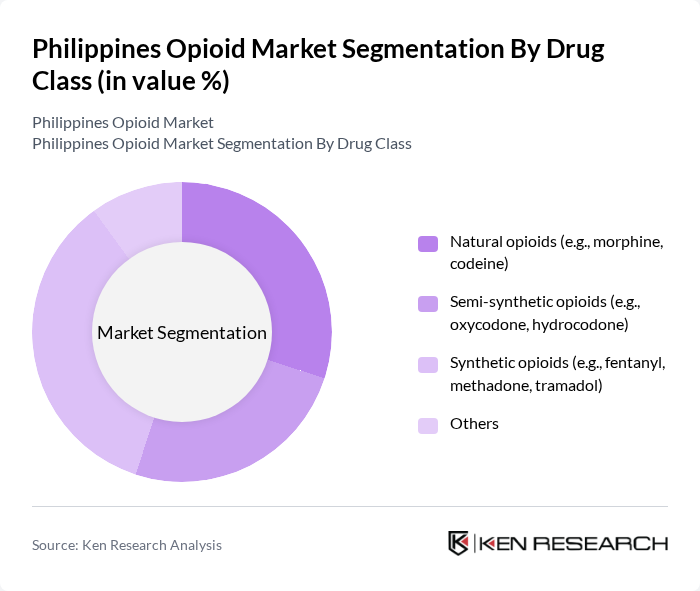
By Drug Class:The drug class segmentation includes various types of opioids, each serving different therapeutic needs. Natural opioids, such as morphine and codeine, are derived from the opium poppy and remain the backbone of moderate to severe cancer and postoperative pain management in many hospital and palliative care settings. Semi-synthetic opioids, like oxycodone and hydrocodone, are modified from natural opioids and are globally used for moderate to severe pain, although in the Philippines their availability and use are more tightly controlled and generally concentrated in specialist and hospital-based practice. Synthetic opioids, including fentanyl, tramadol, and methadone, are entirely man-made; tramadol and fentanyl in particular are widely used in the Asia-Pacific region for chronic and acute pain as well as anesthesia. The "Others" category includes less commonly used opioids and combination products that address specific clinical needs such as breakthrough pain or refractory cases.
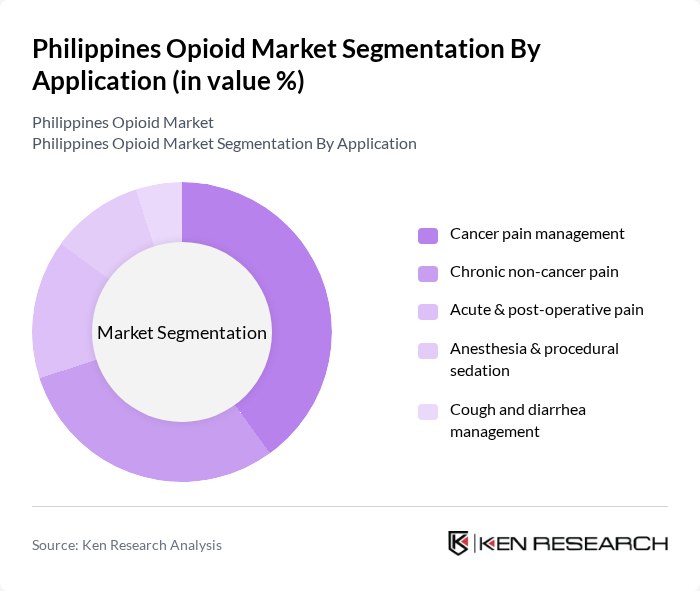
By Application:The application segmentation highlights the various therapeutic uses of opioids. Cancer pain management is a significant segment due to the growing cancer burden in the Philippines and the central role of morphine, fentanyl, and other strong opioids in palliative and end-of-life care. Chronic non-cancer pain management is also a major application, supported by rising prevalence of musculoskeletal disorders, back pain, neuropathic pain, and other long-term painful conditions in Asia-Pacific populations. Acute and post-operative pain management is crucial in surgical and trauma care, where injectable and immediate-release opioids are routinely used in hospitals. Anesthesia and procedural sedation are essential in various medical procedures, with agents such as fentanyl and remifentanil used as part of balanced anesthesia techniques. Cough and diarrhea management, although a smaller segment, contributes to the overall market through antitussive and antidiarrheal formulations based on codeine, loperamide, and related opioid derivatives.
Philippines Opioid Market Competitive Landscape
The Philippines Opioid Market is characterized by a dynamic mix of regional and international players. Leading participants such as Sanofi, Pfizer, Johnson & Johnson, Mundipharma, Teva Pharmaceutical Industries Ltd., Abbott Laboratories, Novartis International AG, Aurobindo Pharma Limited, Hikma Pharmaceuticals PLC, Viatris Inc. (including legacy Mylan), Endo International plc, Purdue Pharma L.P., Amgen Inc., GlaxoSmithKline plc (GSK), Sandoz Group AG contribute to innovation, geographic expansion, and service delivery in this space.
Philippines Opioid Market Industry Analysis
Growth Drivers
- Increasing Prevalence of Chronic Pain:The Philippines has seen a significant rise in chronic pain conditions, with approximately 29 million people affected, according to the Department of Health. This growing patient population drives demand for effective pain management solutions, including opioids. The aging population, projected to reach 13 million in future, further exacerbates this issue, as older adults are more likely to experience chronic pain, thus increasing the need for opioid therapies.
- Rising Awareness and Acceptance of Opioid Therapies:Awareness campaigns by healthcare organizations have led to a notable increase in the acceptance of opioid therapies among both healthcare providers and patients. In future, it is estimated that 65% of healthcare professionals will be more informed about opioid prescribing guidelines, as per the Philippine Medical Association. This shift is crucial in addressing pain management needs and reducing the stigma associated with opioid use, ultimately enhancing patient outcomes.
- Expansion of Healthcare Infrastructure:The Philippine government has invested heavily in healthcare infrastructure, with a budget allocation of PHP 220 billion for future. This investment aims to improve access to healthcare services, particularly in rural areas where opioid prescriptions are limited. Enhanced healthcare facilities and trained personnel will facilitate better pain management practices, leading to increased opioid utilization and improved patient care across the nation.
Market Challenges
- Regulatory Restrictions on Opioid Prescriptions:The Philippine government has implemented stringent regulations on opioid prescriptions to combat misuse and addiction. In future, it is estimated that only 32% of patients with chronic pain will receive prescribed opioids due to these restrictions. This limited access poses a significant challenge for healthcare providers aiming to manage pain effectively while adhering to regulatory guidelines, ultimately affecting patient care.
- Stigma Associated with Opioid Use:Despite increasing awareness, stigma surrounding opioid use remains a significant barrier in the Philippines. A survey conducted by the Department of Health in future revealed that 48% of patients expressed concerns about being judged for using opioids. This stigma can deter patients from seeking necessary pain management, leading to untreated chronic pain and a lower quality of life, which complicates the overall market landscape.
Philippines Opioid Market Future Outlook
The future of the Philippines opioid market appears promising, driven by advancements in pain management strategies and increasing healthcare access. As the government continues to enhance healthcare infrastructure, the integration of telemedicine and personalized medicine will likely reshape pain management approaches. Additionally, ongoing education initiatives for healthcare providers will foster a more informed prescribing environment, ultimately improving patient outcomes and reducing stigma associated with opioid therapies in future.
Market Opportunities
- Development of Abuse-Deterrent Formulations:There is a growing opportunity for pharmaceutical companies to invest in the development of abuse-deterrent formulations. With the increasing focus on preventing opioid misuse, these formulations can enhance patient safety and compliance, potentially capturing a larger market share as healthcare providers seek safer pain management options.
- Growth in Telemedicine for Pain Management:The rise of telemedicine presents a unique opportunity for opioid market expansion. In future, it is projected that telemedicine consultations for pain management will increase by 45%, allowing patients in remote areas to access necessary prescriptions and consultations, thereby improving overall pain management accessibility and adherence.
Scope of the Report
| Segment | Sub-Segments |
|---|---|
| By Drug Class | Natural opioids (e.g., morphine, codeine) Semi-synthetic opioids (e.g., oxycodone, hydrocodone) Synthetic opioids (e.g., fentanyl, methadone, tramadol) Others |
| By Application | Cancer pain management Chronic non-cancer pain Acute & post-operative pain Anesthesia & procedural sedation Cough and diarrhea management Others |
| By Route of Administration | Oral Injectable (parenteral) Transdermal Others |
| By Distribution Channel | Hospital pharmacies Retail/community pharmacies Online pharmacies Government procurement & institutional supply Others |
| By End-User | Public hospitals Private hospitals Specialty pain & oncology clinics Home-based & palliative care settings Others |
| By Formulation | Immediate-release formulations Extended/controlled-release formulations Combination products Others |
| By Regulatory / Access Category | Essential medicines list opioids Specially controlled / restricted opioids Palliative care program-linked opioids Others |
Key Target Audience
Investors and Venture Capitalist Firms
Government and Regulatory Bodies (e.g., Department of Health, Food and Drug Administration)
Manufacturers and Producers
Distributors and Retailers
Pharmaceutical Wholesalers
Healthcare Providers and Institutions
Industry Associations (e.g., Pharmaceutical and Healthcare Association of the Philippines)
Insurance Companies and Health Plans
Players Mentioned in the Report:
Sanofi
Pfizer
Johnson & Johnson
Mundipharma
Teva Pharmaceutical Industries Ltd.
Abbott Laboratories
Novartis International AG
Aurobindo Pharma Limited
Hikma Pharmaceuticals PLC
Viatris Inc. (including legacy Mylan)
Endo International plc
Purdue Pharma L.P.
Amgen Inc.
GlaxoSmithKline plc (GSK)
Sandoz Group AG
Table of Contents
Market Assessment Phase
1. Executive Summary and Approach
2. Philippines Opioid Market Overview
2.1 Key Insights and Strategic Recommendations
2.2 Philippines Opioid Market Overview
2.3 Definition and Scope
2.4 Evolution of Market Ecosystem
2.5 Timeline of Key Regulatory Milestones
2.6 Value Chain & Stakeholder Mapping
2.7 Business Cycle Analysis
2.8 Policy & Incentive Landscape
3. Philippines Opioid Market Analysis
3.1 Growth Drivers
3.1.1 Increasing prevalence of chronic pain
3.1.2 Rising awareness and acceptance of opioid therapies
3.1.3 Expansion of healthcare infrastructure
3.1.4 Government initiatives for pain management
3.2 Market Challenges
3.2.1 Regulatory restrictions on opioid prescriptions
3.2.2 Stigma associated with opioid use
3.2.3 Risk of addiction and misuse
3.2.4 Limited access in rural areas
3.3 Market Opportunities
3.3.1 Development of abuse-deterrent formulations
3.3.2 Growth in telemedicine for pain management
3.3.3 Partnerships with healthcare providers
3.3.4 Expansion into underserved markets
3.4 Market Trends
3.4.1 Shift towards personalized medicine
3.4.2 Increasing focus on patient education
3.4.3 Integration of technology in pain management
3.4.4 Rise of alternative therapies
3.5 Government Regulation
3.5.1 Implementation of prescription monitoring programs
3.5.2 Guidelines for opioid prescribing
3.5.3 Restrictions on advertising opioids
3.5.4 Support for addiction treatment programs
4. SWOT Analysis
5. Stakeholder Analysis
6. Porter's Five Forces Analysis
7. Philippines Opioid Market Market Size, 2019-2024
7.1 By Value
7.2 By Volume
7.3 By Average Selling Price
8. Philippines Opioid Market Segmentation
8.1 By Drug Class
8.1.1 Natural opioids (e.g., morphine, codeine)
8.1.2 Semi-synthetic opioids (e.g., oxycodone, hydrocodone)
8.1.3 Synthetic opioids (e.g., fentanyl, methadone, tramadol)
8.1.4 Others
8.2 By Application
8.2.1 Cancer pain management
8.2.2 Chronic non-cancer pain
8.2.3 Acute & post-operative pain
8.2.4 Anesthesia & procedural sedation
8.2.5 Cough and diarrhea management
8.2.6 Others
8.3 By Route of Administration
8.3.1 Oral
8.3.2 Injectable (parenteral)
8.3.3 Transdermal
8.3.4 Others
8.4 By Distribution Channel
8.4.1 Hospital pharmacies
8.4.2 Retail/community pharmacies
8.4.3 Online pharmacies
8.4.4 Government procurement & institutional supply
8.4.5 Others
8.5 By End-User
8.5.1 Public hospitals
8.5.2 Private hospitals
8.5.3 Specialty pain & oncology clinics
8.5.4 Home-based & palliative care settings
8.5.5 Others
8.6 By Formulation
8.6.1 Immediate-release formulations
8.6.2 Extended/controlled-release formulations
8.6.3 Combination products
8.6.4 Others
8.7 By Regulatory / Access Category
8.7.1 Essential medicines list opioids
8.7.2 Specially controlled / restricted opioids
8.7.3 Palliative care program-linked opioids
8.7.4 Others
9. Philippines Opioid Market Competitive Analysis
9.1 Market Share of Key Players
9.2 Cross Comparison of Key Players
9.2.1 Company Name
9.2.2 Group Size (Large, Medium, or Small as per industry convention)
9.2.3 Philippines opioid revenue (US$ Mn)
9.2.4 Philippines opioid revenue CAGR, last 3–5 years (%)
9.2.5 Philippines market share (%)
9.2.6 Opioid portfolio breadth (number of SKUs / molecules)
9.2.7 Average selling price index vs market
9.2.8 EBITDA margin from opioid portfolio (%)
9.2.9 R&D and pharmacovigilance spend as % of opioid sales
9.2.10 Distribution coverage (hospital & retail pharmacy reach)
9.2.11 Regulatory compliance and inspection track record
9.2.12 Brand equity index among prescribers (awareness & preference)
9.3 SWOT Analysis of Top Players
9.4 Pricing Analysis
9.5 Detailed Profile of Major Companies
9.5.1 Sanofi
9.5.2 Pfizer
9.5.3 Johnson & Johnson
9.5.4 Mundipharma
9.5.5 Teva Pharmaceutical Industries Ltd.
9.5.6 Abbott Laboratories
9.5.7 Novartis International AG
9.5.8 Aurobindo Pharma Limited
9.5.9 Hikma Pharmaceuticals PLC
9.5.10 Viatris Inc. (including legacy Mylan)
9.5.11 Endo International plc
9.5.12 Purdue Pharma L.P.
9.5.13 Amgen Inc.
9.5.14 GlaxoSmithKline plc (GSK)
9.5.15 Sandoz Group AG
10. Philippines Opioid Market End-User Analysis
10.1 Procurement Behavior of Key Ministries
10.1.1 Ministry of Health
10.1.2 Department of Social Welfare and Development
10.1.3 Local Government Units
10.1.4 Others
10.2 Corporate Spend on Infrastructure & Energy
10.2.1 Healthcare facilities
10.2.2 Pain management programs
10.2.3 Research and development
10.2.4 Others
10.3 Pain Point Analysis by End-User Category
10.3.1 Patients
10.3.2 Healthcare providers
10.3.3 Payers
10.3.4 Others
10.4 User Readiness for Adoption
10.4.1 Awareness levels
10.4.2 Training and education
10.4.3 Accessibility of opioids
10.4.4 Others
10.5 Post-Deployment ROI and Use Case Expansion
10.5.1 Patient outcomes
10.5.2 Cost savings
10.5.3 Market expansion opportunities
10.5.4 Others
11. Philippines Opioid Market Future Size, 2025-2030
11.1 By Value
11.2 By Volume
11.3 By Average Selling Price
Go-To-Market Strategy Phase
1. Whitespace Analysis + Business Model Canvas
1.1 Market Gaps Identification
1.2 Value Proposition Development
1.3 Revenue Streams Analysis
1.4 Cost Structure Evaluation
1.5 Key Partnerships Exploration
1.6 Customer Segments Definition
1.7 Channels Strategy
2. Marketing and Positioning Recommendations
2.1 Branding strategies
2.2 Product USPs
3. Distribution Plan
3.1 Urban retail vs rural NGO tie-ups
4. Channel & Pricing Gaps
4.1 Underserved routes
4.2 Pricing bands
5. Unmet Demand & Latent Needs
5.1 Category gaps
5.2 Consumer segments
6. Customer Relationship
6.1 Loyalty programs
6.2 After-sales service
7. Value Proposition
7.1 Sustainability
7.2 Integrated supply chains
8. Key Activities
8.1 Regulatory compliance
8.2 Branding
8.3 Distribution setup
9. Entry Strategy Evaluation
9.1 Domestic Market Entry Strategy
9.1.1 Product mix
9.1.2 Pricing band
9.1.3 Packaging
9.2 Export Entry Strategy
9.2.1 Target countries
9.2.2 Compliance roadmap
10. Entry Mode Assessment
10.1 JV
10.2 Greenfield
10.3 M&A
10.4 Distributor Model
11. Capital and Timeline Estimation
11.1 Capital requirements
11.2 Timelines
12. Control vs Risk Trade-Off
12.1 Ownership vs Partnerships
13. Profitability Outlook
13.1 Breakeven analysis
13.2 Long-term sustainability
14. Potential Partner List
14.1 Distributors
14.2 JVs
14.3 Acquisition targets
15. Execution Roadmap
15.1 Phased Plan for Market Entry
15.1.1 Market Setup
15.1.2 Market Entry
15.1.3 Growth Acceleration
15.1.4 Scale & Stabilize
15.2 Key Activities and Milestones
15.2.1 Milestone Planning
15.2.2 Activity Scheduling
Research Methodology
Phase 1: Approach1
Desk Research
- Analysis of government reports on opioid usage and regulation in the Philippines
- Review of academic journals and publications on opioid market trends and health impacts
- Examination of industry reports from health organizations and pharmaceutical associations
Primary Research
- Interviews with healthcare professionals, including pharmacists and physicians
- Surveys conducted with patients and caregivers regarding opioid usage and perceptions
- Focus group discussions with addiction specialists and rehabilitation center staff
Validation & Triangulation
- Cross-validation of findings with multiple data sources, including health statistics and market reports
- Triangulation of qualitative insights from interviews with quantitative survey data
- Sanity checks through expert panel reviews involving industry stakeholders
Phase 2: Market Size Estimation1
Top-down Assessment
- Estimation of total opioid consumption based on national health expenditure data
- Segmentation of the market by therapeutic areas and demographic profiles
- Incorporation of government health initiatives and regulatory frameworks affecting opioid distribution
Bottom-up Modeling
- Collection of sales data from major pharmaceutical distributors and manufacturers
- Estimation of prescription volumes based on healthcare provider data
- Analysis of pricing trends and reimbursement rates for opioid medications
Forecasting & Scenario Analysis
- Multi-factor regression analysis incorporating factors such as population growth and healthcare access
- Scenario modeling based on potential changes in regulations and public health campaigns
- Development of baseline, optimistic, and pessimistic market projections through 2030
Phase 3: CATI Sample Composition1
| Scope Item/Segment | Sample Size | Target Respondent Profiles |
|---|---|---|
| Healthcare Provider Insights | 120 | Doctors, Pharmacists, Nurses |
| Patient Experience Surveys | 100 | Chronic Pain Patients, Caregivers |
| Rehabilitation Center Feedback | 80 | Addiction Counselors, Facility Administrators |
| Pharmaceutical Distribution Analysis | 70 | Supply Chain Managers, Sales Representatives |
| Regulatory Impact Assessment | 60 | Policy Makers, Health Regulators |
Frequently Asked Questions
What is the current value of the Philippines Opioid Market?
The Philippines Opioid Market is valued at approximately USD 1.1 billion, reflecting the country's share in the Asia-Pacific and global opioids market. This valuation is based on a five-year historical analysis and highlights the growing demand for effective pain management solutions.
What factors are driving the growth of the Opioid Market in the Philippines?
Which cities are the primary hubs for the Opioid Market in the Philippines?
What regulatory measures govern opioid use in the Philippines?
Other Regional/Country Reports
Indonesia Opioid Market Size Share Growth Drivers Trends Opportunities & Forecast 2025–2030
Malaysia Opioid Market Size Share Growth Drivers Trends Opportunities & Forecast 2025–2030
KSA Opioid Market Size Share Growth Drivers Trends Opportunities & Forecast 2025–2030
Other Adjacent Reports
South Korea Pain Management Market
South Africa Palliative Care Market
South Korea Oncology Drugs Market
United States Anesthesia Drugs Market Outlook to 2030: Size, Share, Growth and TrendsThailand Chronic Pain Treatment Market
Saudi Arabia Pharmaceutical Distribution Market Size, Share, Growth Drivers, Trends, Opportunities & Forecast 2025–2030Indonesia Telemedicine Services Market
UAE Generic Drugs MarketSingapore Abuse-Deterrent Formulations Market
Why Buy From Us?

What makes us stand out is that our consultants follow Robust, Refine and Result (RRR) methodology. Robust for clear definitions, approaches and sanity checking, Refine for differentiating respondents' facts and opinions, and Result for presenting data with story.

We have set a benchmark in the industry by offering our clients with syndicated and customized market research reports featuring coverage of entire market as well as meticulous research and analyst insights.

While we don't replace traditional research, we flip the method upside down. Our dual approach of Top Bottom & Bottom Top ensures quality deliverable by not just verifying company fundamentals but also looking at the sector and macroeconomic factors.

With one step in the future, our research team constantly tries to show you the bigger picture. We help with some of the tough questions you may encounter along the way: How is the industry positioned? Best marketing channel? KPI's of competitors? By aligning every element, we help maximize success.

Our report gives you instant access to the answers and sources that other companies might choose to hide. We elaborate each steps of research methodology we have used and showcase you the sample size to earn your trust.

If you need any support, we are here! We pride ourselves on universe strength, data quality, and quick, friendly, and professional service.