About the Report
Base Year 2024Qatar Baby Food and Infant Nutrition Market Overview
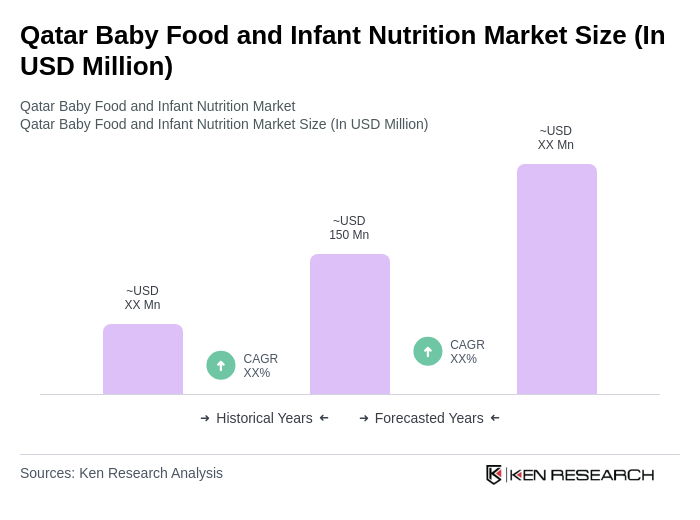
- The Qatar Baby Food and Infant Nutrition Market is valued at USD 150 million, based on a five-year historical analysis. This growth is primarily driven by increasing awareness among parents regarding the nutritional needs of infants, coupled with a rise in disposable income and urbanization. The demand for high-quality baby food products has surged as parents seek convenient and healthy options for their children.
- Doha is the dominant city in the Qatar Baby Food and Infant Nutrition Market, primarily due to its high population density and concentration of expatriates. The city’s affluent demographic and growing number of working parents contribute to the demand for baby food products. Additionally, the presence of major retail chains and supermarkets in Doha facilitates easy access to a variety of baby food options.
- In 2023, the Qatari government implemented regulations mandating stricter quality control measures for baby food products. This regulation requires manufacturers to adhere to specific nutritional standards and labeling requirements, ensuring that all baby food products are safe and nutritious for infants. The initiative aims to enhance consumer confidence and promote healthier eating habits among infants.
Qatar Baby Food and Infant Nutrition Market Segmentation
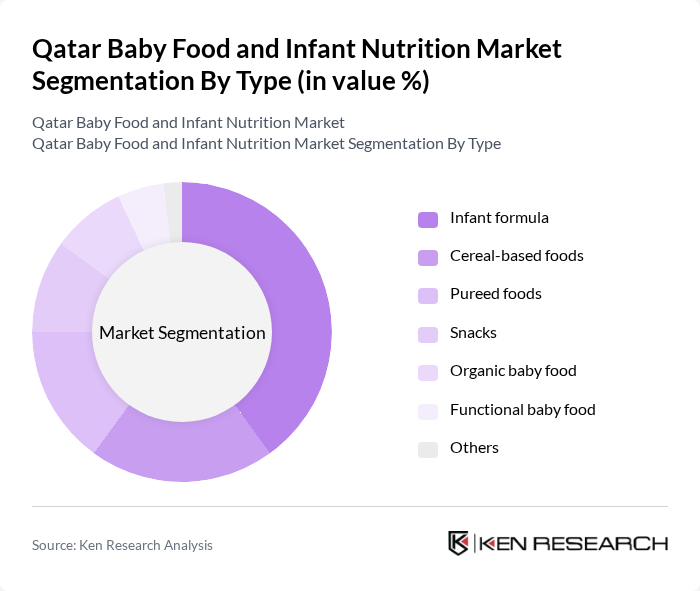
By Type:The market is segmented into various types of baby food products, including infant formula, cereal-based foods, pureed foods, snacks, organic baby food, functional baby food, and others. Among these, infant formula is the leading sub-segment due to its essential role in infant nutrition, especially for working parents who prefer convenient feeding options. The increasing trend towards organic and functional baby foods is also notable, as parents are becoming more health-conscious and seeking products that offer additional nutritional benefits.
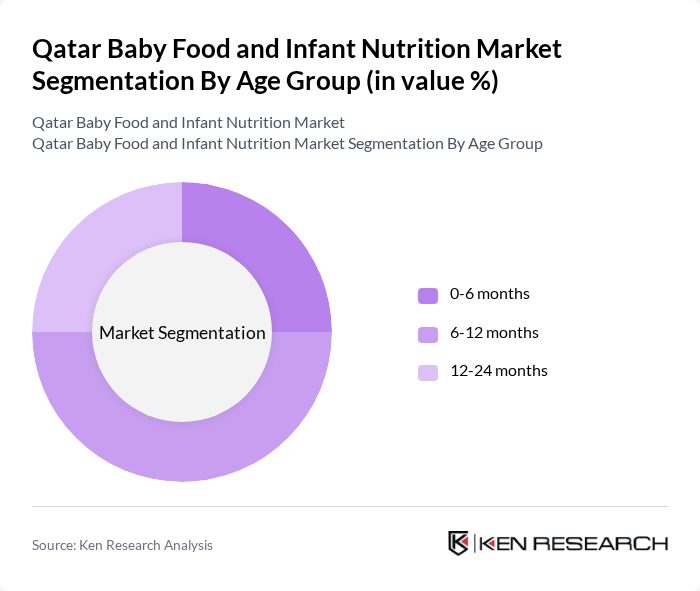
By Age Group:The market is categorized by age groups, including 0-6 months, 6-12 months, and 12-24 months. The 6-12 months age group dominates the market, as this is a critical period for introducing solid foods to infants. Parents are increasingly looking for nutritious and easy-to-digest options for their babies during this stage, leading to a higher demand for products tailored to this age group. The trend towards organic and fortified foods is also prominent among parents of infants in this age range.
Qatar Baby Food and Infant Nutrition Market Competitive Landscape
The Qatar Baby Food and Infant Nutrition Market is characterized by a dynamic mix of regional and international players. Leading participants such as Nestlé S.A., Danone S.A., Abbott Laboratories, Mead Johnson Nutrition Company, Hero Group, Hain Celestial Group, Inc., FrieslandCampina, Perrigo Company plc, Bledina (part of Danone), Bellamy's Organic, Earth’s Best (part of Hain Celestial), Plum Organics (part of Campbell Soup Company), Sprout Organic Foods, Little Spoon, Baby Gourmet Foods Inc. contribute to innovation, geographic expansion, and service delivery in this space.
Qatar Baby Food and Infant Nutrition Market Industry Analysis
Growth Drivers
- Increasing Awareness of Infant Nutrition:The growing awareness of the importance of infant nutrition is a significant driver in Qatar. According to the Qatar National Health Strategy 2018-2022, 70% of parents are now more informed about nutritional needs. This shift is supported by educational campaigns from health authorities, leading to a 15% increase in demand for fortified baby food products. As parents prioritize nutrition, the market for high-quality infant nutrition is expected to expand significantly.
- Rising Disposable Incomes:Qatar's GDP per capita is projected to reach $66,000 in the future, reflecting a 10% increase from previous figures. This rise in disposable income allows families to invest more in premium baby food products. As a result, the demand for organic and specialized infant nutrition products is expected to grow, with a notable increase in sales of high-end brands. This economic trend supports the overall growth of the baby food market in Qatar.
- Growth in Working Mothers:The percentage of working mothers in Qatar has increased to 48% in the future, up from 40% in previous years. This demographic shift has led to a higher demand for convenient and nutritious baby food options. As working mothers seek quick and healthy meal solutions for their infants, the market for ready-to-eat and easy-to-prepare baby food products is expanding. This trend is driving innovation and product development in the sector.
Market Challenges
- Stringent Regulatory Requirements:The baby food industry in Qatar faces stringent regulatory requirements, including compliance with the Qatar Food Safety Law. Companies must adhere to rigorous food safety standards, which can increase operational costs. In the future, the government is expected to enforce stricter labeling regulations, requiring detailed nutritional information. This regulatory landscape poses challenges for new entrants and existing brands, impacting their market strategies and profitability.
- High Competition Among Brands:The Qatar baby food market is characterized by intense competition, with over 35 brands vying for market share. Major players like Nestlé and Danone dominate, making it difficult for smaller brands to establish a foothold. In the future, the competitive landscape is expected to intensify, with brands investing heavily in marketing and product differentiation. This competition can lead to price wars, affecting profit margins across the industry.
Qatar Baby Food and Infant Nutrition Market Future Outlook
The future of the Qatar baby food and infant nutrition market appears promising, driven by evolving consumer preferences and economic growth. As parents increasingly prioritize health and nutrition, the demand for organic and specialized products is expected to rise. Additionally, the expansion of e-commerce platforms will facilitate greater access to a variety of baby food options, enhancing consumer convenience. These trends indicate a dynamic market landscape that will continue to evolve in response to consumer needs and preferences.
Market Opportunities
- Introduction of Organic Baby Food Products:The demand for organic baby food is on the rise, with sales projected to increase by 25% in the future. Parents are increasingly seeking healthier options free from artificial additives. This trend presents a significant opportunity for brands to innovate and introduce organic lines, catering to health-conscious consumers and enhancing brand loyalty.
- Expansion into E-commerce Platforms:E-commerce sales of baby food products are expected to grow by 35% in the future, driven by increased online shopping trends. Brands can leverage this opportunity by establishing a strong online presence and utilizing digital marketing strategies. This expansion into e-commerce will not only enhance accessibility but also allow brands to reach a broader audience, driving sales growth.
Scope of the Report
| Segment | Sub-Segments |
|---|---|
| By Type | Infant formula Cereal-based foods Pureed foods Snacks Organic baby food Functional baby food Others |
| By Age Group | 6 months 12 months 24 months |
| By Distribution Channel | Supermarkets/Hypermarkets Online Retail Pharmacies Specialty Stores Others |
| By Packaging Type | Jars Pouches Tetra packs Cans |
| By Brand Type | National brands Private labels Premium brands |
| By Nutritional Content | High protein Low sugar Fortified with vitamins |
| By Price Range | Economy Mid-range Premium |
Key Target Audience
Investors and Venture Capitalist Firms
Government and Regulatory Bodies (e.g., Ministry of Public Health, Qatar Standards and Metrology Authority)
Manufacturers and Producers
Distributors and Retailers
Health Care Providers and Pediatricians
Food Safety and Quality Assurance Organizations
Industry Associations (e.g., Qatar Chamber of Commerce)
Financial Institutions and Banks
Players Mentioned in the Report:
Nestle S.A.
Danone S.A.
Abbott Laboratories
Mead Johnson Nutrition Company
Hero Group
Hain Celestial Group, Inc.
FrieslandCampina
Perrigo Company plc
Bledina (part of Danone)
Bellamy's Organic
Earths Best (part of Hain Celestial)
Plum Organics (part of Campbell Soup Company)
Sprout Organic Foods
Little Spoon
Baby Gourmet Foods Inc.
Table of Contents
Market Assessment Phase
1. Executive Summary and Approach
2. Qatar Baby Food and Infant Nutrition Market Overview
2.1 Key Insights and Strategic Recommendations
2.2 Qatar Baby Food and Infant Nutrition Market Overview
2.3 Definition and Scope
2.4 Evolution of Market Ecosystem
2.5 Timeline of Key Regulatory Milestones
2.6 Value Chain & Stakeholder Mapping
2.7 Business Cycle Analysis
2.8 Policy & Incentive Landscape
3. Qatar Baby Food and Infant Nutrition Market Analysis
3.1 Growth Drivers
3.1.1 Increasing awareness of infant nutrition
3.1.2 Rising disposable incomes
3.1.3 Growth in working mothers
3.1.4 Expansion of retail channels
3.2 Market Challenges
3.2.1 Stringent regulatory requirements
3.2.2 High competition among brands
3.2.3 Fluctuating raw material prices
3.2.4 Consumer skepticism towards product safety
3.3 Market Opportunities
3.3.1 Introduction of organic baby food products
3.3.2 Expansion into e-commerce platforms
3.3.3 Development of specialized nutrition products
3.3.4 Collaborations with healthcare professionals
3.4 Market Trends
3.4.1 Shift towards plant-based baby food
3.4.2 Increased focus on sustainability
3.4.3 Growth in subscription-based services
3.4.4 Rising demand for convenience packaging
3.5 Government Regulation
3.5.1 Compliance with food safety standards
3.5.2 Labeling requirements for nutritional information
3.5.3 Restrictions on marketing to children
3.5.4 Import regulations for baby food products
4. SWOT Analysis
5. Stakeholder Analysis
6. Porter's Five Forces Analysis
7. Qatar Baby Food and Infant Nutrition Market Market Size, 2019-2024
7.1 By Value
7.2 By Volume
7.3 By Average Selling Price
8. Qatar Baby Food and Infant Nutrition Market Segmentation
8.1 By Type
8.1.1 Infant formula
8.1.2 Cereal-based foods
8.1.3 Pureed foods
8.1.4 Snacks
8.1.5 Organic baby food
8.1.6 Functional baby food
8.1.7 Others
8.2 By Age Group
8.2.1 0-6 months
8.2.2 6-12 months
8.2.3 12-24 months
8.3 By Distribution Channel
8.3.1 Supermarkets/Hypermarkets
8.3.2 Online Retail
8.3.3 Pharmacies
8.3.4 Specialty Stores
8.3.5 Others
8.4 By Packaging Type
8.4.1 Jars
8.4.2 Pouches
8.4.3 Tetra packs
8.4.4 Cans
8.5 By Brand Type
8.5.1 National brands
8.5.2 Private labels
8.5.3 Premium brands
8.6 By Nutritional Content
8.6.1 High protein
8.6.2 Low sugar
8.6.3 Fortified with vitamins
8.7 By Price Range
8.7.1 Economy
8.7.2 Mid-range
8.7.3 Premium
9. Qatar Baby Food and Infant Nutrition Market Competitive Analysis
9.1 Market Share of Key Players
9.2 Cross Comparison of Key Players
9.2.1 Company Name
9.2.2 Group Size (Large, Medium, or Small as per industry convention)
9.2.3 Revenue Growth Rate
9.2.4 Market Penetration Rate
9.2.5 Customer Retention Rate
9.2.6 Pricing Strategy
9.2.7 Product Diversification Index
9.2.8 Brand Equity Score
9.2.9 Distribution Network Efficiency
9.2.10 Customer Satisfaction Index
9.3 SWOT Analysis of Top Players
9.4 Pricing Analysis
9.5 Detailed Profile of Major Companies
9.5.1 Nestlé S.A.
9.5.2 Danone S.A.
9.5.3 Abbott Laboratories
9.5.4 Mead Johnson Nutrition Company
9.5.5 Hero Group
9.5.6 Hain Celestial Group, Inc.
9.5.7 FrieslandCampina
9.5.8 Perrigo Company plc
9.5.9 Bledina (part of Danone)
9.5.10 Bellamy's Organic
9.5.11 Earth’s Best (part of Hain Celestial)
9.5.12 Plum Organics (part of Campbell Soup Company)
9.5.13 Sprout Organic Foods
9.5.14 Little Spoon
9.5.15 Baby Gourmet Foods Inc.
10. Qatar Baby Food and Infant Nutrition Market End-User Analysis
10.1 Procurement Behavior of Key Ministries
10.1.1 Ministry of Public Health
10.1.2 Ministry of Education
10.1.3 Ministry of Commerce and Industry
10.2 Corporate Spend on Infrastructure & Energy
10.2.1 Investment in health and nutrition programs
10.2.2 Funding for public health initiatives
10.3 Pain Point Analysis by End-User Category
10.3.1 Concerns over product safety
10.3.2 Accessibility of products
10.4 User Readiness for Adoption
10.4.1 Awareness of nutritional benefits
10.4.2 Willingness to pay for premium products
10.5 Post-Deployment ROI and Use Case Expansion
10.5.1 Evaluation of product effectiveness
10.5.2 Opportunities for product line expansion
11. Qatar Baby Food and Infant Nutrition Market Future Size, 2025-2030
11.1 By Value
11.2 By Volume
11.3 By Average Selling Price
Go-To-Market Strategy Phase
1. Whitespace Analysis + Business Model Canvas
1.1 Market Gaps Identification
1.2 Business Model Framework
2. Marketing and Positioning Recommendations
2.1 Branding strategies
2.2 Product USPs
3. Distribution Plan
3.1 Urban retail vs rural NGO tie-ups
4. Channel & Pricing Gaps
4.1 Underserved routes
4.2 Pricing bands
5. Unmet Demand & Latent Needs
5.1 Category gaps
5.2 Consumer segments
6. Customer Relationship
6.1 Loyalty programs
6.2 After-sales service
7. Value Proposition
7.1 Sustainability
7.2 Integrated supply chains
8. Key Activities
8.1 Regulatory compliance
8.2 Branding
8.3 Distribution setup
9. Entry Strategy Evaluation
9.1 Domestic Market Entry Strategy
9.1.1 Product mix
9.1.2 Pricing band
9.1.3 Packaging
9.2 Export Entry Strategy
9.2.1 Target countries
9.2.2 Compliance roadmap
10. Entry Mode Assessment
10.1 JV
10.2 Greenfield
10.3 M&A
10.4 Distributor Model
11. Capital and Timeline Estimation
11.1 Capital requirements
11.2 Timelines
12. Control vs Risk Trade-Off
12.1 Ownership vs Partnerships
13. Profitability Outlook
13.1 Breakeven analysis
13.2 Long-term sustainability
14. Potential Partner List
14.1 Distributors
14.2 JVs
14.3 Acquisition targets
15. Execution Roadmap
15.1 Phased Plan for Market Entry
15.1.1 Market Setup
15.1.2 Market Entry
15.1.3 Growth Acceleration
15.1.4 Scale & Stabilize
15.2 Key Activities and Milestones
15.2.1 Activity Timeline
15.2.2 Milestone Tracking
Research Methodology
Phase 1: Approach1
Desk Research
- Analysis of market reports from government health agencies and infant nutrition associations
- Review of published articles and white papers on baby food trends and consumer preferences
- Examination of demographic data and birth rates from Qatar's national statistics bureau
Primary Research
- Interviews with pediatric nutritionists and healthcare professionals specializing in infant care
- Surveys conducted with parents of infants to gather insights on purchasing behavior and preferences
- Focus group discussions with caregivers to understand attitudes towards baby food brands and products
Validation & Triangulation
- Cross-validation of findings through multiple data sources, including sales data and consumer feedback
- Triangulation of insights from healthcare professionals, parents, and market data
- Sanity checks through expert panel reviews comprising industry veterans and market analysts
Phase 2: Market Size Estimation1
Top-down Assessment
- Estimation of total market size based on national health expenditure and consumer spending on baby food
- Segmentation of the market by product type, including organic, non-organic, and specialized formulas
- Incorporation of growth rates from related sectors such as organic food and health supplements
Bottom-up Modeling
- Collection of sales data from major retailers and distributors of baby food products
- Estimation of average price points for various baby food categories and brands
- Volume estimates based on birth rates and average consumption rates per infant
Forecasting & Scenario Analysis
- Multi-factor regression analysis incorporating economic indicators, birth rates, and health trends
- Scenario modeling based on potential regulatory changes and shifts in consumer preferences
- Development of baseline, optimistic, and pessimistic forecasts through 2030
Phase 3: CATI Sample Composition1
| Scope Item/Segment | Sample Size | Target Respondent Profiles |
|---|---|---|
| Retail Baby Food Outlets | 100 | Store Managers, Sales Representatives |
| Pediatric Healthcare Providers | 75 | Pediatricians, Nutritionists |
| Parents of Infants (0-12 months) | 150 | New Parents, Caregivers |
| Baby Food Manufacturers | 60 | Product Development Managers, Marketing Executives |
| Nutrition and Health Experts | 50 | Dietitians, Health Policy Advisors |
Frequently Asked Questions
What is the current value of the Qatar Baby Food and Infant Nutrition Market?
The Qatar Baby Food and Infant Nutrition Market is valued at approximately USD 150 million, reflecting a significant growth trend driven by increased awareness of infant nutrition and rising disposable incomes among parents.
Which city dominates the Qatar Baby Food and Infant Nutrition Market?
What are the main types of baby food products available in Qatar?
What age group dominates the baby food market in Qatar?
Other Adjacent Reports
Philippines Infant Formula Market
KSA Pediatric Nutrition Market
South Africa Maternal Nutrition Market
Mexico Organic Food Market
Belgium Nutritional Supplements Market
Belgium Baby Care Products Market
Malaysia Dairy Products Market
Vietnam Food Packaging Market
Thailand E-commerce Baby Products Market
Thailand Child Healthcare Market
Why Buy From Us?

What makes us stand out is that our consultants follow Robust, Refine and Result (RRR) methodology. Robust for clear definitions, approaches and sanity checking, Refine for differentiating respondents' facts and opinions, and Result for presenting data with story.

We have set a benchmark in the industry by offering our clients with syndicated and customized market research reports featuring coverage of entire market as well as meticulous research and analyst insights.

While we don't replace traditional research, we flip the method upside down. Our dual approach of Top Bottom & Bottom Top ensures quality deliverable by not just verifying company fundamentals but also looking at the sector and macroeconomic factors.

With one step in the future, our research team constantly tries to show you the bigger picture. We help with some of the tough questions you may encounter along the way: How is the industry positioned? Best marketing channel? KPI's of competitors? By aligning every element, we help maximize success.

Our report gives you instant access to the answers and sources that other companies might choose to hide. We elaborate each steps of research methodology we have used and showcase you the sample size to earn your trust.

If you need any support, we are here! We pride ourselves on universe strength, data quality, and quick, friendly, and professional service.