Qatar Distributed Acoustic Sensing Market Report Size Share Growth Drivers Trends Opportunities & Forecast 2025–2030

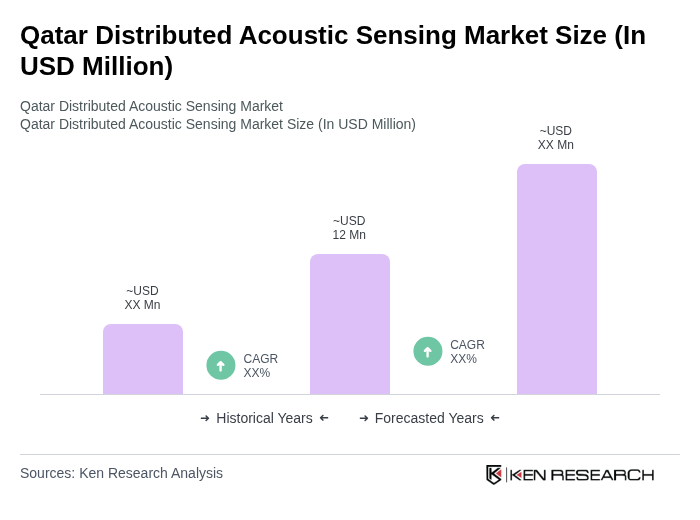
Qatar Distributed Acoustic Sensing Market, valued at USD 12 million, grows due to demand for real-time monitoring in oil, gas, and infrastructure, with single-mode fiber and interrogator units leading segments.

Region:Middle East

Author(s):Dev

Product Code:KRAC5159

Pages:89

Published On:January 2026
About the Report

Base Year 2024

Qatar Distributed Acoustic Sensing Market Overview

  • The Qatar Distributed Acoustic Sensing Market is valued at USD 12 million, based on a five-year historical analysis and benchmarking against the share of the Middle East and Africa distributed fiber optic sensing market and Qatar’s oil and gas–driven adoption profile. This growth is primarily driven by the increasing demand for real-time monitoring solutions in sectors such as oil and gas, security, and infrastructure, in line with broader global DAS adoption trends. The adoption of advanced fiber?optic sensing technologies and the need for enhanced safety, leak detection, and asset integrity in pipelines, rail, and critical facilities have further propelled the market’s expansion.
  • Key demand hubs in this market include industrial and infrastructure corridors around Doha, Al Rayyan, and Lusail, which lead in deployment due to large-scale investments in oil and gas facilities, transport networks, stadiums, and smart city projects. The concentration of upstream and midstream oil and gas operations, transmission pipelines, and critical infrastructure in these areas, together with national initiatives to strengthen perimeter security, event security, and real-time asset monitoring, reinforces their role as primary centers of DAS adoption.
  • Qatar’s regulatory and policy framework supporting advanced monitoring technologies is anchored in instruments such as the Critical Infrastructure Protection Regulations issued under the Ministry of Interior and internal security authorities, which require operators of strategic assets (including energy, transportation, utilities, and major event venues) to implement approved electronic security, surveillance, and monitoring systems and to comply with design, integration, and performance standards for continuous monitoring of critical infrastructure. These requirements, together with safety and integrity standards applicable to pipelines and industrial facilities, are driving the adoption of fiber?optic–based distributed acoustic sensing in oil and gas, transportation, and utilities to support real-time threat detection, leak detection, and operational efficiency.
Qatar Distributed Acoustic Sensing Market Size

Qatar Distributed Acoustic Sensing Market Segmentation

By Fiber Type:The market is segmented into Single-mode Fiber and Multimode Fiber, consistent with global DAS deployments. Single-mode fiber is dominating the market due to its superior performance over long distances, low attenuation, and high detection sensitivity, making it ideal for applications in oil and gas pipelines, perimeter security, and utility and power cable monitoring. Multimode fiber, while still relevant, is primarily used in shorter-range or in-facility applications where link distances are limited and cost considerations are higher. The preference for single-mode fiber is driven by its ability to support long-haul, continuous sensing, higher bandwidth, and lower signal loss, which are critical for real-time, distributed monitoring systems across Qatar’s extended pipeline and infrastructure networks.
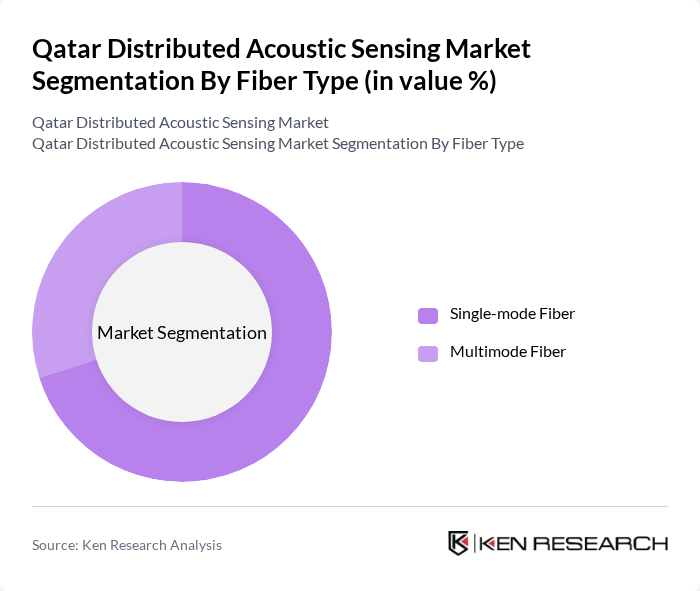
Qatar Distributed Acoustic Sensing Market segmentation by Fiber Type.

By Component:The components of the market include Interrogator Units, Fiber Optic Cables, Acoustic / Sensing Cables, Software & Analytics Platforms, and Services (Integration, Maintenance, Monitoring), in line with global DAS value chain definitions. Interrogator units are leading the market due to their critical role in converting backscattered light into usable acoustic data and processing the large volumes of signals collected from fiber optic cables in real time. The increasing complexity and scale of monitoring systems in oil and gas, transportation, and smart infrastructure have led to higher demand for advanced interrogator units with enhanced channel capacity, higher spatial resolution, and integrated analytics. Additionally, the growth of software and analytics platforms is notable, as they enable event classification, pattern recognition, and integration with control room and SCADA systems, providing essential insights for predictive maintenance, security incident response, and operational optimization across various applications.
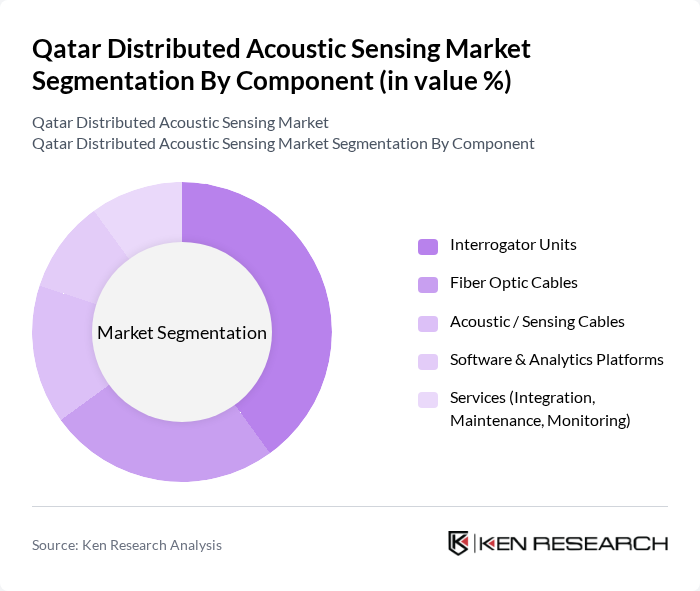
Qatar Distributed Acoustic Sensing Market segmentation by Component.

Qatar Distributed Acoustic Sensing Market Competitive Landscape

The Qatar Distributed Acoustic Sensing Market is characterized by a dynamic mix of regional and international players. Leading participants such as QinetiQ Group plc, SLB (Schlumberger), Halliburton Company, Baker Hughes Company, OptaSense (Luna Innovations), Fotech Solutions (now part of BP Launchpad / Lumen), Silixa Ltd, Hifi Engineering, Yokogawa Electric Corporation, NKT Photonics, FiberSense, Sercel, AP Sensing, Future Fiber Technologies (FFT), and other emerging regional players contribute to innovation, geographic expansion, and service delivery in this space.

QinetiQ Group plc

2001

Farnborough, UK

SLB (Schlumberger)

1926

Houston, USA

Halliburton Company

1919

Houston, USA

Baker Hughes Company

1907

Houston, USA

OptaSense (Luna Innovations)

2009

Blacksburg, USA

Company

Establishment Year

Headquarters

Global DAS Revenue in Qatar (USD million)

Qatar DAS Revenue CAGR (Historical & Forecast)

Share of Revenue from Oil & Gas in Qatar (%)

Share of Revenue from Non-Oil & Gas Verticals in Qatar (%)

Average Contract Size in Qatar (USD million)

Active DAS Installations in Qatar (Number of Sites)

Qatar Distributed Acoustic Sensing Market Industry Analysis

Growth Drivers

  • Increasing Demand for Real-Time Monitoring:The Qatar Distributed Acoustic Sensing market is experiencing heightened demand for real-time monitoring solutions, particularly in sectors like oil and gas. In future, the oil and gas sector in Qatar is projected to invest approximately $20 billion in advanced monitoring technologies, driven by the need for enhanced safety and operational efficiency. This investment is expected to significantly boost the adoption of distributed acoustic sensing systems, which provide continuous data collection and analysis capabilities.
  • Advancements in Fiber Optic Technology:The rapid advancements in fiber optic technology are propelling the growth of the distributed acoustic sensing market in Qatar. In future, the fiber optic cable market is anticipated to reach approximately $1.5 billion, with a significant portion allocated to sensing applications. These advancements enable higher sensitivity and longer detection ranges, making them ideal for various applications, including infrastructure monitoring and environmental assessments, thus driving market growth.
  • Rising Investments in Infrastructure Development:Qatar's ongoing infrastructure development projects, particularly in preparation for large-scale national development programs, are fueling the demand for distributed acoustic sensing technologies. The government has earmarked approximately $200 billion for infrastructure projects, including transportation and utilities. This investment is expected to create a substantial market for monitoring solutions, as stakeholders seek to ensure the integrity and safety of critical infrastructure through advanced sensing technologies.

Market Challenges

  • High Initial Setup Costs:One of the significant challenges facing the Qatar Distributed Acoustic Sensing market is the high initial setup costs associated with deploying these systems. The average installation cost for a distributed acoustic sensing system can range from $500,000 to $1 million, which can deter potential users, especially smaller companies. This financial barrier limits market penetration and adoption rates, particularly in less capital-intensive sectors.
  • Limited Awareness Among Potential Users:Limited awareness and understanding of distributed acoustic sensing technologies among potential users pose a challenge to market growth. Many industries, particularly in construction and environmental monitoring, lack knowledge about the benefits and applications of these systems. In future, it is estimated that only around 30% of potential users in Qatar are familiar with the technology, hindering broader adoption and investment in these advanced monitoring solutions.

Qatar Distributed Acoustic Sensing Market Future Outlook

The future outlook for the Qatar Distributed Acoustic Sensing market appears promising, driven by technological advancements and increasing demand across various sectors. As industries recognize the value of real-time data and monitoring capabilities, the adoption of these systems is expected to rise. Furthermore, government initiatives aimed at enhancing infrastructure and environmental monitoring will likely create additional opportunities for growth, positioning Qatar as a leader in innovative sensing technologies in the region.

Market Opportunities

  • Expansion into New Industrial Applications:There is a significant opportunity for distributed acoustic sensing technologies to expand into new industrial applications, such as smart city initiatives. With Qatar's commitment to developing smart infrastructure, the integration of these sensing solutions can enhance urban management and safety, potentially increasing market demand by 20% in future.
  • Collaborations with Technology Providers:Collaborations with technology providers present a lucrative opportunity for market players. By partnering with firms specializing in AI and data analytics, companies can enhance their offerings, leading to improved system capabilities. Such collaborations could result in a 15% increase in market penetration as businesses seek comprehensive solutions that integrate advanced analytics with distributed acoustic sensing technologies.

Scope of the Report

SegmentSub-Segments
By Fiber Type

Single-mode Fiber

Multimode Fiber

By Component

Interrogator Units

Fiber Optic Cables

Acoustic / Sensing Cables

Software & Analytics Platforms

Services (Integration, Maintenance, Monitoring)

By Application

Pipeline & Flowline Monitoring

Wellbore & Reservoir Monitoring

Perimeter & Border Security

Power Cable & Utility Asset Monitoring

Transportation Infrastructure Monitoring (Road & Rail)

Seismic & Vibration Monitoring

Others

By End-Use Industry

Oil & Gas

Power & Utilities

Security & Surveillance

Transportation & Logistics

Environment & Infrastructure

Others

By Technology

Distributed Acoustic Sensing (DAS)

Distributed Temperature Sensing (DTS)

Distributed Strain Sensing (DSS)

Hybrid DAS/DTS Systems

Others

By Deployment Model

Onshore

Offshore / Subsea

By Ownership / Investment Model

End-user Owned Systems (Capex Model)

Service-based / Monitoring-as-a-Service (Opex Model)

Joint Ventures & Consortium-led Projects

Others

Key Target Audience

Investors and Venture Capitalist Firms

Government and Regulatory Bodies (e.g., Qatar Ministry of Transport and Communications)

Oil and Gas Companies

Telecommunications Service Providers

Infrastructure Development Agencies

Environmental Monitoring Organizations

Utility Companies

Security and Surveillance Firms

Players Mentioned in the Report:

QinetiQ Group plc

SLB (Schlumberger)

Halliburton Company

Baker Hughes Company

OptaSense (Luna Innovations)

Fotech Solutions (now part of BP Launchpad / Lumen)

Silixa Ltd

Hifi Engineering

Yokogawa Electric Corporation

NKT Photonics

FiberSense

Sercel

AP Sensing

Future Fiber Technologies (FFT)

Other Emerging Regional Players

Table of Contents

Market Assessment Phase

1. Executive Summary and Approach


2. Qatar Distributed Acoustic Sensing Market Overview

2.1 Key Insights and Strategic Recommendations

2.2 Qatar Distributed Acoustic Sensing Market Overview

2.3 Definition and Scope

2.4 Evolution of Market Ecosystem

2.5 Timeline of Key Regulatory Milestones

2.6 Value Chain & Stakeholder Mapping

2.7 Business Cycle Analysis

2.8 Policy & Incentive Landscape


3. Qatar Distributed Acoustic Sensing Market Analysis

3.1 Growth Drivers

3.1.1 Increasing demand for real-time monitoring
3.1.2 Advancements in fiber optic technology
3.1.3 Rising investments in infrastructure development
3.1.4 Growing applications in oil and gas exploration

3.2 Market Challenges

3.2.1 High initial setup costs
3.2.2 Limited awareness among potential users
3.2.3 Regulatory hurdles
3.2.4 Competition from traditional monitoring methods

3.3 Market Opportunities

3.3.1 Expansion into new industrial applications
3.3.2 Collaborations with technology providers
3.3.3 Government initiatives for smart city projects
3.3.4 Increasing focus on environmental monitoring

3.4 Market Trends

3.4.1 Integration of AI and machine learning
3.4.2 Growing emphasis on cybersecurity measures
3.4.3 Adoption of cloud-based data analytics
3.4.4 Shift towards sustainable monitoring solutions

3.5 Government Regulation

3.5.1 Compliance with environmental standards
3.5.2 Licensing requirements for technology deployment
3.5.3 Data protection regulations
3.5.4 Incentives for renewable energy projects

4. SWOT Analysis


5. Stakeholder Analysis


6. Porter's Five Forces Analysis


7. Qatar Distributed Acoustic Sensing Market Market Size, 2019-2024

7.1 By Value

7.2 By Volume

7.3 By Average Selling Price


8. Qatar Distributed Acoustic Sensing Market Segmentation

8.1 By Fiber Type

8.1.1 Single-mode Fiber
8.1.2 Multimode Fiber

8.2 By Component

8.2.1 Interrogator Units
8.2.2 Fiber Optic Cables
8.2.3 Acoustic / Sensing Cables
8.2.4 Software & Analytics Platforms
8.2.5 Services (Integration, Maintenance, Monitoring)

8.3 By Application

8.3.1 Pipeline & Flowline Monitoring
8.3.2 Wellbore & Reservoir Monitoring
8.3.3 Perimeter & Border Security
8.3.4 Power Cable & Utility Asset Monitoring
8.3.5 Transportation Infrastructure Monitoring (Road & Rail)
8.3.6 Seismic & Vibration Monitoring
8.3.7 Others

8.4 By End-Use Industry

8.4.1 Oil & Gas
8.4.2 Power & Utilities
8.4.3 Security & Surveillance
8.4.4 Transportation & Logistics
8.4.5 Environment & Infrastructure
8.4.6 Others

8.5 By Technology

8.5.1 Distributed Acoustic Sensing (DAS)
8.5.2 Distributed Temperature Sensing (DTS)
8.5.3 Distributed Strain Sensing (DSS)
8.5.4 Hybrid DAS/DTS Systems
8.5.5 Others

8.6 By Deployment Model

8.6.1 Onshore
8.6.2 Offshore / Subsea

8.7 By Ownership / Investment Model

8.7.1 End-user Owned Systems (Capex Model)
8.7.2 Service-based / Monitoring-as-a-Service (Opex Model)
8.7.3 Joint Ventures & Consortium-led Projects
8.7.4 Others

9. Qatar Distributed Acoustic Sensing Market Competitive Analysis

9.1 Market Share of Key Players

9.2 Cross Comparison of Key Players

9.2.1 Company Name
9.2.2 Global DAS Revenue in Qatar (USD million)
9.2.3 Qatar DAS Revenue CAGR (Historical & Forecast)
9.2.4 Share of Revenue from Oil & Gas in Qatar (%)
9.2.5 Share of Revenue from Non-Oil & Gas Verticals in Qatar (%)
9.2.6 Average Contract Size in Qatar (USD million)
9.2.7 Active DAS Installations in Qatar (Number of Sites)
9.2.8 Average Contract Duration (Years)
9.2.9 EBITDA Margin for DAS Business (%)
9.2.10 R&D Spend on DAS as % of Revenue
9.2.11 Win-rate in Competitive Tenders in Qatar (%)
9.2.12 Local Partnership / Localization Level
9.2.13 After-sales Response Time SLA (Hours)

9.3 SWOT Analysis of Top Players

9.4 Pricing Analysis

9.5 Detailed Profile of Major Companies

9.5.1 QinetiQ Group plc
9.5.2 SLB (Schlumberger)
9.5.3 Halliburton Company
9.5.4 Baker Hughes Company
9.5.5 OptaSense (Luna Innovations)
9.5.6 Fotech Solutions (now part of BP Launchpad / Lumen)
9.5.7 Silixa Ltd
9.5.8 Hifi Engineering
9.5.9 Yokogawa Electric Corporation
9.5.10 NKT Photonics
9.5.11 FiberSense
9.5.12 Sercel
9.5.13 AP Sensing
9.5.14 Future Fiber Technologies (FFT)
9.5.15 Other Emerging Regional Players

10. Qatar Distributed Acoustic Sensing Market End-User Analysis

10.1 Procurement Behavior of Key Ministries

10.1.1 Ministry of Energy and Industry
10.1.2 Ministry of Transport and Communications
10.1.3 Ministry of Municipality and Environment
10.1.4 Others

10.2 Corporate Spend on Infrastructure & Energy

10.2.1 Investment Trends in Energy Sector
10.2.2 Infrastructure Development Budgets
10.2.3 Corporate Social Responsibility Initiatives
10.2.4 Others

10.3 Pain Point Analysis by End-User Category

10.3.1 Oil and Gas Sector Challenges
10.3.2 Infrastructure Monitoring Issues
10.3.3 Environmental Compliance Difficulties
10.3.4 Others

10.4 User Readiness for Adoption

10.4.1 Awareness Levels
10.4.2 Training and Support Needs
10.4.3 Technology Acceptance
10.4.4 Others

10.5 Post-Deployment ROI and Use Case Expansion

10.5.1 Measurement of ROI
10.5.2 Case Studies of Successful Implementations
10.5.3 Future Use Case Opportunities
10.5.4 Others

11. Qatar Distributed Acoustic Sensing Market Future Size, 2025-2030

11.1 By Value

11.2 By Volume

11.3 By Average Selling Price


Go-To-Market Strategy Phase

1. Whitespace Analysis + Business Model Canvas

1.1 Market Gaps Identification

1.2 Business Model Development


2. Marketing and Positioning Recommendations

2.1 Branding Strategies

2.2 Product USPs


3. Distribution Plan

3.1 Urban Retail vs Rural NGO Tie-ups


4. Channel & Pricing Gaps

4.1 Underserved Routes

4.2 Pricing Bands


5. Unmet Demand & Latent Needs

5.1 Category Gaps

5.2 Consumer Segments


6. Customer Relationship

6.1 Loyalty Programs

6.2 After-sales Service


7. Value Proposition

7.1 Sustainability

7.2 Integrated Supply Chains


8. Key Activities

8.1 Regulatory Compliance

8.2 Branding

8.3 Distribution Setup


9. Entry Strategy Evaluation

9.1 Domestic Market Entry Strategy

9.1.1 Product Mix
9.1.2 Pricing Band
9.1.3 Packaging

9.2 Export Entry Strategy

9.2.1 Target Countries
9.2.2 Compliance Roadmap

10. Entry Mode Assessment

10.1 JV

10.2 Greenfield

10.3 M&A

10.4 Distributor Model


11. Capital and Timeline Estimation

11.1 Capital Requirements

11.2 Timelines


12. Control vs Risk Trade-Off

12.1 Ownership vs Partnerships


13. Profitability Outlook

13.1 Breakeven Analysis

13.2 Long-term Sustainability


14. Potential Partner List

14.1 Distributors

14.2 JVs

14.3 Acquisition Targets


15. Execution Roadmap

15.1 Phased Plan for Market Entry

15.1.1 Market Setup
15.1.2 Market Entry
15.1.3 Growth Acceleration
15.1.4 Scale & Stabilize

15.2 Key Activities and Milestones

15.2.1 Milestone Planning
15.2.2 Activity Tracking

Research Methodology

ApproachModellingSample

Phase 1: Approach1

Desk Research

  • Analysis of industry reports from government agencies and trade associations in Qatar
  • Review of published market studies and white papers on distributed acoustic sensing technologies
  • Examination of academic journals and conference proceedings related to fiber optic sensing applications

Primary Research

  • Interviews with key stakeholders in the oil and gas sector, including engineers and project managers
  • Surveys with technology providers and integrators specializing in distributed acoustic sensing solutions
  • Field interviews with end-users in infrastructure monitoring and environmental assessment

Validation & Triangulation

  • Cross-validation of findings through multiple data sources, including market reports and expert opinions
  • Triangulation of insights from primary interviews with secondary data trends
  • Sanity checks conducted through expert panel reviews and feedback sessions

Phase 2: Market Size Estimation1

Top-down Assessment

  • Estimation of the total addressable market based on national infrastructure investment plans
  • Segmentation of market size by application areas such as oil and gas, transportation, and utilities
  • Incorporation of government initiatives promoting smart city technologies and environmental monitoring

Bottom-up Modeling

  • Collection of sales data from leading distributed acoustic sensing technology providers in Qatar
  • Operational cost analysis based on service pricing models and installation requirements
  • Volume estimates derived from project pipelines and ongoing contracts in key sectors

Forecasting & Scenario Analysis

  • Multi-factor regression analysis incorporating economic growth, energy sector trends, and technological advancements
  • Scenario modeling based on varying levels of investment in infrastructure and regulatory changes
  • Development of baseline, optimistic, and pessimistic forecasts through 2030

Phase 3: CATI Sample Composition1

Scope Item/SegmentSample SizeTarget Respondent Profiles
Oil and Gas Monitoring120Field Engineers, Operations Managers
Infrastructure Health Monitoring90Civil Engineers, Project Managers
Environmental Monitoring70Environmental Scientists, Compliance Officers
Transportation Systems60Transport Planners, Safety Inspectors
Telecommunications Infrastructure80Network Engineers, Technical Directors

Frequently Asked Questions

What is the current value of the Qatar Distributed Acoustic Sensing Market?

The Qatar Distributed Acoustic Sensing Market is valued at approximately USD 12 million, reflecting a five-year historical analysis and benchmarking against the broader Middle East and Africa distributed fiber optic sensing market.

What are the primary drivers of growth in the Qatar Distributed Acoustic Sensing Market?

Which areas in Qatar are the main hubs for Distributed Acoustic Sensing adoption?

What regulatory frameworks support the adoption of Distributed Acoustic Sensing in Qatar?

Other Adjacent Reports

Malaysia Fiber Optic Sensing Market

Bahrain Pipeline Monitoring Market

UAE Perimeter Security Market

Singapore Oil and Gas Automation Market

Global Infrastructure Monitoring Market Report Size, Share, Growth Drivers, Trends, Opportunities & Forecast 2025–2030

KSA Leak Detection Systems Market

Oman Smart City Technology Market

Belgium Real-Time Analytics Market

Indonesia SCADA Systems Market

Belgium Acoustic Monitoring Market

Why Buy From Us?

Refine Robust Result (RRR) Framework

What makes us stand out is that our consultants follow Robust, Refine and Result (RRR) methodology. Robust for clear definitions, approaches and sanity checking, Refine for differentiating respondents' facts and opinions, and Result for presenting data with story.

Our Reach Is Unmatched

We have set a benchmark in the industry by offering our clients with syndicated and customized market research reports featuring coverage of entire market as well as meticulous research and analyst insights.

Shifting the Research Paradigm

While we don't replace traditional research, we flip the method upside down. Our dual approach of Top Bottom & Bottom Top ensures quality deliverable by not just verifying company fundamentals but also looking at the sector and macroeconomic factors.

More Insights-Better Decisions

With one step in the future, our research team constantly tries to show you the bigger picture. We help with some of the tough questions you may encounter along the way: How is the industry positioned? Best marketing channel? KPI's of competitors? By aligning every element, we help maximize success.

Transparency and Trust

Our report gives you instant access to the answers and sources that other companies might choose to hide. We elaborate each steps of research methodology we have used and showcase you the sample size to earn your trust.

Round the Clock Support

If you need any support, we are here! We pride ourselves on universe strength, data quality, and quick, friendly, and professional service.

Why Clients Choose Us?

400000+
Reports in repository
150+
Consulting projects a year
100+
Analysts
8000+
Client Queries in 2022








