About the Report
Base Year 2024Qatar Himalayan Salt Market Overview
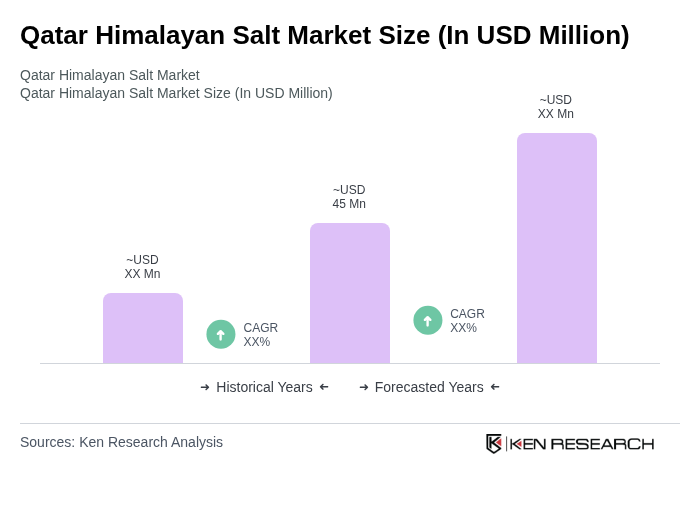
- The Qatar Himalayan Salt Market is valued at USD 45 million, based on a five-year historical analysis. This growth is primarily driven by increasing consumer awareness of health benefits associated with Himalayan salt, alongside a rising trend in wellness and spa treatments. The culinary sector also contributes significantly, as gourmet cooking continues to gain popularity among consumers.
- Key players in this market include Doha, Al Rayyan, and Al Wakrah. These cities dominate due to their high population density, affluent consumer base, and a growing number of wellness and spa centers that utilize Himalayan salt products. The presence of international retailers and local distributors further enhances market accessibility in these regions.
- The Law No. 8 of 1990 on the Regulation of Food Safety issued by the Ministry of Public Health requires importers and distributors of food-grade salts, including Himalayan salt, to obtain prior approval for product registration, conduct laboratory testing for contaminants and mineral composition, and adhere to mandatory nutritional labeling standards specifying sodium content and origin declaration.
Qatar Himalayan Salt Market Segmentation
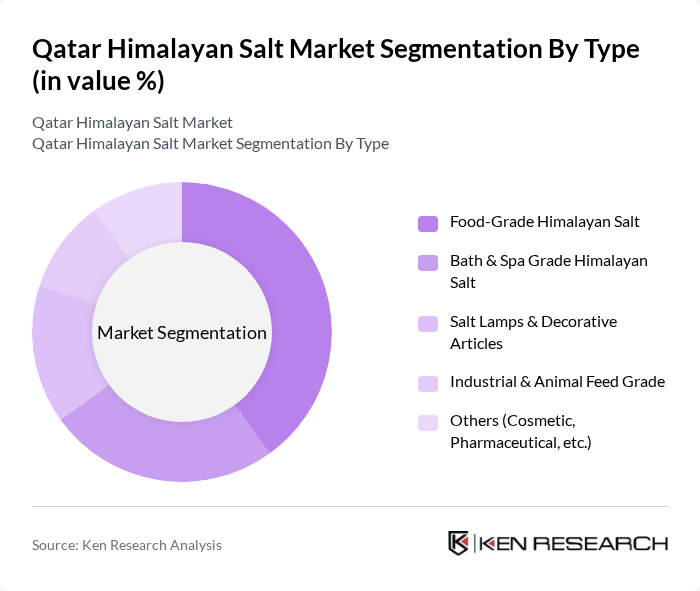
By Type:The market is segmented into various types of Himalayan salt products, including Food-Grade Himalayan Salt, Bath & Spa Grade Himalayan Salt, Salt Lamps & Decorative Articles, Industrial & Animal Feed Grade, and Others (Cosmetic, Pharmaceutical, etc.). Among these, Food-Grade Himalayan Salt is the leading subsegment, driven by its increasing use in culinary applications and health-conscious consumer preferences. Bath & Spa Grade Himalayan Salt is also gaining traction due to the rising popularity of wellness and spa treatments.
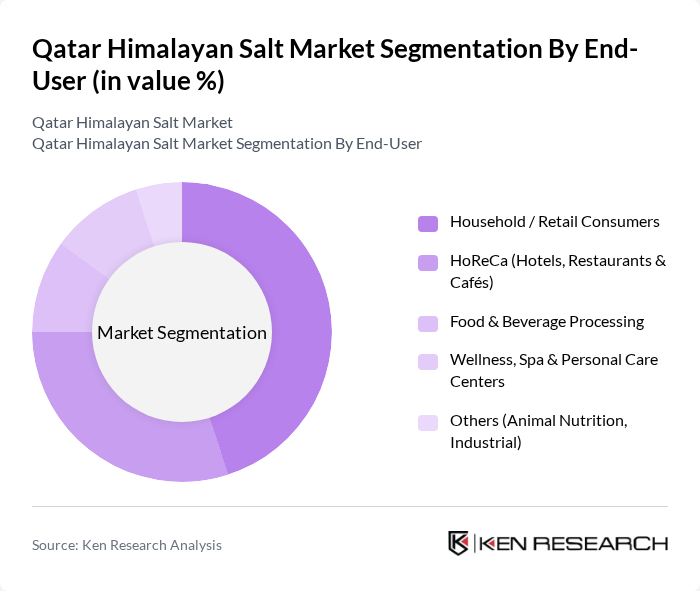
By End-User:The end-user segmentation includes Household / Retail Consumers, HoReCa (Hotels, Restaurants & Cafés), Food & Beverage Processing, Wellness, Spa & Personal Care Centers, and Others (Animal Nutrition, Industrial). The Household / Retail Consumers segment is the most significant, driven by the growing trend of using Himalayan salt in everyday cooking and health applications. The HoReCa segment is also expanding, as restaurants and cafes increasingly incorporate Himalayan salt into their menus.
Qatar Himalayan Salt Market Competitive Landscape
The Qatar Himalayan Salt Market is characterized by a dynamic mix of regional and international players. Leading participants such as Al Meera Consumer Goods Company (Private Label Himalayan Salt), Carrefour Qatar (Majid Al Futtaim) – Imported Himalayan Salt Range, LuLu Hypermarket Qatar – LuLu Private Label & Imported Himalayan Salt, Spinneys Qatar – Gourmet & Health-Focused Himalayan Salt Portfolio, Monoprix Qatar – Premium International Himalayan Salt Brands, Quality Hypermarket & Department Store – Ethnic & Bulk Himalayan Salt, MegaMart Qatar – Specialty & Imported Himalayan Salt SKUs, Al Rawabi Group (Retail & Wholesale Distribution of Himalayan Salt), Talabat, Snoonu & Other Q-Commerce Platforms (Online Himalayan Salt Sales), GMG (Gulf Marketing Group) – Regional Himalayan Pink Salt Manufacturer & Supplier, Shan Foods – Branded Himalayan Salt & Seasoning Supplier to Qatar, National Foods Limited – Himalayan Salt & Blends Distributed in Qatar, Humza Foods / Batla Group – Ethnic Food Importer Including Himalayan Salt, Local HoReCa Distributors (Bidfood Qatar, Abela & Co) – Bulk Himalayan Salt Supply, Online Specialty Stores & Wellness Boutiques (e.g., organic shops retailing Himalayan Salt Lamps & Bath Salts) contribute to innovation, geographic expansion, and service delivery in this space.
Qatar Himalayan Salt Market Industry Analysis
Growth Drivers
- Increasing Health Consciousness:The growing awareness of health benefits associated with Himalayan salt is driving demand. In Qatar, the health and wellness market is projected to reach $1.8 billion in future, with consumers increasingly seeking natural alternatives to processed salts. This trend is supported by a 25% increase in health-related product sales in the region, indicating a shift towards healthier lifestyle choices that favor natural products like Himalayan salt.
- Rising Demand for Natural Products:The global trend towards organic and natural products is reflected in Qatar's market, where sales of natural food products have surged by 35% over the past two years. This shift is driven by consumers' preference for products perceived as healthier and more environmentally friendly. As a result, Himalayan salt, known for its mineral content and purity, is increasingly favored, contributing to its market growth in the region.
- Expanding Culinary Applications:The culinary sector in Qatar is evolving, with gourmet cooking gaining popularity. The number of restaurants offering gourmet dishes has increased by 20% annually, leading to a higher demand for specialty ingredients like Himalayan salt. This salt is not only used for seasoning but also as a cooking medium, enhancing its appeal among chefs and home cooks alike, thereby boosting its market presence.
Market Challenges
- Competition from Alternative Salts:The market faces significant competition from alternative salts, such as sea salt and kosher salt, which are often cheaper and more widely available. In Qatar, the price difference can be as much as 30%, making it challenging for Himalayan salt to compete. This competition is exacerbated by the increasing consumer preference for cost-effective options, which can hinder market growth for Himalayan salt.
- Limited Awareness Among Consumers:Despite its benefits, consumer awareness of Himalayan salt remains limited in Qatar. A recent survey indicated that only 45% of consumers are familiar with its health benefits. This lack of knowledge poses a challenge for market penetration, as many consumers continue to rely on traditional salts. Educational initiatives are necessary to enhance awareness and drive demand for Himalayan salt products.
Qatar Himalayan Salt Market Future Outlook
The future of the Qatar Himalayan salt market appears promising, driven by increasing health consciousness and a growing culinary scene. As consumers continue to prioritize natural and organic products, the demand for Himalayan salt is expected to rise in future. Additionally, the expansion of e-commerce platforms will facilitate direct sales, making Himalayan salt more accessible. Collaborations with health and wellness brands will further enhance market visibility, positioning Himalayan salt as a staple in health-oriented diets and gourmet cooking.
Market Opportunities
- Export Potential to Neighboring Countries:Qatar's strategic location offers significant export opportunities for Himalayan salt to neighboring markets, such as the UAE and Saudi Arabia. With a combined population exceeding 60 million, these markets present a lucrative avenue for growth, especially as demand for natural products continues to rise in the region.
- Development of Value-Added Products:There is a growing opportunity to develop value-added products, such as flavored Himalayan salts and salt-based health supplements. The health and wellness market in Qatar is projected to grow by 12% annually, indicating a strong potential for innovative products that cater to health-conscious consumers, thereby enhancing market growth.
Scope of the Report
| Segment | Sub-Segments |
|---|---|
| By Type | Food-Grade Himalayan Salt Bath & Spa Grade Himalayan Salt Salt Lamps & Decorative Articles Industrial & Animal Feed Grade Others (Cosmetic, Pharmaceutical, etc.) |
| By End-User | Household / Retail Consumers HoReCa (Hotels, Restaurants & Cafés) Food & Beverage Processing Wellness, Spa & Personal Care Centers Others (Animal Nutrition, Industrial) |
| By Packaging Type | Flexible Pouches & Bags Jars, Glass & Rigid Containers Bulk Sacks (B2B) Premium / Gift & HoReCa Packs |
| By Distribution Channel | Supermarkets / Hypermarkets Convenience & Grocery Stores Specialty Gourmet & Health Stores Online Retail (Marketplaces & D2C) HoReCa & Institutional Direct Supply |
| By Region | Doha Al Rayyan Al Wakrah Others |
| By Application | Culinary & Gourmet Uses Decorative & Lighting (Lamps, Bricks) Bath, Spa & Therapeutic Uses Others (Cosmetics, Inhalation, Ritual) |
| By Price Range | Premium Imported & Branded Mid-Range Branded Economy / Private Label HoReCa & Bulk Value Packs |
Key Target Audience
Investors and Venture Capitalist Firms
Government and Regulatory Bodies (e.g., Ministry of Commerce and Industry, Qatar General Authority for Standards and Metrology)
Manufacturers and Producers
Distributors and Retailers
Importers and Exporters
Health and Wellness Industry Stakeholders
Hospitality and Food Service Providers
Natural Product Retailers
Players Mentioned in the Report:
Al Meera Consumer Goods Company (Private Label Himalayan Salt)
Carrefour Qatar (Majid Al Futtaim) Imported Himalayan Salt Range
LuLu Hypermarket Qatar LuLu Private Label & Imported Himalayan Salt
Spinneys Qatar Gourmet & Health-Focused Himalayan Salt Portfolio
Monoprix Qatar Premium International Himalayan Salt Brands
Quality Hypermarket & Department Store Ethnic & Bulk Himalayan Salt
MegaMart Qatar Specialty & Imported Himalayan Salt SKUs
Al Rawabi Group (Retail & Wholesale Distribution of Himalayan Salt)
Talabat, Snoonu & Other Q-Commerce Platforms (Online Himalayan Salt Sales)
GMG (Gulf Marketing Group) Regional Himalayan Pink Salt Manufacturer & Supplier
Shan Foods Branded Himalayan Salt & Seasoning Supplier to Qatar
National Foods Limited Himalayan Salt & Blends Distributed in Qatar
Humza Foods / Batla Group Ethnic Food Importer Including Himalayan Salt
Local HoReCa Distributors (Bidfood Qatar, Abela & Co) Bulk Himalayan Salt Supply
Online Specialty Stores & Wellness Boutiques (e.g., organic shops retailing Himalayan Salt Lamps & Bath Salts)
Table of Contents
Market Assessment Phase
1. Executive Summary and Approach
2. Qatar Himalayan Salt Market Overview
2.1 Key Insights and Strategic Recommendations
2.2 Qatar Himalayan Salt Market Overview
2.3 Definition and Scope
2.4 Evolution of Market Ecosystem
2.5 Timeline of Key Regulatory Milestones
2.6 Value Chain & Stakeholder Mapping
2.7 Business Cycle Analysis
2.8 Policy & Incentive Landscape
3. Qatar Himalayan Salt Market Analysis
3.1 Growth Drivers
3.1.1 Increasing Health Consciousness
3.1.2 Rising Demand for Natural Products
3.1.3 Expanding Culinary Applications
3.1.4 Growth in the Food Processing Industry
3.2 Market Challenges
3.2.1 Competition from Alternative Salts
3.2.2 Price Volatility of Raw Materials
3.2.3 Limited Awareness Among Consumers
3.2.4 Regulatory Compliance Issues
3.3 Market Opportunities
3.3.1 Export Potential to Neighboring Countries
3.3.2 Development of Value-Added Products
3.3.3 E-commerce Growth for Direct Sales
3.3.4 Collaborations with Health and Wellness Brands
3.4 Market Trends
3.4.1 Increasing Popularity of Gourmet Salts
3.4.2 Sustainable Sourcing Practices
3.4.3 Innovative Packaging Solutions
3.4.4 Rising Interest in Himalayan Salt Lamps
3.5 Government Regulation
3.5.1 Food Safety Standards
3.5.2 Import Tariffs on Salt Products
3.5.3 Labeling Requirements for Health Claims
3.5.4 Environmental Regulations on Mining Practices
4. SWOT Analysis
5. Stakeholder Analysis
6. Porter's Five Forces Analysis
7. Qatar Himalayan Salt Market Market Size, 2019-2024
7.1 By Value
7.2 By Volume
7.3 By Average Selling Price
8. Qatar Himalayan Salt Market Segmentation
8.1 By Type
8.1.1 Food-Grade Himalayan Salt
8.1.2 Bath & Spa Grade Himalayan Salt
8.1.3 Salt Lamps & Decorative Articles
8.1.4 Industrial & Animal Feed Grade
8.1.5 Others (Cosmetic, Pharmaceutical, etc.)
8.2 By End-User
8.2.1 Household / Retail Consumers
8.2.2 HoReCa (Hotels, Restaurants & Cafés)
8.2.3 Food & Beverage Processing
8.2.4 Wellness, Spa & Personal Care Centers
8.2.5 Others (Animal Nutrition, Industrial)
8.3 By Packaging Type
8.3.1 Flexible Pouches & Bags
8.3.2 Jars, Glass & Rigid Containers
8.3.3 Bulk Sacks (B2B)
8.3.4 Premium / Gift & HoReCa Packs
8.4 By Distribution Channel
8.4.1 Supermarkets / Hypermarkets
8.4.2 Convenience & Grocery Stores
8.4.3 Specialty Gourmet & Health Stores
8.4.4 Online Retail (Marketplaces & D2C)
8.4.5 HoReCa & Institutional Direct Supply
8.5 By Region
8.5.1 Doha
8.5.2 Al Rayyan
8.5.3 Al Wakrah
8.5.4 Others
8.6 By Application
8.6.1 Culinary & Gourmet Uses
8.6.2 Decorative & Lighting (Lamps, Bricks)
8.6.3 Bath, Spa & Therapeutic Uses
8.6.4 Others (Cosmetics, Inhalation, Ritual)
8.7 By Price Range
8.7.1 Premium Imported & Branded
8.7.2 Mid-Range Branded
8.7.3 Economy / Private Label
8.7.4 HoReCa & Bulk Value Packs
9. Qatar Himalayan Salt Market Competitive Analysis
9.1 Market Share of Key Players
9.2 Cross Comparison of Key Players
9.2.1 Company Name
9.2.2 Presence in Qatar (Years in Market, Number of Retail & HoReCa Accounts)
9.2.3 Qatar Revenue & 3-Year CAGR from Himalayan Salt
9.2.4 Product Portfolio Breadth (Culinary, Bath, Lamps, HoReCa SKUs)
9.2.5 Average Price Positioning vs Category (Premium / Mid / Value Index)
9.2.6 Share of Sales by Channel (Modern Trade, Traditional, Online, HoReCa)
9.2.7 Import & Supply Chain Capability (Sourcing Countries, Local Stocking Points)
9.2.8 Brand Awareness & Preference in Qatar (Consumer / HoReCa Surveys)
9.2.9 Distribution Reach (Number of Outlets & Online Platforms Listed)
9.2.10 Compliance & Certifications (Halal, ISO, Organic, Qatari Standards)
9.3 SWOT Analysis of Top Players
9.4 Pricing Analysis
9.5 Detailed Profile of Major Companies
9.5.1 Al Meera Consumer Goods Company (Private Label Himalayan Salt)
9.5.2 Carrefour Qatar (Majid Al Futtaim) – Imported Himalayan Salt Range
9.5.3 LuLu Hypermarket Qatar – LuLu Private Label & Imported Himalayan Salt
9.5.4 Spinneys Qatar – Gourmet & Health-Focused Himalayan Salt Portfolio
9.5.5 Monoprix Qatar – Premium International Himalayan Salt Brands
9.5.6 Quality Hypermarket & Department Store – Ethnic & Bulk Himalayan Salt
9.5.7 MegaMart Qatar – Specialty & Imported Himalayan Salt SKUs
9.5.8 Al Rawabi Group (Retail & Wholesale Distribution of Himalayan Salt)
9.5.9 Talabat, Snoonu & Other Q-Commerce Platforms (Online Himalayan Salt Sales)
9.5.10 GMG (Gulf Marketing Group) – Regional Himalayan Pink Salt Manufacturer & Supplier
9.5.11 Shan Foods – Branded Himalayan Salt & Seasoning Supplier to Qatar
9.5.12 National Foods Limited – Himalayan Salt & Blends Distributed in Qatar
9.5.13 Humza Foods / Batla Group – Ethnic Food Importer Including Himalayan Salt
9.5.14 Local HoReCa Distributors (Bidfood Qatar, Abela & Co) – Bulk Himalayan Salt Supply
9.5.15 Online Specialty Stores & Wellness Boutiques (e.g., organic shops retailing Himalayan Salt Lamps & Bath Salts)
10. Qatar Himalayan Salt Market End-User Analysis
10.1 Procurement Behavior of Key Ministries
10.1.1 Key Procurement Trends
10.1.2 Budget Allocations
10.1.3 Supplier Selection Criteria
10.1.4 Contracting Processes
10.2 Corporate Spend on Infrastructure & Energy
10.2.1 Investment Trends
10.2.2 Major Projects
10.2.3 Budget Priorities
10.2.4 Spending Patterns
10.3 Pain Point Analysis by End-User Category
10.3.1 Common Challenges Faced
10.3.2 Demand Fluctuations
10.3.3 Quality Concerns
10.3.4 Supply Chain Issues
10.4 User Readiness for Adoption
10.4.1 Awareness Levels
10.4.2 Adoption Barriers
10.4.3 Training Needs
10.4.4 Support Requirements
10.5 Post-Deployment ROI and Use Case Expansion
10.5.1 ROI Measurement Techniques
10.5.2 Success Stories
10.5.3 Future Use Cases
10.5.4 Expansion Opportunities
11. Qatar Himalayan Salt Market Future Size, 2025-2030
11.1 By Value
11.2 By Volume
11.3 By Average Selling Price
Go-To-Market Strategy Phase
1. Whitespace Analysis + Business Model Canvas
1.1 Market Gaps Identification
1.2 Business Model Components
2. Marketing and Positioning Recommendations
2.1 Branding Strategies
2.2 Product USPs
3. Distribution Plan
3.1 Urban Retail vs Rural NGO Tie-ups
4. Channel & Pricing Gaps
4.1 Underserved Routes
4.2 Pricing Bands
5. Unmet Demand & Latent Needs
5.1 Category Gaps
5.2 Consumer Segments
6. Customer Relationship
6.1 Loyalty Programs
6.2 After-sales Service
7. Value Proposition
7.1 Sustainability
7.2 Integrated Supply Chains
8. Key Activities
8.1 Regulatory Compliance
8.2 Branding
8.3 Distribution Setup
9. Entry Strategy Evaluation
9.1 Domestic Market Entry Strategy
9.1.1 Product Mix
9.1.2 Pricing Band
9.1.3 Packaging
9.2 Export Entry Strategy
9.2.1 Target Countries
9.2.2 Compliance Roadmap
10. Entry Mode Assessment
10.1 JV
10.2 Greenfield
10.3 M&A
10.4 Distributor Model
11. Capital and Timeline Estimation
11.1 Capital Requirements
11.2 Timelines
12. Control vs Risk Trade-Off
12.1 Ownership vs Partnerships
13. Profitability Outlook
13.1 Breakeven Analysis
13.2 Long-term Sustainability
14. Potential Partner List
14.1 Distributors
14.2 JVs
14.3 Acquisition Targets
15. Execution Roadmap
15.1 Phased Plan for Market Entry
15.1.1 Market Setup
15.1.2 Market Entry
15.1.3 Growth Acceleration
15.1.4 Scale & Stabilize
15.2 Key Activities and Milestones
15.2.1 Milestone Planning
15.2.2 Activity Tracking
Research Methodology
Phase 1: Approach1
Desk Research
- Analysis of market reports from industry associations and trade publications related to Himalayan salt
- Review of import/export data from Qatar's Ministry of Economy and Commerce
- Examination of consumer trends and preferences through online surveys and social media analytics
Primary Research
- Interviews with key stakeholders in the food and wellness sectors, including retailers and distributors
- Surveys targeting health and wellness professionals to gauge consumer awareness and demand
- Field visits to local markets and health stores to observe product placement and consumer interactions
Validation & Triangulation
- Cross-validation of findings with multiple data sources, including sales data and consumer feedback
- Triangulation of insights from industry experts and market analysts to ensure data reliability
- Sanity checks through expert panel discussions to validate assumptions and projections
Phase 2: Market Size Estimation1
Top-down Assessment
- Estimation of total market size based on national health and wellness spending trends
- Segmentation of the market by product type, including culinary, therapeutic, and decorative Himalayan salt
- Incorporation of demographic data to assess potential market growth among different consumer segments
Bottom-up Modeling
- Collection of sales data from major retailers and distributors of Himalayan salt in Qatar
- Estimation of average pricing and volume sold across different product categories
- Analysis of consumer purchasing patterns to determine frequency and volume of purchases
Forecasting & Scenario Analysis
- Development of forecasting models based on historical sales data and market trends
- Scenario analysis considering factors such as health trends, economic conditions, and regulatory changes
- Creation of baseline, optimistic, and pessimistic forecasts for market growth through 2030
Phase 3: CATI Sample Composition1
| Scope Item/Segment | Sample Size | Target Respondent Profiles |
|---|---|---|
| Retail Sector Insights | 90 | Store Managers, Category Buyers |
| Health and Wellness Professionals | 70 | Nutritionists, Fitness Trainers |
| Consumer Preferences Survey | 140 | Health-Conscious Consumers, Home Chefs |
| Distribution Channel Analysis | 80 | Wholesalers, Importers |
| Market Trend Evaluation | 60 | Market Analysts, Industry Experts |
Frequently Asked Questions
What is the current value of the Qatar Himalayan Salt Market?
The Qatar Himalayan Salt Market is valued at approximately USD 45 million, reflecting a growing consumer interest in the health benefits of Himalayan salt and its increasing use in culinary and wellness applications.
What are the main drivers of growth in the Qatar Himalayan Salt Market?
Which cities in Qatar dominate the Himalayan salt market?
What types of Himalayan salt products are available in Qatar?
Other Regional/Country Reports
Indonesia Himalayan Salt Market
Malaysia Himalayan Salt Market
KSA Himalayan Salt Market
APAC Himalayan Salt Market
SEA Himalayan Salt Market
Other Adjacent Reports
Brazil Gourmet Seasonings Market
Qatar Wellness Products Market
Vietnam Organic Food Market Outlook to 2030Vietnam Health Supplements Market Outlook to 2030Thailand Bath Products Market
Oman Salt Lamps Market
Philippines Food Ingredients Market Outlook to 2021Asia Pacific Animal Feed Market Outlook to 2030: Size, Share, Growth and TrendsBelgium Cosmetic Ingredients Market
Why Buy From Us?

What makes us stand out is that our consultants follow Robust, Refine and Result (RRR) methodology. Robust for clear definitions, approaches and sanity checking, Refine for differentiating respondents' facts and opinions, and Result for presenting data with story.

We have set a benchmark in the industry by offering our clients with syndicated and customized market research reports featuring coverage of entire market as well as meticulous research and analyst insights.

While we don't replace traditional research, we flip the method upside down. Our dual approach of Top Bottom & Bottom Top ensures quality deliverable by not just verifying company fundamentals but also looking at the sector and macroeconomic factors.

With one step in the future, our research team constantly tries to show you the bigger picture. We help with some of the tough questions you may encounter along the way: How is the industry positioned? Best marketing channel? KPI's of competitors? By aligning every element, we help maximize success.

Our report gives you instant access to the answers and sources that other companies might choose to hide. We elaborate each steps of research methodology we have used and showcase you the sample size to earn your trust.

If you need any support, we are here! We pride ourselves on universe strength, data quality, and quick, friendly, and professional service.