About the Report
Base Year 2024Qatar K12 Education Market Overview
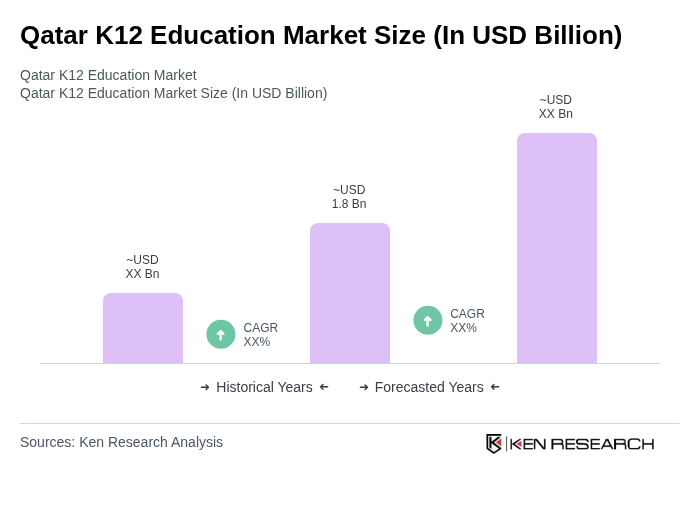
- The Qatar K12 Education Market is valued at USD 1.8 billion, based on a five-year historical analysis of the private K12 segment. This growth is primarily driven by increasing government investment in education infrastructure, a rising expatriate population, and a growing emphasis on high-quality and holistic education. The demand for diverse educational options, particularly international curricula, as well as personalized learning and extracurricular offerings, has also contributed to the market's expansion.
- Doha is the dominant city in the Qatar K12 Education Market, primarily due to its status as the capital and largest city, housing a significant number of international schools and educational institutions. The presence of a diverse expatriate community further fuels the demand for various educational offerings, making it a hub for quality education in the region.
- The Private Schools Policy, 2023, issued by the Ministry of Education and Higher Education, mandates that all private schools in Qatar align their curricula with the National Curriculum Framework. This regulation aims to standardize educational quality across the country and ensure that all students receive a comprehensive education that meets national standards. The policy requires private schools to integrate core subjects from the national curriculum and comply with periodic quality assurance reviews.
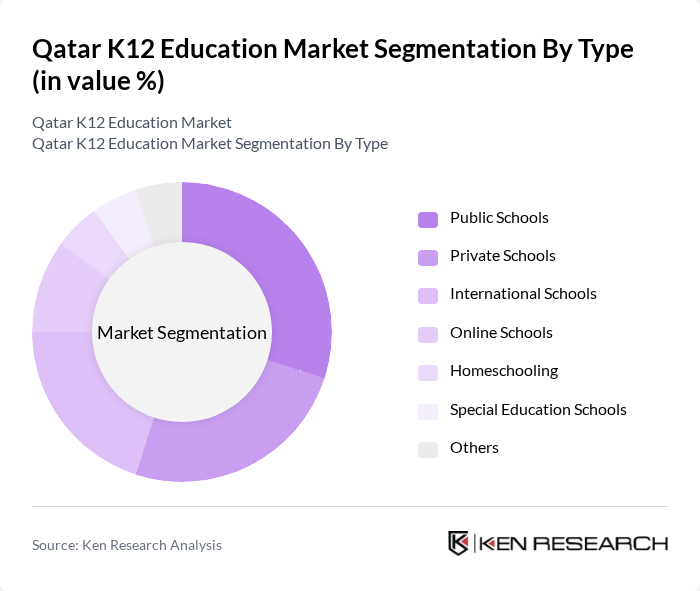
Qatar K12 Education Market Segmentation
By Type:The K12 education market in Qatar is segmented into Public Schools, Private Schools, International Schools, Online Schools, Homeschooling, Special Education Schools, and Others. Public Schools are primarily funded by the government and serve mainly Qatari nationals, while Private and International Schools cater to both local and expatriate populations, often offering international curricula such as British, American, or IB. Online Schools have gained traction due to increased demand for flexible and remote learning options, particularly following the pandemic. Homeschooling is emerging as a niche alternative for families seeking customized educational experiences, especially among expatriates. Special Education Schools provide tailored support for students with specific learning needs, ensuring inclusivity and access to education for all segments.
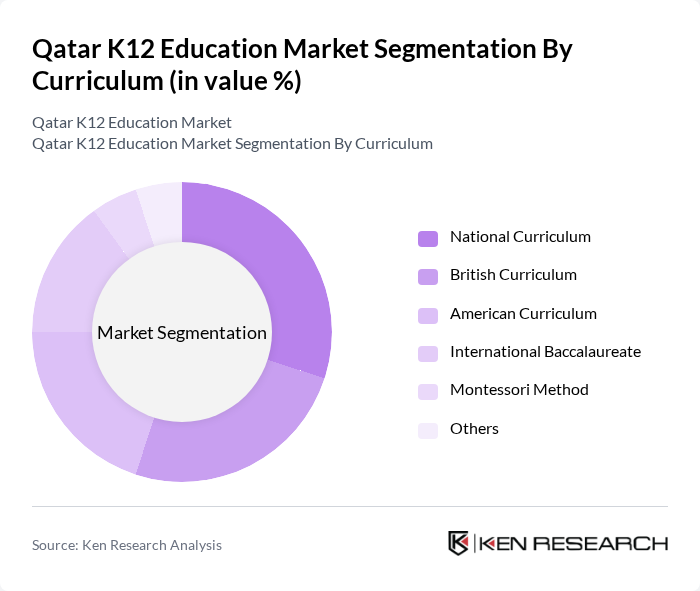
By Curriculum:The K12 education market in Qatar is also segmented by curriculum, including National Curriculum, British Curriculum, American Curriculum, International Baccalaureate, Montessori Method, and Others. The National Curriculum is mandated in public schools and integrated into private schools per regulatory requirements. The British and American Curricula are especially popular among private and international schools, serving the large expatriate community. The International Baccalaureate offers a globally recognized qualification, attracting families seeking international standards. The Montessori Method is gaining interest among parents who prefer alternative, child-centered educational approaches.
Qatar K12 Education Market Competitive Landscape
The Qatar K12 Education Market is characterized by a dynamic mix of regional and international players. Leading participants such as Qatar Foundation Schools, GEMS Education (GEMS American Academy, GEMS Wellington School), Nord Anglia Education (Doha College, Doha British School), Qatar International School, The International School of Qatar, Compass International School, The Learning Center, The Pearl Academy, The International Academy of Doha, Qatar International Academy, The American Academy School, American School of Doha, International Community School, The British School of Doha, DPS Modern Indian School contribute to innovation, geographic expansion, and service delivery in this space.
Qatar K12 Education Market Industry Analysis
Growth Drivers
- Increasing Population and Enrollment Rates:Qatar's population is projected to reach approximately 2.7 million in the future, driving demand for K12 education. The enrollment rate in primary education stands at 98%, with secondary education enrollment at 92%. This growth is fueled by a young demographic, where about 13% of the population is under 15 years old, necessitating expanded educational facilities and resources to accommodate rising student numbers.
- Government Investment in Education:The Qatari government allocated approximately QAR 17.8 billion (approximately USD 4.9 billion) for education in the future, reflecting a commitment to enhancing educational infrastructure. This investment supports the development of new schools and the improvement of existing facilities, aiming to increase the quality of education. The government’s focus on education is part of its National Vision 2030, which emphasizes human capital development as a key priority.
- Technological Advancements in Learning:The integration of technology in Qatar's K12 education is accelerating, with over 70% of schools adopting digital learning tools in the future. The Ministry of Education has initiated programs to enhance digital literacy, investing QAR 1.5 billion (approximately USD 412 million) in educational technology. This shift towards tech-driven learning environments is expected to improve student engagement and learning outcomes significantly.
Market Challenges
- Limited Infrastructure in Remote Areas:Despite significant investments, many remote areas in Qatar still lack adequate educational infrastructure. Approximately 15% of students in rural regions face challenges accessing quality education due to insufficient school facilities. This disparity can hinder overall educational attainment and limit opportunities for students in these areas, necessitating targeted government interventions to bridge the gap.
- High Competition Among Private Institutions:The K12 education sector in Qatar is characterized by intense competition, with over 200 private schools operating in the market. This saturation leads to challenges in maintaining quality and attracting students. Many institutions struggle to differentiate themselves, resulting in price wars and potential compromises on educational standards, which can adversely affect the overall market landscape.
Qatar K12 Education Market Future Outlook
The future of Qatar's K12 education market appears promising, driven by ongoing government initiatives and a growing emphasis on quality education. The integration of advanced technologies and personalized learning approaches is expected to reshape educational experiences. Additionally, the increasing demand for international curricula will likely lead to the establishment of more international schools, catering to diverse student populations and enhancing educational offerings across the region.
Market Opportunities
- Growth of Online Learning Platforms:The rise of online learning platforms presents a significant opportunity, with an estimated 30% of students in Qatar expected to engage in online education in the future. This shift allows for flexible learning options and access to diverse educational resources, catering to the needs of students and parents seeking alternative educational pathways.
- Expansion of International Schools:The demand for international schools is on the rise, with projections indicating a 20% increase in enrollment in the future. This trend is driven by expatriate families seeking quality education aligned with global standards. The establishment of new international schools can enhance educational diversity and provide students with a broader range of learning opportunities.
Scope of the Report
| Segment | Sub-Segments |
|---|---|
| By Type | Public Schools Private Schools International Schools Online Schools Homeschooling Special Education Schools Others |
| By Curriculum | National Curriculum British Curriculum American Curriculum International Baccalaureate Montessori Method Others |
| By Grade Level | Primary Education Secondary Education Pre-Kindergarten Others |
| By Location | Urban Areas Rural Areas Suburban Areas Others |
| By Student Demographics | Local Students Expatriate Students Special Needs Students Others |
| By Funding Source | Government Funded Private Funded International Aid Others |
| By Technology Integration | Fully Integrated Technology Partially Integrated Technology Traditional Methods Others |
Key Target Audience
Investors and Venture Capitalist Firms
Government and Regulatory Bodies (e.g., Ministry of Education and Higher Education)
Educational Technology Companies
Textbook and Educational Material Publishers
Non-Governmental Organizations (NGOs) focused on education
Corporate Social Responsibility (CSR) Initiatives
Real Estate Developers focusing on school infrastructure
Training and Professional Development Providers
Players Mentioned in the Report:
Qatar Foundation Schools
GEMS Education (GEMS American Academy, GEMS Wellington School)
Nord Anglia Education (Doha College, Doha British School)
Qatar International School
The International School of Qatar
Compass International School
The Learning Center
The Pearl Academy
The International Academy of Doha
Qatar International Academy
The American Academy School
American School of Doha
International Community School
The British School of Doha
DPS Modern Indian School
Table of Contents
Market Assessment Phase
1. Executive Summary and Approach
2. Qatar K12 Education Market Overview
2.1 Key Insights and Strategic Recommendations
2.2 Qatar K12 Education Market Overview
2.3 Definition and Scope
2.4 Evolution of Market Ecosystem
2.5 Timeline of Key Regulatory Milestones
2.6 Value Chain & Stakeholder Mapping
2.7 Business Cycle Analysis
2.8 Policy & Incentive Landscape
3. Qatar K12 Education Market Analysis
3.1 Growth Drivers
3.1.1 Increasing Population and Enrollment Rates
3.1.2 Government Investment in Education
3.1.3 Technological Advancements in Learning
3.1.4 Demand for International Curriculum
3.2 Market Challenges
3.2.1 Limited Infrastructure in Remote Areas
3.2.2 High Competition Among Private Institutions
3.2.3 Regulatory Compliance Issues
3.2.4 Teacher Shortages and Training Needs
3.3 Market Opportunities
3.3.1 Growth of Online Learning Platforms
3.3.2 Expansion of International Schools
3.3.3 Partnerships with EdTech Companies
3.3.4 Increased Focus on STEM Education
3.4 Market Trends
3.4.1 Shift Towards Personalized Learning
3.4.2 Integration of Artificial Intelligence in Education
3.4.3 Emphasis on Mental Health and Wellbeing
3.4.4 Rise of Hybrid Learning Models
3.5 Government Regulation
3.5.1 National Curriculum Framework Implementation
3.5.2 Licensing Requirements for Private Schools
3.5.3 Quality Assurance Standards for Education
3.5.4 Funding and Grants for Educational Initiatives
4. SWOT Analysis
5. Stakeholder Analysis
6. Porter's Five Forces Analysis
7. Qatar K12 Education Market Market Size, 2019-2024
7.1 By Value
7.2 By Volume
7.3 By Average Selling Price
8. Qatar K12 Education Market Segmentation
8.1 By Type
8.1.1 Public Schools
8.1.2 Private Schools
8.1.3 International Schools
8.1.4 Online Schools
8.1.5 Homeschooling
8.1.6 Special Education Schools
8.1.7 Others
8.2 By Curriculum
8.2.1 National Curriculum
8.2.2 British Curriculum
8.2.3 American Curriculum
8.2.4 International Baccalaureate
8.2.5 Montessori Method
8.2.6 Others
8.3 By Grade Level
8.3.1 Primary Education
8.3.2 Secondary Education
8.3.3 Pre-Kindergarten
8.3.4 Others
8.4 By Location
8.4.1 Urban Areas
8.4.2 Rural Areas
8.4.3 Suburban Areas
8.4.4 Others
8.5 By Student Demographics
8.5.1 Local Students
8.5.2 Expatriate Students
8.5.3 Special Needs Students
8.5.4 Others
8.6 By Funding Source
8.6.1 Government Funded
8.6.2 Private Funded
8.6.3 International Aid
8.6.4 Others
8.7 By Technology Integration
8.7.1 Fully Integrated Technology
8.7.2 Partially Integrated Technology
8.7.3 Traditional Methods
8.7.4 Others
9. Qatar K12 Education Market Competitive Analysis
9.1 Market Share of Key Players
9.2 Cross Comparison of Key Players
9.2.1 Company Name
9.2.2 Group Size (Large, Medium, or Small as per industry convention)
9.2.3 Enrollment Growth Rate
9.2.4 Student Retention Rate
9.2.5 Teacher-Student Ratio
9.2.6 Average Class Size
9.2.7 Revenue per Student
9.2.8 Pricing Strategy
9.2.9 Curriculum Diversity Index
9.2.10 Technology Adoption Rate
9.3 SWOT Analysis of Top Players
9.4 Pricing Analysis
9.5 Detailed Profile of Major Companies
9.5.1 Qatar Foundation Schools
9.5.2 GEMS Education (GEMS American Academy, GEMS Wellington School)
9.5.3 Nord Anglia Education (Doha College, Doha British School)
9.5.4 Qatar International School
9.5.5 The International School of Qatar
9.5.6 Compass International School
9.5.7 The Learning Center
9.5.8 The Pearl Academy
9.5.9 The International Academy of Doha
9.5.10 Qatar International Academy
9.5.11 The American Academy School
9.5.12 American School of Doha
9.5.13 International Community School
9.5.14 The British School of Doha
9.5.15 DPS Modern Indian School
10. Qatar K12 Education Market End-User Analysis
10.1 Procurement Behavior of Key Ministries
10.1.1 Ministry of Education and Higher Education
10.1.2 Ministry of Finance
10.1.3 Ministry of Administrative Development, Labor and Social Affairs
10.1.4 Others
10.2 Corporate Spend on Infrastructure & Energy
10.2.1 Investment in School Facilities
10.2.2 Technology Infrastructure Spending
10.2.3 Teacher Training Programs
10.2.4 Others
10.3 Pain Point Analysis by End-User Category
10.3.1 Parents
10.3.2 Students
10.3.3 Educators
10.3.4 School Administrators
10.4 User Readiness for Adoption
10.4.1 Technology Readiness
10.4.2 Curriculum Adaptability
10.4.3 Infrastructure Availability
10.4.4 Others
10.5 Post-Deployment ROI and Use Case Expansion
10.5.1 Performance Metrics
10.5.2 Student Outcomes
10.5.3 Cost Savings
10.5.4 Others
11. Qatar K12 Education Market Future Size, 2025-2030
11.1 By Value
11.2 By Volume
11.3 By Average Selling Price
Go-To-Market Strategy Phase
1. Whitespace Analysis + Business Model Canvas
1.1 Market Gaps Identification
1.2 Business Model Development
2. Marketing and Positioning Recommendations
2.1 Branding Strategies
2.2 Product USPs
3. Distribution Plan
3.1 Urban Retail vs Rural NGO Tie-ups
4. Channel & Pricing Gaps
4.1 Underserved Routes
4.2 Pricing Bands
5. Unmet Demand & Latent Needs
5.1 Category Gaps
5.2 Consumer Segments
6. Customer Relationship
6.1 Loyalty Programs
6.2 After-sales Service
7. Value Proposition
7.1 Sustainability
7.2 Integrated Supply Chains
8. Key Activities
8.1 Regulatory Compliance
8.2 Branding
8.3 Distribution Setup
9. Entry Strategy Evaluation
9.1 Domestic Market Entry Strategy
9.1.1 Product Mix
9.1.2 Pricing Band
9.1.3 Packaging
9.2 Export Entry Strategy
9.2.1 Target Countries
9.2.2 Compliance Roadmap
10. Entry Mode Assessment
10.1 JV
10.2 Greenfield
10.3 M&A
10.4 Distributor Model
11. Capital and Timeline Estimation
11.1 Capital Requirements
11.2 Timelines
12. Control vs Risk Trade-Off
12.1 Ownership vs Partnerships
13. Profitability Outlook
13.1 Breakeven Analysis
13.2 Long-term Sustainability
14. Potential Partner List
14.1 Distributors
14.2 JVs
14.3 Acquisition Targets
15. Execution Roadmap
15.1 Phased Plan for Market Entry
15.1.1 Market Setup
15.1.2 Market Entry
15.1.3 Growth Acceleration
15.1.4 Scale & Stabilize
15.2 Key Activities and Milestones
15.2.1 Milestone Planning
15.2.2 Activity Tracking
Research Methodology
Phase 1: Approach1
Desk Research
- Analysis of government education reports and statistics from the Ministry of Education and Higher Education in Qatar
- Review of academic publications and white papers on K12 education trends in the Middle East
- Examination of market reports from educational consultancies focusing on the Qatari education landscape
Primary Research
- Interviews with school administrators and principals across various K12 institutions
- Surveys conducted with teachers to gather insights on curriculum effectiveness and student engagement
- Focus groups with parents to understand their perceptions and expectations of K12 education
Validation & Triangulation
- Cross-validation of findings through multiple data sources, including government and private sector reports
- Triangulation of qualitative insights from interviews with quantitative data from surveys
- Sanity checks through expert panel reviews involving educational policymakers and industry experts
Phase 2: Market Size Estimation1
Top-down Assessment
- Estimation of total K12 education expenditure based on national education budgets and spending patterns
- Segmentation of the market by type of institution (public vs. private) and educational stage (primary vs. secondary)
- Incorporation of demographic trends and population growth projections in Qatar
Bottom-up Modeling
- Collection of enrollment data from individual schools to establish a baseline for student numbers
- Analysis of tuition fees and operational costs across different types of K12 institutions
- Calculation of market size based on student enrollment multiplied by average spending per student
Forecasting & Scenario Analysis
- Multi-factor regression analysis incorporating economic indicators, population growth, and educational reforms
- Scenario modeling based on potential changes in government policy and funding for education
- Development of baseline, optimistic, and pessimistic forecasts for the K12 market through 2030
Phase 3: CATI Sample Composition1
| Scope Item/Segment | Sample Size | Target Respondent Profiles |
|---|---|---|
| Public School Administrators | 60 | Principals, Vice Principals |
| Private School Teachers | 50 | Classroom Teachers, Subject Coordinators |
| Parent Perspectives on Education | 70 | Parents of K12 Students |
| Educational Policy Makers | 40 | Government Officials, Education Consultants |
| Curriculum Development Experts | 40 | Curriculum Designers, Educational Researchers |
Frequently Asked Questions
What is the current value of the Qatar K12 education market?
The Qatar K12 education market is valued at approximately USD 1.8 billion, driven by government investments in education infrastructure, a growing expatriate population, and an increasing demand for diverse educational options, including international curricula and personalized learning experiences.
Which city dominates the Qatar K12 education market?
What is the Private Schools Policy, 2023 in Qatar?
What types of schools are included in the Qatar K12 education market?
Other Regional/Country Reports
Indonesia K 12 Education Market
Malaysia K 12 Education Market
APAC K 12 Education Market
SEA K 12 Education Market
Other Adjacent Reports
Qatar Educational Technology Market
Belgium Online Learning Platforms Market
Kuwait Tutoring Services Market
Kuwait Early Childhood Education Market
KSA Higher Education Market
Thailand Vocational Training Market
Kuwait Educational Publishing Market
Germany School Supplies Market
Brazil Teacher Training Market
Oman Special Education Services Market
Why Buy From Us?

What makes us stand out is that our consultants follow Robust, Refine and Result (RRR) methodology. Robust for clear definitions, approaches and sanity checking, Refine for differentiating respondents' facts and opinions, and Result for presenting data with story.

We have set a benchmark in the industry by offering our clients with syndicated and customized market research reports featuring coverage of entire market as well as meticulous research and analyst insights.

While we don't replace traditional research, we flip the method upside down. Our dual approach of Top Bottom & Bottom Top ensures quality deliverable by not just verifying company fundamentals but also looking at the sector and macroeconomic factors.

With one step in the future, our research team constantly tries to show you the bigger picture. We help with some of the tough questions you may encounter along the way: How is the industry positioned? Best marketing channel? KPI's of competitors? By aligning every element, we help maximize success.

Our report gives you instant access to the answers and sources that other companies might choose to hide. We elaborate each steps of research methodology we have used and showcase you the sample size to earn your trust.

If you need any support, we are here! We pride ourselves on universe strength, data quality, and quick, friendly, and professional service.