About the Report
Base Year 2024Saudi Arabia AI Pathology Market Overview
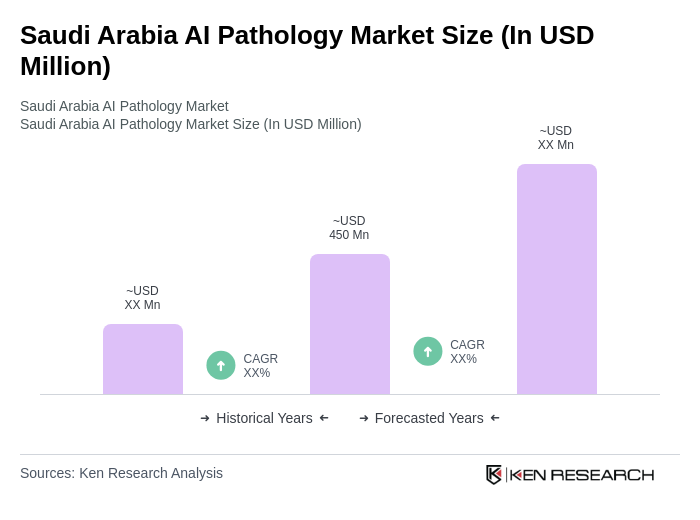
- The Saudi Arabia AI Pathology Market is valued at USD 450 million, based on a five-year historical analysis. Growth is primarily driven by the increasing adoption of digital health technologies, rising prevalence of chronic and genetic diseases, and the need for efficient diagnostic solutions. The integration of artificial intelligence in pathology is enhancing diagnostic accuracy, enabling remote consultations, and reducing turnaround times, making it a vital component of modern healthcare. The market is further propelled by public and private investments in healthcare infrastructure modernization, regulatory approval of digital systems, and the need for scalable, remote solutions in regions with pathologist shortages .
- Key cities such as Riyadh, Jeddah, and Dammam dominate the market due to their advanced healthcare infrastructure and concentration of medical facilities. These urban centers are home to leading hospitals and research institutions that are increasingly adopting AI technologies to improve patient outcomes, streamline operations, and support multi-site collaboration through digital pathology platforms .
- The Artificial Intelligence in Healthcare Regulation, 2023, issued by the Saudi Food and Drug Authority (SFDA), mandates the integration of AI technologies in healthcare systems to enhance diagnostic capabilities. This regulation requires healthcare providers to adopt certified AI-based diagnostic tools, ensure compliance with data privacy standards, and maintain ongoing performance monitoring of AI systems, thereby improving the quality of healthcare services and aligning with global best practices .
Saudi Arabia AI Pathology Market Segmentation
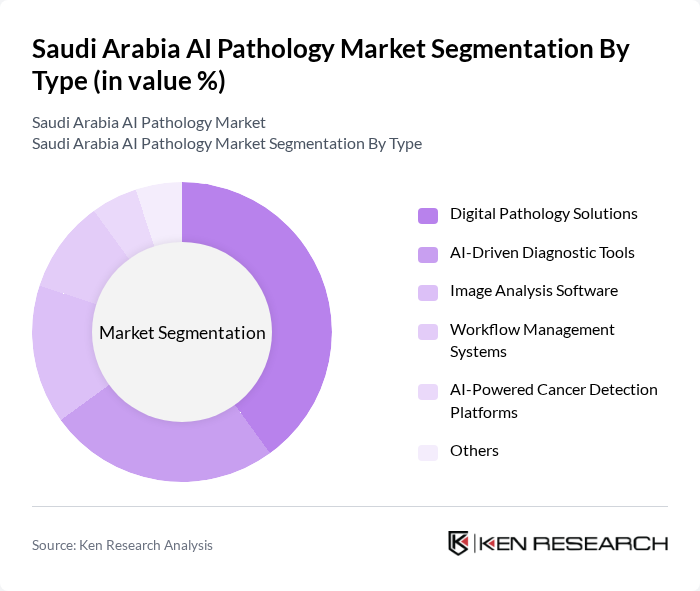
By Type:The market is segmented into Digital Pathology Solutions, AI-Driven Diagnostic Tools, Image Analysis Software, Workflow Management Systems, AI-Powered Cancer Detection Platforms, and Others. Digital Pathology Solutions are gaining significant traction due to their ability to digitize and analyze pathology slides, facilitating remote consultations and improving diagnostic accuracy. AI-Driven Diagnostic Tools are also increasingly popular, enhancing the speed and precision of disease detection, particularly in oncology and chronic disease management. Image Analysis Software and Workflow Management Systems are being adopted to streamline laboratory operations and support high-throughput diagnostics, while AI-Powered Cancer Detection Platforms are contributing to early and accurate cancer diagnosis .
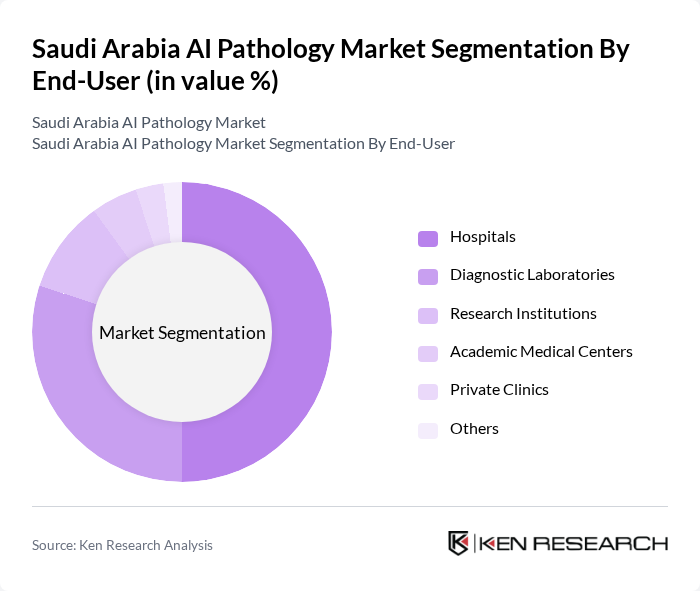
By End-User:The end-user segmentation includes Hospitals, Diagnostic Laboratories, Research Institutions, Academic Medical Centers, Private Clinics, and Others. Hospitals are the leading end-users, driven by the need for advanced diagnostic tools to improve patient care and operational efficiency. Diagnostic Laboratories also play a crucial role as they require high-throughput solutions for accurate and timely test results, particularly in cancer diagnostics. Research Institutions and Academic Medical Centers are adopting AI pathology solutions for clinical research and education, while Private Clinics and Others are gradually integrating these technologies to enhance service quality .
Saudi Arabia AI Pathology Market Competitive Landscape
The Saudi Arabia AI Pathology Market is characterized by a dynamic mix of regional and international players. Leading participants such as Siemens Healthineers, Philips Healthcare, Roche Diagnostics, GE Healthcare, PathAI, Tempus Labs, IBM Watson Health, Agilent Technologies, Bio-Rad Laboratories, Leica Biosystems, 3DHISTECH, Visiopharm, Proscia, XIFIN, Inspirata, Paige, Synyi AI, King Faisal Specialist Hospital & Research Centre, Saudi German Health, and National Unified Procurement Company (NUPCO) contribute to innovation, geographic expansion, and service delivery in this space .
Saudi Arabia AI Pathology Market Industry Analysis
Growth Drivers
- Increasing Prevalence of Chronic Diseases:The rise in chronic diseases such as diabetes and cancer in Saudi Arabia is a significant growth driver for the AI pathology market. According to the Saudi Ministry of Health, approximately4.2 million people are living with diabetes, and cancer cases are projected to reach20,000byin future. This increasing burden necessitates advanced diagnostic solutions, propelling the demand for AI-driven pathology tools that can enhance early detection and treatment outcomes.
- Advancements in AI Technology:The rapid evolution of AI technologies, including machine learning and deep learning, is transforming pathology practices in Saudi Arabia. Inin future, the country is expected to invest overSAR 1 billionin AI healthcare technologies, facilitating the development of sophisticated diagnostic tools. These advancements enable pathologists to analyze complex data sets more efficiently, improving diagnostic accuracy and reducing turnaround times, which is crucial for effective patient management.
- Government Initiatives for Healthcare Digitization:The Saudi government is actively promoting healthcare digitization through initiatives like the National Transformation Program. This program aims to enhance healthcare services by integrating digital technologies, with an allocated budget ofSAR 2.5 billionfor health IT projects. Such initiatives are expected to foster the adoption of AI pathology solutions, as healthcare facilities increasingly seek to modernize their diagnostic capabilities and improve patient care.
Market Challenges
- High Initial Investment Costs:One of the primary challenges facing the AI pathology market in Saudi Arabia is the high initial investment required for implementing AI technologies. The cost of advanced diagnostic equipment and software can exceedSAR 500,000per unit, which may deter smaller healthcare facilities from adopting these solutions. This financial barrier limits the widespread integration of AI in pathology, hindering overall market growth and innovation.
- Limited Awareness Among Healthcare Professionals:There is a notable lack of awareness and understanding of AI technologies among healthcare professionals in Saudi Arabia. A survey conducted by the Saudi Health Council revealed that only30%of pathologists are familiar with AI applications in diagnostics. This knowledge gap can impede the adoption of AI pathology solutions, as professionals may be hesitant to trust or utilize unfamiliar technologies in their practice, affecting patient outcomes.
Saudi Arabia AI Pathology Market Future Outlook
The future of the AI pathology market in Saudi Arabia appears promising, driven by ongoing technological advancements and increasing healthcare investments. As the government continues to prioritize digital health initiatives, the integration of AI into pathology workflows is expected to accelerate. Furthermore, the growing emphasis on personalized medicine will likely enhance the demand for AI-driven diagnostic tools, enabling tailored treatment plans. This evolving landscape presents significant opportunities for innovation and collaboration within the healthcare sector.
Market Opportunities
- Expansion of Telemedicine Services:The rise of telemedicine in Saudi Arabia presents a unique opportunity for AI pathology solutions. With the telemedicine market projected to reachSAR 1.2 billionbyin future, integrating AI diagnostics can enhance remote consultations, allowing pathologists to provide timely and accurate assessments, ultimately improving patient access to quality healthcare services.
- Collaborations with Tech Companies:Collaborations between healthcare providers and technology firms can drive innovation in AI pathology. By leveraging expertise from tech companies, healthcare institutions can develop localized AI solutions tailored to the specific needs of the Saudi market. Such partnerships can enhance diagnostic capabilities and foster the development of cutting-edge tools that address local healthcare challenges effectively.
Scope of the Report
| Segment | Sub-Segments |
|---|---|
| By Type | Digital Pathology Solutions AI-Driven Diagnostic Tools Image Analysis Software Workflow Management Systems AI-Powered Cancer Detection Platforms Others |
| By End-User | Hospitals Diagnostic Laboratories Research Institutions Academic Medical Centers Private Clinics Others |
| By Application | Cancer Diagnosis Infectious Disease Detection Genetic Testing Drug Development Prognosis & Treatment Planning Others |
| By Distribution Channel | Direct Sales Online Platforms Distributors Partnerships with Healthcare Providers Others |
| By Region | Central Region Eastern Region Western Region Southern Region Northern Region Others |
| By Pricing Model | Subscription-Based One-Time Purchase Pay-Per-Use Freemium Models Others |
| By Technology | Machine Learning Deep Learning Natural Language Processing Computer Vision Cloud-Based AI Solutions Others |
Key Target Audience
Investors and Venture Capitalist Firms
Government and Regulatory Bodies (e.g., Saudi Food and Drug Authority, Ministry of Health)
Healthcare Providers and Hospitals
Medical Device Manufacturers
Biotechnology Companies
Pharmaceutical Companies
Health Insurance Companies
Technology Providers and Software Developers
Players Mentioned in the Report:
Siemens Healthineers
Philips Healthcare
Roche Diagnostics
GE Healthcare
PathAI
Tempus Labs
IBM Watson Health
Agilent Technologies
Bio-Rad Laboratories
Leica Biosystems
3DHISTECH
Visiopharm
Proscia
XIFIN
Inspirata
Paige
Synyi AI
King Faisal Specialist Hospital & Research Centre
Saudi German Health
National Unified Procurement Company (NUPCO)
Table of Contents
Market Assessment Phase
1. Executive Summary and Approach
2. Saudi Arabia AI Pathology Market Overview
2.1 Key Insights and Strategic Recommendations
2.2 Saudi Arabia AI Pathology Market Overview
2.3 Definition and Scope
2.4 Evolution of Market Ecosystem
2.5 Timeline of Key Regulatory Milestones
2.6 Value Chain & Stakeholder Mapping
2.7 Business Cycle Analysis
2.8 Policy & Incentive Landscape
3. Saudi Arabia AI Pathology Market Analysis
3.1 Growth Drivers
3.1.1 Increasing prevalence of chronic diseases
3.1.2 Advancements in AI technology
3.1.3 Government initiatives for healthcare digitization
3.1.4 Rising demand for accurate diagnostics
3.2 Market Challenges
3.2.1 High initial investment costs
3.2.2 Limited awareness among healthcare professionals
3.2.3 Regulatory hurdles
3.2.4 Data privacy concerns
3.3 Market Opportunities
3.3.1 Expansion of telemedicine services
3.3.2 Collaborations with tech companies
3.3.3 Development of localized AI solutions
3.3.4 Increasing funding for healthcare innovation
3.4 Market Trends
3.4.1 Integration of AI with existing pathology workflows
3.4.2 Growth of personalized medicine
3.4.3 Adoption of cloud-based solutions
3.4.4 Focus on predictive analytics in pathology
3.5 Government Regulation
3.5.1 Implementation of health data protection laws
3.5.2 Establishment of AI ethics guidelines
3.5.3 Approval processes for AI diagnostic tools
3.5.4 Incentives for AI research and development
4. SWOT Analysis
5. Stakeholder Analysis
6. Porter's Five Forces Analysis
7. Saudi Arabia AI Pathology Market Market Size, 2019-2024
7.1 By Value
7.2 By Volume
7.3 By Average Selling Price
8. Saudi Arabia AI Pathology Market Segmentation
8.1 By Type
8.1.1 Digital Pathology Solutions
8.1.2 AI-Driven Diagnostic Tools
8.1.3 Image Analysis Software
8.1.4 Workflow Management Systems
8.1.5 AI-Powered Cancer Detection Platforms
8.1.6 Others
8.2 By End-User
8.2.1 Hospitals
8.2.2 Diagnostic Laboratories
8.2.3 Research Institutions
8.2.4 Academic Medical Centers
8.2.5 Private Clinics
8.2.6 Others
8.3 By Application
8.3.1 Cancer Diagnosis
8.3.2 Infectious Disease Detection
8.3.3 Genetic Testing
8.3.4 Drug Development
8.3.5 Prognosis & Treatment Planning
8.3.6 Others
8.4 By Distribution Channel
8.4.1 Direct Sales
8.4.2 Online Platforms
8.4.3 Distributors
8.4.4 Partnerships with Healthcare Providers
8.4.5 Others
8.5 By Region
8.5.1 Central Region
8.5.2 Eastern Region
8.5.3 Western Region
8.5.4 Southern Region
8.5.5 Northern Region
8.5.6 Others
8.6 By Pricing Model
8.6.1 Subscription-Based
8.6.2 One-Time Purchase
8.6.3 Pay-Per-Use
8.6.4 Freemium Models
8.6.5 Others
8.7 By Technology
8.7.1 Machine Learning
8.7.2 Deep Learning
8.7.3 Natural Language Processing
8.7.4 Computer Vision
8.7.5 Cloud-Based AI Solutions
8.7.6 Others
9. Saudi Arabia AI Pathology Market Competitive Analysis
9.1 Market Share of Key Players
9.2 Cross Comparison of Key Players
9.2.1 Company Name
9.2.2 Group Size (Large, Medium, or Small as per industry convention)
9.2.3 Revenue Growth Rate (Saudi Arabia AI Pathology Segment)
9.2.4 Market Penetration Rate (Number of Installations/Clients in Saudi Arabia)
9.2.5 Customer Retention Rate (Annual %)
9.2.6 Pricing Strategy (Subscription, Per-Test, Enterprise Licensing)
9.2.7 Product Development Cycle Time (Months from Concept to Launch)
9.2.8 Sales Conversion Rate (Qualified Leads to Sales %)
9.2.9 Customer Satisfaction Score (Saudi Arabia Healthcare Clients)
9.2.10 Regulatory Compliance Status (SFDA, MOH Approvals)
9.2.11 Local Partnership Index (Number of Saudi Collaborations)
9.2.12 Brand Recognition Index (Saudi Healthcare Sector)
9.3 SWOT Analysis of Top Players
9.4 Pricing Analysis
9.5 Detailed Profile of Major Companies
9.5.1 Siemens Healthineers
9.5.2 Philips Healthcare
9.5.3 Roche Diagnostics
9.5.4 GE Healthcare
9.5.5 PathAI
9.5.6 Tempus Labs
9.5.7 IBM Watson Health
9.5.8 Agilent Technologies
9.5.9 Bio-Rad Laboratories
9.5.10 Leica Biosystems
9.5.11 3DHISTECH
9.5.12 Visiopharm
9.5.13 Proscia
9.5.14 XIFIN
9.5.15 Inspirata
9.5.16 Paige
9.5.17 Synyi AI
9.5.18 King Faisal Specialist Hospital & Research Centre
9.5.19 Saudi German Health
9.5.20 National Unified Procurement Company (NUPCO)
10. Saudi Arabia AI Pathology Market End-User Analysis
10.1 Procurement Behavior of Key Ministries
10.1.1 Ministry of Health
10.1.2 Ministry of Education
10.1.3 Ministry of Defense
10.1.4 Ministry of Interior
10.1.5 Others
10.2 Corporate Spend on Infrastructure & Energy
10.2.1 Healthcare Infrastructure Investments
10.2.2 Technology Upgrades
10.2.3 Research and Development Funding
10.2.4 Training and Development Expenditure
10.2.5 Others
10.3 Pain Point Analysis by End-User Category
10.3.1 Hospitals
10.3.2 Diagnostic Laboratories
10.3.3 Research Institutions
10.3.4 Academic Medical Centers
10.3.5 Others
10.4 User Readiness for Adoption
10.4.1 Training Needs Assessment
10.4.2 Technology Familiarity
10.4.3 Infrastructure Readiness
10.4.4 Regulatory Compliance Awareness
10.4.5 Others
10.5 Post-Deployment ROI and Use Case Expansion
10.5.1 Performance Metrics Evaluation
10.5.2 User Feedback Mechanisms
10.5.3 Scalability of Solutions
10.5.4 Long-term Cost Savings Analysis
10.5.5 Others
11. Saudi Arabia AI Pathology Market Future Size, 2025-2030
11.1 By Value
11.2 By Volume
11.3 By Average Selling Price
Go-To-Market Strategy Phase
1. Whitespace Analysis + Business Model Canvas
1.1 Market Gaps Identification
1.2 Value Proposition Development
1.3 Revenue Streams Analysis
1.4 Key Partnerships Exploration
1.5 Customer Segmentation
1.6 Cost Structure Assessment
1.7 Competitive Advantage Analysis
2. Marketing and Positioning Recommendations
2.1 Branding Strategies
2.2 Product USPs
2.3 Target Audience Identification
2.4 Communication Channels
2.5 Marketing Budget Allocation
3. Distribution Plan
3.1 Urban Retail Strategies
3.2 Rural NGO Tie-Ups
3.3 Online Distribution Channels
3.4 Partnerships with Healthcare Providers
3.5 Logistics and Supply Chain Management
4. Channel & Pricing Gaps
4.1 Underserved Routes
4.2 Pricing Bands Analysis
4.3 Competitor Pricing Strategies
4.4 Customer Willingness to Pay
4.5 Value-Based Pricing Models
5. Unmet Demand & Latent Needs
5.1 Category Gaps Identification
5.2 Consumer Segments Analysis
5.3 Emerging Trends Exploration
5.4 Future Needs Assessment
5.5 Innovation Opportunities
6. Customer Relationship
6.1 Loyalty Programs
6.2 After-Sales Service
6.3 Customer Feedback Mechanisms
6.4 Community Engagement Strategies
6.5 Relationship Management Tools
7. Value Proposition
7.1 Sustainability Initiatives
7.2 Integrated Supply Chains
7.3 Customer-Centric Solutions
7.4 Competitive Differentiation
7.5 Long-Term Value Creation
8. Key Activities
8.1 Regulatory Compliance
8.2 Branding Initiatives
8.3 Distribution Setup
8.4 Training and Development
8.5 Market Research and Analysis
9. Entry Strategy Evaluation
9.1 Domestic Market Entry Strategy
9.1.1 Product Mix
9.1.2 Pricing Band
9.1.3 Packaging Strategies
9.2 Export Entry Strategy
9.2.1 Target Countries
9.2.2 Compliance Roadmap
10. Entry Mode Assessment
10.1 Joint Ventures
10.2 Greenfield Investments
10.3 Mergers & Acquisitions
10.4 Distributor Model
10.5 Risk Assessment
11. Capital and Timeline Estimation
11.1 Capital Requirements
11.2 Timelines for Implementation
11.3 Financial Projections
11.4 Funding Sources
11.5 Milestone Tracking
12. Control vs Risk Trade-Off
12.1 Ownership Models
12.2 Partnership Strategies
12.3 Risk Mitigation Plans
12.4 Control Mechanisms
12.5 Performance Monitoring
13. Profitability Outlook
13.1 Breakeven Analysis
13.2 Long-Term Sustainability
13.3 Profit Margin Projections
13.4 Cost Management Strategies
13.5 Revenue Growth Forecasts
14. Potential Partner List
14.1 Distributors
14.2 Joint Ventures
14.3 Acquisition Targets
14.4 Strategic Alliances
14.5 Industry Collaborations
15. Execution Roadmap
15.1 Phased Plan for Market Entry
15.1.1 Market Setup
15.1.2 Market Entry
15.1.3 Growth Acceleration
15.1.4 Scale & Stabilize
15.2 Key Activities and Milestones
15.2.1 Activity Planning
15.2.2 Milestone Tracking
15.2.3 Performance Evaluation
15.2.4 Resource Allocation
15.2.5 Risk Assessment
Research Methodology
Phase 1: Approach1
Desk Research
- Analysis of market reports from healthcare and AI research organizations
- Review of government publications and healthcare policies related to AI in pathology
- Examination of academic journals and white papers on AI applications in medical diagnostics
Primary Research
- Interviews with pathologists and laboratory directors in leading hospitals
- Surveys with healthcare IT professionals and AI solution providers
- Focus groups with medical practitioners to understand adoption barriers
Validation & Triangulation
- Cross-validation of findings through multiple expert interviews
- Triangulation of data from primary and secondary sources for accuracy
- Sanity checks through feedback from a panel of industry experts
Phase 2: Market Size Estimation1
Top-down Assessment
- Estimation of total healthcare expenditure in Saudi Arabia as a baseline
- Segmentation of AI pathology market by technology type and application
- Incorporation of growth rates from related sectors such as telemedicine
Bottom-up Modeling
- Collection of data on the number of pathology labs and their operational capacities
- Estimation of average spending on AI solutions per lab based on current trends
- Volume of pathology tests performed annually as a multiplier for market size
Forecasting & Scenario Analysis
- Multi-variable forecasting based on technological advancements and regulatory changes
- Scenario analysis considering varying levels of AI adoption in healthcare
- Projections for market growth through 2030 under different economic conditions
Phase 3: CATI Sample Composition1
| Scope Item/Segment | Sample Size | Target Respondent Profiles |
|---|---|---|
| Public Hospital Pathology Departments | 100 | Chief Pathologists, Lab Managers |
| Private Laboratory Service Providers | 80 | Operations Directors, IT Managers |
| Healthcare IT Solution Providers | 50 | Product Managers, Sales Executives |
| Regulatory Bodies in Healthcare | 40 | Policy Makers, Compliance Officers |
| Medical Research Institutions | 60 | Research Directors, Clinical Scientists |
Frequently Asked Questions
What is the current value of the Saudi Arabia AI Pathology Market?
The Saudi Arabia AI Pathology Market is valued at approximately USD 450 million, driven by the increasing adoption of digital health technologies and the rising prevalence of chronic diseases, enhancing diagnostic accuracy and efficiency in healthcare.
What factors are driving growth in the Saudi Arabia AI Pathology Market?
Which cities are leading in the adoption of AI pathology solutions in Saudi Arabia?
What are the main types of AI pathology solutions available in Saudi Arabia?
Other Regional/Country Reports
Indonesia AI Pathology Market
Malaysia AI Pathology Market
KSA AI Pathology Market
APAC AI Pathology Market
SEA AI Pathology Market
Vietnam AI Pathology Market
Other Adjacent Reports
KSA AI Healthcare Market
Japan Diagnostic Imaging Market
Global Telemedicine Market Report Size, Share, Growth Drivers, Trends, Opportunities & Forecast 2025–2030UAE Precision Medicine MarketEgypt Oncology Diagnostics Market
Thailand Pathology Software Market
Mexico Health IT Market
Egypt Medical AI Market
Saudi Arabia biotechnology market Size, Share, Growth Drivers, Trends, Opportunities & Forecast 2025–2030Why Buy From Us?

What makes us stand out is that our consultants follow Robust, Refine and Result (RRR) methodology. Robust for clear definitions, approaches and sanity checking, Refine for differentiating respondents' facts and opinions, and Result for presenting data with story.

We have set a benchmark in the industry by offering our clients with syndicated and customized market research reports featuring coverage of entire market as well as meticulous research and analyst insights.

While we don't replace traditional research, we flip the method upside down. Our dual approach of Top Bottom & Bottom Top ensures quality deliverable by not just verifying company fundamentals but also looking at the sector and macroeconomic factors.

With one step in the future, our research team constantly tries to show you the bigger picture. We help with some of the tough questions you may encounter along the way: How is the industry positioned? Best marketing channel? KPI's of competitors? By aligning every element, we help maximize success.

Our report gives you instant access to the answers and sources that other companies might choose to hide. We elaborate each steps of research methodology we have used and showcase you the sample size to earn your trust.

If you need any support, we are here! We pride ourselves on universe strength, data quality, and quick, friendly, and professional service.