Ken Research Logo

Saudi Arabia contraband detector market report size, share, growth drivers, trends, opportunities & forecast 2025–2030

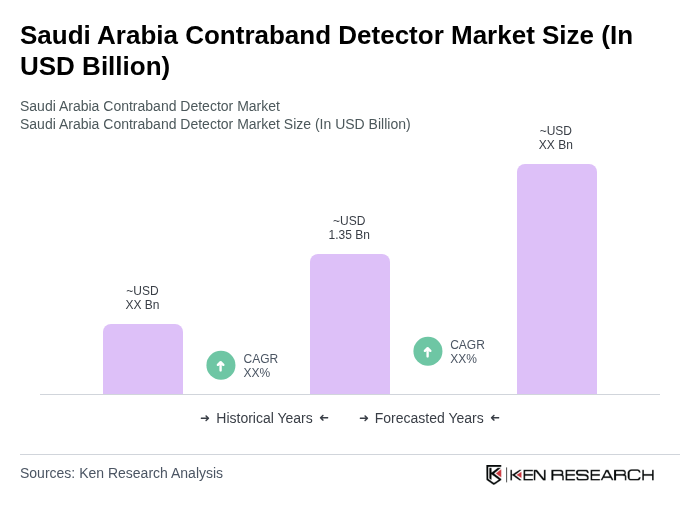
The Saudi Arabia Contraband Detector Market, valued at USD 1.35 Bn, grows due to rising security needs and tech innovations in detection systems.

Region:Middle East

Author(s):Dev

Product Code:KRAC8732

Pages:97

Published On:November 2025
About the Report

Base Year 2024

Saudi Arabia Contraband Detector Market Overview

  • The Saudi Arabia Contraband Detector Market is valued at USD 1.35 billion, based on a five-year historical analysis. This growth is primarily driven by increasing security concerns, government initiatives to combat smuggling, and advancements in detection technologies. The rising need for effective border control and customs enforcement has further propelled the demand for sophisticated contraband detection systems. Additionally, the expansion of transportation infrastructure, including new airports and seaports, has necessitated the deployment of advanced detection systems to handle increased cargo and passenger volumes.
  • Key cities such as Riyadh, Jeddah, and Dammam dominate the market due to their strategic locations and significant trade activities. Riyadh, being the capital, is a hub for government operations and law enforcement agencies, while Jeddah serves as a major port city facilitating international trade. Dammam, with its proximity to oil facilities, also plays a crucial role in security operations.
  • The Saudi government has implemented comprehensive security frameworks that mandate the installation of advanced contraband detection systems at all major entry points, including airports and seaports. These regulatory measures aim to enhance national security and streamline customs processes, ensuring that all goods entering the country are thoroughly inspected for illegal substances and contraband. Government agencies continue to prioritize investments in state-of-the-art security solutions to address evolving smuggling threats and illegal trafficking activities.
Saudi Arabia Contraband Detector Market Size

Saudi Arabia Contraband Detector Market Segmentation

By Technology Type:The technology type segmentation includes various advanced systems designed for detecting contraband. The subsegments are X-ray Imaging Systems, Metal Detection Systems, Chemical Detection Systems, Radiation Detection Systems, and Advanced Spectroscopy Systems. Among these, X-ray Imaging Systems are leading the market due to their widespread application in airports and customs facilities, providing efficient and non-intrusive inspection capabilities. Metal Detection Systems are anticipated to witness accelerated adoption, driven by their cost-effectiveness, ease of installation, and adaptability for human screening at diverse locations.
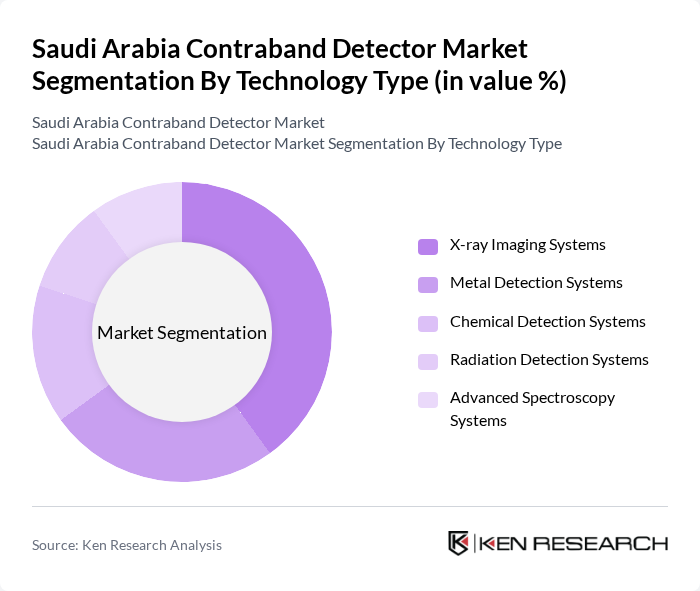
Saudi Arabia Contraband Detector Market segmentation by Technology Type.

By Deployment Type:The deployment type segmentation includes Fixed Installation Systems, Portable Detection Units, and Handheld Detectors. Fixed Installation Systems dominate the market due to their reliability and effectiveness in high-traffic areas such as airports and borders, where continuous monitoring is essential for security operations. However, Portable Detection Units are experiencing rapid growth, fueled by increasing demand for flexible security solutions at temporary checkpoints, events, and remote locations. Their lightweight design and ease of deployment make them suitable for on-the-go inspections and emergency situations.
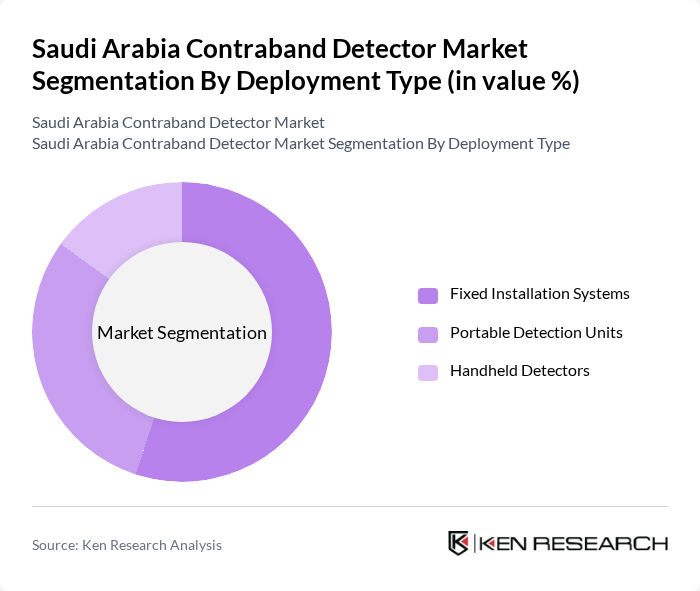
Saudi Arabia Contraband Detector Market segmentation by Deployment Type.

Saudi Arabia Contraband Detector Market Competitive Landscape

The Saudi Arabia Contraband Detector Market is characterized by a dynamic mix of regional and international players. Leading participants such as Smiths Detection, L3Harris Technologies, Nuctech Company Limited, Safran Electronics & Defense, Leidos Holdings, Inc., FLIR Systems (Teledyne FLIR), American Science and Engineering (AS&E), Chemring Group PLC, Bruker Corporation, Ametek, Inc., Kromek Group PLC, Detection Technology Oyj contribute to innovation, geographic expansion, and service delivery in this space.

Smiths Detection

1946

Slough, UK

L3Harris Technologies

2019

Melbourne, Florida, USA

Nuctech Company Limited

1997

Beijing, China

Safran Electronics & Defense

2005

Paris, France

Leidos Holdings, Inc.

1969

Reston, Virginia, USA

Company

Establishment Year

Headquarters

Year-over-Year Revenue Growth Rate (%)

Market Share in Saudi Arabia (%)

Product Portfolio Breadth (Number of Technology Types)

Government Contract Win Rate (%)

Average System Cost per Unit (USD)

R&D Investment as % of Revenue

Saudi Arabia Contraband Detector Market Industry Analysis

Growth Drivers

  • Increasing Security Concerns:The rise in security threats, including terrorism and organized crime, has led to heightened demand for contraband detection systems. In future, Saudi Arabia's defense budget is projected to reach approximately $66 billion, reflecting a 5% increase from previous estimates. This investment underscores the government's commitment to enhancing national security, driving the need for advanced detection technologies to safeguard borders and public spaces against illicit activities.
  • Government Initiatives for Border Control:The Saudi government has implemented various initiatives to strengthen border security, including the establishment of the Border Security Force, which employs over 25,000 personnel. In future, the government plans to allocate $1.8 billion specifically for border control technologies. These initiatives aim to reduce smuggling and illegal immigration, thereby increasing the demand for sophisticated contraband detection systems across the nation.
  • Technological Advancements in Detection Systems:The contraband detector market is experiencing rapid technological advancements, particularly in artificial intelligence and machine learning. In future, the global market for AI in security is expected to exceed $35 billion, with Saudi Arabia investing significantly in these technologies. This trend enhances detection accuracy and efficiency, making advanced systems more appealing to law enforcement and security agencies, thus driving market growth.

Market Challenges

  • High Initial Investment Costs:The adoption of advanced contraband detection systems often requires substantial initial investments, which can deter potential buyers. For instance, the cost of deploying a state-of-the-art detection system can range from $600,000 to $2.5 million, depending on the technology. This financial barrier is particularly challenging for smaller law enforcement agencies and private security firms, limiting market penetration and growth.
  • Lack of Skilled Workforce:The effective operation and maintenance of advanced detection systems necessitate a skilled workforce, which is currently lacking in Saudi Arabia. According to the Ministry of Labor, the unemployment rate among skilled workers in the security sector is approximately 10%. This shortage hampers the implementation of sophisticated technologies, as organizations struggle to find qualified personnel to manage and operate these systems effectively.

Saudi Arabia Contraband Detector Market Future Outlook

The future of the Saudi Arabia contraband detector market appears promising, driven by ongoing government investments in security infrastructure and technological innovations. As the nation continues to enhance its border control measures and address rising security concerns, the demand for advanced detection systems is expected to grow. Additionally, the integration of AI and data analytics will likely improve detection capabilities, making these systems more efficient and effective in combating smuggling and other illicit activities.

Market Opportunities

  • Expansion of Airport Security Measures:With Saudi Arabia's airports handling over 120 million passengers annually, there is a significant opportunity to enhance airport security through advanced contraband detection systems. The government plans to invest $2.5 billion in airport security upgrades in future, creating a robust market for innovative detection technologies.
  • Increasing Demand from Law Enforcement Agencies:Law enforcement agencies in Saudi Arabia are increasingly seeking advanced detection solutions to combat rising crime rates. In future, the Ministry of Interior is expected to allocate $600 million for new security technologies, presenting a substantial opportunity for suppliers of contraband detection systems to meet this growing demand.

Scope of the Report

SegmentSub-Segments
By Technology Type

X-ray Imaging Systems

Metal Detection Systems

Chemical Detection Systems

Radiation Detection Systems

Advanced Spectroscopy Systems

By Deployment Type

Fixed Installation Systems

Portable Detection Units

Handheld Detectors

By End-User Sector

Government & Law Enforcement

Transportation & Logistics

Border & Customs Authorities

Military & Defense

Commercial & Retail

By Application

Airport Security Screening

Border Crossing Inspection

Seaport & Cargo Inspection

Event & Venue Security

Critical Infrastructure Protection

By Geographic Region

Central Region (Riyadh)

Eastern Region (Dammam, Khobar)

Western Region (Jeddah, Mecca)

Southern Region (Abha, Jizan)

Northern Region (Tabuk)

By Funding Source

Government Budget Allocation

Private Sector Investment

Public-Private Partnerships

International Development Assistance

Key Target Audience

Investors and Venture Capitalist Firms

Government and Regulatory Bodies (e.g., Saudi Customs, Ministry of Interior)

Manufacturers and Producers of Detection Equipment

Security Agencies and Law Enforcement Organizations

Border Control and Immigration Authorities

Logistics and Transportation Companies

Industry Associations and Trade Organizations

Financial Institutions and Funding Agencies

Players Mentioned in the Report:

Smiths Detection

L3Harris Technologies

Nuctech Company Limited

Safran Electronics & Defense

Leidos Holdings, Inc.

FLIR Systems (Teledyne FLIR)

American Science and Engineering (AS&E)

Chemring Group PLC

Bruker Corporation

Ametek, Inc.

Kromek Group PLC

Detection Technology Oyj

Table of Contents

Market Assessment Phase

1. Executive Summary and Approach


2. Saudi Arabia Contraband Detector Market Overview

2.1 Key Insights and Strategic Recommendations

2.2 Saudi Arabia Contraband Detector Market Overview

2.3 Definition and Scope

2.4 Evolution of Market Ecosystem

2.5 Timeline of Key Regulatory Milestones

2.6 Value Chain & Stakeholder Mapping

2.7 Business Cycle Analysis

2.8 Policy & Incentive Landscape


3. Saudi Arabia Contraband Detector Market Analysis

3.1 Growth Drivers

3.1.1 Increasing Security Concerns
3.1.2 Government Initiatives for Border Control
3.1.3 Technological Advancements in Detection Systems
3.1.4 Rising Smuggling Activities

3.2 Market Challenges

3.2.1 High Initial Investment Costs
3.2.2 Lack of Skilled Workforce
3.2.3 Regulatory Compliance Issues
3.2.4 Competition from Alternative Security Solutions

3.3 Market Opportunities

3.3.1 Expansion of Airport Security Measures
3.3.2 Increasing Demand from Law Enforcement Agencies
3.3.3 Development of Smart City Initiatives
3.3.4 Collaborations with International Security Firms

3.4 Market Trends

3.4.1 Integration of AI in Detection Technologies
3.4.2 Shift Towards Mobile Detection Units
3.4.3 Growing Use of Drones for Surveillance
3.4.4 Enhanced Data Analytics for Threat Assessment

3.5 Government Regulation

3.5.1 Implementation of Stricter Border Control Policies
3.5.2 Compliance with International Security Standards
3.5.3 Licensing Requirements for Detection Equipment
3.5.4 Funding for Security Infrastructure Projects

4. SWOT Analysis


5. Stakeholder Analysis


6. Porter's Five Forces Analysis


7. Saudi Arabia Contraband Detector Market Market Size, 2019-2024

7.1 By Value

7.2 By Volume

7.3 By Average Selling Price


8. Saudi Arabia Contraband Detector Market Segmentation

8.1 By Technology Type

8.1.1 X-ray Imaging Systems
8.1.2 Metal Detection Systems
8.1.3 Chemical Detection Systems
8.1.4 Radiation Detection Systems
8.1.5 Advanced Spectroscopy Systems

8.2 By Deployment Type

8.2.1 Fixed Installation Systems
8.2.2 Portable Detection Units
8.2.3 Handheld Detectors

8.3 By End-User Sector

8.3.1 Government & Law Enforcement
8.3.2 Transportation & Logistics
8.3.3 Border & Customs Authorities
8.3.4 Military & Defense
8.3.5 Commercial & Retail

8.4 By Application

8.4.1 Airport Security Screening
8.4.2 Border Crossing Inspection
8.4.3 Seaport & Cargo Inspection
8.4.4 Event & Venue Security
8.4.5 Critical Infrastructure Protection

8.5 By Geographic Region

8.5.1 Central Region (Riyadh)
8.5.2 Eastern Region (Dammam, Khobar)
8.5.3 Western Region (Jeddah, Mecca)
8.5.4 Southern Region (Abha, Jizan)
8.5.5 Northern Region (Tabuk)

8.6 By Funding Source

8.6.1 Government Budget Allocation
8.6.2 Private Sector Investment
8.6.3 Public-Private Partnerships
8.6.4 International Development Assistance

9. Saudi Arabia Contraband Detector Market Competitive Analysis

9.1 Market Share of Key Players

9.2 KPIs for Cross Comparison of Key Players

9.2.1 Annual Revenue (USD Million)
9.2.2 Year-over-Year Revenue Growth Rate (%)
9.2.3 Market Share in Saudi Arabia (%)
9.2.4 Product Portfolio Breadth (Number of Technology Types)
9.2.5 Government Contract Win Rate (%)
9.2.6 Average System Cost per Unit (USD)
9.2.7 R&D Investment as % of Revenue
9.2.8 Customer Retention Rate (%)
9.2.9 System Uptime & Reliability Score (%)
9.2.10 Local Presence & Service Centers (Number)

9.3 SWOT Analysis of Top Players

9.4 Pricing Analysis

9.5 Detailed Profile of Major Companies

9.5.1 Smiths Detection
9.5.2 L3Harris Technologies
9.5.3 Nuctech Company Limited
9.5.4 Safran Electronics & Defense
9.5.5 Leidos Holdings, Inc.
9.5.6 FLIR Systems (Teledyne FLIR)
9.5.7 American Science and Engineering (AS&E)
9.5.8 Chemring Group PLC
9.5.9 Bruker Corporation
9.5.10 Ametek, Inc.
9.5.11 Kromek Group PLC
9.5.12 Detection Technology Oyj

10. Saudi Arabia Contraband Detector Market End-User Analysis

10.1 Procurement Behavior of Key Government Entities

10.1.1 Ministry of Interior (General Directorate of Border Guard)
10.1.2 Ministry of Defense & Aviation
10.1.3 General Authority of Civil Aviation
10.1.4 Saudi Customs Authority

10.2 Corporate Spend on Security Infrastructure

10.2.1 Government Security Contracts
10.2.2 Private Sector Security Investments

10.3 Pain Point Analysis by End-User Category

10.3.1 Security Gaps & Threat Detection Challenges
10.3.2 Budget Constraints & ROI Requirements

10.4 User Readiness for Adoption

10.4.1 Training Needs & Capacity Building
10.4.2 Technology Acceptance & Integration

10.5 Post-Deployment ROI and Use Case Expansion

10.5.1 Performance Metrics & Effectiveness
10.5.2 Future Expansion Plans

11. Saudi Arabia Contraband Detector Market Future Size, 2025-2030

11.1 By Value

11.2 By Volume

11.3 By Average Selling Price


Go-To-Market Strategy Phase

1. Whitespace Analysis + Business Model Canvas

1.1 Market Gaps Identification

1.2 Business Model Development


2. Marketing and Positioning Recommendations

2.1 Branding Strategies

2.2 Product USPs


3. Distribution Plan

3.1 Urban Retail Strategies

3.2 Rural NGO Tie-ups


4. Channel & Pricing Gaps

4.1 Underserved Routes

4.2 Pricing Bands


5. Unmet Demand & Latent Needs

5.1 Category Gaps

5.2 Consumer Segments


6. Customer Relationship

6.1 Loyalty Programs

6.2 After-sales Service


7. Value Proposition

7.1 Sustainability Initiatives

7.2 Integrated Supply Chains


8. Key Activities

8.1 Regulatory Compliance

8.2 Branding Efforts

8.3 Distribution Setup


9. Entry Strategy Evaluation

9.1 Domestic Market Entry Strategy

9.1.1 Product Mix
9.1.2 Pricing Band
9.1.3 Packaging

9.2 Export Entry Strategy

9.2.1 Target Countries
9.2.2 Compliance Roadmap

10. Entry Mode Assessment

10.1 Joint Ventures

10.2 Greenfield Investments

10.3 Mergers & Acquisitions

10.4 Distributor Model


11. Capital and Timeline Estimation

11.1 Capital Requirements

11.2 Timelines


12. Control vs Risk Trade-Off

12.1 Ownership vs Partnerships


13. Profitability Outlook

13.1 Breakeven Analysis

13.2 Long-term Sustainability


14. Potential Partner List

14.1 Distributors

14.2 Joint Ventures

14.3 Acquisition Targets


15. Execution Roadmap

15.1 Phased Plan for Market Entry

15.1.1 Market Setup
15.1.2 Market Entry
15.1.3 Growth Acceleration
15.1.4 Scale & Stabilize

15.2 Key Activities and Milestones

15.2.1 Activity Timeline
15.2.2 Milestone Tracking

Research Methodology

ApproachModellingSample

Phase 1: Approach1

Desk Research

  • Analysis of government reports on contraband detection regulations and policies in Saudi Arabia
  • Review of industry publications and white papers on security technology trends
  • Examination of trade statistics and import/export data related to contraband detection equipment

Primary Research

  • Interviews with law enforcement officials and customs agents involved in contraband detection
  • Surveys with manufacturers and suppliers of detection technology
  • Field interviews with security consultants and industry experts on market needs and challenges

Validation & Triangulation

  • Cross-validation of findings through multiple data sources including government and industry reports
  • Triangulation of insights from primary interviews with secondary data trends
  • Sanity checks conducted through expert panel discussions to ensure data reliability

Phase 2: Market Size Estimation1

Top-down Assessment

  • Estimation of total market size based on national security spending and budget allocations
  • Segmentation of the market by end-user categories such as government, private sector, and border control
  • Incorporation of growth rates from related sectors such as surveillance and security technology

Bottom-up Modeling

  • Collection of sales data from key manufacturers of contraband detection systems
  • Estimation of unit sales based on historical data and projected demand growth
  • Cost analysis of detection systems to determine pricing strategies and market entry points

Forecasting & Scenario Analysis

  • Development of forecasting models based on historical growth trends and emerging market drivers
  • Scenario analysis considering potential regulatory changes and technological advancements
  • Creation of baseline, optimistic, and pessimistic forecasts through 2030

Phase 3: CATI Sample Composition1

Scope Item/SegmentSample SizeTarget Respondent Profiles
Government Agencies120Customs Officials, Security Policy Makers
Private Security Firms100Operations Managers, Technology Directors
Manufacturers of Detection Equipment90Product Managers, Sales Executives
Logistics and Supply Chain Companies80Supply Chain Managers, Compliance Officers
Research and Development Institutions60Research Scientists, Technology Innovators

Frequently Asked Questions

What is the current value of the Saudi Arabia Contraband Detector Market?

The Saudi Arabia Contraband Detector Market is valued at approximately USD 1.35 billion, reflecting a significant growth driven by increasing security concerns, government initiatives, and advancements in detection technologies over the past five years.

What are the main drivers of growth in the Saudi Arabia Contraband Detector Market?

Which cities are the primary markets for contraband detectors in Saudi Arabia?

What types of technologies are used in contraband detection systems?

Other Regional/Country Reports

Indonesia Contraband Detector Market

Malaysia Contraband Detector Market

KSA Contraband Detector Market

APAC Contraband Detector Market

SEA Contraband Detector Market

Vietnam Contraband Detector Market

Other Adjacent Reports

UAE Security Screening MarketMiddle East Border Security Market Report Size, Share, Growth Drivers, Trends, Opportunities & Forecast 2025–2030

Germany Explosives Detection Market

Belgium Narcotics Detection Market

Bahrain Radiation Detection Market

Indonesia Metal Detection Market

South Africa X-Ray Imaging Market

Malaysia Chemical Detection Market

Brazil Surveillance Systems Market

APAC airport security market size, share, growth drivers, trends, opportunities & forecast 2025–2030

Why Buy From Us?

Refine Robust Result (RRR) Framework

What makes us stand out is that our consultants follow Robust, Refine and Result (RRR) methodology. Robust for clear definitions, approaches and sanity checking, Refine for differentiating respondents' facts and opinions, and Result for presenting data with story.

Our Reach Is Unmatched

We have set a benchmark in the industry by offering our clients with syndicated and customized market research reports featuring coverage of entire market as well as meticulous research and analyst insights.

Shifting the Research Paradigm

While we don't replace traditional research, we flip the method upside down. Our dual approach of Top Bottom & Bottom Top ensures quality deliverable by not just verifying company fundamentals but also looking at the sector and macroeconomic factors.

More Insights-Better Decisions

With one step in the future, our research team constantly tries to show you the bigger picture. We help with some of the tough questions you may encounter along the way: How is the industry positioned? Best marketing channel? KPI's of competitors? By aligning every element, we help maximize success.

Transparency and Trust

Our report gives you instant access to the answers and sources that other companies might choose to hide. We elaborate each steps of research methodology we have used and showcase you the sample size to earn your trust.

Round the Clock Support

If you need any support, we are here! We pride ourselves on universe strength, data quality, and quick, friendly, and professional service.

Why Clients Choose Us?

400000+
Reports in repository
150+
Consulting projects a year
100+
Analysts
8000+
Client Queries in 2022








