About the Report
Base Year 2024Saudi Arabia Dozer Market Overview
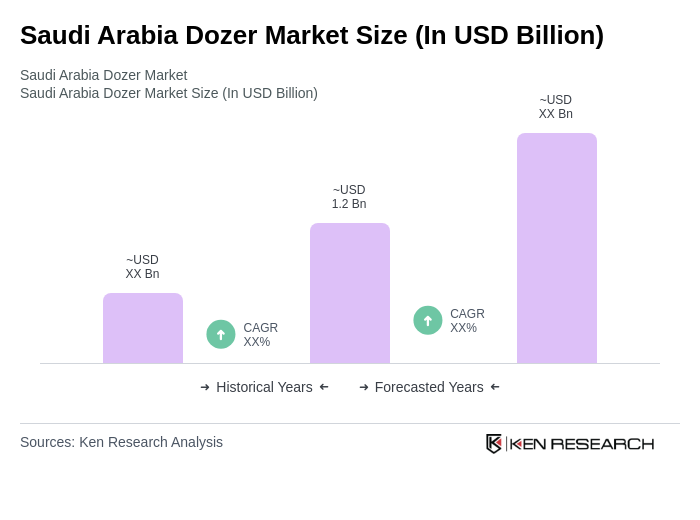
- The Saudi Arabia Dozer Market is valued at USD 1.2 billion, based on a five-year historical analysis. This growth is primarily driven by the rapid expansion of the construction and infrastructure sectors, alongside increasing investments in mining and oil extraction activities. The demand for dozers is significantly influenced by government initiatives aimed at enhancing infrastructure and urban development, which have led to a surge in construction projects across the country. Recent trends highlight the integration of advanced control systems, automation, and environmentally sustainable machinery, further boosting demand for modern, high-performance dozers .
- Key cities such asRiyadh, Jeddah, and Dammamdominate the dozer market due to their strategic importance in construction and infrastructure development. Riyadh, as the capital, is a hub for major construction projects, while Jeddah and Dammam serve as critical ports and industrial centers. The concentration of economic activities in these cities drives the demand for heavy machinery, including dozers, to support ongoing and upcoming projects .
- In 2023, the Saudi government implemented theOccupational Safety and Health Regulation for Construction Work, 2023issued by the Ministry of Human Resources and Social Development. This regulation mandates the use of advanced safety features in heavy machinery, including dozers, to enhance workplace safety standards. All new dozer models must be equipped with automatic shut-off systems, enhanced visibility aids, and operator protection structures, aiming to reduce accidents and improve operational safety in construction and mining sites .
Saudi Arabia Dozer Market Segmentation
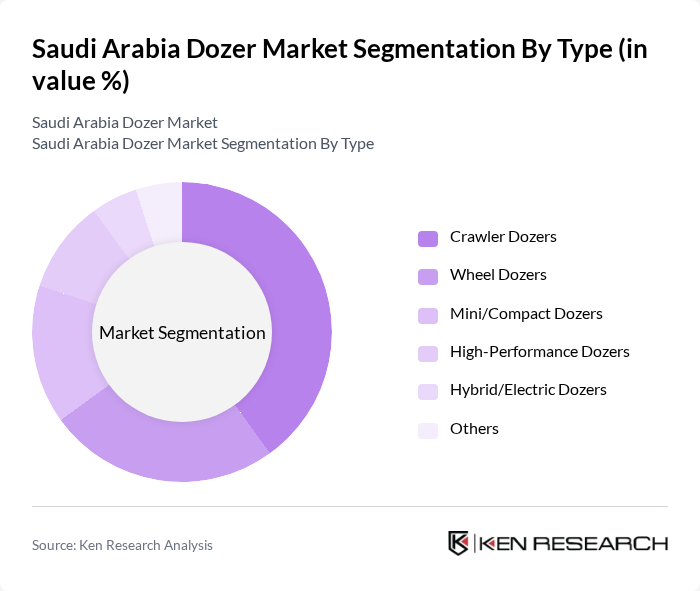
By Type:The dozer market can be segmented into various types, including Crawler Dozers, Wheel Dozers, Mini/Compact Dozers, High-Performance Dozers, Hybrid/Electric Dozers, and Others.Crawler Dozersare widely used due to their stability and traction on rough terrains, whileWheel Dozersare preferred for their speed and maneuverability in urban settings.Mini/Compact Dozerscater to smaller projects, andHigh-Performance Dozersare utilized in heavy-duty applications. The growing interest in sustainability has also led to an increase inHybrid/Electric Dozers.
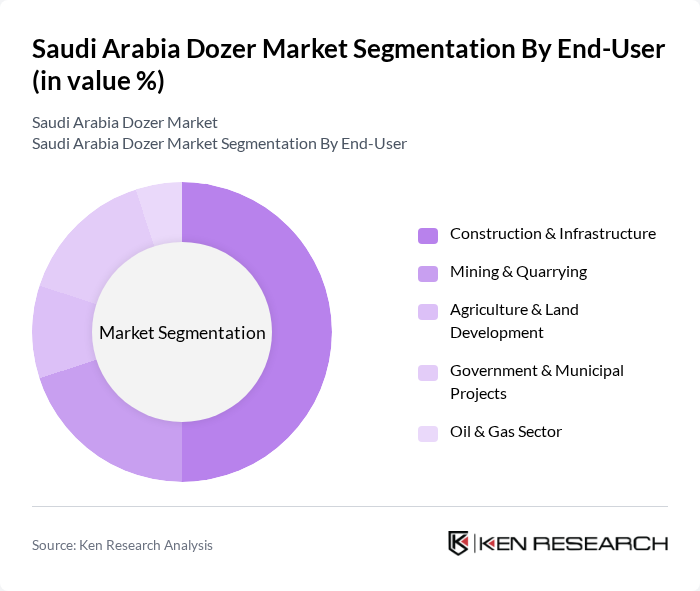
By End-User:The end-user segmentation includes Construction & Infrastructure, Mining & Quarrying, Agriculture & Land Development, Government & Municipal Projects, and Oil & Gas Sector. Theconstruction sectoris the largest consumer of dozers, driven by ongoing infrastructure projects.Mining and quarryingalso represent significant demand due to the need for land clearing and site preparation.Government projectsfurther boost the market, as dozers are essential for various municipal applications .
Saudi Arabia Dozer Market Competitive Landscape
The Saudi Arabia Dozer Market is characterized by a dynamic mix of regional and international players. Leading participants such as Caterpillar Inc., Komatsu Ltd., Volvo Construction Equipment, Hitachi Construction Machinery Co., Ltd., Doosan Infracore, JCB (J.C. Bamford Excavators Limited), Liebherr Group, Case Construction Equipment (CNH Industrial), SANY Group, XCMG (Xuzhou Construction Machinery Group), Terex Corporation, Hyundai Construction Equipment Co., Ltd., Wirtgen Group (A John Deere Company), Manitowoc Company, Inc., Bobcat Company (a Doosan Group company), Zahid Tractor & Heavy Machinery Co. Ltd., Arabian Machinery & Heavy Equipment Co., FAMCO (Al-Futtaim Auto & Machinery Co.) contribute to innovation, geographic expansion, and service delivery in this space.
Saudi Arabia Dozer Market Industry Analysis
Growth Drivers
- Infrastructure Development Initiatives:Saudi Arabia's Vision 2030 aims to invest over $500 billion in infrastructure projects, significantly boosting the dozer market. Major projects include the NEOM city and the Red Sea Project, which are expected to create thousands of jobs and enhance construction activities. The government allocated approximately $100 billion for infrastructure in future, driving demand for heavy machinery, including dozers, to support these ambitious initiatives.
- Urbanization Trends:Rapid urbanization in Saudi Arabia, with urban population growth projected to reach approximately 84% in future, is a key driver for the dozer market. This urban expansion necessitates extensive construction of residential, commercial, and public infrastructure. The Saudi Arabian General Authority for Statistics reported that urban areas are expected to require over 1 million new housing units in future, further increasing the demand for dozers in construction projects.
- Government Investments in Construction:The Saudi government is prioritizing construction as a means to diversify its economy away from oil dependency. In future, public spending on construction is projected to exceed $70 billion, focusing on housing, transportation, and public facilities. This substantial investment is expected to create a robust demand for dozers, as they are essential for earthmoving and site preparation in large-scale construction projects across the nation.
Market Challenges
- Fluctuating Oil Prices:The Saudi economy is heavily reliant on oil revenues, which can be volatile. In future, oil prices are projected to fluctuate within a broad range, impacting government budgets for infrastructure projects. This uncertainty can lead to delays or reductions in planned construction activities, directly affecting the demand for dozers and other heavy machinery in the market.
- Regulatory Compliance Issues:The dozer market faces challenges related to regulatory compliance, particularly concerning safety and environmental standards. In future, new regulations are expected to be implemented, requiring significant investments in compliance measures. Companies may face increased operational costs and potential penalties for non-compliance, which could hinder market growth and deter investment in new dozer equipment.
Saudi Arabia Dozer Market Future Outlook
The Saudi Arabia dozer market is poised for significant growth driven by ongoing infrastructure projects and urbanization trends. As the government continues to invest heavily in construction, the demand for advanced dozers will likely increase. Additionally, the integration of smart technologies and a shift towards sustainable practices will shape the future landscape of the market. Companies that adapt to these trends will be well-positioned to capitalize on emerging opportunities in the evolving construction sector.
Market Opportunities
- Expansion of Renewable Energy Projects:The Saudi government aims to generate approximately 58 GW of renewable energy in future, creating opportunities for dozer manufacturers. This shift towards renewable energy infrastructure will require extensive earthmoving and site preparation, driving demand for dozers in solar and wind farm projects across the country.
- Increased Demand for Rental Services:The trend towards equipment rental is gaining traction in Saudi Arabia, with the rental market projected to grow at a double-digit rate in future. This shift allows construction companies to reduce capital expenditures while accessing the latest dozer technology, creating a lucrative opportunity for rental service providers to expand their fleets and services.
Scope of the Report
| Segment | Sub-Segments |
|---|---|
| By Type | Crawler Dozers Wheel Dozers Mini/Compact Dozers High-Performance Dozers Hybrid/Electric Dozers Others |
| By End-User | Construction & Infrastructure Mining & Quarrying Agriculture & Land Development Government & Municipal Projects Oil & Gas Sector |
| By Application | Land Clearing & Grading Road Construction Site Preparation Demolition & Waste Management Mining Operations |
| By Sales Channel | Direct Sales Authorized Distributors Online Sales Platforms Rental Services |
| By Distribution Mode | Retail Outlets Wholesale Dealers Equipment Rental Companies |
| By Price Range | Budget Mid-Range Premium |
| By Brand Preference | International Brands Local Brands Emerging Brands |
Key Target Audience
Investors and Venture Capitalist Firms
Government and Regulatory Bodies (e.g., Ministry of Municipal and Rural Affairs, Saudi Arabian General Investment Authority)
Manufacturers and Producers
Construction and Infrastructure Companies
Heavy Equipment Rental Companies
Industry Associations (e.g., Saudi Contractors Authority)
Financial Institutions
Logistics and Supply Chain Companies
Players Mentioned in the Report:
Caterpillar Inc.
Komatsu Ltd.
Volvo Construction Equipment
Hitachi Construction Machinery Co., Ltd.
Doosan Infracore
JCB (J.C. Bamford Excavators Limited)
Liebherr Group
Case Construction Equipment (CNH Industrial)
SANY Group
XCMG (Xuzhou Construction Machinery Group)
Terex Corporation
Hyundai Construction Equipment Co., Ltd.
Wirtgen Group (A John Deere Company)
Manitowoc Company, Inc.
Bobcat Company (a Doosan Group company)
Zahid Tractor & Heavy Machinery Co. Ltd.
Arabian Machinery & Heavy Equipment Co.
FAMCO (Al-Futtaim Auto & Machinery Co.)
Table of Contents
Market Assessment Phase
1. Executive Summary and Approach
2. Saudi Arabia Dozer Market Overview
2.1 Key Insights and Strategic Recommendations
2.2 Saudi Arabia Dozer Market Overview
2.3 Definition and Scope
2.4 Evolution of Market Ecosystem
2.5 Timeline of Key Regulatory Milestones
2.6 Value Chain & Stakeholder Mapping
2.7 Business Cycle Analysis
2.8 Policy & Incentive Landscape
3. Saudi Arabia Dozer Market Analysis
3.1 Growth Drivers
3.1.1 Infrastructure Development Initiatives
3.1.2 Urbanization Trends
3.1.3 Government Investments in Construction
3.1.4 Technological Advancements in Machinery
3.2 Market Challenges
3.2.1 Fluctuating Oil Prices
3.2.2 Regulatory Compliance Issues
3.2.3 Competition from Alternative Equipment
3.2.4 Supply Chain Disruptions
3.3 Market Opportunities
3.3.1 Expansion of Renewable Energy Projects
3.3.2 Public-Private Partnerships
3.3.3 Increased Demand for Rental Services
3.3.4 Adoption of Smart Construction Technologies
3.4 Market Trends
3.4.1 Shift Towards Electric Dozers
3.4.2 Integration of AI in Equipment Management
3.4.3 Focus on Sustainability and Eco-Friendly Practices
3.4.4 Rise of Modular Construction Techniques
3.5 Government Regulation
3.5.1 Safety Standards for Construction Equipment
3.5.2 Environmental Regulations on Emissions
3.5.3 Licensing Requirements for Operators
3.5.4 Import Tariffs on Heavy Machinery
4. SWOT Analysis
5. Stakeholder Analysis
6. Porter's Five Forces Analysis
7. Saudi Arabia Dozer Market Market Size, 2019-2024
7.1 By Value
7.2 By Volume
7.3 By Average Selling Price
8. Saudi Arabia Dozer Market Segmentation
8.1 By Type
8.1.1 Crawler Dozers
8.1.2 Wheel Dozers
8.1.3 Mini/Compact Dozers
8.1.4 High-Performance Dozers
8.1.5 Hybrid/Electric Dozers
8.1.6 Others
8.2 By End-User
8.2.1 Construction & Infrastructure
8.2.2 Mining & Quarrying
8.2.3 Agriculture & Land Development
8.2.4 Government & Municipal Projects
8.2.5 Oil & Gas Sector
8.3 By Application
8.3.1 Land Clearing & Grading
8.3.2 Road Construction
8.3.3 Site Preparation
8.3.4 Demolition & Waste Management
8.3.5 Mining Operations
8.4 By Sales Channel
8.4.1 Direct Sales
8.4.2 Authorized Distributors
8.4.3 Online Sales Platforms
8.4.4 Rental Services
8.5 By Distribution Mode
8.5.1 Retail Outlets
8.5.2 Wholesale Dealers
8.5.3 Equipment Rental Companies
8.6 By Price Range
8.6.1 Budget
8.6.2 Mid-Range
8.6.3 Premium
8.7 By Brand Preference
8.7.1 International Brands
8.7.2 Local Brands
8.7.3 Emerging Brands
9. Saudi Arabia Dozer Market Competitive Analysis
9.1 Market Share of Key Players
9.2 KPIs for Cross Comparison of Key Players
9.2.1 Market Share (%)
9.2.2 Annual Revenue (USD Million)
9.2.3 Sales Volume (Units)
9.2.4 Revenue Growth Rate (%)
9.2.5 Market Penetration Rate (%)
9.2.6 Customer Retention Rate (%)
9.2.7 Average Selling Price (USD)
9.2.8 Product Portfolio Breadth
9.2.9 After-Sales Service Coverage
9.2.10 Distribution Network Strength
9.2.11 Rental Fleet Size
9.2.12 Brand Recognition Index
9.2.13 Operational Efficiency Ratio
9.2.14 Local Partnership Presence
9.3 SWOT Analysis of Top Players
9.4 Pricing Analysis
9.5 Detailed Profile of Major Companies
9.5.1 Caterpillar Inc.
9.5.2 Komatsu Ltd.
9.5.3 Volvo Construction Equipment
9.5.4 Hitachi Construction Machinery Co., Ltd.
9.5.5 Doosan Infracore
9.5.6 JCB (J.C. Bamford Excavators Limited)
9.5.7 Liebherr Group
9.5.8 Case Construction Equipment (CNH Industrial)
9.5.9 SANY Group
9.5.10 XCMG (Xuzhou Construction Machinery Group)
9.5.11 Terex Corporation
9.5.12 Hyundai Construction Equipment Co., Ltd.
9.5.13 Wirtgen Group (A John Deere Company)
9.5.14 Manitowoc Company, Inc.
9.5.15 Bobcat Company (a Doosan Group company)
9.5.16 Zahid Tractor & Heavy Machinery Co. Ltd.
9.5.17 Arabian Machinery & Heavy Equipment Co.
9.5.18 FAMCO (Al-Futtaim Auto & Machinery Co.)
10. Saudi Arabia Dozer Market End-User Analysis
10.1 Procurement Behavior of Key Ministries
10.1.1 Ministry of Transport
10.1.2 Ministry of Municipal and Rural Affairs
10.1.3 Ministry of Energy
10.1.4 Ministry of Housing
10.2 Corporate Spend on Infrastructure & Energy
10.2.1 Construction Sector Investments
10.2.2 Energy Sector Allocations
10.2.3 Public Infrastructure Projects
10.3 Pain Point Analysis by End-User Category
10.3.1 Equipment Availability
10.3.2 Maintenance Costs
10.3.3 Training and Skill Gaps
10.4 User Readiness for Adoption
10.4.1 Awareness of New Technologies
10.4.2 Financial Readiness
10.4.3 Infrastructure Support
10.5 Post-Deployment ROI and Use Case Expansion
10.5.1 Performance Metrics
10.5.2 Case Studies of Successful Deployments
10.5.3 Future Expansion Plans
11. Saudi Arabia Dozer Market Future Size, 2025-2030
11.1 By Value
11.2 By Volume
11.3 By Average Selling Price
Go-To-Market Strategy Phase
1. Whitespace Analysis + Business Model Canvas
1.1 Market Gaps Identification
1.2 Value Proposition Development
1.3 Revenue Streams Analysis
1.4 Cost Structure Evaluation
1.5 Key Partnerships
1.6 Customer Segments
1.7 Channels
2. Marketing and Positioning Recommendations
2.1 Branding Strategies
2.2 Product USPs
3. Distribution Plan
3.1 Urban Retail Strategies
3.2 Rural NGO Tie-Ups
4. Channel & Pricing Gaps
4.1 Underserved Routes
4.2 Pricing Bands
5. Unmet Demand & Latent Needs
5.1 Category Gaps
5.2 Consumer Segments
6. Customer Relationship
6.1 Loyalty Programs
6.2 After-Sales Service
7. Value Proposition
7.1 Sustainability
7.2 Integrated Supply Chains
8. Key Activities
8.1 Regulatory Compliance
8.2 Branding
8.3 Distribution Setup
9. Entry Strategy Evaluation
9.1 Domestic Market Entry Strategy
9.1.1 Product Mix
9.1.2 Pricing Band
9.1.3 Packaging
9.2 Export Entry Strategy
9.2.1 Target Countries
9.2.2 Compliance Roadmap
10. Entry Mode Assessment
10.1 JV
10.2 Greenfield
10.3 M&A
10.4 Distributor Model
11. Capital and Timeline Estimation
11.1 Capital Requirements
11.2 Timelines
12. Control vs Risk Trade-Off
12.1 Ownership vs Partnerships
13. Profitability Outlook
13.1 Breakeven Analysis
13.2 Long-Term Sustainability
14. Potential Partner List
14.1 Distributors
14.2 JVs
14.3 Acquisition Targets
15. Execution Roadmap
15.1 Phased Plan for Market Entry
15.1.1 Market Setup
15.1.2 Market Entry
15.1.3 Growth Acceleration
15.1.4 Scale & Stabilize
15.2 Key Activities and Milestones
15.2.1 Milestone Planning
15.2.2 Activity Tracking
Research Methodology
Phase 1: Approach1
Desk Research
- Analysis of industry reports from government agencies and trade associations in Saudi Arabia
- Review of market studies and white papers published by construction and heavy machinery organizations
- Examination of economic indicators and infrastructure development plans from the Saudi Vision 2030 initiative
Primary Research
- Interviews with key stakeholders in the construction sector, including project managers and equipment procurement specialists
- Surveys conducted with dozer operators and maintenance personnel to gather insights on usage patterns and preferences
- Field visits to construction sites to observe dozer applications and gather qualitative data
Validation & Triangulation
- Cross-validation of findings through comparison with historical sales data and market trends
- Triangulation of insights from primary interviews with secondary data sources to ensure consistency
- Sanity checks through expert panel discussions with industry veterans and market analysts
Phase 2: Market Size Estimation1
Top-down Assessment
- Estimation of the dozer market size based on national construction expenditure and infrastructure investment forecasts
- Segmentation of the market by end-user industries such as construction, mining, and agriculture
- Incorporation of government spending on public works and infrastructure projects into market projections
Bottom-up Modeling
- Collection of sales data from leading dozer manufacturers and distributors operating in Saudi Arabia
- Estimation of market share based on unit sales and revenue figures from key players
- Analysis of rental market dynamics and their impact on overall dozer demand
Forecasting & Scenario Analysis
- Development of forecasting models using historical growth rates and projected economic indicators
- Scenario analysis based on potential changes in regulatory frameworks and environmental policies
- Creation of multiple growth scenarios (baseline, optimistic, and pessimistic) through 2030
Phase 3: CATI Sample Composition1
| Scope Item/Segment | Sample Size | Target Respondent Profiles |
|---|---|---|
| Construction Sector Dozer Usage | 100 | Project Managers, Site Supervisors |
| Mining Industry Equipment Preferences | 60 | Mining Engineers, Operations Managers |
| Agricultural Machinery Insights | 40 | Farm Equipment Dealers, Agricultural Engineers |
| Rental Market Dynamics | 50 | Rental Company Managers, Equipment Fleet Supervisors |
| Government Infrastructure Projects | 50 | Public Works Officials, Urban Planners |
Frequently Asked Questions
What is the current value of the Saudi Arabia Dozer Market?
The Saudi Arabia Dozer Market is valued at approximately USD 1.2 billion, driven by growth in construction, infrastructure, mining, and oil extraction sectors, alongside government initiatives to enhance urban development.
What factors are driving the growth of the dozer market in Saudi Arabia?
Which cities are the primary markets for dozers in Saudi Arabia?
What types of dozers are available in the Saudi Arabian market?
Other Regional/Country Reports
Indonesia Dozer Market
Malaysia Dozer Market
KSA Dozer Market
APAC Dozer Market
SEA Dozer Market
Vietnam Dozer Market
Other Adjacent Reports
Japan Wheel Loader Market
Philippines motor grader market report size, share, growth drivers, trends, opportunities & forecast 2025–2030Philippines Backhoe Loader Market
KSA Dump Truck Market
UAE Mobile Crane MarketOman construction equipment rental market Size, Share, Growth Drivers, Trends, Opportunities & Forecast 2025–2030Global Mining Equipment MarketUAE Road Construction Machinery MarketIndonesia Heavy Machinery Aftermarket Market
Why Buy From Us?

What makes us stand out is that our consultants follow Robust, Refine and Result (RRR) methodology. Robust for clear definitions, approaches and sanity checking, Refine for differentiating respondents' facts and opinions, and Result for presenting data with story.

We have set a benchmark in the industry by offering our clients with syndicated and customized market research reports featuring coverage of entire market as well as meticulous research and analyst insights.

While we don't replace traditional research, we flip the method upside down. Our dual approach of Top Bottom & Bottom Top ensures quality deliverable by not just verifying company fundamentals but also looking at the sector and macroeconomic factors.

With one step in the future, our research team constantly tries to show you the bigger picture. We help with some of the tough questions you may encounter along the way: How is the industry positioned? Best marketing channel? KPI's of competitors? By aligning every element, we help maximize success.

Our report gives you instant access to the answers and sources that other companies might choose to hide. We elaborate each steps of research methodology we have used and showcase you the sample size to earn your trust.

If you need any support, we are here! We pride ourselves on universe strength, data quality, and quick, friendly, and professional service.