Region:Middle East
Author(s):Shubham
Product Code:KRAD0927
Pages:89
Published On:November 2025
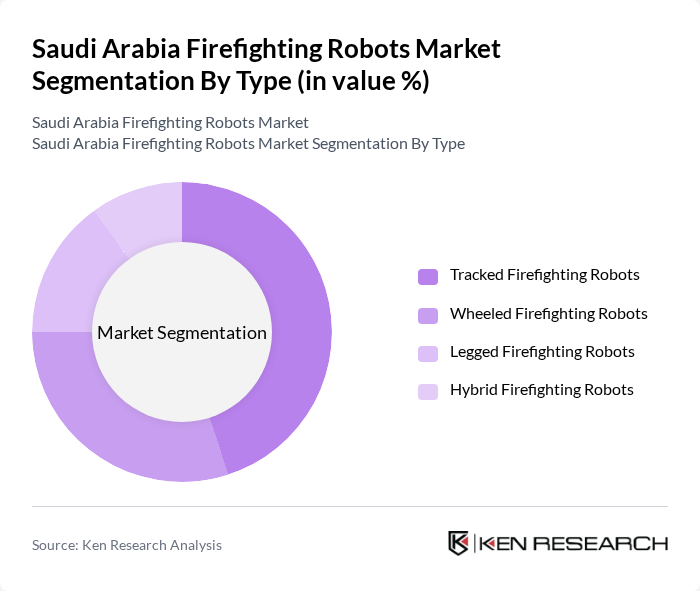
By Type:The market is segmented into tracked, wheeled, legged, and hybrid firefighting robots.Tracked firefighting robotslead the market, favored for their superior mobility and stability in hazardous and uneven terrains, making them ideal for industrial and urban firefighting.Wheeled robotsare preferred for rapid deployment in urban environments, whilelegged and hybrid robotsare gaining traction for their ability to navigate complex and confined spaces, especially in high-risk industrial zones .
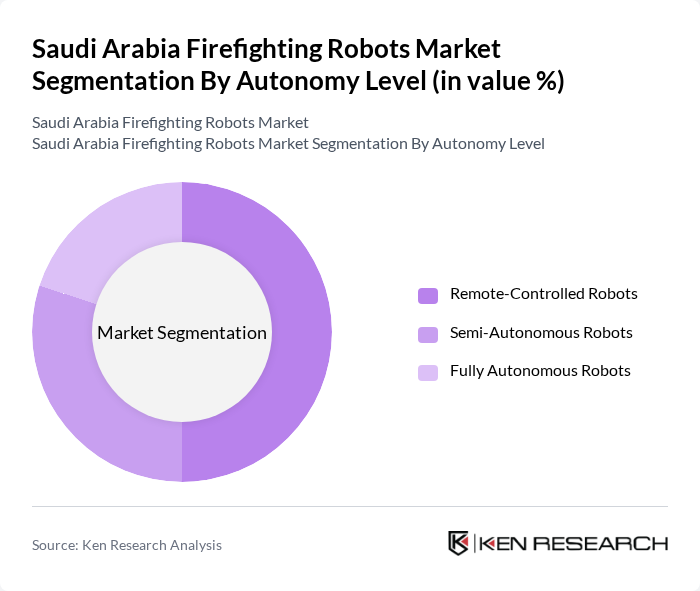
By Autonomy Level:Segmentation by autonomy level includes remote-controlled, semi-autonomous, and fully autonomous robots.Remote-controlled robotshold the largest share, valued for their immediate usability and operator control during emergencies.Semi-autonomous robotsare increasingly adopted for their blend of human oversight and automated functions, whilefully autonomous robotsare emerging in specialized applications, particularly in hazardous industrial environments .
The Saudi Arabia Firefighting Robots Market is characterized by a dynamic mix of regional and international players. Leading participants such as Thermite Robotics (Howe & Howe Technologies, a subsidiary of Textron Systems), Teledyne FLIR, QinetiQ Group plc, ECA Group, SMP Robotics, Shark Robotics, Milrem Robotics, Roboteam, KAWASAKI Heavy Industries, Tecdron Robotics, ABB Robotics, DJI Technology, Rosenbauer International AG, Saudi Sicli Company, NAFFCO (National Fire Fighting Manufacturing FZCO) contribute to innovation, geographic expansion, and service delivery in this space.
The future of the firefighting robots market in Saudi Arabia appears promising, driven by ongoing urbanization and technological advancements. As cities expand, the demand for innovative firefighting solutions will likely increase, particularly in high-risk areas. Additionally, the integration of AI and machine learning into firefighting robots will enhance their operational efficiency. The government’s commitment to improving public safety through advanced technologies will further support market growth, creating a favorable environment for investment and development in this sector.
| Segment | Sub-Segments |
|---|---|
| By Type | Tracked Firefighting Robots Wheeled Firefighting Robots Legged Firefighting Robots Hybrid Firefighting Robots |
| By Autonomy Level | Remote-Controlled Robots Semi-Autonomous Robots Fully Autonomous Robots |
| By Application | Fire Suppression Search and Rescue Operations Hazardous Material Handling Industrial Firefighting Military & Defense Operations |
| By End-User | Fire Departments and Emergency Services Industrial Facilities (Oil & Gas, Petrochemicals, Power Plants) Commercial Buildings Military and Defense Residential |
| By Technology | Sensor Technology (Thermal, Gas, Visual) Communication Technology (Wireless, IoT-enabled) Navigation Technology (GPS, LIDAR, SLAM) AI and Machine Learning Integration |
| By Deployment Mode | On-Site Deployment Remote Deployment Hybrid Deployment |
| By Region | Central Region (Riyadh) Eastern Region (Dammam, Jubail) Western Region (Jeddah, Makkah) Southern Region |
| By Policy Support | Government Subsidies Tax Incentives Grants for Research and Development Local Content Requirements |
| Scope Item/Segment | Sample Size | Target Respondent Profiles |
|---|---|---|
| Urban Fire Departments | 100 | Fire Chiefs, Operations Managers |
| Industrial Safety Units | 75 | Safety Officers, Facility Managers |
| Disaster Response Teams | 60 | Emergency Response Coordinators, Logistics Managers |
| Robotics Manufacturers | 50 | Product Development Managers, Sales Directors |
| Government Regulatory Bodies | 40 | Policy Makers, Regulatory Affairs Specialists |
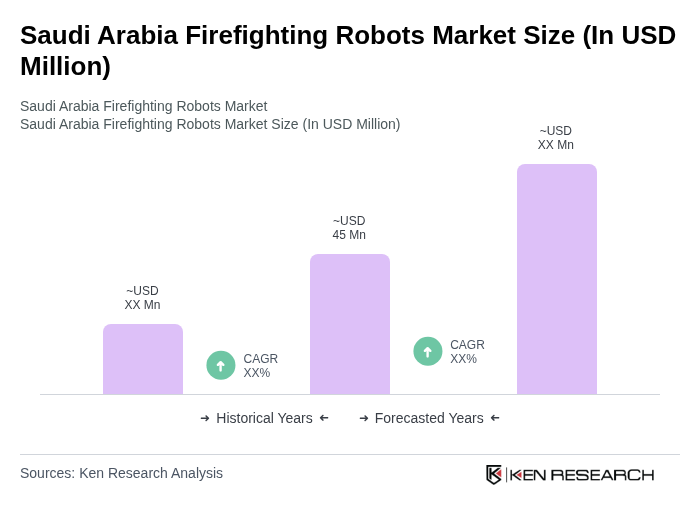
The Saudi Arabia Firefighting Robots Market is valued at approximately USD 45 million, reflecting a significant growth trend driven by increased investments in automation and the demand for advanced emergency response systems.

What makes us stand out is that our consultants follow Robust, Refine and Result (RRR) methodology. Robust for clear definitions, approaches and sanity checking, Refine for differentiating respondents' facts and opinions, and Result for presenting data with story.

We have set a benchmark in the industry by offering our clients with syndicated and customized market research reports featuring coverage of entire market as well as meticulous research and analyst insights.

While we don't replace traditional research, we flip the method upside down. Our dual approach of Top Bottom & Bottom Top ensures quality deliverable by not just verifying company fundamentals but also looking at the sector and macroeconomic factors.

With one step in the future, our research team constantly tries to show you the bigger picture. We help with some of the tough questions you may encounter along the way: How is the industry positioned? Best marketing channel? KPI's of competitors? By aligning every element, we help maximize success.

Our report gives you instant access to the answers and sources that other companies might choose to hide. We elaborate each steps of research methodology we have used and showcase you the sample size to earn your trust.

If you need any support, we are here! We pride ourselves on universe strength, data quality, and quick, friendly, and professional service.













