About the Report
Base Year 2024Saudi Arabia Fuel Station Market Overview
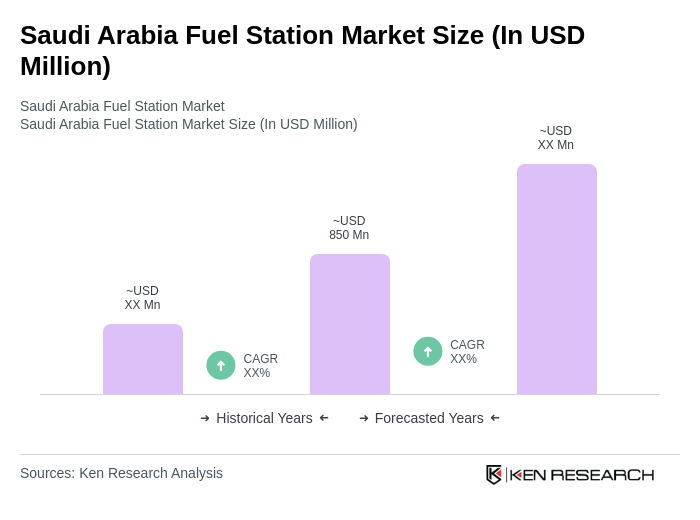
- The Saudi Arabia Fuel Station Market is valued at USD 850 million, based on a five-year historical analysis. This growth is primarily driven by increasing demand for fuel due to rising vehicle ownership, rapid urbanization, and government initiatives to enhance infrastructure. The market has seen significant investments in fuel distribution and retailing, with operators modernizing stations, adding convenience services, and integrating digital technologies to improve customer experience and operational efficiency .
- Key cities such asRiyadh, Jeddah, and Dammamdominate the market due to their high population density and economic activities. Riyadh, as the capital, serves as a central hub for transportation and logistics, while Jeddah’s strategic port location enhances fuel distribution. Dammam, with its proximity to oil fields, plays a crucial role in the fuel supply chain. The country operates over 8,500 fuel stations, with more than 1,200 located in Riyadh alone .
- In 2023, the Saudi government advanced regulations supporting the installation ofelectric vehicle (EV) charging stationsat new and renovated fuel stations. This initiative is designed to promote EV adoption and reduce carbon emissions, aligning with Vision 2030’s goals for sustainable development and energy sector diversification. Leading operators have begun integrating EV charging infrastructure and renewable energy solutions at select locations .
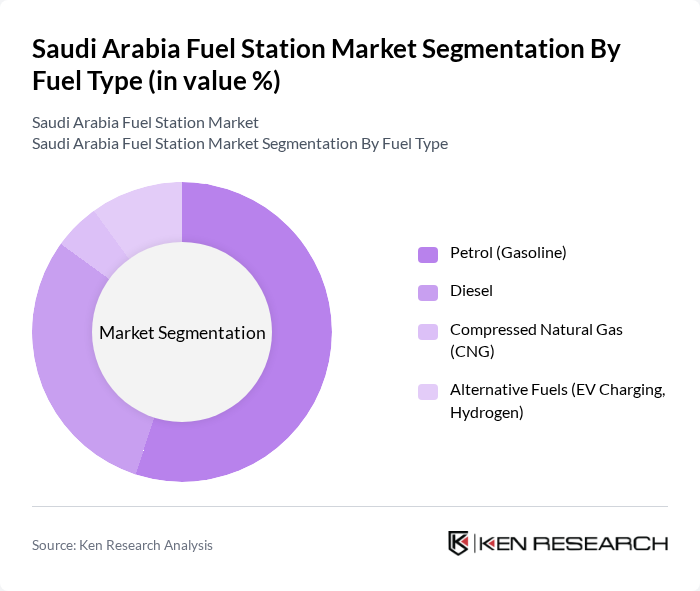
Saudi Arabia Fuel Station Market Segmentation
By Fuel Type:The fuel type segmentation includes petrol (gasoline), diesel, compressed natural gas (CNG), and alternative fuels such as electric vehicle charging and hydrogen.Petrol remains the dominant fuel typedue to its widespread use in passenger vehicles. Diesel is significant for commercial and industrial applications. The market is witnessing a gradual shift toward sustainability, with alternative fuels—particularly EV charging—gaining traction as operators and regulators encourage cleaner energy options .
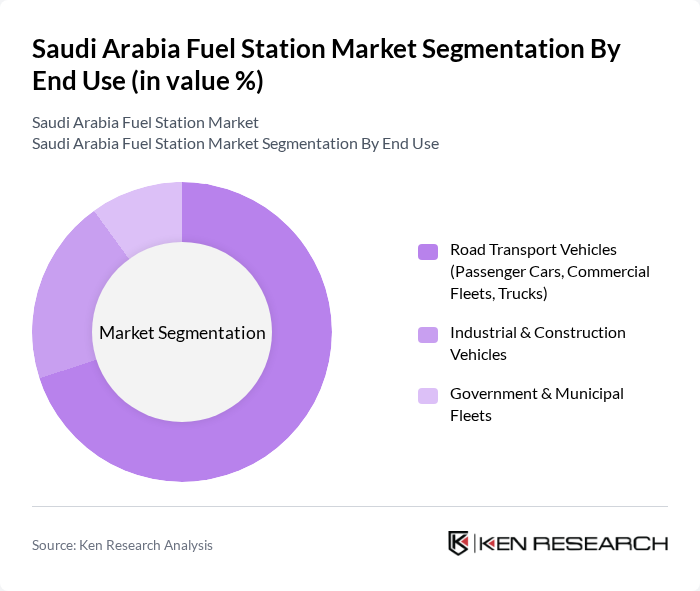
By End Use:The end-use segmentation covers road transport vehicles, industrial and construction vehicles, and government and municipal fleets.Road transport vehicles—including passenger cars, commercial fleets, and trucks—dominate fuel consumption, especially in urban centers. Industrial and construction vehicles contribute significantly, driven by infrastructure development. Government and municipal fleets are increasingly adopting alternative fuels, reflecting a shift toward sustainability in public sector transportation .
Saudi Arabia Fuel Station Market Competitive Landscape
The Saudi Arabia Fuel Station Market is characterized by a dynamic mix of regional and international players. Leading participants such as Saudi Aramco, Aldrees Petroleum & Transport Services Co. (Aldrees), ADNOC Distribution, Emirates National Oil Company (ENOC), Petromin Corporation, Oula Fuel Marketing Company, TotalEnergies SE, NAFT Services Company, Tas’helat Marketing Company (TMC), Watania Petroleum Company, Al Manar Gas Station Company, Al-Jomaih Energy and Water Company, Al-Muhaidib Fuel, Al-Faisaliah Group, and Al-Rajhi Group contribute to innovation, geographic expansion, and enhanced service delivery. Operators are increasingly investing in digitalization, alternative fuels, and strategic partnerships to diversify revenue streams and align with evolving consumer preferences .
Saudi Arabia Fuel Station Market Industry Analysis
Growth Drivers
- Increasing Vehicle Ownership:The vehicle ownership rate in Saudi Arabia has surged, with over14 million registered vehiclesas of in future, reflecting a growth of approximately4% annually. This increase is driven by a growing population and urbanization, leading to higher fuel consumption. The Saudi Arabian government aims to enhance transportation infrastructure, which further supports the demand for fuel stations. As vehicle ownership continues to rise, fuel stations will see increased foot traffic and sales, bolstering the market.
- Government Investment in Infrastructure:The Saudi government has allocated overUSD 80 billionfor infrastructure development in future, focusing on transportation and energy sectors. This investment includes the construction of new roads and highways, which will facilitate easier access to fuel stations. Enhanced infrastructure not only increases the number of potential customers but also improves the efficiency of fuel distribution networks, ultimately driving growth in the fuel station market across the country.
- Rising Demand for Fuel Retailing:The demand for fuel retailing in Saudi Arabia is projected to reach85 billion litersin future, driven by increased transportation needs and economic growth. The expansion of the logistics and transportation sectors, particularly in urban areas, is a significant contributor to this demand. Additionally, the rise in tourism and commercial activities further fuels the need for accessible fuel retailing, creating a favorable environment for fuel station operators to thrive.
Market Challenges
- Regulatory Compliance Issues:Fuel station operators in Saudi Arabia face stringent regulatory compliance requirements, including environmental standards and safety regulations. In future, the government is expected to enforce stricter compliance measures, which may require significant investment in technology and training. Non-compliance can lead to hefty fines and operational shutdowns, posing a substantial challenge for existing and new fuel station operators in the market.
- Competition from Alternative Fuels:The rise of alternative fuels, particularly electric vehicles (EVs), poses a significant challenge to traditional fuel stations. With over150,000 electric vehicles projected on Saudi roadsby in future, the demand for electric vehicle charging stations is increasing. This shift could divert customers away from conventional fuel stations, necessitating adaptation and innovation from fuel retailers to remain competitive in a changing market landscape.
Saudi Arabia Fuel Station Market Future Outlook
The Saudi Arabia fuel station market is poised for transformation as it adapts to evolving consumer preferences and technological advancements. The integration of electric vehicle charging infrastructure and digital payment solutions is expected to redefine customer experiences. Additionally, sustainability initiatives will likely gain traction, aligning with global trends towards greener energy. As the market navigates these changes, strategic partnerships and investments in renewable energy will be crucial for long-term growth and resilience in the face of emerging challenges.
Market Opportunities
- Adoption of Renewable Energy Solutions:The increasing focus on sustainability presents an opportunity for fuel stations to incorporate renewable energy solutions, such as solar panels. By in future, it is estimated that25% of new fuel stations will integrate renewable energy sources, reducing operational costs and appealing to environmentally conscious consumers, thus enhancing market competitiveness.
- Expansion into Underserved Regions:There are significant opportunities for fuel station expansion in underserved regions of Saudi Arabia, particularly in rural areas. With over1,200 new fuel stations projected to be establishedby in future, targeting these regions can capture untapped markets and meet the growing demand for fuel, thereby driving overall market growth and accessibility.
Scope of the Report
| Segment | Sub-Segments |
|---|---|
| By Fuel Type | Petrol (Gasoline) Diesel Compressed Natural Gas (CNG) Alternative Fuels (EV Charging, Hydrogen) |
| By End Use | Road Transport Vehicles (Passenger Cars, Commercial Fleets, Trucks) Industrial & Construction Vehicles Government & Municipal Fleets |
| By Service Offering | Fuel Sales Convenience Store Services Vehicle Maintenance & Car Wash Electric Vehicle Charging |
| By Location | Urban Stations Highway Stations Rural Stations |
| By Ownership | Company-Owned & Operated Franchise/Dealer-Owned Independent Operators |
Key Target Audience
Investors and Venture Capitalist Firms
Government and Regulatory Bodies (e.g., Ministry of Energy, Saudi Arabian Oil Company)
Fuel Station Operators
Logistics and Supply Chain Companies
Energy Sector Analysts
Environmental Agencies (e.g., Saudi Environmental Protection Agency)
Automotive Industry Stakeholders
Infrastructure Development Firms
Players Mentioned in the Report:
Saudi Aramco
Aldrees Petroleum & Transport Services Co. (Aldrees)
ADNOC Distribution
Emirates National Oil Company (ENOC)
Petromin Corporation
Oula Fuel Marketing Company
TotalEnergies SE
NAFT Services Company
Tashelat Marketing Company (TMC)
Watania Petroleum Company
Al Manar Gas Station Company
Al-Jomaih Energy and Water Company
Al-Muhaidib Fuel
Al-Faisaliah Group
Al-Rajhi Group
Table of Contents
Market Assessment Phase
1. Executive Summary and Approach
2. Saudi Arabia Fuel Station Market Overview
2.1 Key Insights and Strategic Recommendations
2.2 Saudi Arabia Fuel Station Market Overview
2.3 Definition and Scope
2.4 Evolution of Market Ecosystem
2.5 Timeline of Key Regulatory Milestones
2.6 Value Chain & Stakeholder Mapping
2.7 Business Cycle Analysis
2.8 Policy & Incentive Landscape
3. Saudi Arabia Fuel Station Market Analysis
3.1 Growth Drivers
3.1.1 Increasing Vehicle Ownership
3.1.2 Government Investment in Infrastructure
3.1.3 Rising Demand for Fuel Retailing
3.1.4 Expansion of Urban Areas
3.2 Market Challenges
3.2.1 Regulatory Compliance Issues
3.2.2 Competition from Alternative Fuels
3.2.3 Fluctuating Oil Prices
3.2.4 Supply Chain Disruptions
3.3 Market Opportunities
3.3.1 Adoption of Renewable Energy Solutions
3.3.2 Expansion into Underserved Regions
3.3.3 Technological Advancements in Fuel Dispensing
3.3.4 Strategic Partnerships with Local Businesses
3.4 Market Trends
3.4.1 Shift Towards Electric Vehicle Charging Stations
3.4.2 Integration of Digital Payment Solutions
3.4.3 Focus on Customer Experience Enhancements
3.4.4 Sustainability Initiatives in Fuel Retailing
3.5 Government Regulation
3.5.1 Fuel Pricing Regulations
3.5.2 Environmental Compliance Standards
3.5.3 Licensing Requirements for Fuel Stations
3.5.4 Safety and Operational Guidelines
4. SWOT Analysis
5. Stakeholder Analysis
6. Porter's Five Forces Analysis
7. Saudi Arabia Fuel Station Market Market Size, 2019-2024
7.1 By Value
7.2 By Volume
7.3 By Average Selling Price
8. Saudi Arabia Fuel Station Market Segmentation
8.1 By Fuel Type
8.1.1 Petrol (Gasoline)
8.1.2 Diesel
8.1.3 Compressed Natural Gas (CNG)
8.1.4 Alternative Fuels (EV Charging, Hydrogen)
8.2 By End Use
8.2.1 Road Transport Vehicles (Passenger Cars, Commercial Fleets, Trucks)
8.2.2 Industrial & Construction Vehicles
8.2.3 Government & Municipal Fleets
8.3 By Service Offering
8.3.1 Fuel Sales
8.3.2 Convenience Store Services
8.3.3 Vehicle Maintenance & Car Wash
8.3.4 Electric Vehicle Charging
8.4 By Location
8.4.1 Urban Stations
8.4.2 Highway Stations
8.4.3 Rural Stations
8.5 By Ownership
8.5.1 Company-Owned & Operated
8.5.2 Franchise/Dealer-Owned
8.5.3 Independent Operators
9. Saudi Arabia Fuel Station Market Competitive Analysis
9.1 Market Share of Key Players
9.2 KPIs for Cross Comparison of Key Players
9.2.1 Number of Fuel Stations (Network Size)
9.2.2 Annual Fuel Sales Volume (Liters or Barrels)
9.2.3 Revenue (SAR/USD)
9.2.4 Market Share (%)
9.2.5 Geographic Coverage (Regions/Cities Served)
9.2.6 Average Transaction Value per Customer
9.2.7 Non-Fuel Revenue Share (%)
9.2.8 Customer Footfall (Annual Visits)
9.2.9 Operational Efficiency (Fuel Throughput per Station)
9.2.10 Environmental Compliance (Number of Green/Eco-Friendly Stations)
9.3 SWOT Analysis of Top Players
9.4 Pricing Analysis
9.5 List of Major Companies
9.5.1 Saudi Aramco
9.5.2 Aldrees Petroleum & Transport Services Co. (Aldrees)
9.5.3 ADNOC Distribution
9.5.4 Emirates National Oil Company (ENOC)
9.5.5 Petromin Corporation
9.5.6 Oula Fuel Marketing Company
9.5.7 TotalEnergies SE
9.5.8 NAFT Services Company
9.5.9 Tas’helat Marketing Company (TMC)
9.5.10 Watania Petroleum Company
9.5.11 Al Manar Gas Station Company
9.5.12 Al-Jomaih Energy and Water Company
9.5.13 Al-Muhaidib Fuel
9.5.14 Al-Faisaliah Group
9.5.15 Al-Rajhi Group
10. Saudi Arabia Fuel Station Market End-User Analysis
10.1 Procurement Behavior of Key Ministries
10.1.1 Ministry of Energy
10.1.2 Ministry of Transport
10.1.3 Ministry of Municipal and Rural Affairs
10.2 Corporate Spend on Infrastructure & Energy
10.2.1 Investment in Fuel Infrastructure
10.2.2 Budget Allocation for Energy Projects
10.3 Pain Point Analysis by End-User Category
10.3.1 Fuel Accessibility Issues
10.3.2 Pricing Volatility Concerns
10.4 User Readiness for Adoption
10.4.1 Awareness of Alternative Fuels
10.4.2 Acceptance of New Technologies
10.5 Post-Deployment ROI and Use Case Expansion
10.5.1 Evaluation of Fuel Efficiency
10.5.2 Expansion of Service Offerings
11. Saudi Arabia Fuel Station Market Future Size, 2025-2030
11.1 By Value
11.2 By Volume
11.3 By Average Selling Price
Go-To-Market Strategy Phase
1. Whitespace Analysis + Business Model Canvas
1.1 Market Gaps Identification
1.2 Business Model Framework
2. Marketing and Positioning Recommendations
2.1 Branding Strategies
2.2 Product USPs
3. Distribution Plan
3.1 Urban Retail Strategies
3.2 Rural NGO Tie-Ups
4. Channel & Pricing Gaps
4.1 Underserved Routes
4.2 Pricing Bands Analysis
5. Unmet Demand & Latent Needs
5.1 Category Gaps
5.2 Consumer Segments
6. Customer Relationship
6.1 Loyalty Programs
6.2 After-Sales Service
7. Value Proposition
7.1 Sustainability Initiatives
7.2 Integrated Supply Chains
8. Key Activities
8.1 Regulatory Compliance
8.2 Branding Efforts
8.3 Distribution Setup
9. Entry Strategy Evaluation
9.1 Domestic Market Entry Strategy
9.1.1 Product Mix Considerations
9.1.2 Pricing Band Strategy
9.1.3 Packaging Options
9.2 Export Entry Strategy
9.2.1 Target Countries
9.2.2 Compliance Roadmap
10. Entry Mode Assessment
10.1 Joint Ventures
10.2 Greenfield Investments
10.3 Mergers & Acquisitions
10.4 Distributor Model
11. Capital and Timeline Estimation
11.1 Capital Requirements
11.2 Timelines for Implementation
12. Control vs Risk Trade-Off
12.1 Ownership Considerations
12.2 Partnerships Evaluation
13. Profitability Outlook
13.1 Breakeven Analysis
13.2 Long-Term Sustainability
14. Potential Partner List
14.1 Distributors
14.2 Joint Ventures
14.3 Acquisition Targets
15. Execution Roadmap
15.1 Phased Plan for Market Entry
15.1.1 Market Setup
15.1.2 Market Entry
15.1.3 Growth Acceleration
15.1.4 Scale & Stabilize
15.2 Key Activities and Milestones
15.2.1 Milestone Planning
15.2.2 Activity Tracking
Research Methodology
Phase 1: Approach1
Desk Research
- Analysis of government publications and reports on fuel consumption trends in Saudi Arabia
- Review of industry reports from energy and fuel associations within the region
- Examination of market studies and white papers from consultancy firms focusing on the fuel sector
Primary Research
- Interviews with executives from major fuel station chains operating in Saudi Arabia
- Surveys conducted with fuel station managers to gather insights on operational challenges and consumer behavior
- Field visits to various fuel stations to observe service offerings and customer interactions
Validation & Triangulation
- Cross-validation of data through comparison with historical fuel consumption statistics
- Triangulation of findings from primary interviews with secondary data sources
- Sanity checks through expert panel discussions with industry veterans and analysts
Phase 2: Market Size Estimation1
Top-down Assessment
- Estimation of total fuel consumption in Saudi Arabia and its correlation with fuel station revenues
- Segmentation of the market by fuel type (petrol, diesel, etc.) and geographical distribution
- Incorporation of government initiatives aimed at promoting alternative fuels and their impact on market size
Bottom-up Modeling
- Collection of sales data from a sample of fuel stations to establish average revenue per station
- Analysis of operational costs and pricing strategies employed by fuel stations
- Volume estimates based on fuel sales and customer footfall metrics
Forecasting & Scenario Analysis
- Multi-variable regression analysis incorporating economic indicators and fuel price trends
- Scenario modeling based on potential regulatory changes and shifts in consumer preferences
- Development of baseline, optimistic, and pessimistic forecasts for the next five years
Phase 3: CATI Sample Composition1
| Scope Item/Segment | Sample Size | Target Respondent Profiles |
|---|---|---|
| Urban Fuel Station Operations | 100 | Station Managers, Regional Directors |
| Rural Fuel Station Dynamics | 60 | Owners, Local Business Operators |
| Alternative Fuel Adoption | 40 | Policy Makers, Sustainability Managers |
| Consumer Behavior Insights | 120 | Regular Fuel Users, Fleet Managers |
| Market Trends and Innovations | 80 | Industry Analysts, Technology Providers |
Frequently Asked Questions
What is the current value of the Saudi Arabia Fuel Station Market?
The Saudi Arabia Fuel Station Market is valued at approximately USD 850 million, driven by increasing fuel demand due to rising vehicle ownership, urbanization, and government infrastructure initiatives.
Which cities dominate the Saudi Arabia Fuel Station Market?
What are the main fuel types available at Saudi fuel stations?
How is the Saudi government supporting electric vehicle adoption?
Other Regional/Country Reports
Indonesia Fuel Station Market
Malaysia Fuel Station Market
APAC Fuel Station Market
SEA Fuel Station Market
Vietnam Fuel Station Market
Why Buy From Us?

What makes us stand out is that our consultants follow Robust, Refine and Result (RRR) methodology. Robust for clear definitions, approaches and sanity checking, Refine for differentiating respondents' facts and opinions, and Result for presenting data with story.

We have set a benchmark in the industry by offering our clients with syndicated and customized market research reports featuring coverage of entire market as well as meticulous research and analyst insights.

While we don't replace traditional research, we flip the method upside down. Our dual approach of Top Bottom & Bottom Top ensures quality deliverable by not just verifying company fundamentals but also looking at the sector and macroeconomic factors.

With one step in the future, our research team constantly tries to show you the bigger picture. We help with some of the tough questions you may encounter along the way: How is the industry positioned? Best marketing channel? KPI's of competitors? By aligning every element, we help maximize success.

Our report gives you instant access to the answers and sources that other companies might choose to hide. We elaborate each steps of research methodology we have used and showcase you the sample size to earn your trust.

If you need any support, we are here! We pride ourselves on universe strength, data quality, and quick, friendly, and professional service.