About the Report
Base Year 2024Saudi Arabia Healthcare ERP Market Overview
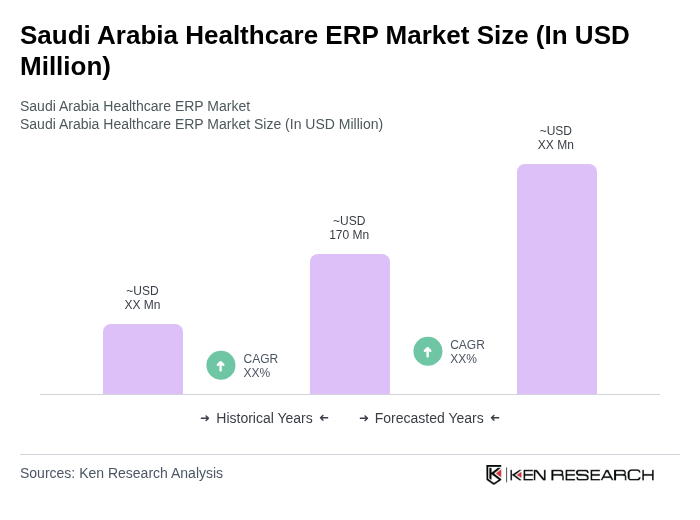
- The Saudi Arabia Healthcare ERP Market is valued at USD 170 million, based on a five-year historical analysis, in line with the broader Saudi Arabia enterprise resource planning market, which generated about USD 170–175 million in revenue recently across sectors. This growth is primarily driven by the increasing demand for integrated healthcare solutions, rapid digitization of healthcare services under Vision 2030, and the government's focus on enhancing healthcare infrastructure and private sector participation. The rising need for efficient management of healthcare resources and patient data, including electronic health records, hospital management systems, and revenue-cycle processes, has further propelled the adoption of ERP systems in the sector.
- Key cities dominating the Saudi Arabia Healthcare ERP Market include Riyadh, Jeddah, and Dammam. Riyadh, as the capital and the main focus area of healthcare IT and healthcare information system deployments, is a hub for healthcare innovation, major public and private hospitals, and large-scale digital health investments. Jeddah and Dammam are significant due to their large populations, extensive healthcare facilities, and their location in the Western and Eastern Provinces, which together account for a substantial share of hospital capacity and digital health initiatives. The concentration of healthcare providers and the presence of major hospitals in these cities, often prioritized in national health digitization projects, contribute to their dominance in the market.
- In 2023, the Saudi Arabian government advanced the National Health Information Exchange initiative under the Seha (Seha Virtual Hospital and related digital health programs) framework, aligned with the Ministry of Health’s health information exchange and interoperability agenda. The key binding instrument supporting standardized healthcare data management and interoperability is the Health Information Exchange Policies and Procedures issued by the Ministry of Health, originally framed under the Saudi Health Information Exchange (SeHE) Program and aligned with the Saudi Health Information Exchange Policies and Procedures document endorsed by the Ministry of Health. This framework mandates healthcare facilities connecting to national platforms to adopt interoperable systems, enforce data-sharing, security, and privacy controls, and comply with defined standards for exchanging clinical and administrative data. These requirements are expected to drive the adoption of ERP and related healthcare information systems that can integrate with HIE, EHR, and other national digital health platforms and meet interoperability, audit, and reporting standards.
Saudi Arabia Healthcare ERP Market Segmentation
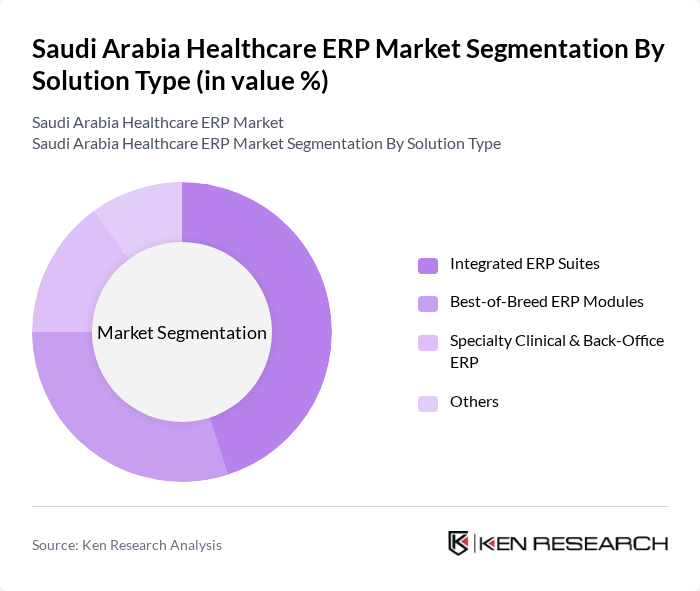
By Solution Type:The market is segmented into Integrated ERP Suites, Best-of-Breed ERP Modules, Specialty Clinical & Back-Office ERP, and Others. Integrated ERP Suites are gaining traction due to their comprehensive functionalities, allowing healthcare organizations to manage finance, supply chain, human resources, and core clinical-support operations in a unified platform, which aligns with broader healthcare IT integration trends in Saudi Arabia. Best-of-Breed ERP Modules are preferred for specific functional needs such as financials, procurement, or inventory management where hospitals seek deep capabilities that integrate with existing electronic medical records and hospital information systems. Specialty Clinical & Back-Office ERP solutions cater to niche requirements including operating room scheduling, pharmacy and laboratory workflows, and revenue-cycle management, increasingly integrated with EHR and telemedicine platforms. The Others category includes emerging solutions such as AI-enabled analytics layers, mobile-first ERP extensions, and cloud-native microservices that support interoperability, real-time performance dashboards, and predictive resource planning, which are gaining popularity with large private hospital groups and new greenfield facilities.
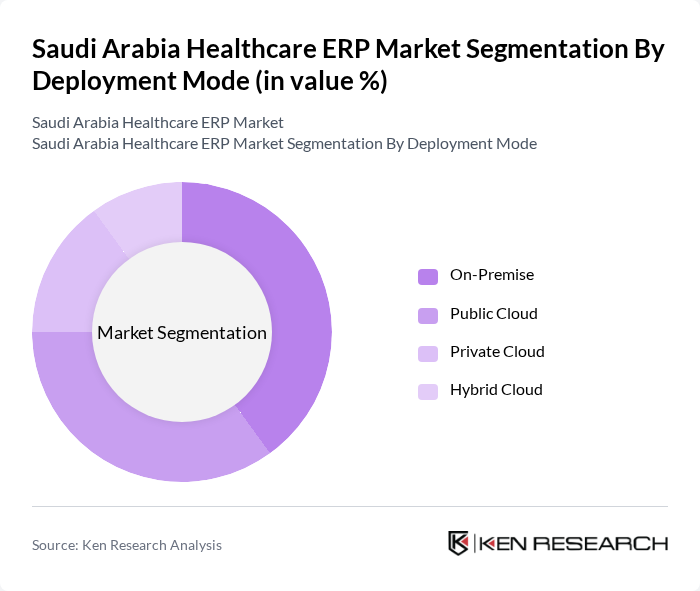
By Deployment Mode:This segment includes On-Premise, Public Cloud, Private Cloud, and Hybrid Cloud deployment modes. The On-Premise model remains popular among large healthcare organizations and public-sector institutions due to stringent data residency, cybersecurity, and compliance requirements, consistent with the dominance of on-premises ERP deployments in healthcare globally. Public Cloud solutions are gaining traction for their cost-effectiveness, scalability, and faster deployment cycles, particularly among private hospitals, clinics, and specialty centers adopting software-as-a-service healthcare IT. Private Cloud offers a balance of security, performance, and customization, supporting organizations that require dedicated environments integrated with national health information systems and internal data centers. Hybrid Cloud is increasingly adopted for its versatility, enabling sensitive data and core systems to remain on-premises or in private clouds, while analytics, non-clinical workloads, and innovation sandboxes leverage public cloud services in line with national digital transformation programs.
Saudi Arabia Healthcare ERP Market Competitive Landscape
The Saudi Arabia Healthcare ERP Market is characterized by a dynamic mix of regional and international players. Leading participants such as SAP SE, Oracle Corporation, Microsoft Corporation, Infor, Inc., Cerner Corporation (Oracle Health), Altera Digital Health (formerly Allscripts), MEDITECH, Epic Systems Corporation, NextGen Healthcare, Inc., eClinicalWorks, LLC, athenahealth, Inc., Siemens Healthineers, GE HealthCare Technologies Inc., Philips Healthcare (Royal Philips), IBM Watson Health / Merative contribute to innovation, geographic expansion, and service delivery in this space.
Saudi Arabia Healthcare ERP Market Industry Analysis
Growth Drivers
- Increasing Demand for Integrated Healthcare Solutions:The Saudi Arabian healthcare sector is experiencing a surge in demand for integrated healthcare solutions, driven by a population of approximately 36 million. The Ministry of Health's budget for the upcoming year is projected at SAR 180 billion, reflecting a commitment to enhancing healthcare services. This investment is expected to facilitate the adoption of ERP systems that streamline operations, improve patient care, and enhance data management across healthcare facilities, ultimately leading to better health outcomes.
- Government Initiatives for Digital Transformation:The Saudi government has launched Vision 2030, which emphasizes digital transformation in healthcare. In the upcoming year, the government plans to allocate SAR 1.6 billion towards health IT initiatives, including the implementation of electronic health records and ERP systems. This strategic investment aims to modernize healthcare infrastructure, improve service delivery, and enhance patient engagement, thereby driving the adoption of healthcare ERP solutions across the nation.
- Rising Healthcare Expenditure:Saudi Arabia's healthcare expenditure is projected to reach SAR 210 billion in the upcoming year, reflecting a growing commitment to improving healthcare services. This increase in spending is expected to drive the demand for ERP systems that can optimize resource allocation, reduce operational costs, and enhance service delivery. As healthcare providers seek to manage rising costs while improving patient care, the adoption of ERP solutions will become increasingly critical in achieving these objectives.
Market Challenges
- High Implementation Costs:The initial costs associated with implementing healthcare ERP systems can be substantial, often exceeding SAR 6 million for large hospitals. This financial burden can deter smaller healthcare providers from adopting these systems, limiting market growth. Additionally, ongoing maintenance and training costs can further strain budgets, making it essential for stakeholders to evaluate the long-term return on investment before committing to such solutions.
- Resistance to Change from Traditional Systems:Many healthcare organizations in Saudi Arabia still rely on traditional systems, which can create significant resistance to adopting new ERP solutions. This reluctance is often rooted in concerns about the complexity of transitioning to new technologies and the potential disruption to existing workflows. Overcoming this challenge requires effective change management strategies and comprehensive training programs to ensure a smooth transition and buy-in from all stakeholders.
Saudi Arabia Healthcare ERP Market Future Outlook
The future of the Saudi Arabia healthcare ERP market appears promising, driven by ongoing government support and technological advancements. As healthcare providers increasingly recognize the importance of data-driven decision-making, the integration of AI and machine learning into ERP systems is expected to enhance operational efficiency. Furthermore, the expansion of telemedicine services will likely create additional demand for robust ERP solutions that can support remote patient management and data analytics, positioning the market for significant growth in the coming years.
Market Opportunities
- Expansion of Telemedicine Services:The rise of telemedicine in Saudi Arabia presents a significant opportunity for healthcare ERP systems. With an estimated 35% increase in telehealth consultations expected in the upcoming year, ERP solutions that integrate telemedicine functionalities can enhance patient management and streamline operations, ultimately improving healthcare delivery and patient satisfaction.
- Adoption of AI and Machine Learning in Healthcare:The integration of AI and machine learning into healthcare ERP systems is poised to revolutionize patient care. In the upcoming year, investments in AI technologies in healthcare are projected to reach SAR 1.2 billion, enabling predictive analytics and personalized treatment plans. This trend will create opportunities for ERP providers to develop innovative solutions that enhance clinical decision-making and operational efficiency.
Scope of the Report
| Segment | Sub-Segments |
|---|---|
| By Solution Type | Integrated ERP Suites Best-of-Breed ERP Modules Specialty Clinical & Back-Office ERP Others |
| By Deployment Mode | On-Premise Public Cloud Private Cloud Hybrid Cloud |
| By Healthcare Facility Type | Public Hospitals Private Hospitals Polyclinics & Specialty Clinics Diagnostic & Imaging Centers Day Surgery Centers & Others |
| By Functional Module | Finance & Billing Management Supply Chain & Inventory Management Human Capital & Workforce Management Patient Administration & Revenue Cycle Asset & Maintenance Management Others |
| By Size of Healthcare Facility | Large Healthcare Systems & Tertiary Hospitals Medium Hospitals & Networks Small Hospitals, Clinics & Centers Others |
| By Service Type | Consulting & Strategy Services Implementation & Integration Services Managed Services & Outsourcing Maintenance, Support & Training Others |
| By Region | Central Region Eastern Region Western Region Southern Region |
Key Target Audience
Investors and Venture Capitalist Firms
Government and Regulatory Bodies (e.g., Ministry of Health, Saudi Food and Drug Authority)
Healthcare Providers and Hospitals
Healthcare IT Solution Providers
Pharmaceutical Companies
Insurance Companies
Healthcare Management Organizations
Medical Equipment Manufacturers
Players Mentioned in the Report:
SAP SE
Oracle Corporation
Microsoft Corporation
Infor, Inc.
Cerner Corporation (Oracle Health)
Altera Digital Health (formerly Allscripts)
MEDITECH
Epic Systems Corporation
NextGen Healthcare, Inc.
eClinicalWorks, LLC
athenahealth, Inc.
Siemens Healthineers
GE HealthCare Technologies Inc.
Philips Healthcare (Royal Philips)
IBM Watson Health / Merative
Table of Contents
Market Assessment Phase
1. Executive Summary and Approach
2. Saudi Arabia Healthcare ERP Market Overview
2.1 Key Insights and Strategic Recommendations
2.2 Saudi Arabia Healthcare ERP Market Overview
2.3 Definition and Scope
2.4 Evolution of Market Ecosystem
2.5 Timeline of Key Regulatory Milestones
2.6 Value Chain & Stakeholder Mapping
2.7 Business Cycle Analysis
2.8 Policy & Incentive Landscape
3. Saudi Arabia Healthcare ERP Market Analysis
3.1 Growth Drivers
3.1.1 Increasing demand for integrated healthcare solutions
3.1.2 Government initiatives for digital transformation
3.1.3 Rising healthcare expenditure
3.1.4 Need for operational efficiency and cost reduction
3.2 Market Challenges
3.2.1 High implementation costs
3.2.2 Resistance to change from traditional systems
3.2.3 Data security and privacy concerns
3.2.4 Limited skilled workforce
3.3 Market Opportunities
3.3.1 Expansion of telemedicine services
3.3.2 Adoption of AI and machine learning in healthcare
3.3.3 Increasing partnerships between healthcare providers and tech firms
3.3.4 Growth in patient-centric care models
3.4 Market Trends
3.4.1 Shift towards cloud-based ERP solutions
3.4.2 Integration of IoT in healthcare management
3.4.3 Focus on patient data analytics
3.4.4 Rise of mobile health applications
3.5 Government Regulation
3.5.1 National Health Information Exchange policies
3.5.2 Data protection regulations
3.5.3 Standards for electronic health records
3.5.4 Licensing requirements for healthcare software
4. SWOT Analysis
5. Stakeholder Analysis
6. Porter's Five Forces Analysis
7. Saudi Arabia Healthcare ERP Market Market Size, 2019-2024
7.1 By Value
7.2 By Volume
7.3 By Average Selling Price
8. Saudi Arabia Healthcare ERP Market Segmentation
8.1 By Solution Type
8.1.1 Integrated ERP Suites
8.1.2 Best-of-Breed ERP Modules
8.1.3 Specialty Clinical & Back-Office ERP
8.1.4 Others
8.2 By Deployment Mode
8.2.1 On-Premise
8.2.2 Public Cloud
8.2.3 Private Cloud
8.2.4 Hybrid Cloud
8.3 By Healthcare Facility Type
8.3.1 Public Hospitals
8.3.2 Private Hospitals
8.3.3 Polyclinics & Specialty Clinics
8.3.4 Diagnostic & Imaging Centers
8.3.5 Day Surgery Centers & Others
8.4 By Functional Module
8.4.1 Finance & Billing Management
8.4.2 Supply Chain & Inventory Management
8.4.3 Human Capital & Workforce Management
8.4.4 Patient Administration & Revenue Cycle
8.4.5 Asset & Maintenance Management
8.4.6 Others
8.5 By Size of Healthcare Facility
8.5.1 Large Healthcare Systems & Tertiary Hospitals
8.5.2 Medium Hospitals & Networks
8.5.3 Small Hospitals, Clinics & Centers
8.5.4 Others
8.6 By Service Type
8.6.1 Consulting & Strategy Services
8.6.2 Implementation & Integration Services
8.6.3 Managed Services & Outsourcing
8.6.4 Maintenance, Support & Training
8.6.5 Others
8.7 By Region
8.7.1 Central Region
8.7.2 Eastern Region
8.7.3 Western Region
8.7.4 Southern Region
9. Saudi Arabia Healthcare ERP Market Competitive Analysis
9.1 Market Share of Key Players
9.2 Cross Comparison of Key Players
9.2.1 Company Name
9.2.2 Group Size (Global, Regional, Local)
9.2.3 Saudi Arabia Healthcare ERP Revenue
9.2.4 3-Year Revenue CAGR in Saudi Healthcare ERP
9.2.5 Number of Healthcare Clients in Saudi Arabia
9.2.6 Average Contract Value (ACV)
9.2.7 Average Implementation Time per Site
9.2.8 Customer Retention / Renewal Rate
9.2.9 Cloud vs On-Premise Revenue Mix
9.2.10 Share of Revenue from Services vs Licenses / Subscriptions
9.2.11 Win Rate in Competitive Bids
9.2.12 Net Promoter Score (NPS) / Customer Satisfaction Score
9.3 SWOT Analysis of Top Players
9.4 Pricing Analysis
9.5 Detailed Profile of Major Companies
9.5.1 SAP SE
9.5.2 Oracle Corporation
9.5.3 Microsoft Corporation
9.5.4 Infor, Inc.
9.5.5 Cerner Corporation (Oracle Health)
9.5.6 Altera Digital Health (formerly Allscripts)
9.5.7 MEDITECH
9.5.8 Epic Systems Corporation
9.5.9 NextGen Healthcare, Inc.
9.5.10 eClinicalWorks, LLC
9.5.11 athenahealth, Inc.
9.5.12 Siemens Healthineers
9.5.13 GE HealthCare Technologies Inc.
9.5.14 Philips Healthcare (Royal Philips)
9.5.15 IBM Watson Health / Merative
10. Saudi Arabia Healthcare ERP Market End-User Analysis
10.1 Procurement Behavior of Key Ministries
10.1.1 Budget Allocation Trends
10.1.2 Decision-Making Processes
10.1.3 Preferred Procurement Channels
10.1.4 Contracting Practices
10.2 Corporate Spend on Infrastructure & Energy
10.2.1 Investment Priorities
10.2.2 Spending Trends in Healthcare IT
10.2.3 Budgeting for ERP Solutions
10.2.4 Cost-Benefit Analysis Practices
10.3 Pain Point Analysis by End-User Category
10.3.1 Common Challenges Faced by Hospitals
10.3.2 Issues in Clinics
10.3.3 Barriers for Diagnostic Centers
10.3.4 Others
10.4 User Readiness for Adoption
10.4.1 Training Needs Assessment
10.4.2 Technology Acceptance Levels
10.4.3 Change Management Strategies
10.4.4 Others
10.5 Post-Deployment ROI and Use Case Expansion
10.5.1 Measurement of ROI
10.5.2 Use Case Success Stories
10.5.3 Scalability of Solutions
10.5.4 Others
11. Saudi Arabia Healthcare ERP Market Future Size, 2025-2030
11.1 By Value
11.2 By Volume
11.3 By Average Selling Price
Go-To-Market Strategy Phase
1. Whitespace Analysis + Business Model Canvas
1.1 Market Gaps Identification
1.2 Value Proposition Development
1.3 Revenue Streams Analysis
1.4 Cost Structure Evaluation
1.5 Key Partnerships Exploration
1.6 Customer Segmentation
1.7 Channels of Distribution
2. Marketing and Positioning Recommendations
2.1 Branding Strategies
2.2 Product USPs
2.3 Target Audience Identification
2.4 Communication Strategies
2.5 Digital Marketing Approaches
2.6 Offline Marketing Tactics
2.7 Performance Metrics
3. Distribution Plan
3.1 Urban Retail Strategies
3.2 Rural NGO Tie-Ups
3.3 Online Distribution Channels
3.4 Direct Sales Approaches
3.5 Partnership with Distributors
3.6 Logistics and Supply Chain Management
3.7 Performance Evaluation
4. Channel & Pricing Gaps
4.1 Underserved Routes
4.2 Pricing Bands Analysis
4.3 Competitor Pricing Strategies
4.4 Customer Willingness to Pay
4.5 Price Sensitivity Analysis
4.6 Discounting Strategies
4.7 Pricing Model Innovation
5. Unmet Demand & Latent Needs
5.1 Category Gaps
5.2 Consumer Segments Analysis
5.3 Emerging Trends Identification
5.4 Customer Feedback Mechanisms
5.5 Market Research Insights
5.6 Future Demand Projections
5.7 Product Development Opportunities
6. Customer Relationship
6.1 Loyalty Programs
6.2 After-Sales Service
6.3 Customer Engagement Strategies
6.4 Feedback and Improvement Processes
6.5 Relationship Management Tools
6.6 Customer Retention Strategies
6.7 Performance Metrics
7. Value Proposition
7.1 Sustainability Initiatives
7.2 Integrated Supply Chains
7.3 Unique Selling Points
7.4 Customer-Centric Approaches
7.5 Competitive Advantages
7.6 Value Delivery Mechanisms
7.7 Performance Metrics
8. Key Activities
8.1 Regulatory Compliance
8.2 Branding Initiatives
8.3 Distribution Setup
8.4 Training and Development
8.5 Marketing Campaigns
8.6 Performance Monitoring
8.7 Continuous Improvement Processes
9. Entry Strategy Evaluation
9.1 Domestic Market Entry Strategy
9.1.1 Product Mix Considerations
9.1.2 Pricing Band Strategies
9.1.3 Packaging Innovations
9.2 Export Entry Strategy
9.2.1 Target Countries Analysis
9.2.2 Compliance Roadmap Development
10. Entry Mode Assessment
10.1 Joint Ventures
10.2 Greenfield Investments
10.3 Mergers & Acquisitions
10.4 Distributor Model Evaluation
10.5 Risk Assessment
10.6 Strategic Fit Analysis
10.7 Performance Metrics
11. Capital and Timeline Estimation
11.1 Capital Requirements
11.2 Timelines for Implementation
11.3 Financial Projections
11.4 Funding Sources
11.5 Risk Management Strategies
11.6 Performance Metrics
12. Control vs Risk Trade-Off
12.1 Ownership Considerations
12.2 Partnership Opportunities
12.3 Risk Mitigation Strategies
12.4 Performance Metrics
13. Profitability Outlook
13.1 Breakeven Analysis
13.2 Long-Term Sustainability Strategies
13.3 Financial Health Indicators
13.4 Performance Metrics
14. Potential Partner List
14.1 Distributors
14.2 Joint Ventures
14.3 Acquisition Targets
14.4 Strategic Alliances
14.5 Performance Metrics
15. Execution Roadmap
15.1 Phased Plan for Market Entry
15.1.1 Market Setup
15.1.2 Market Entry
15.1.3 Growth Acceleration
15.1.4 Scale & Stabilize
15.2 Key Activities and Milestones
15.2.1 Activity Planning
15.2.2 Milestone Tracking
15.2.3 Performance Evaluation
Research Methodology
Phase 1: Approach1
Desk Research
- Analysis of healthcare expenditure reports from the Saudi Ministry of Health
- Review of industry publications and white papers on ERP systems in healthcare
- Examination of market trends and forecasts from healthcare analytics firms
Primary Research
- Interviews with IT managers at major hospitals and healthcare facilities
- Surveys with ERP solution providers and consultants specializing in healthcare
- Focus groups with healthcare administrators to understand ERP needs and challenges
Validation & Triangulation
- Cross-validation of findings with multiple data sources including government and private sector reports
- Triangulation of qualitative insights from interviews with quantitative data from surveys
- Sanity checks through expert panel reviews comprising industry veterans and analysts
Phase 2: Market Size Estimation1
Top-down Assessment
- Estimation of total healthcare spending in Saudi Arabia as a basis for ERP market size
- Segmentation of the market by healthcare sectors such as hospitals, clinics, and pharmacies
- Incorporation of government initiatives aimed at digital transformation in healthcare
Bottom-up Modeling
- Collection of data on ERP adoption rates among healthcare providers in Saudi Arabia
- Estimation of average spending on ERP systems per healthcare facility
- Calculation of market size based on the number of healthcare facilities and their ERP expenditure
Forecasting & Scenario Analysis
- Multi-factor regression analysis considering factors like population growth and healthcare digitization
- Scenario modeling based on potential regulatory changes and technological advancements
- Development of baseline, optimistic, and pessimistic forecasts through 2030
Phase 3: CATI Sample Composition1
| Scope Item/Segment | Sample Size | Target Respondent Profiles |
|---|---|---|
| Hospital ERP Implementation | 120 | IT Directors, Chief Information Officers |
| Clinic Management Systems | 90 | Clinic Managers, Operations Directors |
| Pharmacy Management Solutions | 70 | Pharmacy Owners, IT Managers |
| Healthcare Analytics Tools | 80 | Data Analysts, Business Intelligence Managers |
| Telemedicine Integration | 60 | Telehealth Coordinators, IT Specialists |
Frequently Asked Questions
What is the current value of the Saudi Arabia Healthcare ERP Market?
The Saudi Arabia Healthcare ERP Market is valued at approximately USD 170 million, reflecting a significant growth trend driven by the demand for integrated healthcare solutions and the government's focus on enhancing healthcare infrastructure under Vision 2030.
What factors are driving the growth of the Healthcare ERP Market in Saudi Arabia?
Which cities are leading in the Saudi Arabia Healthcare ERP Market?
What are the main types of ERP solutions available in the Saudi healthcare sector?
Other Regional/Country Reports
Other Adjacent Reports
Mexico Healthcare IT Solutions Market
Global Telemedicine Market Report Size, Share, Growth Drivers, Trends, Opportunities & Forecast 2025–2030Qatar AI in Healthcare MarketUnited States Cloud Computing in Healthcare Market Outlook to 2030: Size, Share, Growth and TrendsSouth Korea Health Information Exchange Market
Apac Asc Revenue Cycle Management Market Report Size, Share, Growth Drivers, Trends, Opportunities & Forecast 2025–2030United States Healthcare Analytics Market Outlook to 2030: Size, Share, Growth and TrendsAsia Pacific Digital Health Market Outlook to 2030: Size, Share, Growth and TrendsWhy Buy From Us?

What makes us stand out is that our consultants follow Robust, Refine and Result (RRR) methodology. Robust for clear definitions, approaches and sanity checking, Refine for differentiating respondents' facts and opinions, and Result for presenting data with story.

We have set a benchmark in the industry by offering our clients with syndicated and customized market research reports featuring coverage of entire market as well as meticulous research and analyst insights.

While we don't replace traditional research, we flip the method upside down. Our dual approach of Top Bottom & Bottom Top ensures quality deliverable by not just verifying company fundamentals but also looking at the sector and macroeconomic factors.

With one step in the future, our research team constantly tries to show you the bigger picture. We help with some of the tough questions you may encounter along the way: How is the industry positioned? Best marketing channel? KPI's of competitors? By aligning every element, we help maximize success.

Our report gives you instant access to the answers and sources that other companies might choose to hide. We elaborate each steps of research methodology we have used and showcase you the sample size to earn your trust.

If you need any support, we are here! We pride ourselves on universe strength, data quality, and quick, friendly, and professional service.