About the Report
Base Year 2024Listen to the audio summary
Saudi Arabia Hospital Supplies Market Overview
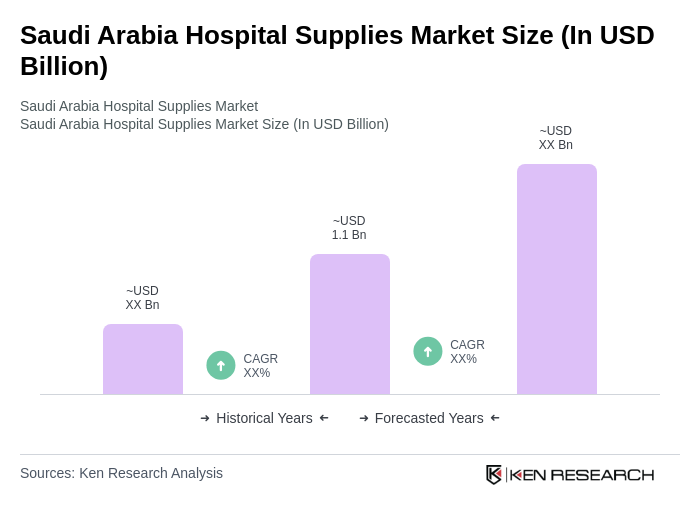
- The Saudi Arabia Hospital Supplies Market is valued at USD 1.1 billion, based on a five-year historical analysis. This growth is primarily driven by the increasing demand for advanced healthcare services, a growing population with a high burden of noncommunicable diseases, and the government's commitment to enhancing healthcare infrastructure under Vision 2030 reforms. The rise in chronic diseases such as diabetes and cardiovascular conditions, combined with infection prevention priorities post-pandemic, has further fueled the demand for hospital supplies.
- Key cities such as Riyadh, Jeddah, and Dammam dominate the market due to their advanced healthcare facilities and concentration of hospitals and clinics. Riyadh, being the capital, concentrates major Ministry of Health and specialized hospitals; Jeddah’s role as a commercial hub attracts private investment; and Dammam anchors the Eastern Province healthcare network and logistics corridors supporting hospital supply distribution. These metropolitan areas collectively account for a significant share of hospital procurement and service coverage due to population density and tertiary care capacity.
- In 2023, the Saudi government reinforced the requirement that all medical devices and hospital supplies be registered with the Saudi Food and Drug Authority (SFDA) in the Medical Devices Marketing Authorization/MDEL framework prior to distribution, with Unique Device Identification (UDI) adoption milestones and strict post-market surveillance. This policy aims to ensure safety and efficacy, elevate quality standards, and harmonize with international regulatory practices, thereby strengthening patient safety across the health system.
Saudi Arabia Hospital Supplies Market Segmentation
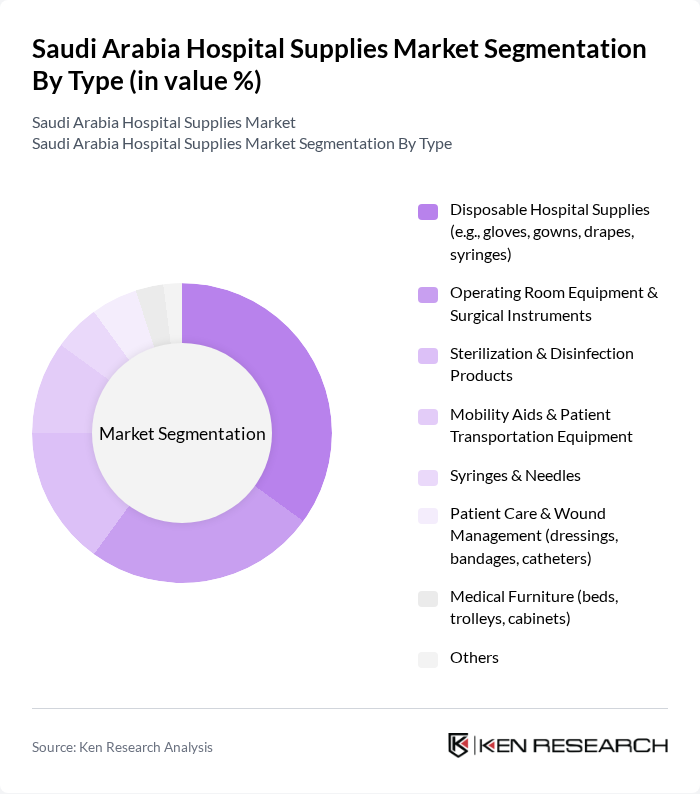
By Type:The market is segmented into various types of hospital supplies, including disposable hospital supplies, operating room equipment, sterilization products, mobility aids, syringes, patient care products, medical furniture, and others. Disposable hospital supplies, such as gloves and syringes, are currently dominating the market due to their essential role in infection control and patient safety. The increasing focus on hygiene and safety in healthcare settings has led to a surge in demand for these products.
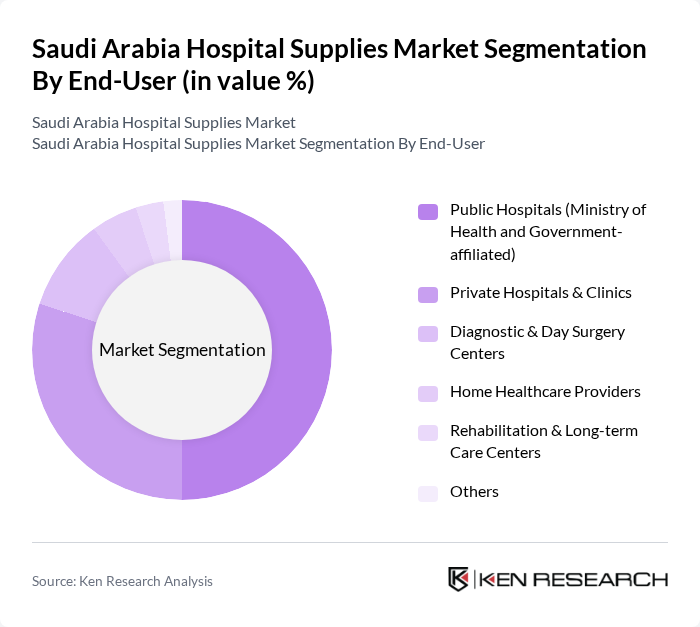
By End-User:The end-user segmentation includes public hospitals, private hospitals, diagnostic centers, home healthcare providers, rehabilitation centers, and others. Public hospitals are the leading segment due to the government's significant investment in healthcare infrastructure and services. The increasing patient load in public facilities drives the demand for various hospital supplies, ensuring that these institutions remain well-equipped to handle healthcare needs.
Saudi Arabia Hospital Supplies Market Competitive Landscape
The Saudi Arabia Hospital Supplies Market is characterized by a dynamic mix of regional and international players. Leading participants such as Becton, Dickinson and Company (BD), 3M Health Care, Johnson & Johnson MedTech (including Ethicon), Baxter International, B. Braun Melsungen AG, Cardinal Health, Medtronic, Fresenius Kabi, Terumo Corporation, Smith & Nephew, Abbott Laboratories, Mölnlycke Health Care, Kimberly-Clark Professional, Nihon Kohden Corporation, Drägerwerk AG & Co. KGaA, Philips (Health Systems), GE HealthCare, Siemens Healthineers, Al Maarefa Medical Co. (Saudi distributor/manufacturer), Al Faisaliah Medical Systems (AFMS) contribute to innovation, geographic expansion, and service delivery in this space.
Saudi Arabia Hospital Supplies Market Industry Analysis
Growth Drivers
- Increasing Healthcare Expenditure:Saudi Arabia's healthcare expenditure is projected to reach approximately SAR 200 billion (USD 53.3 billion) in future, driven by the government's commitment to improving healthcare services. This increase is part of the Vision 2030 initiative, which aims to enhance the quality of healthcare and expand access. The rising expenditure supports the procurement of advanced hospital supplies, thereby stimulating market growth and enhancing the overall healthcare infrastructure in the region.
- Rising Demand for Advanced Medical Equipment:The demand for advanced medical equipment in Saudi Arabia is expected to grow significantly, with an estimated increase of 15% annually. This surge is attributed to the growing prevalence of chronic diseases, such as diabetes and cardiovascular conditions, which require sophisticated medical interventions. As hospitals upgrade their facilities to meet these needs, the market for hospital supplies, particularly high-tech medical devices, is poised for substantial growth, enhancing patient care and operational efficiency.
- Expansion of Healthcare Infrastructure:The Saudi government is investing heavily in healthcare infrastructure, with plans to build over 30 new hospitals in future, adding approximately 10,000 beds. This expansion is part of a broader strategy to improve healthcare access and quality across the nation. As new facilities come online, the demand for hospital supplies will increase, creating opportunities for suppliers to provide essential medical products and equipment to meet the needs of these new institutions.
Market Challenges
- Regulatory Compliance Issues:Navigating the complex regulatory landscape in Saudi Arabia poses significant challenges for hospital supply companies. The Saudi Food and Drug Authority (SFDA) enforces stringent regulations that require compliance with international standards. Companies face delays and increased costs associated with obtaining necessary certifications and approvals, which can hinder market entry and expansion efforts, ultimately affecting supply chain efficiency and product availability.
- High Import Tariffs on Medical Supplies:Import tariffs on medical supplies in Saudi Arabia can reach up to 20%, significantly impacting the cost structure for foreign suppliers. These tariffs create a financial burden that can lead to higher prices for healthcare providers, potentially limiting access to essential medical products. This challenge is exacerbated by the limited local manufacturing capabilities, making it difficult for the market to meet the growing demand for hospital supplies efficiently.
Saudi Arabia Hospital Supplies Market Future Outlook
The future of the Saudi Arabia hospital supplies market appears promising, driven by ongoing investments in healthcare infrastructure and technological advancements. The integration of digital health solutions and telemedicine is expected to reshape service delivery, enhancing patient outcomes. Additionally, the focus on preventive healthcare will likely lead to increased demand for diagnostic and monitoring equipment, further stimulating market growth. As the healthcare landscape evolves, suppliers must adapt to these trends to remain competitive and meet the changing needs of healthcare providers.
Market Opportunities
- Growth in Telemedicine and Remote Healthcare:The rise of telemedicine in Saudi Arabia presents a significant opportunity for hospital supply companies. With an estimated 30% increase in telehealth consultations expected in future, there is a growing need for remote monitoring devices and digital health solutions. This trend allows suppliers to innovate and provide products that cater to the evolving healthcare delivery models, enhancing patient engagement and care continuity.
- Technological Advancements in Medical Devices:The rapid pace of technological advancements in medical devices offers substantial opportunities for market players. Innovations such as AI-driven diagnostic tools and smart medical equipment are gaining traction. By investing in research and development, suppliers can introduce cutting-edge products that improve patient outcomes and operational efficiency, positioning themselves favorably in a competitive market landscape.
Scope of the Report
| Segment | Sub-Segments |
|---|---|
| By Type | Disposable Hospital Supplies (e.g., gloves, gowns, drapes, syringes) Operating Room Equipment & Surgical Instruments Sterilization & Disinfection Products Mobility Aids & Patient Transportation Equipment Syringes & Needles Patient Care & Wound Management (dressings, bandages, catheters) Medical Furniture (beds, trolleys, cabinets) Others |
| By End-User | Public Hospitals (Ministry of Health and Government-affiliated) Private Hospitals & Clinics Diagnostic & Day Surgery Centers Home Healthcare Providers Rehabilitation & Long-term Care Centers Others |
| By Distribution Channel | Direct Tendering (MOH, GHC & Government Procurement) Authorized Distributors/Dealers Hospital Group Purchasing & Wholesalers E-commerce & Digital Procurement Platforms Others |
| By Application | Surgical Procedures Emergency & Critical Care Diagnostics & Infection Control Routine Patient Care & Nursing Others |
| By Product Class | Consumables & Disposables Durable Equipment Capital Equipment Others |
| By Brand Positioning | Premium Brands Mid-Tier Brands Value/Budget Brands Others |
| By Regulatory Compliance | SFDA-Approved/Registered Products CE-Marked Products FDA-Cleared/Approved Products Others |
Key Target Audience
Investors and Venture Capitalist Firms
Government and Regulatory Bodies (e.g., Ministry of Health, Saudi Food and Drug Authority)
Manufacturers and Producers
Distributors and Retailers
Healthcare Providers (e.g., Hospitals, Clinics)
Medical Equipment Suppliers
Industry Associations (e.g., Saudi Arabian Health Council)
Financial Institutions
Players Mentioned in the Report:
Becton, Dickinson and Company (BD)
3M Health Care
Johnson & Johnson MedTech (including Ethicon)
Baxter International
B. Braun Melsungen AG
Cardinal Health
Medtronic
Fresenius Kabi
Terumo Corporation
Smith & Nephew
Abbott Laboratories
Molnlycke Health Care
Kimberly-Clark Professional
Nihon Kohden Corporation
Dragerwerk AG & Co. KGaA
Philips (Health Systems)
GE HealthCare
Siemens Healthineers
Al Maarefa Medical Co. (Saudi distributor/manufacturer)
Al Faisaliah Medical Systems (AFMS)
Table of Contents
Market Assessment Phase
1. Executive Summary and Approach
2. Saudi Arabia Hospital Supplies Market Overview
2.1 Key Insights and Strategic Recommendations
2.2 Saudi Arabia Hospital Supplies Market Overview
2.3 Definition and Scope
2.4 Evolution of Market Ecosystem
2.5 Timeline of Key Regulatory Milestones
2.6 Value Chain & Stakeholder Mapping
2.7 Business Cycle Analysis
2.8 Policy & Incentive Landscape
3. Saudi Arabia Hospital Supplies Market Analysis
3.1 Growth Drivers
3.1.1 Increasing Healthcare Expenditure
3.1.2 Rising Demand for Advanced Medical Equipment
3.1.3 Expansion of Healthcare Infrastructure
3.1.4 Government Initiatives for Health Sector Development
3.2 Market Challenges
3.2.1 Regulatory Compliance Issues
3.2.2 High Import Tariffs on Medical Supplies
3.2.3 Limited Local Manufacturing Capabilities
3.2.4 Price Sensitivity Among Healthcare Providers
3.3 Market Opportunities
3.3.1 Growth in Telemedicine and Remote Healthcare
3.3.2 Increasing Focus on Preventive Healthcare
3.3.3 Expansion of Private Healthcare Facilities
3.3.4 Technological Advancements in Medical Devices
3.4 Market Trends
3.4.1 Shift Towards Disposable Medical Supplies
3.4.2 Integration of IoT in Hospital Supplies
3.4.3 Emphasis on Sustainability in Medical Products
3.4.4 Growth of E-commerce in Medical Supplies
3.5 Government Regulation
3.5.1 Implementation of New Health Policies
3.5.2 Stricter Quality Control Standards
3.5.3 Licensing Requirements for Medical Suppliers
3.5.4 Incentives for Local Manufacturing
4. SWOT Analysis
5. Stakeholder Analysis
6. Porter's Five Forces Analysis
7. Saudi Arabia Hospital Supplies Market Market Size, 2019-2024
7.1 By Value
7.2 By Volume
7.3 By Average Selling Price
8. Saudi Arabia Hospital Supplies Market Segmentation
8.1 By Type
8.1.1 Disposable Hospital Supplies (e.g., gloves, gowns, drapes, syringes)
8.1.2 Operating Room Equipment & Surgical Instruments
8.1.3 Sterilization & Disinfection Products
8.1.4 Mobility Aids & Patient Transportation Equipment
8.1.5 Syringes & Needles
8.1.6 Patient Care & Wound Management (dressings, bandages, catheters)
8.1.7 Medical Furniture (beds, trolleys, cabinets)
8.1.8 Others
8.2 By End-User
8.2.1 Public Hospitals (Ministry of Health and Government-affiliated)
8.2.2 Private Hospitals & Clinics
8.2.3 Diagnostic & Day Surgery Centers
8.2.4 Home Healthcare Providers
8.2.5 Rehabilitation & Long-term Care Centers
8.2.6 Others
8.3 By Distribution Channel
8.3.1 Direct Tendering (MOH, GHC & Government Procurement)
8.3.2 Authorized Distributors/Dealers
8.3.3 Hospital Group Purchasing & Wholesalers
8.3.4 E-commerce & Digital Procurement Platforms
8.3.5 Others
8.4 By Application
8.4.1 Surgical Procedures
8.4.2 Emergency & Critical Care
8.4.3 Diagnostics & Infection Control
8.4.4 Routine Patient Care & Nursing
8.4.5 Others
8.5 By Product Class
8.5.1 Consumables & Disposables
8.5.2 Durable Equipment
8.5.3 Capital Equipment
8.5.4 Others
8.6 By Brand Positioning
8.6.1 Premium Brands
8.6.2 Mid-Tier Brands
8.6.3 Value/Budget Brands
8.6.4 Others
8.7 By Regulatory Compliance
8.7.1 SFDA-Approved/Registered Products
8.7.2 CE-Marked Products
8.7.3 FDA-Cleared/Approved Products
8.7.4 Others
9. Saudi Arabia Hospital Supplies Market Competitive Analysis
9.1 Market Share of Key Players
9.2 Cross Comparison of Key Players
9.2.1 Company Name
9.2.2 Scale in KSA (Local legal entity, distribution footprint, service network)
9.2.3 Saudi Revenue/Share and 3-year CAGR
9.2.4 Tender Win Rate (MOH/Govt) and Private Sector Penetration
9.2.5 Key Product Mix (Disposables vs. Equipment) and Portfolio Breadth
9.2.6 SFDA Registration Coverage and Compliance Lead Time
9.2.7 Average Lead Time & Fill Rate (Supply Chain Reliability)
9.2.8 Pricing Positioning (Premium/Mid/Value) and Discounting Depth
9.2.9 Innovation & Localization (New launches, local assembly/packaging)
9.2.10 After-sales & Clinical Support ( installed base coverage, training KPIs)
9.3 SWOT Analysis of Top Players
9.4 Pricing Analysis
9.5 Detailed Profile of Major Companies
9.5.1 Becton, Dickinson and Company (BD)
9.5.2 3M Health Care
9.5.3 Johnson & Johnson MedTech (including Ethicon)
9.5.4 Baxter International
9.5.5 B. Braun Melsungen AG
9.5.6 Cardinal Health
9.5.7 Medtronic
9.5.8 Fresenius Kabi
9.5.9 Terumo Corporation
9.5.10 Smith & Nephew
9.5.11 Abbott Laboratories
9.5.12 Mölnlycke Health Care
9.5.13 Kimberly-Clark Professional
9.5.14 Nihon Kohden Corporation
9.5.15 Drägerwerk AG & Co. KGaA
9.5.16 Philips (Health Systems)
9.5.17 GE HealthCare
9.5.18 Siemens Healthineers
9.5.19 Al Maarefa Medical Co. (Saudi distributor/manufacturer)
9.5.20 Al Faisaliah Medical Systems (AFMS)
10. Saudi Arabia Hospital Supplies Market End-User Analysis
10.1 Procurement Behavior of Key Ministries
10.1.1 Ministry of Health
10.1.2 Ministry of Defense
10.1.3 Ministry of Education
10.1.4 Ministry of Interior
10.2 Corporate Spend on Infrastructure & Energy
10.2.1 Hospital Infrastructure Development
10.2.2 Energy Efficiency Initiatives
10.2.3 Investment in Medical Technology
10.3 Pain Point Analysis by End-User Category
10.3.1 Hospitals
10.3.2 Clinics
10.3.3 Home Healthcare Providers
10.4 User Readiness for Adoption
10.4.1 Training and Support Needs
10.4.2 Technology Acceptance Levels
10.5 Post-Deployment ROI and Use Case Expansion
10.5.1 Measurement of ROI
10.5.2 Expansion into New Use Cases
11. Saudi Arabia Hospital Supplies Market Future Size, 2025-2030
11.1 By Value
11.2 By Volume
11.3 By Average Selling Price
Go-To-Market Strategy Phase
1. Whitespace Analysis + Business Model Canvas
1.1 Market Gaps Identification
1.2 Business Model Framework
2. Marketing and Positioning Recommendations
2.1 Branding Strategies
2.2 Product USPs
3. Distribution Plan
3.1 Urban Retail Strategies
3.2 Rural NGO Tie-Ups
4. Channel & Pricing Gaps
4.1 Underserved Routes
4.2 Pricing Bands
5. Unmet Demand & Latent Needs
5.1 Category Gaps
5.2 Consumer Segments
6. Customer Relationship
6.1 Loyalty Programs
6.2 After-Sales Service
7. Value Proposition
7.1 Sustainability Initiatives
7.2 Integrated Supply Chains
8. Key Activities
8.1 Regulatory Compliance
8.2 Branding Efforts
8.3 Distribution Setup
9. Entry Strategy Evaluation
9.1 Domestic Market Entry Strategy
9.1.1 Product Mix
9.1.2 Pricing Band
9.1.3 Packaging
9.2 Export Entry Strategy
9.2.1 Target Countries
9.2.2 Compliance Roadmap
10. Entry Mode Assessment
10.1 Joint Ventures
10.2 Greenfield Investments
10.3 Mergers & Acquisitions
10.4 Distributor Model
11. Capital and Timeline Estimation
11.1 Capital Requirements
11.2 Timelines
12. Control vs Risk Trade-Off
12.1 Ownership vs Partnerships
13. Profitability Outlook
13.1 Breakeven Analysis
13.2 Long-Term Sustainability
14. Potential Partner List
14.1 Distributors
14.2 Joint Ventures
14.3 Acquisition Targets
15. Execution Roadmap
15.1 Phased Plan for Market Entry
15.1.1 Market Setup
15.1.2 Market Entry
15.1.3 Growth Acceleration
15.1.4 Scale & Stabilize
15.2 Key Activities and Milestones
15.2.1 Activity Timeline
15.2.2 Milestone Tracking
Research Methodology
Phase 1: Approach1
Desk Research
- Analysis of healthcare expenditure reports from the Saudi Ministry of Health
- Review of industry publications and market reports on hospital supplies
- Examination of import/export data from Saudi Customs for hospital equipment
Primary Research
- Interviews with procurement managers at major hospitals and healthcare facilities
- Surveys with suppliers and distributors of hospital supplies in Saudi Arabia
- Field interviews with healthcare professionals regarding supply chain challenges
Validation & Triangulation
- Cross-validation of data through multiple industry sources and reports
- Triangulation of findings from primary interviews and secondary data
- Sanity checks through expert panels comprising healthcare industry veterans
Phase 2: Market Size Estimation1
Top-down Assessment
- Estimation of total healthcare spending in Saudi Arabia as a baseline
- Segmentation of market size by product categories such as surgical supplies, diagnostic equipment, etc.
- Incorporation of government healthcare initiatives and Vision 2030 objectives
Bottom-up Modeling
- Collection of sales data from leading hospital supply companies operating in the region
- Estimation of average spending per hospital based on bed capacity and service offerings
- Volume and pricing analysis for key product categories to derive market size
Forecasting & Scenario Analysis
- Multi-variable forecasting using historical growth rates and healthcare trends
- Scenario analysis based on potential regulatory changes and market dynamics
- Development of baseline, optimistic, and pessimistic market growth projections through 2030
Phase 3: CATI Sample Composition1
| Scope Item/Segment | Sample Size | Target Respondent Profiles |
|---|---|---|
| Surgical Supplies Procurement | 100 | Procurement Managers, Hospital Administrators |
| Diagnostic Equipment Usage | 80 | Radiologists, Laboratory Managers |
| Patient Care Supplies | 90 | Nursing Supervisors, Supply Chain Coordinators |
| Pharmaceutical Supplies | 70 | Pharmacy Directors, Inventory Managers |
| Healthcare Facility Management | 60 | Facility Managers, Operations Directors |
Frequently Asked Questions
What is the current value of the Saudi Arabia Hospital Supplies Market?
The Saudi Arabia Hospital Supplies Market is valued at approximately USD 1.1 billion, reflecting a significant growth driven by increasing healthcare demands, a rising population burdened with chronic diseases, and government initiatives to enhance healthcare infrastructure under Vision 2030 reforms.
What factors are driving growth in the Saudi Arabia Hospital Supplies Market?
Which cities are the main contributors to the Saudi Arabia Hospital Supplies Market?
What are the regulatory requirements for hospital supplies in Saudi Arabia?
Other Regional/Country Reports
Indonesia Hospital Supplies Market
Malaysia Hospital Supplies Market
KSA Hospital Supplies Market
APAC Hospital Supplies Market
Why Buy From Us?

What makes us stand out is that our consultants follow Robust, Refine and Result (RRR) methodology. Robust for clear definitions, approaches and sanity checking, Refine for differentiating respondents' facts and opinions, and Result for presenting data with story.

We have set a benchmark in the industry by offering our clients with syndicated and customized market research reports featuring coverage of entire market as well as meticulous research and analyst insights.

While we don't replace traditional research, we flip the method upside down. Our dual approach of Top Bottom & Bottom Top ensures quality deliverable by not just verifying company fundamentals but also looking at the sector and macroeconomic factors.

With one step in the future, our research team constantly tries to show you the bigger picture. We help with some of the tough questions you may encounter along the way: How is the industry positioned? Best marketing channel? KPI's of competitors? By aligning every element, we help maximize success.

Our report gives you instant access to the answers and sources that other companies might choose to hide. We elaborate each steps of research methodology we have used and showcase you the sample size to earn your trust.

If you need any support, we are here! We pride ourselves on universe strength, data quality, and quick, friendly, and professional service.