About the Report
Base Year 2024Saudi Arabia Laptop Backpack Market Overview
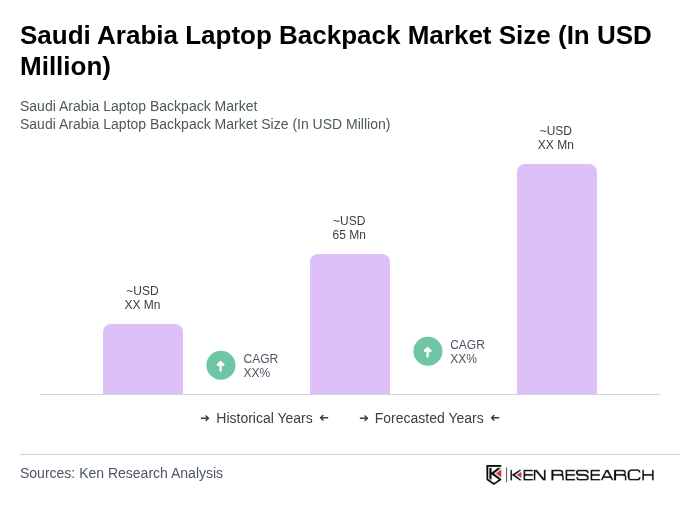
- The Saudi Arabia Laptop Backpack Market is valued at USD 65 million, based on a five-year historical analysis. This growth is primarily driven by the increasing adoption of laptops among students and professionals, supported by expanding higher-education enrollment and a growing white-collar workforce in major cities, coupled with the rising demand for stylish and functional backpacks that cater to various user needs. The market has seen a surge in online sales through platforms such as regional e-commerce marketplaces and brand-owned webstores, further boosting its overall value as consumers increasingly prefer digital channels for fashion and accessory purchases.
- Key cities such as Riyadh, Jeddah, and Dammam dominate the market due to their high population density and concentration of educational institutions, corporate offices, and expatriate communities, which collectively drive demand for laptop-compatible bags and backpacks. The urban lifestyle in these cities drives the demand for laptop backpacks, as consumers seek products that combine practicality, durability, and modern aesthetics, with growing interest in features such as padded laptop compartments, USB charging ports, and ergonomic designs.
- To support Vision 2030 sustainability objectives, Saudi Arabia has strengthened policies encouraging the use of eco-friendly materials and responsible manufacturing in products including bags and backpacks, with requirements cascading through supply chains via public procurement standards and corporate ESG commitments. The Framework Law for Waste Management, issued by Royal Decree No. M/59 of 1443H and implemented by the National Center for Waste Management, sets obligations on waste reduction, recycling, and extended producer responsibility, prompting manufacturers and importers to increasingly adopt recyclable, reusable, and lower-impact materials in soft goods such as laptop backpacks. This regulatory direction, combined with corporate sustainability initiatives, is fostering a gradual market shift towards eco-friendly laptop backpacks made from recycled polyester, organic fabrics, and reduced-plastic packaging.
Saudi Arabia Laptop Backpack Market Segmentation
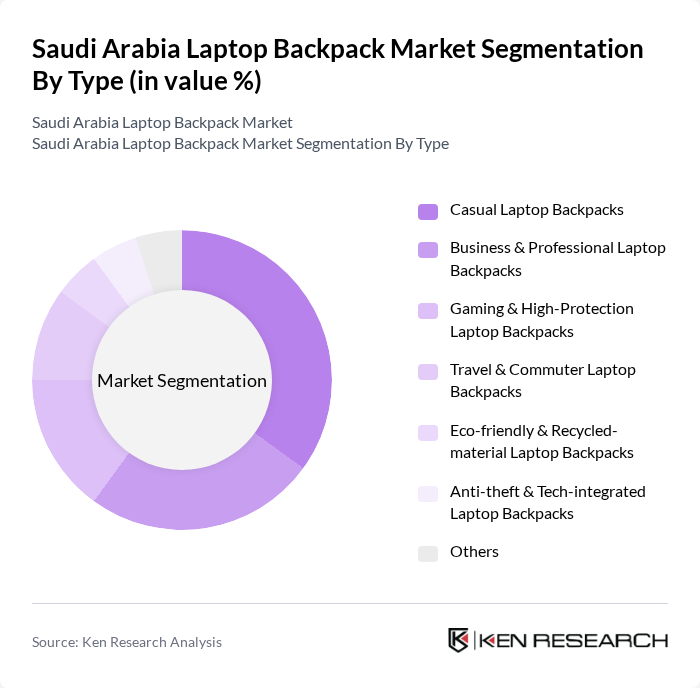
By Type:The market is segmented into various types of laptop backpacks, each catering to different consumer preferences and needs. The subsegments include Casual Laptop Backpacks, Business & Professional Laptop Backpacks, Gaming & High-Protection Laptop Backpacks, Travel & Commuter Laptop Backpacks, Eco-friendly & Recycled-material Laptop Backpacks, Anti-theft & Tech-integrated Laptop Backpacks, and Others. Casual Laptop Backpacks account for a significant share of demand due to their versatility and appeal to a broad audience, including students and young professionals who prioritize style, everyday functionality, and affordable price points. Business & Professional Laptop Backpacks are gaining traction among office workers and corporate buyers that emphasize organization, premium materials, and compatibility with business travel, while Gaming & High-Protection Laptop Backpacks benefit from rising sales of gaming laptops and demand for enhanced padding and shock resistance. Travel & Commuter Laptop Backpacks serve frequent travelers and daily commuters seeking lightweight, carry-on-compliant designs, whereas Eco-friendly & Recycled-material Laptop Backpacks and Anti-theft & Tech-integrated Laptop Backpacks represent faster-growing niches driven by sustainability awareness and demand for features such as RFID-blocking pockets, USB ports, and integrated power-bank sleeves.
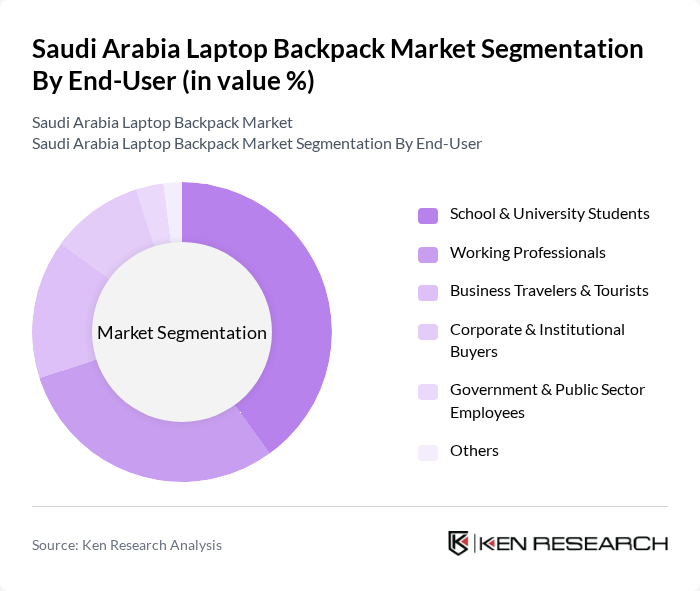
By End-User:The end-user segmentation includes School & University Students, Working Professionals, Business Travelers & Tourists, Corporate & Institutional Buyers, Government & Public Sector Employees, and Others. School & University Students represent the largest segment, driven by the increasing number of educational institutions, expanding higher education enrollment, and the growing trend of using laptops and tablets for academic purposes. This demographic values affordability, comfort, and design, making it a key focus for manufacturers that offer lightweight, durable, and fashion-forward backpack ranges targeted at youth. Working Professionals and Business Travelers & Tourists also form substantial demand pools, supported by flexible work models, business travel, and the need for organized, travel-ready laptop storage solutions.
Saudi Arabia Laptop Backpack Market Competitive Landscape
The Saudi Arabia Laptop Backpack Market is characterized by a dynamic mix of regional and international players. Leading participants such as Samsonite International S.A., Targus Inc., Thule Group AB, HP Inc. (HP Laptop Backpacks), Dell Technologies Inc. (Dell Laptop Backpacks), Lenovo Group Limited (Lenovo Laptop Backpacks), SwissGear (Wenger / Victorinox Swiss Army), Osprey Packs, Inc., Eastpak (VF Corporation), Herschel Supply Company, Inateck Technology Co., Ltd., Amazon Basics (Amazon.com, Inc.), Fjällräven (Fenix Outdoor AB), The North Face (VF Corporation), Adidas AG contribute to innovation, geographic expansion, and service delivery in this space. These brands compete on durability, ergonomic design, material quality, and feature-rich offerings, while also leveraging both brick-and-mortar distribution and fast-growing e-commerce channels across Saudi Arabia’s major urban centers.
Saudi Arabia Laptop Backpack Market Industry Analysis
Growth Drivers
- Increasing Demand for Portable Computing Devices:The demand for portable computing devices in Saudi Arabia is projected to reach 5.5 million units in future, driven by a growing tech-savvy population. The rise in smartphone and laptop usage, which is expected to hit 95% penetration among young adults, fuels the need for laptop backpacks. This trend is further supported by the Kingdom's Vision 2030 initiative, which emphasizes digital transformation and technology adoption across various sectors, enhancing the market for laptop backpacks.
- Rising Trend of Remote Work and Online Education:The shift towards remote work and online education has led to a significant increase in laptop usage, with an estimated 3.5 million students engaged in online learning in future. This trend has created a heightened demand for laptop backpacks that cater to students and professionals alike. The Saudi government’s investment in digital infrastructure, amounting to USD 1.8 billion, further supports this growth, as it facilitates access to online resources and learning platforms, driving the need for portable solutions.
- Growing Awareness of Ergonomic Designs:As awareness of health and wellness increases, the demand for ergonomic laptop backpacks is on the rise. In future, approximately 65% of consumers are expected to prioritize ergonomic features in their purchases, reflecting a shift towards products that promote comfort and reduce strain. This trend is supported by a growing body of research indicating that ergonomic designs can significantly reduce back pain, leading to a more informed consumer base willing to invest in quality backpacks that enhance their daily experiences.
Market Challenges
- Intense Competition from Low-Cost Alternatives:The Saudi laptop backpack market faces significant challenges from low-cost alternatives, particularly from Asian manufacturers. In future, it is estimated that low-cost brands will capture approximately 45% of the market share, making it difficult for premium brands to compete. This price sensitivity among consumers, driven by economic factors and the availability of cheaper options, poses a challenge for companies aiming to position themselves as quality leaders in the market.
- Fluctuating Raw Material Prices:The laptop backpack industry is heavily reliant on raw materials such as polyester and nylon, which have seen price fluctuations of up to 20% in the past year. In future, ongoing supply chain issues and geopolitical tensions are expected to exacerbate these fluctuations, impacting production costs. Manufacturers may struggle to maintain profit margins while balancing the need for quality materials, leading to potential price increases that could deter price-sensitive consumers.
Saudi Arabia Laptop Backpack Market Future Outlook
The future of the Saudi Arabia laptop backpack market appears promising, driven by technological advancements and changing consumer preferences. As the youth population continues to grow, with over 65% under the age of 30, there will be an increasing demand for innovative and stylish backpacks. Additionally, the integration of smart technology into backpack designs, such as built-in charging ports, is expected to gain traction. Companies that adapt to these trends and focus on sustainability will likely capture a larger market share in the coming years.
Market Opportunities
- Increasing Disposable Income Among Consumers:With the average disposable income in Saudi Arabia projected to rise to USD 30,000 per capita in future, consumers are more likely to invest in high-quality laptop backpacks. This increase in purchasing power presents an opportunity for brands to market premium products that emphasize durability and style, catering to a more affluent consumer base seeking value in their purchases.
- Expansion into Untapped Rural Markets:As urbanization continues, rural areas in Saudi Arabia are becoming increasingly accessible, with a projected 20% growth in rural population connectivity in future. This presents a significant opportunity for laptop backpack manufacturers to expand their reach into these markets. By offering tailored products that meet the specific needs of rural consumers, companies can tap into a previously underserved segment, driving sales and brand loyalty.
Scope of the Report
| Segment | Sub-Segments |
|---|---|
| By Type | Casual Laptop Backpacks Business & Professional Laptop Backpacks Gaming & High-Protection Laptop Backpacks Travel & Commuter Laptop Backpacks Eco-friendly & Recycled-material Laptop Backpacks Anti-theft & Tech-integrated Laptop Backpacks Others |
| By End-User | School & University Students Working Professionals Business Travelers & Tourists Corporate & Institutional Buyers Government & Public Sector Employees Others |
| By Price Range | Economy (Value/Budget) Mass Premium (Mid-range) Premium/Branded Luxury & Designer Others |
| By Material | Nylon & Polyamide Polyester Genuine & Synthetic Leather Canvas & Fabric Blends Eco-friendly & Recycled Materials Others |
| By Distribution Channel | Online Marketplaces (e.g., Amazon.sa, Noon, Namshi) Brand E-commerce & Direct-to-Consumer Platforms Modern Trade & Hypermarkets (e.g., Carrefour, Lulu, Panda) Specialty Electronics & IT Retailers (e.g., Jarir, Extra, Virgin Megastore) Traditional Stores & Wholesalers |
| By Brand Positioning | Global Premium & Lifestyle Brands International Mass & Value Brands Local & Regional Brands Private Label & Retail-owned Brands |
| By User Demographics | Age Group (Teenagers, Young Adults, Middle-aged, Seniors) Gender (Unisex, Male-focused, Female-focused) Income Level (Low, Middle, Upper-middle, High) Lifestyle & Usage Pattern (Urban Commuters, Frequent Travelers, Gamers, Students) Others |
Key Target Audience
Investors and Venture Capitalist Firms
Government and Regulatory Bodies (e.g., Saudi Standards, Metrology and Quality Organization)
Manufacturers and Producers
Distributors and Retailers
Logistics and Supply Chain Companies
Technology Providers
Industry Associations (e.g., Saudi Arabian General Investment Authority)
Financial Institutions
Players Mentioned in the Report:
Samsonite International S.A.
Targus Inc.
Thule Group AB
HP Inc. (HP Laptop Backpacks)
Dell Technologies Inc. (Dell Laptop Backpacks)
Lenovo Group Limited (Lenovo Laptop Backpacks)
SwissGear (Wenger / Victorinox Swiss Army)
Osprey Packs, Inc.
Eastpak (VF Corporation)
Herschel Supply Company
Inateck Technology Co., Ltd.
Amazon Basics (Amazon.com, Inc.)
Fjallraven (Fenix Outdoor AB)
The North Face (VF Corporation)
Adidas AG
Table of Contents
Market Assessment Phase
1. Executive Summary and Approach
2. Saudi Arabia Laptop Backpack Market Overview
2.1 Key Insights and Strategic Recommendations
2.2 Saudi Arabia Laptop Backpack Market Overview
2.3 Definition and Scope
2.4 Evolution of Market Ecosystem
2.5 Timeline of Key Regulatory Milestones
2.6 Value Chain & Stakeholder Mapping
2.7 Business Cycle Analysis
2.8 Policy & Incentive Landscape
3. Saudi Arabia Laptop Backpack Market Analysis
3.1 Growth Drivers
3.1.1 Increasing demand for portable computing devices
3.1.2 Rising trend of remote work and online education
3.1.3 Growing awareness of ergonomic designs
3.1.4 Expansion of e-commerce platforms
3.2 Market Challenges
3.2.1 Intense competition from low-cost alternatives
3.2.2 Fluctuating raw material prices
3.2.3 Limited consumer awareness of premium products
3.2.4 Supply chain disruptions
3.3 Market Opportunities
3.3.1 Increasing disposable income among consumers
3.3.2 Growth in the youth population
3.3.3 Potential for customization and personalization
3.3.4 Expansion into untapped rural markets
3.4 Market Trends
3.4.1 Shift towards sustainable and eco-friendly materials
3.4.2 Integration of technology in backpack designs
3.4.3 Rise of multifunctional backpacks
3.4.4 Increasing online sales channels
3.5 Government Regulation
3.5.1 Import tariffs on electronic accessories
3.5.2 Safety standards for consumer products
3.5.3 Environmental regulations on materials used
3.5.4 Consumer protection laws
4. SWOT Analysis
5. Stakeholder Analysis
6. Porter's Five Forces Analysis
7. Saudi Arabia Laptop Backpack Market Market Size, 2019-2024
7.1 By Value
7.2 By Volume
7.3 By Average Selling Price
8. Saudi Arabia Laptop Backpack Market Segmentation
8.1 By Type
8.1.1 Casual Laptop Backpacks
8.1.2 Business & Professional Laptop Backpacks
8.1.3 Gaming & High-Protection Laptop Backpacks
8.1.4 Travel & Commuter Laptop Backpacks
8.1.5 Eco-friendly & Recycled-material Laptop Backpacks
8.1.6 Anti-theft & Tech-integrated Laptop Backpacks
8.1.7 Others
8.2 By End-User
8.2.1 School & University Students
8.2.2 Working Professionals
8.2.3 Business Travelers & Tourists
8.2.4 Corporate & Institutional Buyers
8.2.5 Government & Public Sector Employees
8.2.6 Others
8.3 By Price Range
8.3.1 Economy (Value/Budget)
8.3.2 Mass Premium (Mid-range)
8.3.3 Premium/Branded
8.3.4 Luxury & Designer
8.3.5 Others
8.4 By Material
8.4.1 Nylon & Polyamide
8.4.2 Polyester
8.4.3 Genuine & Synthetic Leather
8.4.4 Canvas & Fabric Blends
8.4.5 Eco-friendly & Recycled Materials
8.4.6 Others
8.5 By Distribution Channel
8.5.1 Online Marketplaces (e.g., Amazon.sa, Noon, Namshi)
8.5.2 Brand E-commerce & Direct-to-Consumer Platforms
8.5.3 Modern Trade & Hypermarkets (e.g., Carrefour, Lulu, Panda)
8.5.4 Specialty Electronics & IT Retailers (e.g., Jarir, Extra, Virgin Megastore)
8.5.5 Traditional Stores & Wholesalers
8.6 By Brand Positioning
8.6.1 Global Premium & Lifestyle Brands
8.6.2 International Mass & Value Brands
8.6.3 Local & Regional Brands
8.6.4 Private Label & Retail-owned Brands
8.7 By User Demographics
8.7.1 Age Group (Teenagers, Young Adults, Middle-aged, Seniors)
8.7.2 Gender (Unisex, Male-focused, Female-focused)
8.7.3 Income Level (Low, Middle, Upper-middle, High)
8.7.4 Lifestyle & Usage Pattern (Urban Commuters, Frequent Travelers, Gamers, Students)
8.7.5 Others
9. Saudi Arabia Laptop Backpack Market Competitive Analysis
9.1 Market Share of Key Players
9.2 Cross Comparison of Key Players
9.2.1 Company Name
9.2.2 Group Size (Global, Regional, or Local Player)
9.2.3 Revenue from Laptop Backpacks in Saudi Arabia
9.2.4 3-year CAGR in Laptop Backpack Sales (Units / Value)
9.2.5 Market Share in Saudi Arabia Laptop Backpack Segment
9.2.6 Average Selling Price (ASP) in Saudi Arabia
9.2.7 Share of Online vs Offline Sales
9.2.8 Number of Retail Touchpoints / Stores Covered in KSA
9.2.9 Portfolio Breadth (Number of Laptop Backpack SKUs)
9.2.10 Customer Ratings & Review Score (Major E-commerce Platforms)
9.2.11 Warranty & After-sales Coverage in KSA
9.2.12 Marketing & Promotion Intensity (Spend Proxy / Campaign Presence)
9.3 SWOT Analysis of Top Players
9.4 Pricing Analysis
9.5 Detailed Profile of Major Companies
9.5.1 Samsonite International S.A.
9.5.2 Targus Inc.
9.5.3 Thule Group AB
9.5.4 HP Inc. (HP Laptop Backpacks)
9.5.5 Dell Technologies Inc. (Dell Laptop Backpacks)
9.5.6 Lenovo Group Limited (Lenovo Laptop Backpacks)
9.5.7 SwissGear (Wenger / Victorinox Swiss Army)
9.5.8 Osprey Packs, Inc.
9.5.9 Eastpak (VF Corporation)
9.5.10 Herschel Supply Company
9.5.11 Inateck Technology Co., Ltd.
9.5.12 Amazon Basics (Amazon.com, Inc.)
9.5.13 Fjällräven (Fenix Outdoor AB)
9.5.14 The North Face (VF Corporation)
9.5.15 Adidas AG
10. Saudi Arabia Laptop Backpack Market End-User Analysis
10.1 Procurement Behavior of Key Ministries
10.1.1 Budget Allocation Trends
10.1.2 Preferred Suppliers
10.1.3 Procurement Processes
10.1.4 Contract Duration Preferences
10.2 Corporate Spend on Infrastructure & Energy
10.2.1 Investment Trends
10.2.2 Budget Prioritization
10.2.3 Spending Patterns
10.2.4 Key Decision Makers
10.3 Pain Point Analysis by End-User Category
10.3.1 Common Issues Faced
10.3.2 Product Performance Expectations
10.3.3 Service and Support Needs
10.3.4 Price Sensitivity
10.4 User Readiness for Adoption
10.4.1 Awareness Levels
10.4.2 Training Requirements
10.4.3 Adoption Barriers
10.4.4 Feedback Mechanisms
10.5 Post-Deployment ROI and Use Case Expansion
10.5.1 Measurement of Success
10.5.2 Future Investment Plans
10.5.3 Expansion Opportunities
10.5.4 User Satisfaction Metrics
11. Saudi Arabia Laptop Backpack Market Future Size, 2025-2030
11.1 By Value
11.2 By Volume
11.3 By Average Selling Price
Go-To-Market Strategy Phase
1. Whitespace Analysis + Business Model Canvas
1.1 Market Gaps Identification
1.2 Value Proposition Development
1.3 Revenue Streams
1.4 Cost Structure Analysis
1.5 Key Partnerships
1.6 Customer Segments
1.7 Channels
2. Marketing and Positioning Recommendations
2.1 Branding Strategies
2.2 Product USPs
3. Distribution Plan
3.1 Urban Retail vs Rural NGO Tie-ups
4. Channel & Pricing Gaps
4.1 Underserved Routes
4.2 Pricing Bands
5. Unmet Demand & Latent Needs
5.1 Category Gaps
5.2 Consumer Segments
6. Customer Relationship
6.1 Loyalty Programs
6.2 After-sales Service
7. Value Proposition
7.1 Sustainability
7.2 Integrated Supply Chains
8. Key Activities
8.1 Regulatory Compliance
8.2 Branding
8.3 Distribution Setup
9. Entry Strategy Evaluation
9.1 Domestic Market Entry Strategy
9.1.1 Product Mix
9.1.2 Pricing Band
9.1.3 Packaging
9.2 Export Entry Strategy
9.2.1 Target Countries
9.2.2 Compliance Roadmap
10. Entry Mode Assessment
10.1 JV
10.2 Greenfield
10.3 M&A
10.4 Distributor Model
11. Capital and Timeline Estimation
11.1 Capital Requirements
11.2 Timelines
12. Control vs Risk Trade-Off
12.1 Ownership vs Partnerships
13. Profitability Outlook
13.1 Breakeven Analysis
13.2 Long-term Sustainability
14. Potential Partner List
14.1 Distributors
14.2 JVs
14.3 Acquisition Targets
15. Execution Roadmap
15.1 Phased Plan for Market Entry
15.1.1 Market Setup
15.1.2 Market Entry
15.1.3 Growth Acceleration
15.1.4 Scale & Stabilize
15.2 Key Activities and Milestones
Research Methodology
Phase 1: Approach1
Desk Research
- Analysis of market reports from industry associations and government publications related to the laptop backpack sector in Saudi Arabia
- Review of online retail platforms to assess product offerings, pricing strategies, and consumer reviews
- Examination of demographic and economic data from the Saudi Arabian General Authority for Statistics to understand target market segments
Primary Research
- Interviews with product managers and marketing executives from leading backpack manufacturers and retailers
- Surveys conducted with consumers to gather insights on preferences, purchasing behavior, and brand loyalty
- Focus group discussions with university students and professionals to explore specific needs and trends in laptop backpack usage
Validation & Triangulation
- Cross-validation of findings through comparison with international market trends and local consumer behavior studies
- Triangulation of data from primary interviews, surveys, and secondary research to ensure consistency and reliability
- Sanity checks through expert panel reviews involving industry veterans and market analysts
Phase 2: Market Size Estimation1
Top-down Assessment
- Estimation of total addressable market (TAM) based on overall consumer electronics sales in Saudi Arabia
- Segmentation of the market by demographics, including age, income level, and education to identify key consumer groups
- Incorporation of growth rates from related sectors, such as e-commerce and education, to project future demand
Bottom-up Modeling
- Collection of sales data from major retailers and e-commerce platforms to establish baseline sales figures
- Analysis of average selling prices and volume sold per segment to derive revenue estimates
- Estimation of market penetration rates based on consumer adoption trends and competitive landscape
Forecasting & Scenario Analysis
- Utilization of time series analysis to project market growth based on historical sales data
- Scenario modeling to assess the impact of economic fluctuations, consumer trends, and technological advancements on market dynamics
- Development of multiple forecasts (baseline, optimistic, and pessimistic) to account for uncertainties in market conditions
Phase 3: CATI Sample Composition1
| Scope Item/Segment | Sample Size | Target Respondent Profiles |
|---|---|---|
| Consumer Preferences for Laptop Backpacks | 150 | Students, Young Professionals |
| Retail Insights from Backpack Sellers | 100 | Store Managers, Sales Representatives |
| Market Trends in E-commerce Sales | 80 | E-commerce Managers, Digital Marketing Specialists |
| Brand Perception Studies | 70 | Brand Managers, Marketing Analysts |
| Usage Patterns Among Professionals | 90 | Corporate Employees, IT Professionals |
Frequently Asked Questions
What is the current value of the Saudi Arabia Laptop Backpack Market?
The Saudi Arabia Laptop Backpack Market is valued at approximately USD 65 million, reflecting a significant growth driven by the increasing adoption of laptops among students and professionals, as well as the rising demand for stylish and functional backpacks.
What factors are driving the growth of the laptop backpack market in Saudi Arabia?
Which cities in Saudi Arabia dominate the laptop backpack market?
What types of laptop backpacks are available in the Saudi market?
Other Regional/Country Reports
Indonesia Laptop Backpack Market
Malaysia Laptop Backpack Market
KSA Laptop Backpack Market
APAC Laptop Backpack Market
SEA Laptop Backpack Market
Vietnam Laptop Backpack Market
Other Adjacent Reports
Philippines Travel Gear Market
South Korea School Supplies Market
Qatar Professional Bags Market
UAE Eco-Friendly Backpacks Market
KSA gaming accessories market report size, share, growth drivers, trends, opportunities & forecast 2025–2030South Korea Ergonomic Products Market
KSA E-Commerce Fashion Market
Vietnam Portable Electronics Market
Why Buy From Us?

What makes us stand out is that our consultants follow Robust, Refine and Result (RRR) methodology. Robust for clear definitions, approaches and sanity checking, Refine for differentiating respondents' facts and opinions, and Result for presenting data with story.

We have set a benchmark in the industry by offering our clients with syndicated and customized market research reports featuring coverage of entire market as well as meticulous research and analyst insights.

While we don't replace traditional research, we flip the method upside down. Our dual approach of Top Bottom & Bottom Top ensures quality deliverable by not just verifying company fundamentals but also looking at the sector and macroeconomic factors.

With one step in the future, our research team constantly tries to show you the bigger picture. We help with some of the tough questions you may encounter along the way: How is the industry positioned? Best marketing channel? KPI's of competitors? By aligning every element, we help maximize success.

Our report gives you instant access to the answers and sources that other companies might choose to hide. We elaborate each steps of research methodology we have used and showcase you the sample size to earn your trust.

If you need any support, we are here! We pride ourselves on universe strength, data quality, and quick, friendly, and professional service.