Region:Middle East
Author(s):Dev
Product Code:KRAD3382
Pages:94
Published On:November 2025
By Type:
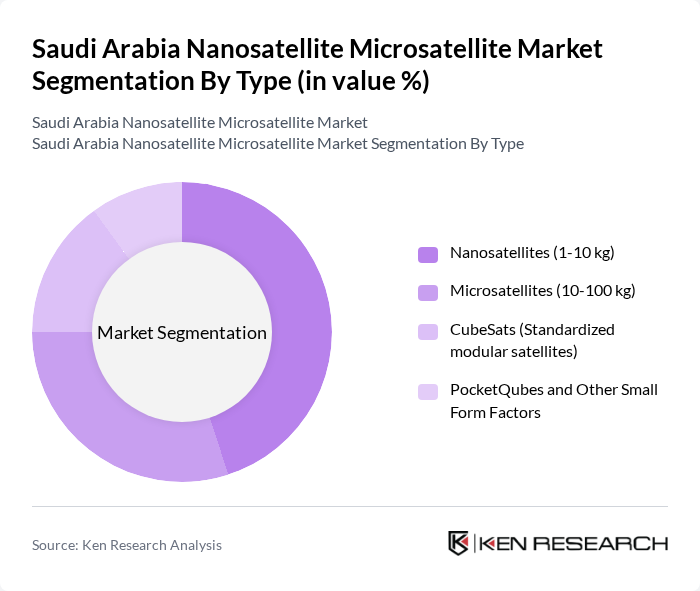
The market is segmented into four main types:Nanosatellites (1-10 kg), Microsatellites (10-100 kg), CubeSats (standardized modular satellites), and PocketQubes and other small form factors. Nanosatellites currently lead the market, driven by their cost-effectiveness, rapid deployment, and versatility in Earth observation, secure communications, and IoT applications. Government and commercial entities are increasingly adopting nanosatellites for real-time data collection, environmental monitoring, and broadband connectivity. Microsatellites retain a significant share, particularly for missions requiring higher payload capacities and advanced imaging. The trend toward miniaturization, combined with the localization of satellite manufacturing and the entry of new players such as Neo Space Group, is expected to further accelerate the adoption of small satellite technologies in Saudi Arabia .
By End-User:
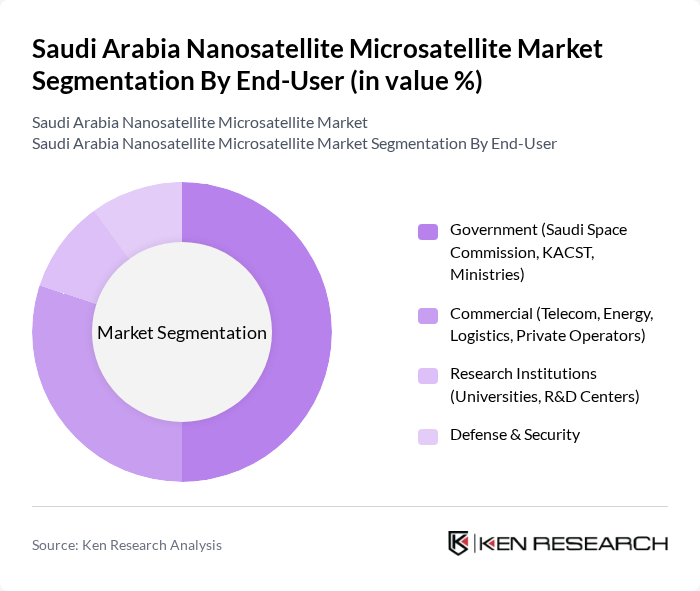
The end-user segmentation includesGovernment (Saudi Space Commission, KACST, Ministries), Commercial (Telecom, Energy, Logistics, Private Operators), Research Institutions (Universities, R&D Centers), and Defense & Security. The Government sector is the leading end-user, propelled by direct investments, national digital inclusion policies, and strategic initiatives under Vision 2030. The Saudi Space Commission and KACST play pivotal roles in advancing satellite projects for applications such as environmental monitoring, disaster management, and national security. The Commercial sector is expanding, with telecom, energy, and logistics companies leveraging small satellites for connectivity and operational efficiency. Research institutions are increasingly involved in R&D and technology demonstration missions, while Defense & Security applications are gaining traction with the deployment of secure, encrypted satellite networks .
The Saudi Arabia Nanosatellite Microsatellite Market features a dynamic mix of regional and international players. Leading participants such as King Abdulaziz City for Science and Technology (KACST), Saudi Space Commission, Thales Alenia Space, Airbus Defence and Space, Northrop Grumman, Planet Labs, Spire Global, NanoAvionics, GomSpace Group AB, Inmarsat, SES S.A., Rocket Lab, Arianespace, Surrey Satellite Technology Limited (SSTL), SpaceX, Lockheed Martin Corporation, Raytheon Technologies, Boeing Company, Clyde Space Ltd., and SpaceQuest Ltd. drive innovation, geographic expansion, and service delivery. The emergence of Neo Space Group, backed by the Public Investment Fund, is accelerating localization and manufacturing capabilities, further strengthening Saudi Arabia’s position in the global small satellite industry .
The future of the Saudi Arabia nanosatellite microsatellite market appears promising, driven by increasing investments in space technology and a growing emphasis on local manufacturing capabilities. As the government continues to support initiatives that foster innovation, the market is likely to witness a surge in satellite launches and applications. Furthermore, collaborations with international space agencies will enhance knowledge transfer, enabling local companies to develop advanced satellite technologies and expand their service offerings in various sectors.
| Segment | Sub-Segments |
|---|---|
| By Type | Nanosatellites (1-10 kg) Microsatellites (10-100 kg) CubeSats (Standardized modular satellites) PocketQubes and Other Small Form Factors |
| By End-User | Government (Saudi Space Commission, KACST, Ministries) Commercial (Telecom, Energy, Logistics, Private Operators) Research Institutions (Universities, R&D Centers) Defense & Security |
| By Application | Earth Observation (Agriculture, Environmental Monitoring, Urban Planning) Communication (IoT, Broadband, Remote Connectivity) Scientific Research (Space Science, Technology Demonstration) Navigation & Remote Sensing |
| By Launch Method | Dedicated Launch (Direct-to-Orbit) Ride-Share Launch (Shared Payload) Piggyback Launch |
| By Payload Capacity | Less than 10 kg kg to 100 kg More than 100 kg Others |
| By Orbit Type | Low Earth Orbit (LEO) Medium Earth Orbit (MEO) Geostationary Orbit (GEO) Polar Orbit |
| By Region | Central Region (Riyadh, Qassim) Eastern Region (Dammam, Al Khobar) Western Region (Jeddah, Makkah) Southern Region |
| Scope Item/Segment | Sample Size | Target Respondent Profiles |
|---|---|---|
| Government Space Initiatives | 60 | Policy Makers, Space Agency Officials |
| Commercial Satellite Manufacturing | 50 | Manufacturing Managers, R&D Directors |
| Academic Research Projects | 40 | University Researchers, Project Leads |
| Satellite Launch Services | 45 | Operations Managers, Launch Coordinators |
| End-User Applications | 55 | Business Development Managers, Application Engineers |
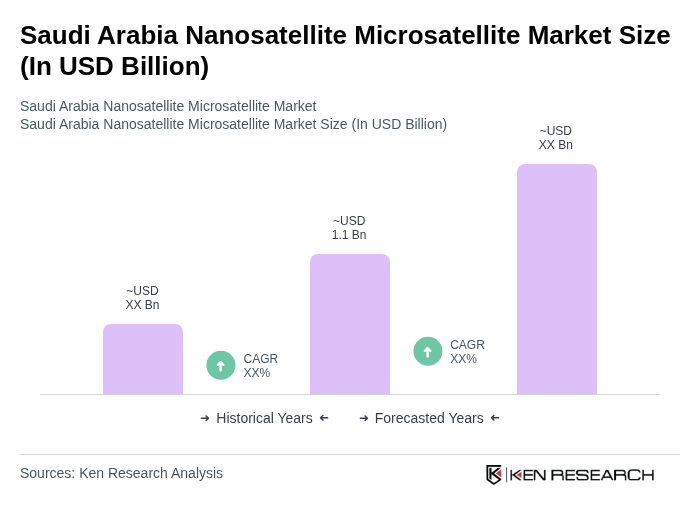
The Saudi Arabia Nanosatellite Microsatellite Market is valued at approximately USD 1.1 billion, driven by advancements in satellite technology and government investments under Vision 2030, which emphasizes the importance of satellite-based services across various sectors.

What makes us stand out is that our consultants follow Robust, Refine and Result (RRR) methodology. Robust for clear definitions, approaches and sanity checking, Refine for differentiating respondents' facts and opinions, and Result for presenting data with story.

We have set a benchmark in the industry by offering our clients with syndicated and customized market research reports featuring coverage of entire market as well as meticulous research and analyst insights.

While we don't replace traditional research, we flip the method upside down. Our dual approach of Top Bottom & Bottom Top ensures quality deliverable by not just verifying company fundamentals but also looking at the sector and macroeconomic factors.

With one step in the future, our research team constantly tries to show you the bigger picture. We help with some of the tough questions you may encounter along the way: How is the industry positioned? Best marketing channel? KPI's of competitors? By aligning every element, we help maximize success.

Our report gives you instant access to the answers and sources that other companies might choose to hide. We elaborate each steps of research methodology we have used and showcase you the sample size to earn your trust.

If you need any support, we are here! We pride ourselves on universe strength, data quality, and quick, friendly, and professional service.













