Region:Middle East
Author(s):Geetanshi
Product Code:KRAA5279
Pages:95
Published On:September 2025
By Type:
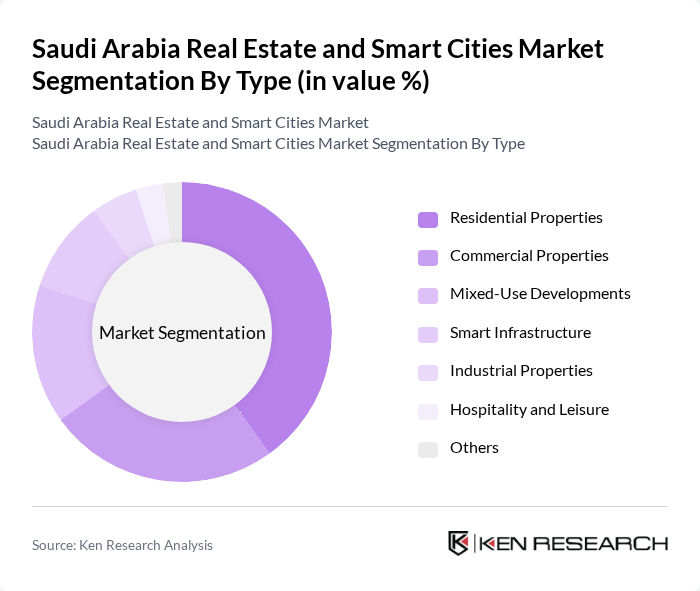
The market is segmented into various types, including Residential Properties, Commercial Properties, Mixed-Use Developments, Smart Infrastructure, Industrial Properties, Hospitality and Leisure, and Others. Among these, Residential Properties dominate the market due to the increasing demand for housing driven by population growth and urbanization. The trend towards mixed-use developments is also gaining traction, as they offer integrated living and working spaces, appealing to modern consumers seeking convenience and community.
By End-User:
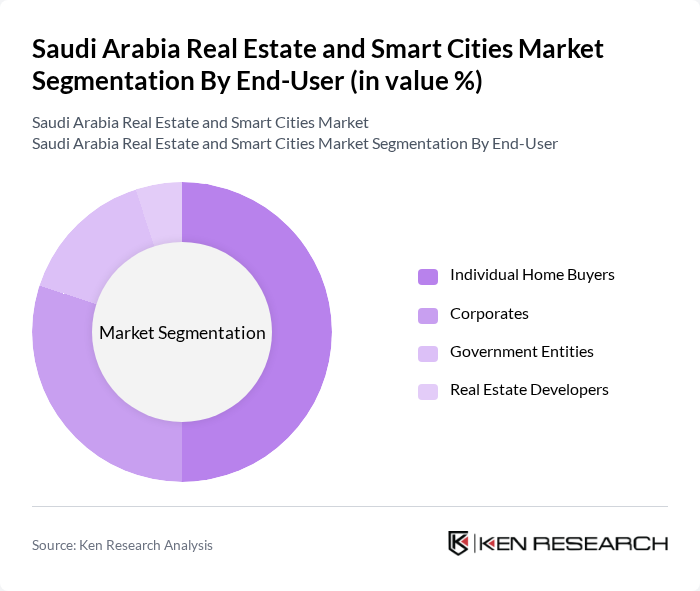
This market is also segmented by end-users, including Individual Home Buyers, Corporates, Government Entities, and Real Estate Developers. Individual Home Buyers represent the largest segment, driven by the growing population and government initiatives aimed at increasing home ownership. Corporates are increasingly investing in commercial properties to accommodate their expanding workforce, while government entities focus on infrastructure projects to support urban development.
The Saudi Arabia Real Estate and Smart Cities Market is characterized by a dynamic mix of regional and international players. Leading participants such as Emaar Properties, Dar Al Arkan, Saudi Real Estate Company (Aqarat), JLL Saudi Arabia, Knight Frank, Al Habtoor Group, Red Sea Global, Mace Group, Al-Futtaim Group, Alinma Investment, Al Rajhi Capital, Colliers International, CBRE Group, Al Oula Real Estate, and Saudi Binladin Group contribute to innovation, geographic expansion, and service delivery in this space.
The future of the Saudi Arabian real estate and smart cities market appears promising, driven by ongoing urbanization and government initiatives. As the population continues to grow, the demand for innovative housing solutions and smart infrastructure will increase. Additionally, the focus on sustainability and digital transformation will shape the market landscape, encouraging investments in green technologies and smart city projects. The collaboration between public and private sectors will be crucial in overcoming challenges and capitalizing on emerging opportunities.
| Segment | Sub-Segments |
|---|---|
| By Type | Residential Properties Commercial Properties Mixed-Use Developments Smart Infrastructure Industrial Properties Hospitality and Leisure Others |
| By End-User | Individual Home Buyers Corporates Government Entities Real Estate Developers |
| By Investment Source | Domestic Investors Foreign Direct Investment (FDI) Public-Private Partnerships (PPP) Government Schemes |
| By Application | Residential Development Commercial Development Urban Infrastructure Smart City Solutions |
| By Pricing Strategy | Luxury Segment Mid-Range Segment Affordable Segment |
| By Policy Support | Subsidies for Housing Projects Tax Incentives for Developers Grants for Smart City Initiatives |
| By Distribution Mode | Direct Sales Real Estate Agencies Online Platforms Auctions |
| Scope Item/Segment | Sample Size | Target Respondent Profiles |
|---|---|---|
| Residential Smart Developments | 150 | Real Estate Developers, Urban Planners |
| Commercial Real Estate Trends | 100 | Property Managers, Investment Analysts |
| Smart Infrastructure Projects | 80 | City Officials, Infrastructure Engineers |
| Technology Adoption in Real Estate | 70 | IT Managers, Smart Technology Providers |
| Public Perception of Smart Cities | 120 | Residents, Community Leaders |
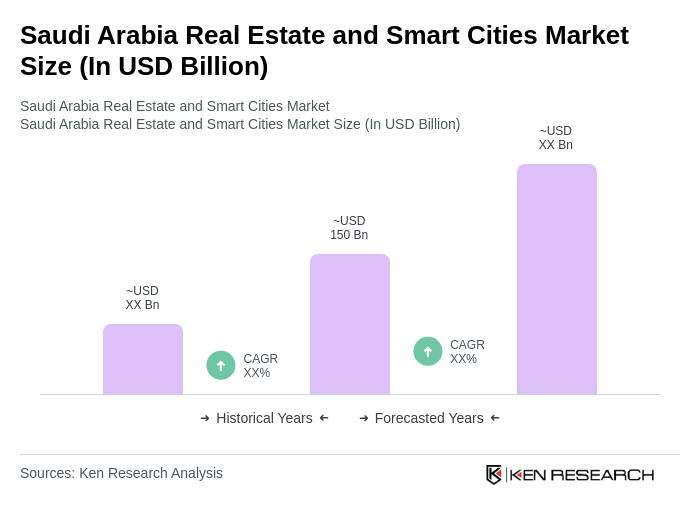
The Saudi Arabia Real Estate and Smart Cities Market is valued at approximately USD 150 billion, driven by rapid urbanization, government initiatives, and increasing foreign investments in infrastructure and real estate projects.

What makes us stand out is that our consultants follow Robust, Refine and Result (RRR) methodology. Robust for clear definitions, approaches and sanity checking, Refine for differentiating respondents' facts and opinions, and Result for presenting data with story.

We have set a benchmark in the industry by offering our clients with syndicated and customized market research reports featuring coverage of entire market as well as meticulous research and analyst insights.

While we don't replace traditional research, we flip the method upside down. Our dual approach of Top Bottom & Bottom Top ensures quality deliverable by not just verifying company fundamentals but also looking at the sector and macroeconomic factors.

With one step in the future, our research team constantly tries to show you the bigger picture. We help with some of the tough questions you may encounter along the way: How is the industry positioned? Best marketing channel? KPI's of competitors? By aligning every element, we help maximize success.

Our report gives you instant access to the answers and sources that other companies might choose to hide. We elaborate each steps of research methodology we have used and showcase you the sample size to earn your trust.

If you need any support, we are here! We pride ourselves on universe strength, data quality, and quick, friendly, and professional service.













