About the Report
Base Year 2024Saudi Arabia Roaming Tariff Market Overview
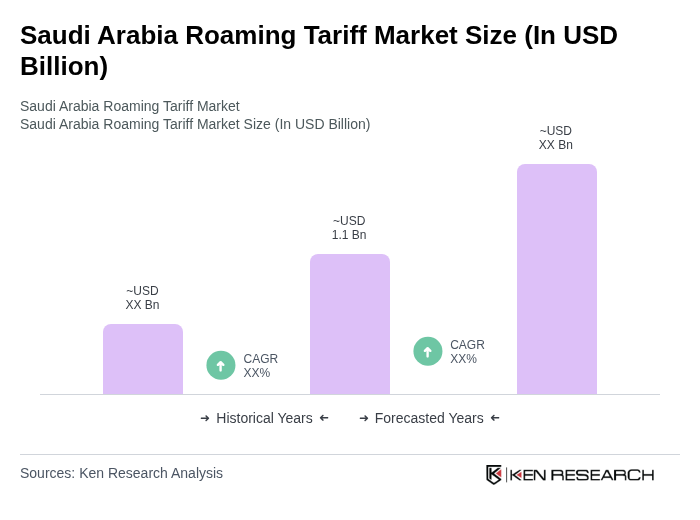
- The Saudi Arabia Roaming Tariff Market is valued at USD 1.1 billion, based on a five-year historical analysis. This market growth is primarily driven by the rising number of international travelers, surging mobile data consumption, and extensive telecom infrastructure upgrades. The push for seamless connectivity—especially with the expansion of 5G—has accelerated demand for roaming services, positioning this segment as a critical component of the national telecommunications industry .
- Key players in this market include major telecom operators such asSTC, Mobily, and Zain KSA. These companies maintain market leadership through extensive network coverage, strong brand equity, and continuous innovation in service offerings. Their ability to deliver competitive roaming packages, leverage international partnerships, and rapidly deploy new technologies—such as 5G and eSIM—further consolidates their market position .
- In 2023, the Saudi government enacted theTelecommunications and Information Technology Law, 2022issued by the Communications, Space & Technology Commission (CST). This regulation mandates transparency in roaming charges, introduces a cap on roaming fees for consumers traveling abroad, and requires operators to clearly disclose all tariffs. The law aims to ensure fair pricing, enhance consumer protection, and improve customer satisfaction in the roaming tariff market .
Saudi Arabia Roaming Tariff Market Segmentation
By Roaming Type:
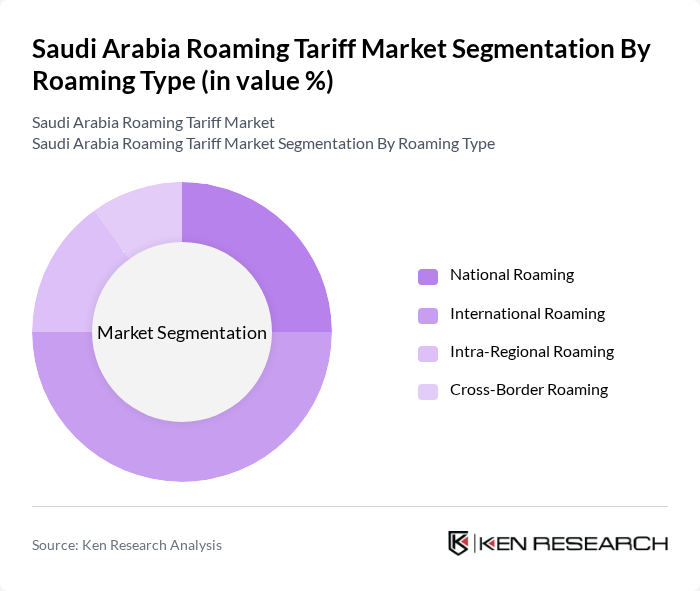
The roaming type segmentation includesNational Roaming, International Roaming, Intra-Regional Roaming, and Cross-Border Roaming. Among these,International Roamingis the dominant segment, fueled by the increasing number of Saudi travelers abroad and the growing demand for high-speed data services. National Roaming remains significant, especially for domestic travelers requiring uninterrupted connectivity across different service providers. The surge in mobile data usage, 5G adoption, and the need for seamless connectivity are the primary factors shaping these trends .
By Service Type:
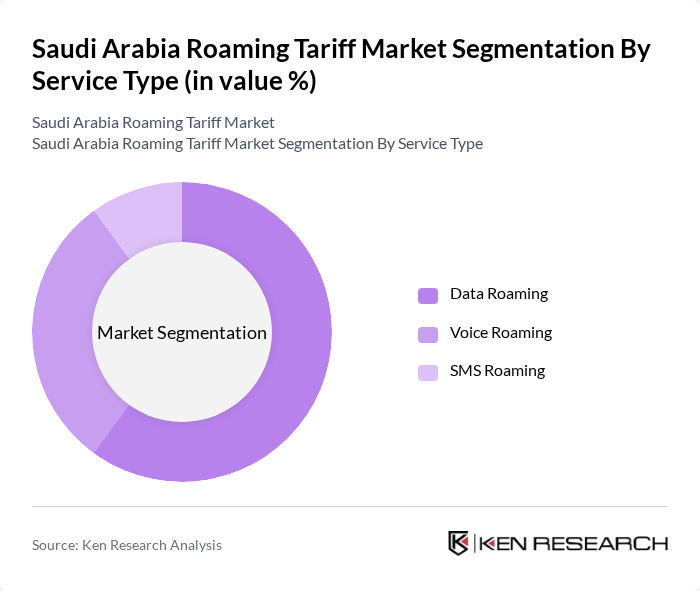
This segmentation includesData Roaming, Voice Roaming, and SMS Roaming.Data Roamingleads the market, reflecting the shift toward mobile internet for communication, streaming, and social media while traveling. Voice Roaming remains relevant but is gradually overtaken by data-centric services as users increasingly prefer messaging apps and digital platforms. SMS Roaming continues to decline as consumers adopt more cost-effective data-based alternatives .
Saudi Arabia Roaming Tariff Market Competitive Landscape
The Saudi Arabia Roaming Tariff Market is characterized by a dynamic mix of regional and international players. Leading participants such as STC (Saudi Telecom Company), Mobily (Etihad Etisalat Company), Zain KSA, Virgin Mobile KSA, Lebara Mobile, Atheeb Telecom, GO Telecom, Taliya (MVNO), International Roaming Partners (Vodafone, Orange, Telefonica), Regional Telecom Providers (UAE Telecom, Omantel), Technology Enablers (Mavenir, Ericsson, Nokia), and Regulatory Bodies (CITC - Communications and Information Technology Commission) contribute to innovation, geographic expansion, and service delivery in this space.
Saudi Arabia Roaming Tariff Market Industry Analysis
Growth Drivers
- Increasing Mobile Data Usage:The mobile data consumption in Saudi Arabia reached approximately 5.5 million terabytes in future, reflecting a year-on-year increase of 15%. This surge is driven by the growing reliance on mobile applications and social media platforms, with the average user consuming around 10 GB per month. As mobile data becomes integral to daily life, the demand for roaming services is expected to rise, further propelling the roaming tariff market in future.
- Expansion of International Travel:In future, Saudi Arabia recorded over 20 million outbound travelers, a significant increase from previous years. This trend is supported by the government's initiatives to promote tourism and ease visa regulations. As international travel continues to grow, the demand for affordable roaming services will increase, leading to a more competitive market landscape and driving revenue for telecom operators in future.
- Technological Advancements in Telecommunications:The rollout of 5G technology in Saudi Arabia is projected to reach 80% coverage by the end of future. This advancement enhances mobile connectivity and data speeds, making roaming services more appealing to consumers. With faster and more reliable networks, telecom operators can offer innovative roaming packages, thus stimulating market growth and attracting more users to their services.
Market Challenges
- Regulatory Compliance Issues:The Saudi telecommunications sector faces stringent regulatory frameworks, including compliance with the Communications and Information Technology Commission (CITC) guidelines. In future, operators incurred costs exceeding SAR 500 million due to compliance-related adjustments. These regulations can hinder flexibility in pricing strategies and limit the ability to respond swiftly to market changes, posing a challenge for growth in the roaming tariff market.
- High Operational Costs:The operational costs for telecom operators in Saudi Arabia have risen significantly, with average expenditures reaching SAR 1.2 billion in future. Factors contributing to these costs include infrastructure maintenance, customer service, and technology upgrades. High operational costs can limit the ability of operators to offer competitive roaming tariffs, impacting their market position and profitability in the long term.
Saudi Arabia Roaming Tariff Market Future Outlook
The Saudi Arabia roaming tariff market is poised for significant transformation as mobile data usage continues to rise and international travel expands. The adoption of 5G technology will enhance user experiences, while competitive pricing strategies will attract more consumers. Additionally, the focus on customer experience will drive innovation in service offerings. As operators navigate regulatory challenges, they will need to leverage partnerships and technological advancements to capitalize on emerging opportunities in the market.
Market Opportunities
- Partnerships with International Carriers:Collaborating with international telecom operators can enhance service offerings and expand coverage. Such partnerships can lead to bundled roaming packages, providing consumers with more value and convenience, thus increasing market penetration and customer loyalty.
- Development of Innovative Roaming Packages:Creating tailored roaming packages that cater to specific consumer needs can drive growth. For instance, offering data-heavy plans for business travelers or family packages can attract diverse customer segments, enhancing revenue streams and market share for telecom operators.
Scope of the Report
| Segment | Sub-Segments |
|---|---|
| By Roaming Type | National Roaming International Roaming Intra-Regional Roaming Cross-Border Roaming |
| By Service Type | Data Roaming Voice Roaming SMS Roaming |
| By Distribution Channel | Retail Roaming Wholesale Roaming |
| By End-User | Individual Consumers Business Travelers Corporate Clients Tourists IoT and M2M Applications |
| By Technology | G Roaming G/LTE Roaming G Roaming eSIM Technology |
| By Region | Central Region (Riyadh) Eastern Region (Dammam) Western Region (Jeddah) Southern Region Northern Region |
| By Plan Type | Prepaid Roaming Plans Postpaid Roaming Plans Unlimited Data Plans Regional Roaming Plans |
Key Target Audience
Investors and Venture Capitalist Firms
Government and Regulatory Bodies (e.g., Saudi Communications and Information Technology Commission)
Telecommunications Operators
Mobile Virtual Network Operators (MVNOs)
International Roaming Service Providers
Telecom Equipment Manufacturers
Industry Associations (e.g., Saudi Telecom Association)
Financial Institutions and Investment Banks
Players Mentioned in the Report:
STC (Saudi Telecom Company)
Mobily (Etihad Etisalat Company)
Zain KSA
Virgin Mobile KSA
Lebara Mobile
Atheeb Telecom
GO Telecom
Taliya (MVNO)
International Roaming Partners (Vodafone, Orange, Telefonica)
Regional Telecom Providers (UAE Telecom, Omantel)
Technology Enablers (Mavenir, Ericsson, Nokia)
Regulatory Bodies (CITC - Communications and Information Technology Commission)
Table of Contents
Market Assessment Phase
1. Executive Summary and Approach
2. Saudi Arabia Roaming Tariff Market Overview
2.1 Key Insights and Strategic Recommendations
2.2 Saudi Arabia Roaming Tariff Market Overview
2.3 Definition and Scope
2.4 Evolution of Market Ecosystem
2.5 Timeline of Key Regulatory Milestones
2.6 Value Chain & Stakeholder Mapping
2.7 Business Cycle Analysis
2.8 Policy & Incentive Landscape
3. Saudi Arabia Roaming Tariff Market Analysis
3.1 Growth Drivers
3.1.1 Increasing Mobile Data Usage
3.1.2 Expansion of International Travel
3.1.3 Competitive Pricing Strategies
3.1.4 Technological Advancements in Telecommunications
3.2 Market Challenges
3.2.1 Regulatory Compliance Issues
3.2.2 High Operational Costs
3.2.3 Market Saturation
3.2.4 Consumer Price Sensitivity
3.3 Market Opportunities
3.3.1 Growth in E-commerce and Digital Services
3.3.2 Partnerships with International Carriers
3.3.3 Development of Innovative Roaming Packages
3.3.4 Expansion into Emerging Markets
3.4 Market Trends
3.4.1 Shift Towards Unlimited Data Plans
3.4.2 Increased Focus on Customer Experience
3.4.3 Adoption of 5G Technology
3.4.4 Rise of Mobile Virtual Network Operators (MVNOs)
3.5 Government Regulation
3.5.1 Implementation of Fair Usage Policies
3.5.2 Regulation on Roaming Charges
3.5.3 Consumer Protection Laws
3.5.4 Licensing Requirements for Operators
4. SWOT Analysis
5. Stakeholder Analysis
6. Porter's Five Forces Analysis
7. Saudi Arabia Roaming Tariff Market Market Size, 2019-2024
7.1 By Value
7.2 By Volume
7.3 By Average Selling Price
8. Saudi Arabia Roaming Tariff Market Segmentation
8.1 By Roaming Type
8.1.1 National Roaming
8.1.2 International Roaming
8.1.3 Intra-Regional Roaming
8.1.4 Cross-Border Roaming
8.2 By Service Type
8.2.1 Data Roaming
8.2.2 Voice Roaming
8.2.3 SMS Roaming
8.3 By Distribution Channel
8.3.1 Retail Roaming
8.3.2 Wholesale Roaming
8.4 By End-User
8.4.1 Individual Consumers
8.4.2 Business Travelers
8.4.3 Corporate Clients
8.4.4 Tourists
8.4.5 IoT and M2M Applications
8.5 By Technology
8.5.1 3G Roaming
8.5.2 4G/LTE Roaming
8.5.3 5G Roaming
8.5.4 eSIM Technology
8.6 By Region
8.6.1 Central Region (Riyadh)
8.6.2 Eastern Region (Dammam)
8.6.3 Western Region (Jeddah)
8.6.4 Southern Region
8.6.5 Northern Region
8.7 By Plan Type
8.7.1 Prepaid Roaming Plans
8.7.2 Postpaid Roaming Plans
8.7.3 Unlimited Data Plans
8.7.4 Regional Roaming Plans
9. Saudi Arabia Roaming Tariff Market Competitive Analysis
9.1 Market Share of Key Players
9.2 Cross Comparison of Key Players
9.2.1 Company Name
9.2.2 Market Position (Market Leader, Strong Competitor, Emerging Player)
9.2.3 Revenue Growth Rate (YoY %)
9.2.4 Data Roaming Revenue Share (%)
9.2.5 Average Revenue Per User (ARPU) - Roaming Services
9.2.6 Customer Churn Rate (%)
9.2.7 5G Roaming Coverage (% of Network)
9.2.8 Pricing Strategy (Premium/Mid-Tier/Budget)
9.2.9 Network Partnerships (Number of International Agreements)
9.2.10 eSIM Adoption Rate (%)
9.3 SWOT Analysis of Top Players
9.4 Pricing Analysis
9.5 Detailed Profile of Major Companies
9.5.1 STC (Saudi Telecom Company)
9.5.2 Mobily (Etihad Etisalat Company)
9.5.3 Zain KSA
9.5.4 Virgin Mobile KSA
9.5.5 Lebara Mobile
9.5.6 Atheeb Telecom
9.5.7 GO Telecom
9.5.8 Taliya (MVNO)
9.5.9 International Roaming Partners (Vodafone, Orange, Telefonica)
9.5.10 Regional Telecom Providers (UAE Telecom, Omantel)
9.5.11 Technology Enablers (Mavenir, Ericsson, Nokia)
9.5.12 Regulatory Bodies (CITC - Communications and Information Technology Commission)
10. Saudi Arabia Roaming Tariff Market End-User Analysis
10.1 Procurement Behavior of Key Ministries
10.1.1 Ministry of Communications and Information Technology
10.1.2 Ministry of Tourism
10.1.3 Ministry of Foreign Affairs
10.1.4 Ministry of Finance
10.2 Corporate Spend on Infrastructure & Energy
10.2.1 Corporate Telecommunications Budgets
10.2.2 Investment in Digital Infrastructure
10.2.3 Spending on Roaming Services
10.2.4 Others
10.3 Pain Point Analysis by End-User Category
10.3.1 Individual Users
10.3.2 Business Travelers
10.3.3 Corporate Clients
10.3.4 Tourists
10.4 User Readiness for Adoption
10.4.1 Awareness of Roaming Services
10.4.2 Willingness to Pay for Roaming
10.4.3 Adoption of New Technologies
10.4.4 Others
10.5 Post-Deployment ROI and Use Case Expansion
10.5.1 Evaluation of Roaming Services
10.5.2 Expansion into New Markets
10.5.3 Customer Feedback and Improvement
10.5.4 Others
11. Saudi Arabia Roaming Tariff Market Future Size, 2025-2030
11.1 By Value
11.2 By Volume
11.3 By Average Selling Price
Go-To-Market Strategy Phase
1. Whitespace Analysis + Business Model Canvas
1.1 Market Gaps Identification
1.2 Business Model Development
2. Marketing and Positioning Recommendations
2.1 Branding Strategies
2.2 Product USPs
3. Distribution Plan
3.1 Urban Retail Strategies
3.2 Rural NGO Tie-ups
4. Channel & Pricing Gaps
4.1 Underserved Routes
4.2 Pricing Bands
5. Unmet Demand & Latent Needs
5.1 Category Gaps
5.2 Consumer Segments
6. Customer Relationship
6.1 Loyalty Programs
6.2 After-sales Service
7. Value Proposition
7.1 Sustainability Initiatives
7.2 Integrated Supply Chains
8. Key Activities
8.1 Regulatory Compliance
8.2 Branding Efforts
8.3 Distribution Setup
9. Entry Strategy Evaluation
9.1 Domestic Market Entry Strategy
9.1.1 Product Mix
9.1.2 Pricing Band
9.1.3 Packaging Strategies
9.2 Export Entry Strategy
9.2.1 Target Countries
9.2.2 Compliance Roadmap
10. Entry Mode Assessment
10.1 Joint Ventures
10.2 Greenfield Investments
10.3 Mergers & Acquisitions
10.4 Distributor Model
11. Capital and Timeline Estimation
11.1 Capital Requirements
11.2 Timelines for Implementation
12. Control vs Risk Trade-Off
12.1 Ownership vs Partnerships
13. Profitability Outlook
13.1 Breakeven Analysis
13.2 Long-term Sustainability
14. Potential Partner List
14.1 Distributors
14.2 Joint Ventures
14.3 Acquisition Targets
15. Execution Roadmap
15.1 Phased Plan for Market Entry
15.1.1 Market Setup
15.1.2 Market Entry
15.1.3 Growth Acceleration
15.1.4 Scale & Stabilize
15.2 Key Activities and Milestones
15.2.1 Milestone Planning
15.2.2 Activity Tracking
Research Methodology
Phase 1: Approach1
Desk Research
- Analysis of regulatory frameworks governing roaming tariffs in Saudi Arabia
- Review of industry reports and publications from telecommunications authorities
- Examination of historical tariff data and trends from major telecom operators
Primary Research
- Interviews with executives from leading telecom companies operating in Saudi Arabia
- Surveys targeting frequent travelers to assess roaming tariff perceptions and usage
- Focus groups with consumers to understand preferences and pain points regarding roaming services
Validation & Triangulation
- Cross-validation of findings with data from international roaming agreements
- Triangulation of consumer insights with operator pricing strategies
- Sanity checks through expert reviews from industry analysts and consultants
Phase 2: Market Size Estimation1
Top-down Assessment
- Estimation of total roaming revenue based on national telecom revenue reports
- Segmentation of market size by traveler demographics and usage patterns
- Incorporation of growth projections based on tourism and business travel trends
Bottom-up Modeling
- Analysis of average spending per traveler on roaming services
- Estimation of user base growth through subscriber data from telecom operators
- Calculation of revenue based on service uptake and pricing models
Forecasting & Scenario Analysis
- Multi-variable forecasting using factors such as smartphone penetration and data consumption
- Scenario analysis based on potential regulatory changes and competitive dynamics
- Development of baseline, optimistic, and pessimistic market forecasts through 2030
Phase 3: CATI Sample Composition1
| Scope Item/Segment | Sample Size | Target Respondent Profiles |
|---|---|---|
| Frequent Business Travelers | 100 | Corporate Executives, Business Travelers |
| Tourists Visiting Saudi Arabia | 90 | International Tourists, Travel Agents |
| Telecom Service Users | 80 | Mobile Subscribers, Customer Service Representatives |
| Telecom Industry Experts | 50 | Regulatory Officials, Industry Analysts |
| Consumer Advocacy Groups | 40 | Consumer Rights Advocates, Market Researchers |
Frequently Asked Questions
What is the current value of the Saudi Arabia Roaming Tariff Market?
The Saudi Arabia Roaming Tariff Market is valued at approximately USD 1.1 billion, driven by increased international travel, mobile data consumption, and telecom infrastructure upgrades, particularly with the expansion of 5G technology.
Who are the key players in the Saudi Arabia Roaming Tariff Market?
What types of roaming services are available in Saudi Arabia?
What are the main drivers of growth in the Saudi Arabia Roaming Tariff Market?
Other Regional/Country Reports
Indonesia Roaming Tariff Market
Malaysia Roaming Tariff Market
KSA Roaming Tariff Market
APAC Roaming Tariff Market
SEA Roaming Tariff Market
Other Adjacent Reports
Germany Mobile Data Services Market
South Africa International Telecom Services Market
Vietnam 5G Network Infrastructure Market
Brazil Telecom Billing Software Market
Singapore eSIM Technology Market
Qatar MVNO Services Market
Mexico VoIP Communication Market
Brazil Satellite Roaming Market
Singapore IoT Connectivity Market
Brazil Cybersecurity in Telecom Market
Why Buy From Us?

What makes us stand out is that our consultants follow Robust, Refine and Result (RRR) methodology. Robust for clear definitions, approaches and sanity checking, Refine for differentiating respondents' facts and opinions, and Result for presenting data with story.

We have set a benchmark in the industry by offering our clients with syndicated and customized market research reports featuring coverage of entire market as well as meticulous research and analyst insights.

While we don't replace traditional research, we flip the method upside down. Our dual approach of Top Bottom & Bottom Top ensures quality deliverable by not just verifying company fundamentals but also looking at the sector and macroeconomic factors.

With one step in the future, our research team constantly tries to show you the bigger picture. We help with some of the tough questions you may encounter along the way: How is the industry positioned? Best marketing channel? KPI's of competitors? By aligning every element, we help maximize success.

Our report gives you instant access to the answers and sources that other companies might choose to hide. We elaborate each steps of research methodology we have used and showcase you the sample size to earn your trust.

If you need any support, we are here! We pride ourselves on universe strength, data quality, and quick, friendly, and professional service.