About the Report
Base Year 2024Saudi Arabia Traditional Music Market Overview
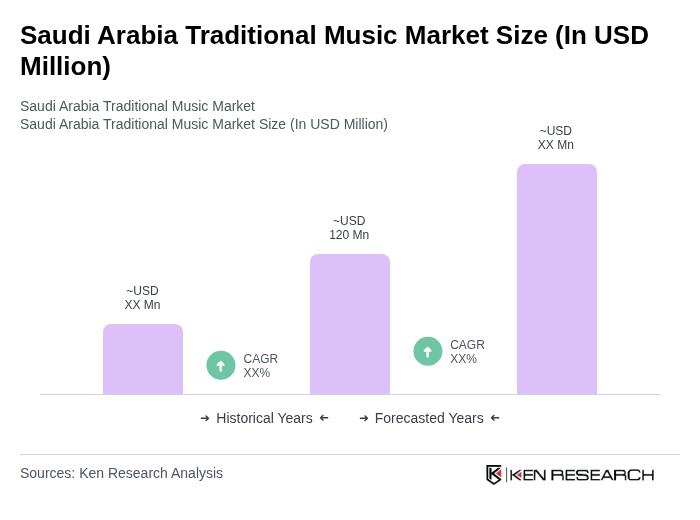
- The Saudi Arabia Traditional Music Market is valued at USD 120 million, based on a five-year historical analysis. Growth is driven by a cultural renaissance, as younger generations show a renewed appreciation for heritage, coupled with increased interest in local music festivals and greater access to recorded traditional music via digital platforms.
- Key cities such as Riyadh, Jeddah, and Dammam dominate the market due to their cultural significance and population density. These urban centers host numerous music festivals and events that celebrate traditional music, fostering a vibrant community of artists and audiences alike.
- A key policy supporting this cultural field is the Kingdom’s Cultural Development Fund, which has disbursed SR 377 million toward music, heritage, and creative projects, while the Ministry of Culture aims to elevate the cultural sector’s GDP contribution to USD 48 billion through Vision 2030 initiatives, fostering talent and infrastructure in music and arts.
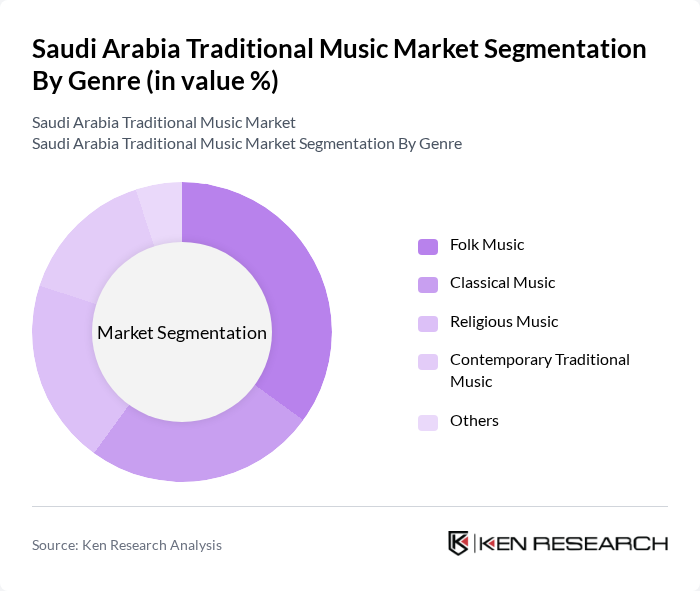
Saudi Arabia Traditional Music Market Segmentation
By Genre:The traditional music market in Saudi Arabia is diverse, encompassing various genres that reflect the rich cultural heritage of the region. The primary genres include Folk Music, Classical Music, Religious Music, Contemporary Traditional Music, and Others. Folk Music is particularly popular among the younger generation, as it resonates with their cultural identity and is often featured in local festivals. Classical Music, while historically significant, has seen a resurgence due to increased interest in traditional forms. Religious Music remains a staple, especially during cultural and religious events, while Contemporary Traditional Music blends modern influences with traditional sounds, appealing to a broader audience.
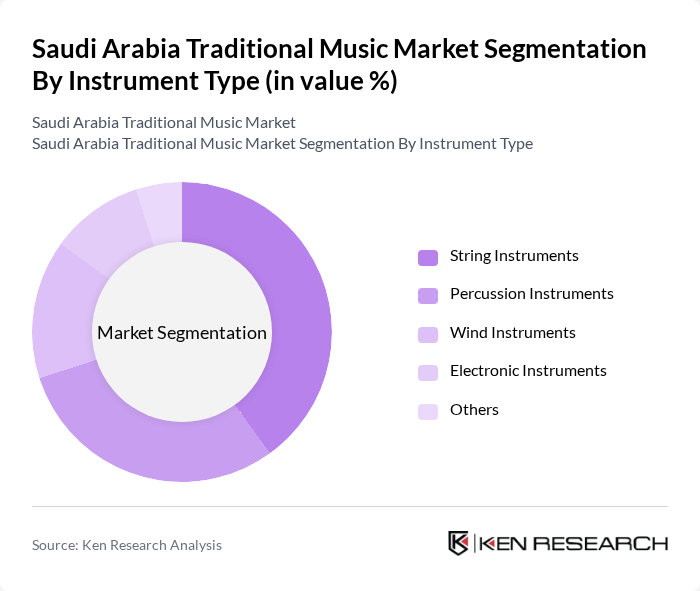
By Instrument Type:The market is also segmented by instrument type, which includes String Instruments, Percussion Instruments, Wind Instruments, Electronic Instruments, and Others. String Instruments, particularly the oud, are the most popular due to their deep-rooted presence in traditional music. Percussion Instruments, such as the darbuka, are essential for rhythm and are widely used in various music genres. Wind Instruments, while less common, are gaining popularity in contemporary settings. Electronic Instruments are increasingly being integrated into traditional music, appealing to younger audiences. The "Others" category includes various traditional instruments that contribute to the rich tapestry of Saudi music.
Saudi Arabia Traditional Music Market Competitive Landscape
The Saudi Arabia Traditional Music Market is characterized by a dynamic mix of regional and international players. Leading participants such as Saudi Music Company, Al-Mawred Music, Rotana Records, Mazzika, Universal Music MENA, Melody Music, Taqat Music, Al-Faisal Music, Jood Music, Al-Masdar Music, Al-Hekma Music, Al-Mawj Music, Al-Mahabba Music, Al-Masrah Music, Al-Mahfaza Music contribute to innovation, geographic expansion, and service delivery in this space.
Saudi Arabia Traditional Music Market Industry Analysis
Growth Drivers
- GDP Growth and Economic Diversification:Saudi Arabia's real GDP growth was 1.3 percent in future, with the non-oil sector expanding by 4.3 percent year-on-year. This economic diversification enhances disposable income, allowing consumers to spend more on cultural experiences, including traditional music events and services. As the economy shifts away from oil dependency, cultural sectors are likely to benefit from increased consumer spending. Source: Reuters.
- ICT Sector Expansion:The Kingdom's ICT market reached SAR 180 billion (approximately USD 48 billion) in future. This growth in the ICT sector strengthens the digital infrastructure necessary for music streaming and distribution, facilitating access to traditional music. Enhanced connectivity allows artists to reach wider audiences, promoting traditional music through various digital platforms. Source: LinkedIn report.
- Internet Penetration:Internet penetration in Saudi Arabia stood at 99 percent in future, with mobile data consumption averaging 48 GB monthly per person. This high level of connectivity enables easy access to digital music platforms, allowing consumers to discover and enjoy traditional music. The widespread use of mobile devices further supports the growth of online music consumption, including traditional genres. Source: Saudi Internet Report 2024.
Market Challenges
- Regional Wealth Disparities:Average monthly household disposable income in Riyadh is 26,000 riyals (approximately USD 6,933), significantly higher than in less affluent regions like Najran. This disparity limits the market size for traditional music, as consumers in lower-income areas may have less disposable income to spend on cultural experiences. Such socioeconomic inequalities can hinder the overall growth of the traditional music market. Source: Financial Times.
- Fiscal Strain on Development Plans:Aramco's profits fell to USD 106.25 billion in future, with projected dividend payouts for future around USD 85.4 billion. This decline in state revenues may lead to reduced public funding for cultural initiatives, including traditional music programs. The fiscal constraints could limit opportunities for artists and organizations to promote and sustain traditional music within the Kingdom. Source: AP News.
Saudi Arabia Traditional Music Market Future Outlook
The future of the Saudi Arabia traditional music market appears promising, driven by digital transformation and the integration of traditional music into the expanding digital economy. With nearly universal internet access and a growing number of mobile users, streaming platforms are likely to become essential for traditional music consumption. Additionally, the increasing engagement of younger demographics on social media presents opportunities for grassroots promotion and cultural exchange, fostering a renewed interest in traditional music forms.
Market Opportunities
- Digital Content Monetization:The high-speed internet and expanding digital economy present opportunities for subscription-based platforms and online events tailored to traditional music fans. This could lead to innovative revenue streams for artists and producers, enhancing the visibility and accessibility of traditional music.
- Regional Cultural Tourism Synergy:Vision 2030's cultural and tourism initiatives could integrate traditional music into tourism offerings, creating experiential value. This synergy can attract both domestic and international tourists, promoting cultural heritage while generating revenue for local artists and communities.
Scope of the Report
| Segment | Sub-Segments |
|---|---|
| By Genre | Folk Music Classical Music Religious Music Contemporary Traditional Music Others |
| By Instrument Type | String Instruments Percussion Instruments Wind Instruments Electronic Instruments Others |
| By Distribution Channel | Online Platforms Retail Stores Live Events Music Festivals Others |
| By Audience Demographics | Age Groups Gender Socioeconomic Status Geographic Location Others |
| By Event Type | Concerts Cultural Festivals Educational Workshops Competitions Others |
| By Media Format | Digital Music Physical Albums Streaming Services Radio Broadcasts Others |
| By Cultural Influence | Bedouin Music Urban Music Regional Variations Global Collaborations Others |
Key Target Audience
Investors and Venture Capitalist Firms
Government and Regulatory Bodies (e.g., Ministry of Culture, Saudi Commission for Tourism and National Heritage)
Music Event Organizers and Promoters
Record Labels and Music Production Companies
Media and Broadcasting Companies
Cultural Institutions and Heritage Organizations
Tourism Boards and Agencies
Local Artisans and Craft Producers
Players Mentioned in the Report:
Saudi Music Company
Al-Mawred Music
Rotana Records
Mazzika
Universal Music MENA
Melody Music
Taqat Music
Al-Faisal Music
Jood Music
Al-Masdar Music
Al-Hekma Music
Al-Mawj Music
Al-Mahabba Music
Al-Masrah Music
Al-Mahfaza Music
Table of Contents
Market Assessment Phase
1. Executive Summary and Approach
2. Saudi Arabia Traditional Music Market Overview
2.1 Key Insights and Strategic Recommendations
2.2 Saudi Arabia Traditional Music Market Overview
2.3 Definition and Scope
2.4 Evolution of Market Ecosystem
2.5 Timeline of Key Regulatory Milestones
2.6 Value Chain & Stakeholder Mapping
2.7 Business Cycle Analysis
2.8 Policy & Incentive Landscape
3. Saudi Arabia Traditional Music Market Analysis
3.1 Growth Drivers
3.1.1 Cultural Heritage Preservation
3.1.2 Increasing Domestic Tourism
3.1.3 Government Support for Arts
3.1.4 Digital Platforms for Music Distribution
3.2 Market Challenges
3.2.1 Limited Global Exposure
3.2.2 Competition from Modern Music Genres
3.2.3 Regulatory Restrictions
3.2.4 Lack of Infrastructure for Live Performances
3.3 Market Opportunities
3.3.1 Collaborations with International Artists
3.3.2 Growth of Music Festivals
3.3.3 Expansion of Online Music Platforms
3.3.4 Educational Programs for Traditional Music
3.4 Market Trends
3.4.1 Fusion of Traditional and Modern Music
3.4.2 Rise of Music Streaming Services
3.4.3 Increased Investment in Music Production
3.4.4 Growing Popularity of Traditional Instruments
3.5 Government Regulation
3.5.1 Licensing Requirements for Performers
3.5.2 Support for Cultural Events
3.5.3 Copyright Laws for Music Distribution
3.5.4 Funding for Traditional Music Projects
4. SWOT Analysis
5. Stakeholder Analysis
6. Porter's Five Forces Analysis
7. Saudi Arabia Traditional Music Market Market Size, 2019-2024
7.1 By Value
7.2 By Volume
7.3 By Average Selling Price
8. Saudi Arabia Traditional Music Market Segmentation
8.1 By Genre
8.1.1 Folk Music
8.1.2 Classical Music
8.1.3 Religious Music
8.1.4 Contemporary Traditional Music
8.1.5 Others
8.2 By Instrument Type
8.2.1 String Instruments
8.2.2 Percussion Instruments
8.2.3 Wind Instruments
8.2.4 Electronic Instruments
8.2.5 Others
8.3 By Distribution Channel
8.3.1 Online Platforms
8.3.2 Retail Stores
8.3.3 Live Events
8.3.4 Music Festivals
8.3.5 Others
8.4 By Audience Demographics
8.4.1 Age Groups
8.4.2 Gender
8.4.3 Socioeconomic Status
8.4.4 Geographic Location
8.4.5 Others
8.5 By Event Type
8.5.1 Concerts
8.5.2 Cultural Festivals
8.5.3 Educational Workshops
8.5.4 Competitions
8.5.5 Others
8.6 By Media Format
8.6.1 Digital Music
8.6.2 Physical Albums
8.6.3 Streaming Services
8.6.4 Radio Broadcasts
8.6.5 Others
8.7 By Cultural Influence
8.7.1 Bedouin Music
8.7.2 Urban Music
8.7.3 Regional Variations
8.7.4 Global Collaborations
8.7.5 Others
9. Saudi Arabia Traditional Music Market Competitive Analysis
9.1 Market Share of Key Players
9.2 Cross Comparison of Key Players
9.2.1 Company Name
9.2.2 Group Size (Large, Medium, or Small as per industry convention)
9.2.3 Revenue Growth Rate
9.2.4 Market Penetration Rate
9.2.5 Customer Retention Rate
9.2.6 Pricing Strategy
9.2.7 Brand Recognition Score
9.2.8 Distribution Efficiency
9.2.9 Innovation Rate
9.2.10 Customer Satisfaction Index
9.3 SWOT Analysis of Top Players
9.4 Pricing Analysis
9.5 Detailed Profile of Major Companies
9.5.1 Saudi Music Company
9.5.2 Al-Mawred Music
9.5.3 Rotana Records
9.5.4 Mazzika
9.5.5 Universal Music MENA
9.5.6 Melody Music
9.5.7 Taqat Music
9.5.8 Al-Faisal Music
9.5.9 Jood Music
9.5.10 Al-Masdar Music
9.5.11 Al-Hekma Music
9.5.12 Al-Mawj Music
9.5.13 Al-Mahabba Music
9.5.14 Al-Masrah Music
9.5.15 Al-Mahfaza Music
10. Saudi Arabia Traditional Music Market End-User Analysis
10.1 Procurement Behavior of Key Ministries
10.1.1 Ministry of Culture
10.1.2 Ministry of Tourism
10.1.3 Ministry of Education
10.1.4 Ministry of Media
10.2 Corporate Spend on Infrastructure & Energy
10.2.1 Investment in Music Venues
10.2.2 Sponsorship of Cultural Events
10.2.3 Funding for Music Education
10.2.4 Support for Local Artists
10.3 Pain Point Analysis by End-User Category
10.3.1 Artists
10.3.2 Event Organizers
10.3.3 Music Educators
10.3.4 Cultural Institutions
10.4 User Readiness for Adoption
10.4.1 Awareness of Traditional Music
10.4.2 Accessibility of Resources
10.4.3 Interest in Cultural Events
10.4.4 Engagement with Digital Platforms
10.5 Post-Deployment ROI and Use Case Expansion
10.5.1 Performance Metrics
10.5.2 Audience Growth
10.5.3 Revenue Generation
10.5.4 Brand Partnerships
11. Saudi Arabia Traditional Music Market Future Size, 2025-2030
11.1 By Value
11.2 By Volume
11.3 By Average Selling Price
Go-To-Market Strategy Phase
1. Whitespace Analysis + Business Model Canvas
1.1 Market Gaps Identification
1.2 Value Proposition Development
1.3 Revenue Streams Analysis
1.4 Cost Structure Evaluation
1.5 Key Partnerships Exploration
1.6 Customer Segmentation
1.7 Channels of Distribution
2. Marketing and Positioning Recommendations
2.1 Branding Strategies
2.2 Product USPs
3. Distribution Plan
3.1 Urban Retail vs Rural NGO Tie-ups
4. Channel & Pricing Gaps
4.1 Underserved Routes
4.2 Pricing Bands
5. Unmet Demand & Latent Needs
5.1 Category Gaps
5.2 Consumer Segments
6. Customer Relationship
6.1 Loyalty Programs
6.2 After-sales Service
7. Value Proposition
7.1 Sustainability
7.2 Integrated Supply Chains
8. Key Activities
8.1 Regulatory Compliance
8.2 Branding
8.3 Distribution Setup
9. Entry Strategy Evaluation
9.1 Domestic Market Entry Strategy
9.1.1 Product Mix
9.1.2 Pricing Band
9.1.3 Packaging
9.2 Export Entry Strategy
9.2.1 Target Countries
9.2.2 Compliance Roadmap
10. Entry Mode Assessment
10.1 JV
10.2 Greenfield
10.3 M&A
10.4 Distributor Model
11. Capital and Timeline Estimation
11.1 Capital Requirements
11.2 Timelines
12. Control vs Risk Trade-Off
12.1 Ownership vs Partnerships
13. Profitability Outlook
13.1 Breakeven Analysis
13.2 Long-term Sustainability
14. Potential Partner List
14.1 Distributors
14.2 JVs
14.3 Acquisition Targets
15. Execution Roadmap
15.1 Phased Plan for Market Entry
15.1.1 Market Setup
15.1.2 Market Entry
15.1.3 Growth Acceleration
15.1.4 Scale & Stabilize
15.2 Key Activities and Milestones
15.2.1 Activity Planning
15.2.2 Milestone Tracking
Research Methodology
Phase 1: Approach1
Desk Research
- Analysis of existing literature on traditional music in Saudi Arabia, including academic papers and cultural studies
- Review of government reports and publications from the Saudi Ministry of Culture regarding music heritage and initiatives
- Examination of market reports and industry analyses focusing on the growth and trends in the traditional music sector
Primary Research
- Interviews with cultural experts and ethnomusicologists specializing in Saudi traditional music
- Surveys conducted with local musicians and traditional music practitioners to gather insights on market dynamics
- Focus group discussions with audiences and participants in traditional music events to understand consumer preferences
Validation & Triangulation
- Cross-validation of findings through comparison with international studies on traditional music markets
- Triangulation of data from interviews, surveys, and existing literature to ensure comprehensive understanding
- Sanity checks through expert panel reviews involving stakeholders from the music industry and cultural institutions
Phase 2: Market Size Estimation1
Top-down Assessment
- Estimation of the market size based on national cultural spending and government investment in the arts
- Segmentation of the market by genre, including folk, classical, and contemporary traditional music
- Incorporation of tourism data related to cultural events and festivals featuring traditional music
Bottom-up Modeling
- Collection of revenue data from local music festivals, concerts, and cultural events
- Estimation of income generated by traditional music sales, including physical and digital formats
- Analysis of merchandise sales related to traditional music, such as instruments and recordings
Forecasting & Scenario Analysis
- Multi-factor regression analysis considering factors like population growth, cultural interest, and tourism trends
- Scenario planning based on potential changes in government policy and cultural funding
- Development of baseline, optimistic, and pessimistic forecasts for market growth through 2030
Phase 3: CATI Sample Composition1
| Scope Item/Segment | Sample Size | Target Respondent Profiles |
|---|---|---|
| Local Musicians and Artists | 100 | Traditional Musicians, Folk Artists |
| Cultural Event Organizers | 80 | Event Managers, Festival Coordinators |
| Music Educators and Institutions | 60 | Music Teachers, Cultural Program Directors |
| Audience Members of Traditional Music Events | 120 | Concert Attendees, Cultural Enthusiasts |
| Government and Cultural Policy Makers | 50 | Cultural Affairs Officials, Policy Advisors |
Frequently Asked Questions
What is the current value of the Saudi Arabia Traditional Music Market?
The Saudi Arabia Traditional Music Market is valued at approximately USD 120 million, reflecting a cultural renaissance and increased interest in local music festivals, alongside greater access to traditional music through digital platforms.
Which cities are key players in the Saudi Arabia Traditional Music Market?
What are the main genres of traditional music in Saudi Arabia?
How does the Saudi government support traditional music?
Other Regional/Country Reports
Indonesia Traditional Music Market
Malaysia Traditional Music Market
KSA Traditional Music Market
APAC Traditional Music Market
SEA Traditional Music Market
Vietnam Traditional Music Market
Other Adjacent Reports
Brazil Cultural Tourism Market
Kuwait Live Entertainment Market
Vietnam Musical Instruments Market Outlook to 2030Germany Music Production Market
Saudi Arabia Digital Media Market Outlook to 2030KSA Performing Arts Market
Bahrain event management market report Size, Share, Growth Drivers, Trends, Opportunities & Forecast 2025–2030UAE Audio Equipment MarketSouth Africa Heritage Preservation Market
Why Buy From Us?

What makes us stand out is that our consultants follow Robust, Refine and Result (RRR) methodology. Robust for clear definitions, approaches and sanity checking, Refine for differentiating respondents' facts and opinions, and Result for presenting data with story.

We have set a benchmark in the industry by offering our clients with syndicated and customized market research reports featuring coverage of entire market as well as meticulous research and analyst insights.

While we don't replace traditional research, we flip the method upside down. Our dual approach of Top Bottom & Bottom Top ensures quality deliverable by not just verifying company fundamentals but also looking at the sector and macroeconomic factors.

With one step in the future, our research team constantly tries to show you the bigger picture. We help with some of the tough questions you may encounter along the way: How is the industry positioned? Best marketing channel? KPI's of competitors? By aligning every element, we help maximize success.

Our report gives you instant access to the answers and sources that other companies might choose to hide. We elaborate each steps of research methodology we have used and showcase you the sample size to earn your trust.

If you need any support, we are here! We pride ourselves on universe strength, data quality, and quick, friendly, and professional service.