About the Report
Base Year 2024Saudi Arabia Virtual Events Market Overview
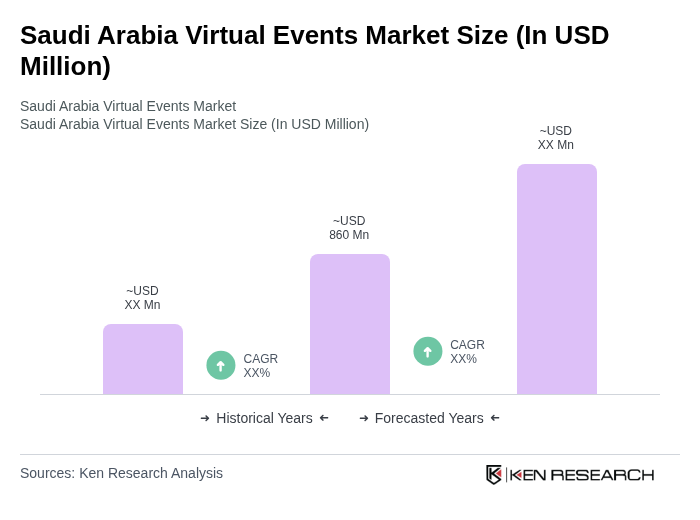
- The Saudi Arabia Virtual Events Market is valued at USD 860 million, based on a five-year historical analysis. This growth is primarily driven by the increasing adoption of digital technologies, strong government-backed digital transformation initiatives under Vision 2030, and the need for businesses to engage with clients and stakeholders virtually. The COVID-19 pandemic significantly accelerated the shift towards virtual and hybrid events, leading to a sustained demand for innovative online solutions in conferencing, exhibitions, and corporate communication.
- Key cities such as Riyadh, Jeddah, and Dammam dominate the Saudi Arabia Virtual Events Market due to their robust digital infrastructure, high internet and smartphone penetration, and a concentration of corporate and government headquarters. These urban centers are pivotal for hosting large-scale virtual and hybrid events, attracting both local and international participants, and are increasingly leveraged for trade shows, conferences, and entertainment events aligned with national tourism and events strategies.
- In 2023, the Saudi government advanced regulations to promote digital transformation across various sectors, including activities relevant to the virtual events industry. The framework is supported by instruments such as the E-Transactions Law issued by the Council of Ministers in 2007, and subsequent updates under the National Digital Transformation Program and Saudi Vision 2030, which mandate secure use of electronic systems, recognition of digital records and signatures, and compliance with cybersecurity and data protection requirements for online services, including virtual event platforms.
Saudi Arabia Virtual Events Market Segmentation
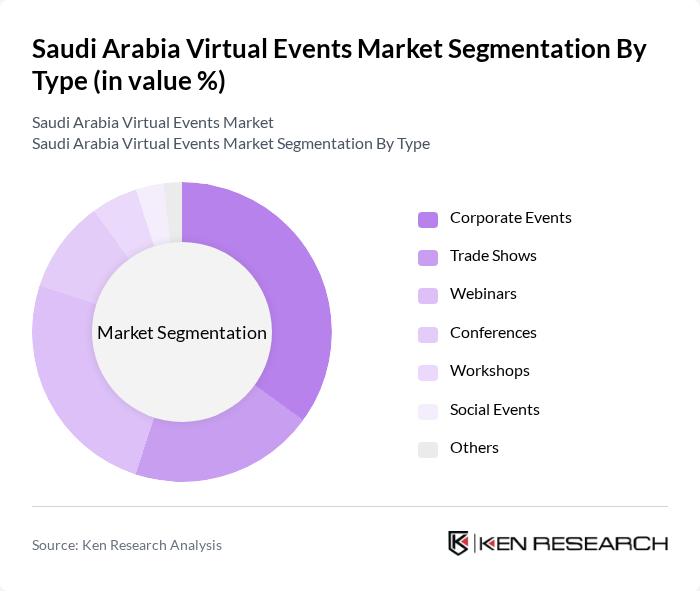
By Type:The segmentation of the market by type includes various formats such as corporate events, trade shows, webinars, conferences, workshops, social events, and others. Corporate events and webinars are particularly dominant due to the extensive use of virtual platforms for internal meetings, investor relations, product launches, sales enablement, and training activities among enterprises. The shift towards remote and hybrid work models has made webinars and virtual conferences a preferred choice for knowledge sharing, professional upskilling, and employee engagement, while virtual corporate events increasingly incorporate features such as AI-powered networking, interactive polling, and analytics to facilitate networking and collaboration in a virtual environment.
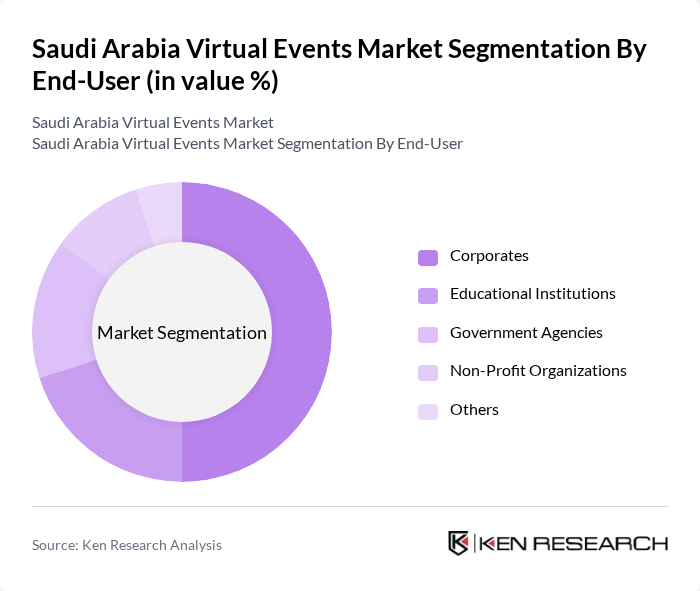
By End-User:The market is segmented by end-user into corporates, educational institutions, government agencies, non-profit organizations, and others. Corporates lead the market due to their extensive use of virtual events for training, town halls, investor days, product launches, and stakeholder engagement, supported by widespread deployment of enterprise collaboration tools and virtual event platforms. Educational institutions and government agencies are also increasingly adopting virtual and hybrid formats for e-learning, large-scale examinations, public consultations, and policy-related events, reflecting the broader push toward digital service delivery and remote participation across the Kingdom.
Saudi Arabia Virtual Events Market Competitive Landscape
The Saudi Arabia Virtual Events Market is characterized by a dynamic mix of regional and international players. Leading participants such as Zoom Video Communications, Microsoft Teams, Cisco Webex, Hopin, Eventbrite, InEvent, ON24, vFairs, Bizzabo, Cvent, Attendify, BigMarker, Whova, Airmeet, Run The World, Saudi Telecom Company (STC), Mobily (Etihad Etisalat), Zain KSA, Tadawul Group, Saudi Events Company (SEC) contribute to innovation, geographic expansion, and service delivery in this space.
Saudi Arabia Virtual Events Market Industry Analysis
Growth Drivers
- Increased Internet Penetration:As of future, Saudi Arabia's internet penetration rate is projected to reach 99%, with approximately 36 million active internet users. This widespread access facilitates participation in virtual events, enabling organizations to reach broader audiences. The government's investment in digital infrastructure, amounting to $1.5 billion, supports this growth. Enhanced connectivity allows for seamless streaming and interaction, making virtual events more appealing to both organizers and attendees.
- Demand for Cost-Effective Solutions:The economic landscape in Saudi Arabia is shifting, with businesses increasingly seeking cost-effective solutions for events. In future, companies are expected to allocate around $300 million towards virtual event platforms, driven by the need to reduce travel and venue costs. This trend is particularly significant as organizations aim to optimize budgets while maintaining engagement levels. Virtual events provide a viable alternative, allowing for high-quality experiences without the associated expenses of traditional formats.
- Rise of Hybrid Events:The hybrid event model is gaining traction in Saudi Arabia, with an estimated 60% of events incorporating both in-person and virtual elements in future. This approach caters to diverse audience preferences, allowing for greater flexibility and participation. The Ministry of Culture's initiatives to promote hybrid formats have led to a 40% increase in event registrations. This trend not only enhances accessibility but also expands the reach of events, making them more inclusive and engaging for all participants.
Market Challenges
- Security and Privacy Concerns:As virtual events become more prevalent, security and privacy issues pose significant challenges. In future, 70% of event organizers express concerns about data breaches and unauthorized access. The lack of robust cybersecurity measures can deter potential users, impacting participation rates. Additionally, compliance with data protection regulations, such as the Personal Data Protection Law, adds complexity for organizers, necessitating investments in secure platforms to safeguard attendee information.
- Limited Awareness Among Potential Users:Despite the growth of virtual events, many potential users remain unaware of their benefits. In future, surveys indicate that 55% of businesses in Saudi Arabia have not yet adopted virtual event solutions. This lack of awareness can hinder market expansion, as organizations may not fully understand how virtual events can enhance engagement and reduce costs. Targeted educational campaigns are essential to bridge this knowledge gap and encourage wider adoption of virtual platforms.
Saudi Arabia Virtual Events Market Future Outlook
The future of the Saudi Arabia virtual events market appears promising, driven by technological advancements and evolving consumer preferences. As organizations increasingly embrace digital transformation, the integration of AI and machine learning into event platforms is expected to enhance personalization and engagement. Furthermore, the growing emphasis on sustainability will likely influence event planning, prompting organizers to adopt eco-friendly practices. These trends indicate a dynamic market landscape, poised for continued innovation and growth in the coming years.
Market Opportunities
- Growth in Corporate Training and Development:The corporate sector in Saudi Arabia is increasingly investing in virtual training solutions, with expenditures projected to reach $200 million. This shift presents a significant opportunity for virtual event platforms to cater to training needs, offering interactive and engaging formats that enhance learning outcomes. Companies are recognizing the value of virtual training in improving employee skills and knowledge retention.
- Collaboration with Influencers and Content Creators:The rise of social media influencers in Saudi Arabia presents a unique opportunity for virtual events. Collaborating with influencers can enhance event visibility and attract larger audiences. In future, brands are expected to invest approximately $150 million in influencer partnerships for virtual events, leveraging their reach to engage potential attendees. This strategy can significantly boost participation and create more dynamic event experiences.
Scope of the Report
| Segment | Sub-Segments |
|---|---|
| By Type | Corporate Events Trade Shows Webinars Conferences Workshops Social Events Others |
| By End-User | Corporates Educational Institutions Government Agencies Non-Profit Organizations Others |
| By Industry | Technology Healthcare Finance Retail Entertainment Others |
| By Event Format | Live Streaming On-Demand Events Hybrid Events Virtual Reality Events Others |
| By Duration | Short-Term Events Long-Term Events Recurring Events Others |
| By Geographic Reach | Local Events National Events International Events Others |
| By Technology Used | Video Conferencing Tools Event Management Software Audience Engagement Tools Analytics Tools Others |
Key Target Audience
Investors and Venture Capitalist Firms
Government and Regulatory Bodies (e.g., Saudi Arabian General Investment Authority, Ministry of Communications and Information Technology)
Event Management Companies
Corporate Organizations and Enterprises
Marketing and Advertising Agencies
Technology Providers and Software Developers
Telecommunications Companies
Media and Broadcasting Organizations
Players Mentioned in the Report:
Zoom Video Communications
Microsoft Teams
Cisco Webex
Hopin
Eventbrite
InEvent
ON24
vFairs
Bizzabo
Cvent
Attendify
BigMarker
Whova
Airmeet
Run The World
Saudi Telecom Company (STC)
Mobily (Etihad Etisalat)
Zain KSA
Tadawul Group
Saudi Events Company (SEC)
Table of Contents
Market Assessment Phase
1. Executive Summary and Approach
2. Saudi Arabia Virtual Events Market Overview
2.1 Key Insights and Strategic Recommendations
2.2 Saudi Arabia Virtual Events Market Overview
2.3 Definition and Scope
2.4 Evolution of Market Ecosystem
2.5 Timeline of Key Regulatory Milestones
2.6 Value Chain & Stakeholder Mapping
2.7 Business Cycle Analysis
2.8 Policy & Incentive Landscape
3. Saudi Arabia Virtual Events Market Analysis
3.1 Growth Drivers
3.1.1 Increased Internet Penetration
3.1.2 Demand for Cost-Effective Solutions
3.1.3 Rise of Hybrid Events
3.1.4 Technological Advancements in Event Platforms
3.2 Market Challenges
3.2.1 Security and Privacy Concerns
3.2.2 Limited Awareness Among Potential Users
3.2.3 Competition from Traditional Events
3.2.4 Technical Issues and Connectivity Problems
3.3 Market Opportunities
3.3.1 Growth in Corporate Training and Development
3.3.2 Expansion of E-commerce and Online Retail
3.3.3 Increased Investment in Digital Marketing
3.3.4 Collaboration with Influencers and Content Creators
3.4 Market Trends
3.4.1 Personalization of Virtual Experiences
3.4.2 Integration of AI and Machine Learning
3.4.3 Focus on Sustainability in Event Planning
3.4.4 Use of Augmented Reality (AR) and Virtual Reality (VR)
3.5 Government Regulation
3.5.1 Data Protection Regulations
3.5.2 Licensing Requirements for Event Organizers
3.5.3 Health and Safety Guidelines for Virtual Events
3.5.4 Support for Digital Transformation Initiatives
4. SWOT Analysis
5. Stakeholder Analysis
6. Porter's Five Forces Analysis
7. Saudi Arabia Virtual Events Market Market Size, 2019-2024
7.1 By Value
7.2 By Volume
7.3 By Average Selling Price
8. Saudi Arabia Virtual Events Market Segmentation
8.1 By Type
8.1.1 Corporate Events
8.1.2 Trade Shows
8.1.3 Webinars
8.1.4 Conferences
8.1.5 Workshops
8.1.6 Social Events
8.1.7 Others
8.2 By End-User
8.2.1 Corporates
8.2.2 Educational Institutions
8.2.3 Government Agencies
8.2.4 Non-Profit Organizations
8.2.5 Others
8.3 By Industry
8.3.1 Technology
8.3.2 Healthcare
8.3.3 Finance
8.3.4 Retail
8.3.5 Entertainment
8.3.6 Others
8.4 By Event Format
8.4.1 Live Streaming
8.4.2 On-Demand Events
8.4.3 Hybrid Events
8.4.4 Virtual Reality Events
8.4.5 Others
8.5 By Duration
8.5.1 Short-Term Events
8.5.2 Long-Term Events
8.5.3 Recurring Events
8.5.4 Others
8.6 By Geographic Reach
8.6.1 Local Events
8.6.2 National Events
8.6.3 International Events
8.6.4 Others
8.7 By Technology Used
8.7.1 Video Conferencing Tools
8.7.2 Event Management Software
8.7.3 Audience Engagement Tools
8.7.4 Analytics Tools
8.7.5 Others
9. Saudi Arabia Virtual Events Market Competitive Analysis
9.1 Market Share of Key Players
9.2 Cross Comparison of Key Players
9.2.1 Company Name
9.2.2 Group Size (Large, Medium, or Small as per industry convention)
9.2.3 Revenue Growth Rate
9.2.4 Customer Retention Rate
9.2.5 Market Penetration Rate
9.2.6 Average Event Attendance Rate
9.2.7 Customer Satisfaction Score
9.2.8 Technology Adoption Rate
9.2.9 Brand Recognition Score
9.2.10 Innovation Index (New Features and Platform Enhancements)
9.3 SWOT Analysis of Top Players
9.4 Pricing Analysis
9.5 Detailed Profile of Major Companies
9.5.1 Zoom Video Communications
9.5.2 Microsoft Teams
9.5.3 Cisco Webex
9.5.4 Hopin
9.5.5 Eventbrite
9.5.6 InEvent
9.5.7 ON24
9.5.8 vFairs
9.5.9 Bizzabo
9.5.10 Cvent
9.5.11 Attendify
9.5.12 BigMarker
9.5.13 Whova
9.5.14 Airmeet
9.5.15 Run The World
9.5.16 Saudi Telecom Company (STC)
9.5.17 Mobily (Etihad Etisalat)
9.5.18 Zain KSA
9.5.19 Tadawul Group
9.5.20 Saudi Events Company (SEC)
10. Saudi Arabia Virtual Events Market End-User Analysis
10.1 Procurement Behavior of Key Ministries
10.1.1 Ministry of Education
10.1.2 Ministry of Health
10.1.3 Ministry of Culture
10.1.4 Ministry of Commerce
10.2 Corporate Spend on Infrastructure & Energy
10.2.1 Corporate Training Budgets
10.2.2 Marketing and Promotion Budgets
10.2.3 Technology Investment Budgets
10.2.4 Event Management Budgets
10.3 Pain Point Analysis by End-User Category
10.3.1 Corporates
10.3.2 Educational Institutions
10.3.3 Government Agencies
10.3.4 Non-Profit Organizations
10.4 User Readiness for Adoption
10.4.1 Awareness Levels
10.4.2 Training Needs
10.4.3 Technology Accessibility
10.4.4 Support Systems
10.5 Post-Deployment ROI and Use Case Expansion
10.5.1 Measurement of Success
10.5.2 Case Studies of Successful Implementations
10.5.3 Future Use Cases
10.5.4 Feedback Mechanisms
11. Saudi Arabia Virtual Events Market Future Size, 2025-2030
11.1 By Value
11.2 By Volume
11.3 By Average Selling Price
Go-To-Market Strategy Phase
1. Whitespace Analysis + Business Model Canvas
1.1 Market Gaps Identification
1.2 Business Model Development
2. Marketing and Positioning Recommendations
2.1 Branding Strategies
2.2 Product USPs
3. Distribution Plan
3.1 Urban Retail Strategies
3.2 Rural NGO Tie-Ups
4. Channel & Pricing Gaps
4.1 Underserved Routes
4.2 Pricing Bands
5. Unmet Demand & Latent Needs
5.1 Category Gaps
5.2 Consumer Segments
6. Customer Relationship
6.1 Loyalty Programs
6.2 After-Sales Service
7. Value Proposition
7.1 Sustainability
7.2 Integrated Supply Chains
8. Key Activities
8.1 Regulatory Compliance
8.2 Branding
8.3 Distribution Setup
9. Entry Strategy Evaluation
9.1 Domestic Market Entry Strategy
9.1.1 Product Mix
9.1.2 Pricing Band
9.1.3 Packaging
9.2 Export Entry Strategy
9.2.1 Target Countries
9.2.2 Compliance Roadmap
10. Entry Mode Assessment
10.1 JV
10.2 Greenfield
10.3 M&A
10.4 Distributor Model
11. Capital and Timeline Estimation
11.1 Capital Requirements
11.2 Timelines
12. Control vs Risk Trade-Off
12.1 Ownership vs Partnerships
13. Profitability Outlook
13.1 Breakeven Analysis
13.2 Long-Term Sustainability
14. Potential Partner List
14.1 Distributors
14.2 JVs
14.3 Acquisition Targets
15. Execution Roadmap
15.1 Phased Plan for Market Entry
15.1.1 Market Setup
15.1.2 Market Entry
15.1.3 Growth Acceleration
15.1.4 Scale & Stabilize
15.2 Key Activities and Milestones
15.2.1 Milestone Planning
15.2.2 Activity Tracking
Research Methodology
Phase 1: Approach1
Desk Research
- Analysis of industry reports from local and international market research firms
- Review of government publications and statistics related to virtual events in Saudi Arabia
- Examination of case studies and white papers on successful virtual events in the region
Primary Research
- Interviews with event organizers and technology providers in the virtual events space
- Surveys targeting corporate clients who have utilized virtual event platforms
- Focus groups with attendees to gather insights on user experience and preferences
Validation & Triangulation
- Cross-validation of findings through multiple data sources, including industry reports and expert opinions
- Triangulation of qualitative insights from interviews with quantitative data from surveys
- Sanity checks through feedback from a panel of industry experts and stakeholders
Phase 2: Market Size Estimation1
Top-down Assessment
- Estimation of market size based on overall event industry revenue in Saudi Arabia
- Segmentation of the virtual events market by industry verticals such as corporate, education, and entertainment
- Incorporation of growth rates from related sectors, such as digital marketing and online education
Bottom-up Modeling
- Collection of data on the number of virtual events hosted and average attendance figures
- Analysis of pricing models for various virtual event platforms and services
- Calculation of total revenue based on the number of events multiplied by average revenue per event
Forecasting & Scenario Analysis
- Development of forecasts based on historical growth trends and emerging market dynamics
- Scenario analysis considering factors such as technological advancements and regulatory changes
- Creation of multiple growth scenarios (baseline, optimistic, and pessimistic) through 2030
Phase 3: CATI Sample Composition1
| Scope Item/Segment | Sample Size | Target Respondent Profiles |
|---|---|---|
| Corporate Virtual Events | 120 | Event Managers, Marketing Directors |
| Educational Webinars | 100 | Academic Coordinators, IT Administrators |
| Entertainment Virtual Events | 80 | Event Producers, Audience Engagement Specialists |
| Trade Shows and Expos | 70 | Exhibition Managers, Sponsorship Coordinators |
| Non-Profit Fundraising Events | 60 | Fundraising Managers, Community Outreach Coordinators |
Frequently Asked Questions
What is the current value of the Saudi Arabia Virtual Events Market?
The Saudi Arabia Virtual Events Market is valued at approximately USD 860 million, reflecting significant growth driven by digital technology adoption and government initiatives under Vision 2030.
What factors are driving the growth of virtual events in Saudi Arabia?
Which cities are leading in the Saudi Arabia Virtual Events Market?
How has the COVID-19 pandemic impacted virtual events in Saudi Arabia?
Other Regional/Country Reports
Indonesia Virtual Events Market Report Size, Share, Growth Drivers, Trends, Opportunities & Forecast 2025–2030
Malaysia Virtual Events Market Report Size, Share, Growth Drivers, Trends, Opportunities & Forecast 2025–2030
KSA Virtual Events Market Report Size, Share, Growth Drivers, Trends, Opportunities & Forecast 2025–2030
APAC Virtual Events Market Report Size, Share, Growth Drivers, Trends, Opportunities & Forecast 2025–2030
SEA Virtual Events Market Report Size, Share, Growth Drivers, Trends, Opportunities & Forecast 2025–2030
Vietnam Virtual Events Market Report Size, Share, Growth Drivers, Trends, Opportunities & Forecast 2025–2030
Other Adjacent Reports
Thailand Video Conferencing Platforms Market
Qatar Webinar Services Market
Singapore Hybrid Event Solutions Market
Oman Digital Marketing Tools Market
Vietnam Content Streaming Market
Oman E-Learning Platforms Market
Vietnam Corporate Training Market (2023-2030)UAE Social Networking Apps Market
UAE Cybersecurity Solutions Market
Why Buy From Us?

What makes us stand out is that our consultants follow Robust, Refine and Result (RRR) methodology. Robust for clear definitions, approaches and sanity checking, Refine for differentiating respondents' facts and opinions, and Result for presenting data with story.

We have set a benchmark in the industry by offering our clients with syndicated and customized market research reports featuring coverage of entire market as well as meticulous research and analyst insights.

While we don't replace traditional research, we flip the method upside down. Our dual approach of Top Bottom & Bottom Top ensures quality deliverable by not just verifying company fundamentals but also looking at the sector and macroeconomic factors.

With one step in the future, our research team constantly tries to show you the bigger picture. We help with some of the tough questions you may encounter along the way: How is the industry positioned? Best marketing channel? KPI's of competitors? By aligning every element, we help maximize success.

Our report gives you instant access to the answers and sources that other companies might choose to hide. We elaborate each steps of research methodology we have used and showcase you the sample size to earn your trust.

If you need any support, we are here! We pride ourselves on universe strength, data quality, and quick, friendly, and professional service.