About the Report
Base Year 2024South Korea Data Center Storage Market Overview
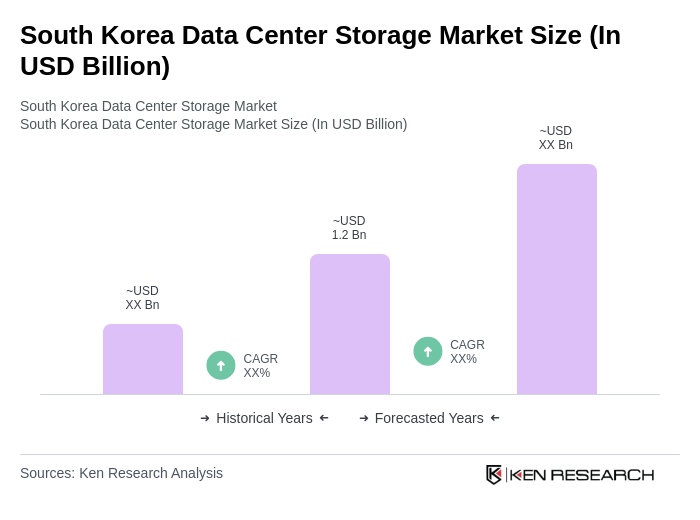
- The South Korea Data Center Storage Market is valued at USD 1.2 billion, based on a five-year historical analysis. This growth is primarily driven by the increasing demand for data storage solutions due to rapid digital transformation across sectors such as IT, telecommunications, and e-commerce. Additional drivers include the proliferation of cloud computing, big data analytics, and the expansion of 5G networks, all of which are generating substantial new data and necessitating advanced storage solutions .
- Seoul, Busan, and Incheon remain the dominant cities in the South Korea Data Center Storage Market. Seoul is the primary hub for technology and finance, attracting the majority of data center investments and hosting the largest share of operational capacity. Busan leverages its strategic port for international data traffic, while Incheon is recognized for its advanced infrastructure and connectivity, making these cities pivotal to the national data center landscape .
- In 2023, the South Korean government introduced policies promoting energy-efficient data center operations, aiming to reduce the sector's carbon footprint. These regulations encourage the adoption of renewable energy sources, advanced cooling technologies, and sustainable practices, aligning with the national focus on green growth and operational efficiency .
South Korea Data Center Storage Market Segmentation
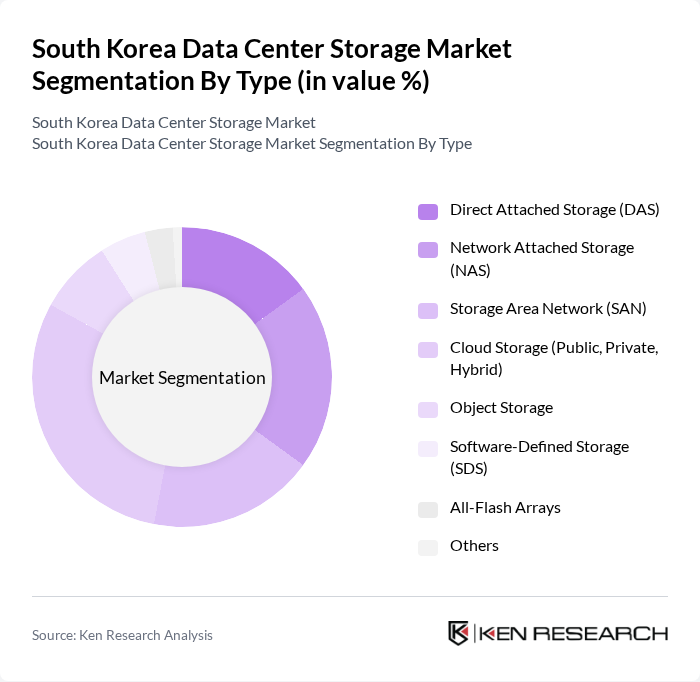
By Type:The market is segmented into various types of storage solutions, including Direct Attached Storage (DAS), Network Attached Storage (NAS), Storage Area Network (SAN), Cloud Storage (Public, Private, Hybrid), Object Storage, Software-Defined Storage (SDS), All-Flash Arrays, and Others. Each type addresses specific enterprise needs, with cloud storage gaining significant traction due to its scalability and flexibility. Notably, all-flash arrays are experiencing the fastest growth rate as enterprises prioritize low-latency storage for AI and analytics workloads .
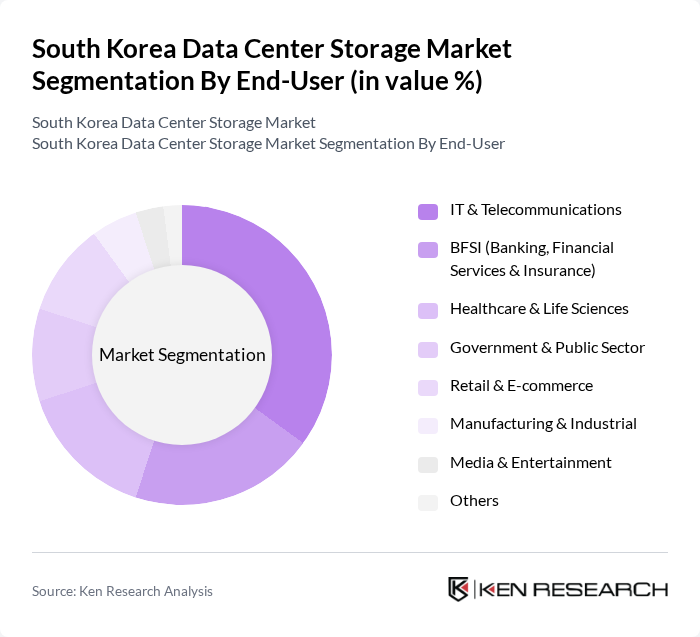
By End-User:The end-user segmentation includes IT & Telecommunications, BFSI (Banking, Financial Services & Insurance), Healthcare & Life Sciences, Government & Public Sector, Retail & E-commerce, Manufacturing & Industrial, Media & Entertainment, and Others. The IT & Telecommunications sector remains the largest consumer of data storage solutions, driven by the need for robust data management and security. Healthcare & Life Sciences is the fastest-growing segment, propelled by AI-driven imaging and medical data analytics .
South Korea Data Center Storage Market Competitive Landscape
The South Korea Data Center Storage Market is characterized by a dynamic mix of regional and international players. Leading participants such as Samsung SDS Co., Ltd., SK hynix Inc., LG CNS Co., Ltd., KT Corporation, Naver Cloud Corporation, Daewoo Engineering & Construction Co., Ltd., Hanwha Techwin Co., Ltd., CJ OliveNetworks Co., Ltd., NHN Cloud, Kakao Corp., LG Electronics Inc., SK Telecom Co., Ltd., Samsung Electronics Co., Ltd., POSCO ICT Co., Ltd., KT Skylife Co., Ltd., Dell Inc., Hewlett Packard Enterprise (HPE), NetApp Inc., Huawei Technologies Co., Ltd., and Hitachi Vantara LLC contribute to innovation, geographic expansion, and service delivery in this space .
South Korea Data Center Storage Market Industry Analysis
Growth Drivers
- Increasing Data Generation:The volume of data generated in South Korea is projected to reach 1.5 zettabytes in future, driven by the proliferation of digital content and online activities. This surge in data generation necessitates robust storage solutions, prompting businesses to invest in data centers. The South Korean government reported that the average data creation per person is expected to exceed 32 gigabytes daily, further fueling the demand for efficient data storage systems.
- Rising Demand for Cloud Services:The cloud services market in South Korea is anticipated to grow to approximately $6.5 billion in future, reflecting a compound annual growth rate of 15%. This growth is largely attributed to businesses transitioning to cloud-based solutions for enhanced flexibility and scalability. As organizations increasingly adopt Software as a Service (SaaS) and Infrastructure as a Service (IaaS), the need for reliable data center storage solutions becomes critical to support these services.
- Expansion of IoT Applications:The Internet of Things (IoT) sector in South Korea is expected to reach a market size of $12 billion in future, driven by advancements in smart devices and connectivity. This expansion leads to an exponential increase in data generated from IoT devices, necessitating advanced data storage solutions. With over 1.8 billion connected devices projected in future, the demand for data centers capable of handling this influx is paramount for businesses and service providers.
Market Challenges
- High Initial Investment Costs:Establishing a data center in South Korea requires significant capital investment, often exceeding $12 million for mid-sized facilities. This high initial cost can deter smaller businesses from entering the market. Additionally, ongoing operational expenses, including energy consumption and maintenance, can further strain budgets, making it challenging for companies to justify the investment in data center infrastructure.
- Data Security Concerns:With cyberattacks on the rise, data security remains a critical challenge for the South Korean data center market. In future, the country experienced over 1,500 reported cyber incidents, highlighting vulnerabilities in data protection. Companies face the daunting task of ensuring compliance with stringent data protection regulations, which can lead to increased operational costs and potential legal liabilities if breaches occur.
South Korea Data Center Storage Market Future Outlook
The South Korean data center storage market is poised for significant transformation as technological advancements and regulatory frameworks evolve. The increasing integration of artificial intelligence and machine learning into data management processes will enhance operational efficiency and data analytics capabilities. Furthermore, the shift towards hybrid cloud solutions will enable businesses to optimize their storage strategies, balancing on-premises and cloud resources. As sustainability becomes a priority, data centers will increasingly adopt energy-efficient technologies to meet environmental standards and reduce operational costs.
Market Opportunities
- Growth in AI and Machine Learning:The AI market in South Korea is projected to reach $4 billion in future, creating opportunities for data centers to offer specialized storage solutions tailored for AI workloads. This growth will drive demand for high-performance storage systems capable of handling large datasets, enabling businesses to leverage AI technologies effectively.
- Adoption of Hybrid Cloud Solutions:As organizations increasingly adopt hybrid cloud strategies, the demand for integrated data storage solutions will rise. In future, hybrid cloud adoption is expected to account for 75% of enterprise cloud strategies in South Korea, presenting opportunities for data centers to provide seamless connectivity and management between on-premises and cloud environments.
Scope of the Report
| Segment | Sub-Segments |
|---|---|
| By Type | Direct Attached Storage (DAS) Network Attached Storage (NAS) Storage Area Network (SAN) Cloud Storage (Public, Private, Hybrid) Object Storage Software-Defined Storage (SDS) All-Flash Arrays Others |
| By End-User | IT & Telecommunications BFSI (Banking, Financial Services & Insurance) Healthcare & Life Sciences Government & Public Sector Retail & E-commerce Manufacturing & Industrial Media & Entertainment Others |
| By Application | Data Backup and Recovery Data Archiving Big Data Analytics Virtualization Cloud Computing AI/ML Workloads Others |
| By Distribution Channel | Direct Sales Online Sales Distributors Value-Added Resellers (VARs) System Integrators Others |
| By Component | Hardware (Storage Devices, Servers) Software (Storage Management, Security) Services (Consulting, Maintenance, Support) Others |
| By Pricing Model | Subscription-Based Pay-As-You-Go One-Time Purchase Others |
| By Deployment Model | On-Premises Cloud-Based Hybrid Colocation Others |
Key Target Audience
Investors and Venture Capitalist Firms
Government and Regulatory Bodies (e.g., Ministry of Science and ICT, Korea Communications Commission)
Data Center Operators
Cloud Service Providers
Telecommunications Companies
IT Infrastructure Providers
Energy Providers
Real Estate Investment Trusts (REITs) focused on Data Centers
Players Mentioned in the Report:
Samsung SDS Co., Ltd.
SK hynix Inc.
LG CNS Co., Ltd.
KT Corporation
Naver Cloud Corporation
Daewoo Engineering & Construction Co., Ltd.
Hanwha Techwin Co., Ltd.
CJ OliveNetworks Co., Ltd.
NHN Cloud
Kakao Corp.
LG Electronics Inc.
SK Telecom Co., Ltd.
Samsung Electronics Co., Ltd.
POSCO ICT Co., Ltd.
KT Skylife Co., Ltd.
Dell Inc.
Hewlett Packard Enterprise (HPE)
NetApp Inc.
Huawei Technologies Co., Ltd.
Hitachi Vantara LLC
Table of Contents
Market Assessment Phase
1. Executive Summary and Approach
2. South Korea Data Center Storage Market Overview
2.1 Key Insights and Strategic Recommendations
2.2 South Korea Data Center Storage Market Overview
2.3 Definition and Scope
2.4 Evolution of Market Ecosystem
2.5 Timeline of Key Regulatory Milestones
2.6 Value Chain & Stakeholder Mapping
2.7 Business Cycle Analysis
2.8 Policy & Incentive Landscape
3. South Korea Data Center Storage Market Analysis
3.1 Growth Drivers
3.1.1 Increasing Data Generation
3.1.2 Rising Demand for Cloud Services
3.1.3 Expansion of IoT Applications
3.1.4 Government Initiatives for Digital Transformation
3.2 Market Challenges
3.2.1 High Initial Investment Costs
3.2.2 Data Security Concerns
3.2.3 Regulatory Compliance Issues
3.2.4 Limited Skilled Workforce
3.3 Market Opportunities
3.3.1 Growth in AI and Machine Learning
3.3.2 Adoption of Hybrid Cloud Solutions
3.3.3 Increasing Focus on Sustainability
3.3.4 Expansion of 5G Networks
3.4 Market Trends
3.4.1 Shift Towards Edge Computing
3.4.2 Increased Use of Automation
3.4.3 Rising Demand for Energy-Efficient Solutions
3.4.4 Growth of Colocation Services
3.5 Government Regulation
3.5.1 Data Protection Laws
3.5.2 Environmental Regulations
3.5.3 Tax Incentives for Green Technologies
3.5.4 Compliance with International Standards
4. SWOT Analysis
5. Stakeholder Analysis
6. Porter's Five Forces Analysis
7. South Korea Data Center Storage Market Market Size, 2019-2024
7.1 By Value
7.2 By Volume
7.3 By Average Selling Price
8. South Korea Data Center Storage Market Segmentation
8.1 By Type
8.1.1 Direct Attached Storage (DAS)
8.1.2 Network Attached Storage (NAS)
8.1.3 Storage Area Network (SAN)
8.1.4 Cloud Storage (Public, Private, Hybrid)
8.1.5 Object Storage
8.1.6 Software-Defined Storage (SDS)
8.1.7 All-Flash Arrays
8.1.8 Others
8.2 By End-User
8.2.1 IT & Telecommunications
8.2.2 BFSI (Banking, Financial Services & Insurance)
8.2.3 Healthcare & Life Sciences
8.2.4 Government & Public Sector
8.2.5 Retail & E-commerce
8.2.6 Manufacturing & Industrial
8.2.7 Media & Entertainment
8.2.8 Others
8.3 By Application
8.3.1 Data Backup and Recovery
8.3.2 Data Archiving
8.3.3 Big Data Analytics
8.3.4 Virtualization
8.3.5 Cloud Computing
8.3.6 AI/ML Workloads
8.3.7 Others
8.4 By Distribution Channel
8.4.1 Direct Sales
8.4.2 Online Sales
8.4.3 Distributors
8.4.4 Value-Added Resellers (VARs)
8.4.5 System Integrators
8.4.6 Others
8.5 By Component
8.5.1 Hardware (Storage Devices, Servers)
8.5.2 Software (Storage Management, Security)
8.5.3 Services (Consulting, Maintenance, Support)
8.5.4 Others
8.6 By Pricing Model
8.6.1 Subscription-Based
8.6.2 Pay-As-You-Go
8.6.3 One-Time Purchase
8.6.4 Others
8.7 By Deployment Model
8.7.1 On-Premises
8.7.2 Cloud-Based
8.7.3 Hybrid
8.7.4 Colocation
8.7.5 Others
9. South Korea Data Center Storage Market Competitive Analysis
9.1 Market Share of Key Players
9.2 KPIs for Cross Comparison of Key Players
9.2.1 Company Name
9.2.2 Group Size (Large, Medium, Small)
9.2.3 Revenue Growth Rate (YoY %)
9.2.4 Market Share (%)
9.2.5 Installed Storage Capacity (Petabytes)
9.2.6 Customer Retention Rate (%)
9.2.7 Average Deal Size (USD)
9.2.8 Pricing Strategy (Premium, Value, Volume)
9.2.9 Operational Efficiency Ratio (OPEX/Revenue)
9.2.10 Customer Satisfaction Score (NPS or Equivalent)
9.2.11 Innovation Index (Patents, R&D Spend)
9.2.12 Data Center Uptime (Tier Certification or SLA %)
9.2.13 ESG/Sustainability Score
9.3 SWOT Analysis of Top Players
9.4 Pricing Analysis
9.5 Detailed Profile of Major Companies
9.5.1 Samsung SDS Co., Ltd.
9.5.2 SK hynix Inc.
9.5.3 LG CNS Co., Ltd.
9.5.4 KT Corporation
9.5.5 Naver Cloud Corporation
9.5.6 Daewoo Engineering & Construction Co., Ltd.
9.5.7 Hanwha Techwin Co., Ltd.
9.5.8 CJ OliveNetworks Co., Ltd.
9.5.9 NHN Cloud
9.5.10 Kakao Corp.
9.5.11 LG Electronics Inc.
9.5.12 SK Telecom Co., Ltd.
9.5.13 Samsung Electronics Co., Ltd.
9.5.14 POSCO ICT Co., Ltd.
9.5.15 KT Skylife Co., Ltd.
9.5.16 Dell Inc.
9.5.17 Hewlett Packard Enterprise (HPE)
9.5.18 NetApp Inc.
9.5.19 Huawei Technologies Co., Ltd.
9.5.20 Hitachi Vantara LLC
10. South Korea Data Center Storage Market End-User Analysis
10.1 Procurement Behavior of Key Ministries
10.1.1 Ministry of Science and ICT
10.1.2 Ministry of Trade, Industry and Energy
10.1.3 Ministry of Health and Welfare
10.1.4 Ministry of Education
10.2 Corporate Spend on Infrastructure & Energy
10.2.1 IT Infrastructure Investments
10.2.2 Energy Efficiency Initiatives
10.2.3 Cloud Migration Budgets
10.2.4 Data Security Expenditures
10.3 Pain Point Analysis by End-User Category
10.3.1 Data Management Challenges
10.3.2 Compliance and Regulatory Issues
10.3.3 Cost Management Concerns
10.3.4 Performance and Scalability Needs
10.4 User Readiness for Adoption
10.4.1 Awareness of Data Center Solutions
10.4.2 Technical Capability Assessment
10.4.3 Budget Allocation for New Technologies
10.4.4 Training and Support Requirements
10.5 Post-Deployment ROI and Use Case Expansion
10.5.1 ROI Measurement Techniques
10.5.2 Use Case Identification for Expansion
10.5.3 Long-term Value Assessment
10.5.4 Customer Feedback Integration
11. South Korea Data Center Storage Market Future Size, 2025-2030
11.1 By Value
11.2 By Volume
11.3 By Average Selling Price
Go-To-Market Strategy Phase
1. Whitespace Analysis + Business Model Canvas
1.1 Market Gaps Identification
1.2 Business Model Framework
1.3 Value Proposition Development
1.4 Revenue Streams Analysis
1.5 Cost Structure Evaluation
1.6 Key Partnerships Exploration
1.7 Customer Segmentation Insights
2. Marketing and Positioning Recommendations
2.1 Branding Strategies
2.2 Product USPs
2.3 Target Audience Identification
2.4 Communication Channels Strategy
2.5 Competitive Positioning
2.6 Marketing Budget Allocation
2.7 Performance Metrics
3. Distribution Plan
3.1 Urban Retail Strategy
3.2 Rural NGO Tie-Ups
3.3 Online Distribution Channels
3.4 Direct Sales Approach
3.5 Partnership with Local Distributors
3.6 Logistics and Supply Chain Management
4. Channel & Pricing Gaps
4.1 Underserved Routes
4.2 Pricing Bands Analysis
4.3 Competitor Pricing Comparison
4.4 Customer Willingness to Pay
4.5 Discount Strategies
4.6 Bundling Opportunities
5. Unmet Demand & Latent Needs
5.1 Category Gaps Identification
5.2 Consumer Segments Analysis
5.3 Emerging Trends Exploration
5.4 Customer Feedback Collection
5.5 Future Needs Forecasting
5.6 Product Development Opportunities
6. Customer Relationship
6.1 Loyalty Programs
6.2 After-Sales Service
6.3 Customer Engagement Strategies
6.4 Feedback Mechanisms
6.5 Relationship Management Tools
6.6 Community Building Initiatives
7. Value Proposition
7.1 Sustainability Initiatives
7.2 Integrated Supply Chains
7.3 Unique Selling Points
7.4 Customer-Centric Approach
7.5 Competitive Advantages
7.6 Value Delivery Mechanisms
8. Key Activities
8.1 Regulatory Compliance
8.2 Branding Efforts
8.3 Distribution Setup
8.4 Marketing Campaigns
8.5 Training and Development
8.6 Performance Monitoring
9. Entry Strategy Evaluation
9.1 Domestic Market Entry Strategy
9.1.1 Product Mix
9.1.2 Pricing Band
9.1.3 Packaging
9.2 Export Entry Strategy
9.2.1 Target Countries
9.2.2 Compliance Roadmap
10. Entry Mode Assessment
10.1 Joint Ventures
10.2 Greenfield Investments
10.3 Mergers & Acquisitions
10.4 Distributor Model
10.5 Risk Assessment
10.6 Strategic Partnerships
11. Capital and Timeline Estimation
11.1 Capital Requirements
11.2 Timelines for Implementation
11.3 Funding Sources
11.4 Financial Projections
11.5 Milestone Tracking
12. Control vs Risk Trade-Off
12.1 Ownership vs Partnerships
12.2 Risk Mitigation Strategies
12.3 Control Mechanisms
12.4 Partnership Evaluation Criteria
12.5 Long-term Strategy Alignment
13. Profitability Outlook
13.1 Breakeven Analysis
13.2 Long-term Sustainability
13.3 Profit Margin Projections
13.4 Cost Management Strategies
13.5 Revenue Growth Forecast
14. Potential Partner List
14.1 Distributors
14.2 Joint Ventures
14.3 Acquisition Targets
14.4 Strategic Alliances
14.5 Local Market Experts
15. Execution Roadmap
15.1 Phased Plan for Market Entry
15.1.1 Market Setup
15.
Research Methodology
Phase 1: Approach1
Desk Research
- Analysis of industry reports from government agencies and market research firms
- Review of white papers and publications from data center associations in South Korea
- Examination of market trends and forecasts from reputable financial news outlets
Primary Research
- Interviews with IT infrastructure managers at leading South Korean enterprises
- Surveys with data center operators regarding storage capacity and technology adoption
- Field interviews with cloud service providers to understand market dynamics
Validation & Triangulation
- Cross-validation of findings through multiple data sources including trade publications
- Triangulation of market data with insights from industry experts and stakeholders
- Sanity checks through expert panel discussions and feedback sessions
Phase 2: Market Size Estimation1
Top-down Assessment
- Estimation of total data center market size based on national IT spending trends
- Segmentation of storage market by technology type (e.g., SSD, HDD) and end-user industries
- Incorporation of government initiatives promoting digital transformation and data localization
Bottom-up Modeling
- Collection of data from major data center operators regarding storage capacity and utilization rates
- Operational cost analysis based on pricing models of storage solutions
- Volume and pricing analysis to derive revenue estimates for different storage segments
Forecasting & Scenario Analysis
- Multi-variable regression analysis incorporating factors such as cloud adoption rates and data generation trends
- Scenario modeling based on potential regulatory changes and technological advancements
- Development of baseline, optimistic, and pessimistic forecasts through 2030
Phase 3: CATI Sample Composition1
| Scope Item/Segment | Sample Size | Target Respondent Profiles |
|---|---|---|
| Enterprise Data Storage Solutions | 100 | IT Managers, Data Center Administrators |
| Cloud Storage Services | 80 | Cloud Architects, Service Delivery Managers |
| Colocation Services | 60 | Facility Managers, Operations Directors |
| Data Backup and Recovery Solutions | 50 | Disaster Recovery Planners, IT Security Officers |
| Emerging Storage Technologies | 40 | R&D Managers, Technology Strategists |
Frequently Asked Questions
What is the current value of the South Korea Data Center Storage Market?
The South Korea Data Center Storage Market is valued at approximately USD 1.2 billion, reflecting significant growth driven by the increasing demand for data storage solutions across various sectors, including IT, telecommunications, and e-commerce.
What factors are driving the growth of the South Korea Data Center Storage Market?
Which cities are the main hubs for data centers in South Korea?
What initiatives has the South Korean government introduced for data centers?
Other Regional/Country Reports
Indonesia Data Center Storage Market
Malaysia Data Center Storage Market
APAC Data Center Storage Market
Why Buy From Us?

What makes us stand out is that our consultants follow Robust, Refine and Result (RRR) methodology. Robust for clear definitions, approaches and sanity checking, Refine for differentiating respondents' facts and opinions, and Result for presenting data with story.

We have set a benchmark in the industry by offering our clients with syndicated and customized market research reports featuring coverage of entire market as well as meticulous research and analyst insights.

While we don't replace traditional research, we flip the method upside down. Our dual approach of Top Bottom & Bottom Top ensures quality deliverable by not just verifying company fundamentals but also looking at the sector and macroeconomic factors.

With one step in the future, our research team constantly tries to show you the bigger picture. We help with some of the tough questions you may encounter along the way: How is the industry positioned? Best marketing channel? KPI's of competitors? By aligning every element, we help maximize success.

Our report gives you instant access to the answers and sources that other companies might choose to hide. We elaborate each steps of research methodology we have used and showcase you the sample size to earn your trust.

If you need any support, we are here! We pride ourselves on universe strength, data quality, and quick, friendly, and professional service.