About the Report
Base Year 2024South Korea Drone Tech for Logistics and Delivery Market Overview
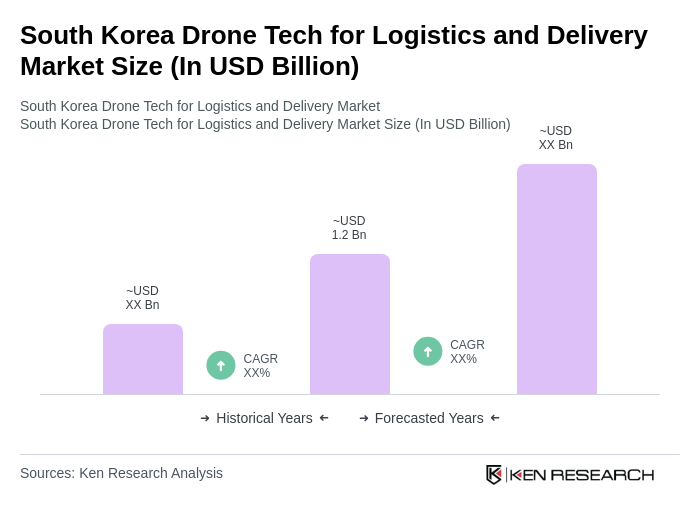
- The South Korea Drone Tech for Logistics and Delivery Market is valued at USD 1.2 billion, based on a five-year historical analysis. This growth is primarily driven by advancements in drone technology, increasing demand for efficient delivery solutions, and the rise of e-commerce. The logistics sector is increasingly adopting drones to enhance operational efficiency and reduce delivery times, contributing to the market's expansion.
- Key players in this market include major cities like Seoul and Busan, which dominate due to their advanced infrastructure, high population density, and significant investment in technology. These urban centers serve as hubs for logistics and delivery services, facilitating the rapid adoption of drone technology in various sectors, including e-commerce and healthcare.
- In 2023, the South Korean government implemented regulations to streamline the integration of drones into the logistics sector. This includes the establishment of designated drone delivery zones and safety protocols to ensure secure operations. The initiative aims to promote innovation while addressing safety concerns, thereby fostering growth in the drone logistics market.
South Korea Drone Tech for Logistics and Delivery Market Segmentation
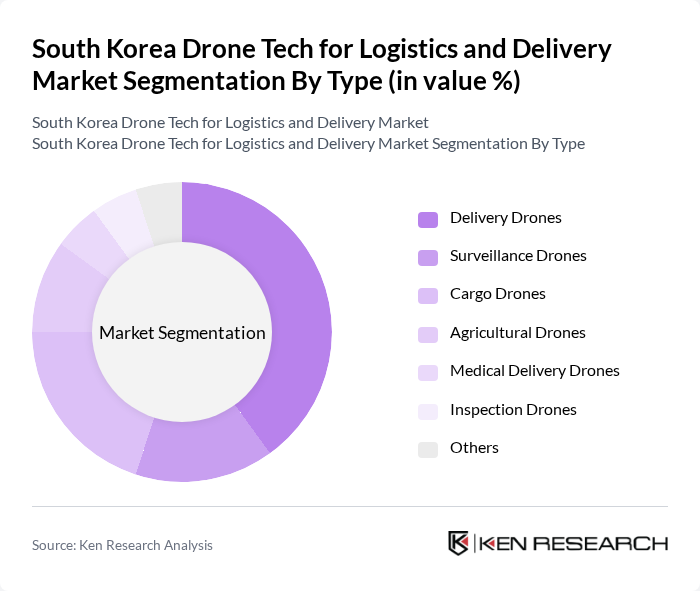
By Type:The market is segmented into various types of drones, including Delivery Drones, Surveillance Drones, Cargo Drones, Agricultural Drones, Medical Delivery Drones, Inspection Drones, and Others. Among these, Delivery Drones are leading the market due to the surge in e-commerce and the need for efficient last-mile delivery solutions. The increasing consumer preference for quick and reliable delivery services has driven the demand for these drones, making them a crucial component of the logistics ecosystem.
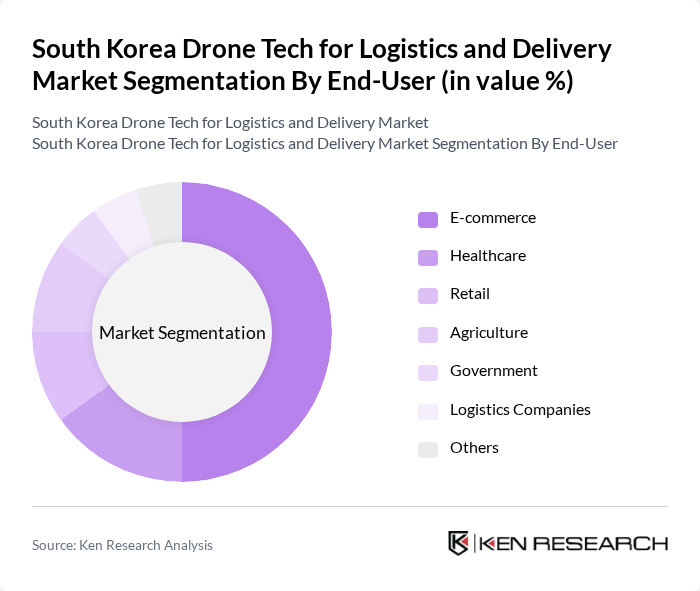
By End-User:The market is segmented by end-users, including E-commerce, Healthcare, Retail, Agriculture, Government, Logistics Companies, and Others. The E-commerce sector is the dominant end-user, driven by the increasing demand for fast and efficient delivery services. As online shopping continues to grow, companies are leveraging drone technology to enhance their logistics capabilities, ensuring timely deliveries and improved customer satisfaction.
South Korea Drone Tech for Logistics and Delivery Market Competitive Landscape
The South Korea Drone Tech for Logistics and Delivery Market is characterized by a dynamic mix of regional and international players. Leading participants such as DJI Technology Co., Ltd., SK Telecom Co., Ltd., Hyundai Robotics, KT Corporation, Hanwha Systems, LG Uplus Corp., Zipline International Inc., Drone Delivery Canada Corp., AirMap, Inc., Wingcopter GmbH, Parrot Drones SAS, Flirtey, Inc., Matternet, Inc., Volansi, Inc., Skycart, Inc. contribute to innovation, geographic expansion, and service delivery in this space.
South Korea Drone Tech for Logistics and Delivery Market Industry Analysis
Growth Drivers
- Increasing Demand for Last-Mile Delivery Solutions:The South Korean logistics sector is experiencing a surge in demand for last-mile delivery solutions, driven by a projected 20% increase in e-commerce sales, reaching approximately $110 billion in future. This growth is fueled by consumer preferences for faster delivery options, with 75% of consumers expecting same-day delivery. As urbanization continues, the need for efficient delivery methods, such as drones, becomes critical to meet these expectations and enhance customer satisfaction.
- Advancements in Drone Technology and Automation:The drone technology landscape in South Korea is rapidly evolving, with investments exceeding $2 billion in research and development in future. Innovations in battery life, payload capacity, and autonomous navigation systems are enhancing operational efficiency. For instance, drones can now carry payloads of up to 7 kilograms over distances of 20 kilometers, significantly improving delivery capabilities. These advancements are crucial for logistics companies aiming to optimize their operations and reduce costs.
- Supportive Government Regulations and Policies:The South Korean government is actively promoting drone technology through favorable regulations, with over 35 new policies introduced in future to facilitate drone operations. These include streamlined approval processes for drone deliveries and the establishment of designated drone corridors. Additionally, the government allocated $250 million for infrastructure development to support drone logistics, creating a conducive environment for companies to innovate and expand their services in the logistics sector.
Market Challenges
- Regulatory Hurdles and Airspace Restrictions:Despite supportive regulations, significant challenges remain in navigating complex airspace restrictions. In future, approximately 45% of urban areas in South Korea are classified as no-fly zones, limiting drone operations. Companies face lengthy approval processes, with an average wait time of 7 months for flight permits. These regulatory hurdles can delay the deployment of drone delivery services, hindering market growth and innovation in logistics.
- High Initial Investment Costs for Drone Technology:The initial investment required for drone technology remains a significant barrier for many logistics companies. In future, the average cost of a commercial drone capable of delivery is around $18,000, excluding maintenance and operational expenses. This high upfront cost can deter smaller companies from entering the market, limiting competition and innovation. As a result, many firms may struggle to adopt drone technology, impacting overall market growth.
South Korea Drone Tech for Logistics and Delivery Market Future Outlook
The future of the South Korean drone tech market for logistics and delivery appears promising, driven by technological advancements and increasing consumer demand. As companies invest in AI and machine learning, operational efficiencies will improve, enabling faster and more reliable deliveries. Furthermore, the integration of drones into existing logistics frameworks will enhance service offerings, positioning companies to capitalize on emerging trends. The focus on sustainability will also drive innovation, as eco-friendly delivery solutions become a priority for consumers and businesses alike.
Market Opportunities
- Expansion into Rural and Underserved Areas:There is a significant opportunity for drone delivery services to expand into rural and underserved regions, where traditional logistics face challenges. With over 35% of South Korea's population residing in these areas, drones can provide essential delivery services, improving access to goods and services. This expansion can enhance market reach and customer satisfaction, driving growth in the logistics sector.
- Partnerships with E-commerce Platforms for Enhanced Services:Collaborating with major e-commerce platforms presents a lucrative opportunity for logistics companies. By integrating drone delivery services, companies can offer faster shipping options, catering to the growing consumer demand for quick deliveries. In future, partnerships with e-commerce giants could potentially increase delivery efficiency by 30%, significantly enhancing service offerings and market competitiveness.
Scope of the Report
| Segment | Sub-Segments |
|---|---|
| By Type | Delivery Drones Surveillance Drones Cargo Drones Agricultural Drones Medical Delivery Drones Inspection Drones Others |
| By End-User | E-commerce Healthcare Retail Agriculture Government Logistics Companies Others |
| By Application | Last-Mile Delivery Inventory Management Emergency Services Surveillance and Monitoring Agricultural Support Others |
| By Distribution Mode | Direct Sales Online Sales Retail Partnerships Third-Party Logistics Others |
| By Pricing Strategy | Premium Pricing Competitive Pricing Value-Based Pricing Discount Pricing Others |
| By Payload Capacity | Light Payload Drones Medium Payload Drones Heavy Payload Drones Others |
| By Regulatory Compliance Level | Fully Compliant Drones Partially Compliant Drones Non-Compliant Drones Others |
Key Target Audience
Investors and Venture Capitalist Firms
Government and Regulatory Bodies (e.g., Ministry of Land, Infrastructure and Transport)
Manufacturers and Producers of Drone Technology
Logistics and Delivery Service Providers
Telecommunications Companies
Aerospace and Defense Contractors
Industry Associations (e.g., Korea Drone Industry Association)
Financial Institutions and Banks
Players Mentioned in the Report:
DJI Technology Co., Ltd.
SK Telecom Co., Ltd.
Hyundai Robotics
KT Corporation
Hanwha Systems
LG Uplus Corp.
Zipline International Inc.
Drone Delivery Canada Corp.
AirMap, Inc.
Wingcopter GmbH
Parrot Drones SAS
Flirtey, Inc.
Matternet, Inc.
Volansi, Inc.
Skycart, Inc.
Table of Contents
Market Assessment Phase
1. Executive Summary and Approach
2. South Korea Drone Tech for Logistics and Delivery Market Overview
2.1 Key Insights and Strategic Recommendations
2.2 South Korea Drone Tech for Logistics and Delivery Market Overview
2.3 Definition and Scope
2.4 Evolution of Market Ecosystem
2.5 Timeline of Key Regulatory Milestones
2.6 Value Chain & Stakeholder Mapping
2.7 Business Cycle Analysis
2.8 Policy & Incentive Landscape
3. South Korea Drone Tech for Logistics and Delivery Market Analysis
3.1 Growth Drivers
3.1.1 Increasing demand for last-mile delivery solutions
3.1.2 Advancements in drone technology and automation
3.1.3 Supportive government regulations and policies
3.1.4 Rising e-commerce activities and consumer expectations
3.2 Market Challenges
3.2.1 Regulatory hurdles and airspace restrictions
3.2.2 High initial investment costs for drone technology
3.2.3 Limited public acceptance and trust in drone deliveries
3.2.4 Technical challenges related to drone operation and maintenance
3.3 Market Opportunities
3.3.1 Expansion into rural and underserved areas
3.3.2 Integration with existing logistics and supply chain systems
3.3.3 Development of specialized drones for specific industries
3.3.4 Partnerships with e-commerce platforms for enhanced services
3.4 Market Trends
3.4.1 Increasing use of AI and machine learning in drone operations
3.4.2 Growth of drone delivery services in urban areas
3.4.3 Focus on sustainability and eco-friendly delivery solutions
3.4.4 Emergence of drone delivery as a competitive differentiator
3.5 Government Regulation
3.5.1 Implementation of drone operation guidelines
3.5.2 Establishment of no-fly zones and air traffic management
3.5.3 Incentives for companies adopting drone technology
3.5.4 Safety regulations for drone deliveries in populated areas
4. SWOT Analysis
5. Stakeholder Analysis
6. Porter's Five Forces Analysis
7. South Korea Drone Tech for Logistics and Delivery Market Market Size, 2019-2024
7.1 By Value
7.2 By Volume
7.3 By Average Selling Price
8. South Korea Drone Tech for Logistics and Delivery Market Segmentation
8.1 By Type
8.1.1 Delivery Drones
8.1.2 Surveillance Drones
8.1.3 Cargo Drones
8.1.4 Agricultural Drones
8.1.5 Medical Delivery Drones
8.1.6 Inspection Drones
8.1.7 Others
8.2 By End-User
8.2.1 E-commerce
8.2.2 Healthcare
8.2.3 Retail
8.2.4 Agriculture
8.2.5 Government
8.2.6 Logistics Companies
8.2.7 Others
8.3 By Application
8.3.1 Last-Mile Delivery
8.3.2 Inventory Management
8.3.3 Emergency Services
8.3.4 Surveillance and Monitoring
8.3.5 Agricultural Support
8.3.6 Others
8.4 By Distribution Mode
8.4.1 Direct Sales
8.4.2 Online Sales
8.4.3 Retail Partnerships
8.4.4 Third-Party Logistics
8.4.5 Others
8.5 By Pricing Strategy
8.5.1 Premium Pricing
8.5.2 Competitive Pricing
8.5.3 Value-Based Pricing
8.5.4 Discount Pricing
8.5.5 Others
8.6 By Payload Capacity
8.6.1 Light Payload Drones
8.6.2 Medium Payload Drones
8.6.3 Heavy Payload Drones
8.6.4 Others
8.7 By Regulatory Compliance Level
8.7.1 Fully Compliant Drones
8.7.2 Partially Compliant Drones
8.7.3 Non-Compliant Drones
8.7.4 Others
9. South Korea Drone Tech for Logistics and Delivery Market Competitive Analysis
9.1 Market Share of Key Players
9.2 Cross Comparison of Key Players
9.2.1 Company Name
9.2.2 Group Size (Large, Medium, or Small as per industry convention)
9.2.3 Revenue Growth Rate
9.2.4 Market Penetration Rate
9.2.5 Customer Retention Rate
9.2.6 Average Delivery Time
9.2.7 Pricing Strategy
9.2.8 Operational Efficiency
9.2.9 Innovation Rate
9.2.10 Customer Satisfaction Score
9.3 SWOT Analysis of Top Players
9.4 Pricing Analysis
9.5 Detailed Profile of Major Companies
9.5.1 DJI Technology Co., Ltd.
9.5.2 SK Telecom Co., Ltd.
9.5.3 Hyundai Robotics
9.5.4 KT Corporation
9.5.5 Hanwha Systems
9.5.6 LG Uplus Corp.
9.5.7 Zipline International Inc.
9.5.8 Drone Delivery Canada Corp.
9.5.9 AirMap, Inc.
9.5.10 Wingcopter GmbH
9.5.11 Parrot Drones SAS
9.5.12 Flirtey, Inc.
9.5.13 Matternet, Inc.
9.5.14 Volansi, Inc.
9.5.15 Skycart, Inc.
10. South Korea Drone Tech for Logistics and Delivery Market End-User Analysis
10.1 Procurement Behavior of Key Ministries
10.1.1 Government procurement policies
10.1.2 Budget allocation for drone technology
10.1.3 Collaboration with private sector
10.2 Corporate Spend on Infrastructure & Energy
10.2.1 Investment in logistics infrastructure
10.2.2 Funding for drone technology integration
10.2.3 Expenditure on training and development
10.3 Pain Point Analysis by End-User Category
10.3.1 Delivery time constraints
10.3.2 Cost efficiency challenges
10.3.3 Regulatory compliance issues
10.4 User Readiness for Adoption
10.4.1 Awareness of drone technology benefits
10.4.2 Training and support requirements
10.4.3 Infrastructure readiness
10.5 Post-Deployment ROI and Use Case Expansion
10.5.1 Measurement of delivery efficiency
10.5.2 Customer feedback and satisfaction
10.5.3 Potential for service diversification
11. South Korea Drone Tech for Logistics and Delivery Market Future Size, 2025-2030
11.1 By Value
11.2 By Volume
11.3 By Average Selling Price
Go-To-Market Strategy Phase
1. Whitespace Analysis + Business Model Canvas
1.1 Market Gaps Identification
1.2 Business Model Development
2. Marketing and Positioning Recommendations
2.1 Branding Strategies
2.2 Product USPs
3. Distribution Plan
3.1 Urban Retail Strategies
3.2 Rural NGO Tie-Ups
4. Channel & Pricing Gaps
4.1 Underserved Routes
4.2 Pricing Bands Analysis
5. Unmet Demand & Latent Needs
5.1 Category Gaps
5.2 Consumer Segments
6. Customer Relationship
6.1 Loyalty Programs
6.2 After-Sales Service
7. Value Proposition
7.1 Sustainability Initiatives
7.2 Integrated Supply Chains
8. Key Activities
8.1 Regulatory Compliance
8.2 Branding Efforts
8.3 Distribution Setup
9. Entry Strategy Evaluation
9.1 Domestic Market Entry Strategy
9.1.1 Product Mix Considerations
9.1.2 Pricing Band Strategy
9.1.3 Packaging Solutions
9.2 Export Entry Strategy
9.2.1 Target Countries Identification
9.2.2 Compliance Roadmap Development
10. Entry Mode Assessment
10.1 Joint Ventures
10.2 Greenfield Investments
10.3 Mergers & Acquisitions
10.4 Distributor Model Evaluation
11. Capital and Timeline Estimation
11.1 Capital Requirements
11.2 Timelines for Implementation
12. Control vs Risk Trade-Off
12.1 Ownership Considerations
12.2 Partnerships Evaluation
13. Profitability Outlook
13.1 Breakeven Analysis
13.2 Long-Term Sustainability Strategies
14. Potential Partner List
14.1 Distributors
14.2 Joint Ventures
14.3 Acquisition Targets
15. Execution Roadmap
15.1 Phased Plan for Market Entry
15.1.1 Market Setup Activities
15.1.2 Market Entry Steps
15.1.3 Growth Acceleration Tactics
15.1.4 Scale & Stabilize Actions
15.2 Key Activities and Milestones
15.2.1 Milestone Identification
15.2.2 Activity Scheduling
Research Methodology
Phase 1: Approach1
Desk Research
- Analysis of government reports on drone regulations and logistics frameworks in South Korea
- Review of industry publications and white papers on drone technology adoption in logistics
- Examination of market reports from logistics associations and drone technology forums
Primary Research
- Interviews with logistics executives from major South Korean delivery companies
- Surveys targeting drone manufacturers and technology providers in the logistics sector
- Field interviews with regulatory bodies overseeing drone operations and safety standards
Validation & Triangulation
- Cross-validation of findings through multiple data sources including trade publications and expert opinions
- Triangulation of market data with insights from logistics and drone technology experts
- Sanity checks through feedback from industry panels and focus groups
Phase 2: Market Size Estimation1
Top-down Assessment
- Estimation of total logistics market size in South Korea and identification of drone logistics share
- Segmentation of the market by industry verticals such as e-commerce, healthcare, and food delivery
- Incorporation of government initiatives promoting drone usage in urban logistics
Bottom-up Modeling
- Collection of operational data from leading logistics firms utilizing drone technology
- Cost analysis based on service pricing models for drone delivery solutions
- Volume estimates derived from pilot projects and case studies in urban areas
Forecasting & Scenario Analysis
- Multi-variable forecasting using trends in e-commerce growth and urbanization rates
- Scenario modeling based on potential regulatory changes and technological advancements
- Development of baseline, optimistic, and pessimistic market projections through 2030
Phase 3: CATI Sample Composition1
| Scope Item/Segment | Sample Size | Target Respondent Profiles |
|---|---|---|
| E-commerce Drone Delivery | 150 | Logistics Managers, E-commerce Operations Heads |
| Healthcare Supply Chain | 100 | Pharmaceutical Logistics Coordinators, Hospital Supply Chain Managers |
| Food Delivery Services | 80 | Operations Managers, Delivery Fleet Supervisors |
| Urban Logistics Innovations | 70 | Urban Planning Officials, Transportation Analysts |
| Drone Technology Providers | 60 | Product Development Managers, Sales Directors |
Frequently Asked Questions
What is the current value of the South Korea Drone Tech for Logistics and Delivery Market?
The South Korea Drone Tech for Logistics and Delivery Market is valued at approximately USD 1.2 billion, driven by advancements in drone technology, increased demand for efficient delivery solutions, and the growth of e-commerce.
What are the key drivers of growth in the South Korea drone logistics market?
Which cities in South Korea are leading in drone logistics adoption?
What types of drones are primarily used in the logistics sector in South Korea?
Other Regional/Country Reports
Indonesia Drone Tech for Logistics and Delivery Market
Malaysia Drone Tech for Logistics and Delivery Market
KSA Drone Tech for Logistics and Delivery Market
APAC Drone Tech for Logistics and Delivery Market
SEA Drone Tech for Logistics and Delivery Market
Vietnam Drone Tech for Logistics and Delivery Market
Other Adjacent Reports
KSA Last-Mile Delivery Solutions Market
Malaysia Autonomous Vehicle Technology Market
Saudi Arabia Supply Chain Automation MarketPhilippines UAV Manufacturing Market
Thailand Aerial Surveillance Systems Market
Bahrain Smart Warehouse Management Market
Qatar AI in Logistics Market
South Korea Sustainable Delivery Technologies Market
Uae Urban Air Mobility Market Report Size, Share, Growth Drivers, Trends, Opportunities & Forecast 2025–2030Why Buy From Us?

What makes us stand out is that our consultants follow Robust, Refine and Result (RRR) methodology. Robust for clear definitions, approaches and sanity checking, Refine for differentiating respondents' facts and opinions, and Result for presenting data with story.

We have set a benchmark in the industry by offering our clients with syndicated and customized market research reports featuring coverage of entire market as well as meticulous research and analyst insights.

While we don't replace traditional research, we flip the method upside down. Our dual approach of Top Bottom & Bottom Top ensures quality deliverable by not just verifying company fundamentals but also looking at the sector and macroeconomic factors.

With one step in the future, our research team constantly tries to show you the bigger picture. We help with some of the tough questions you may encounter along the way: How is the industry positioned? Best marketing channel? KPI's of competitors? By aligning every element, we help maximize success.

Our report gives you instant access to the answers and sources that other companies might choose to hide. We elaborate each steps of research methodology we have used and showcase you the sample size to earn your trust.

If you need any support, we are here! We pride ourselves on universe strength, data quality, and quick, friendly, and professional service.