Region:Asia
Author(s):Geetanshi
Product Code:KRAA4752
Pages:92
Published On:September 2025
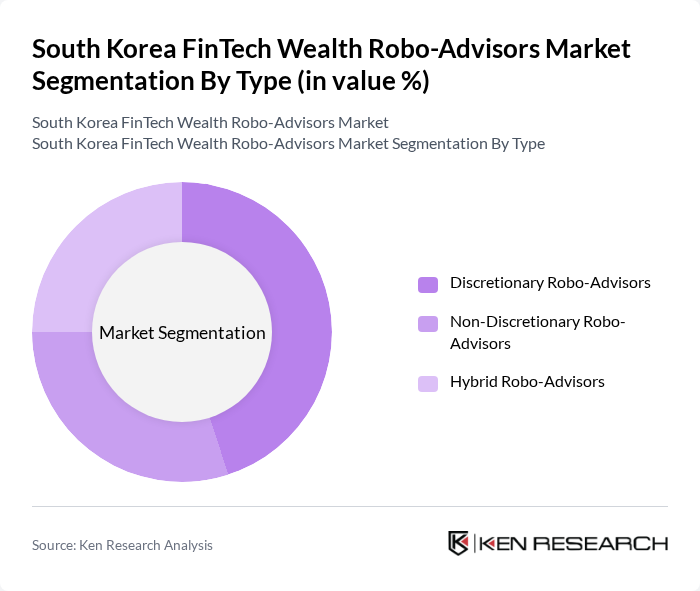
By Type:The market is segmented into three main types of robo-advisors: Discretionary Robo-Advisors, Non-Discretionary Robo-Advisors, and Hybrid Robo-Advisors. Discretionary Robo-Advisors autonomously manage investments for clients based on predefined risk profiles and goals. Non-Discretionary Robo-Advisors provide algorithm-driven recommendations, allowing clients to execute investment decisions independently. Hybrid Robo-Advisors blend automated portfolio management with human advisory support, catering to clients seeking both digital convenience and personalized guidance.
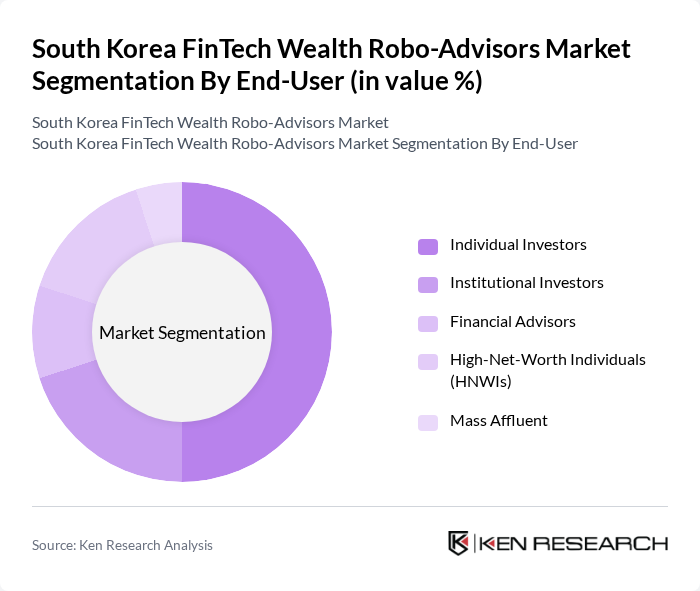
By End-User:The end-user segmentation includes Individual Investors, Institutional Investors, Financial Advisors, High-Net-Worth Individuals (HNWIs), and Mass Affluent. Individual Investors represent the largest segment, driven by the growing number of retail investors seeking affordable, automated investment solutions. Institutional Investors and HNWIs are increasingly adopting robo-advisory platforms for tailored portfolio strategies and risk management, while Financial Advisors leverage these tools to enhance service delivery. The Mass Affluent segment is expanding as digital wealth management becomes more accessible.
The South Korea FinTech Wealth Robo-Advisors Market is characterized by a dynamic mix of regional and international players. Leading participants such as Samsung Asset Management, Mirae Asset Global Investments, NH Investment & Securities, KB Financial Group, Shinhan Financial Group, Hanwha Asset Management, Daishin Securities, Kiwoom Securities, Samsung Securities, KTB Investment & Securities, E*TRADE Korea, Kakao Pay Securities, Toss Securities, Fount, AIM (??), Upbit, Naver Financial, BALAAN contribute to innovation, geographic expansion, and service delivery in this space.
The South Korean FinTech wealth robo-advisors market is poised for significant evolution, driven by technological advancements and changing consumer preferences. As artificial intelligence and machine learning become more integrated into investment strategies, robo-advisors will enhance personalization and efficiency. Additionally, the growing emphasis on sustainable investing will likely lead to the development of ESG-focused products, appealing to socially conscious investors. Overall, the market is expected to adapt rapidly, fostering innovation and expanding its reach among diverse consumer segments.
| Segment | Sub-Segments |
|---|---|
| By Type | Discretionary Robo-Advisors Non-Discretionary Robo-Advisors Hybrid Robo-Advisors |
| By End-User | Individual Investors Institutional Investors Financial Advisors High-Net-Worth Individuals (HNWIs) Mass Affluent |
| By Investment Strategy | Passive Investment Strategies Active Investment Strategies Tactical Asset Allocation ESG-Focused Strategies |
| By Customer Segment | Millennials High-Net-Worth Individuals Retirees Gen Z |
| By Service Model | Full-Service Robo-Advisors Self-Service Robo-Advisors Advisory-Only Platforms |
| By Distribution Channel | Direct Online Platforms Mobile Applications Third-Party Financial Platforms Bank-Affiliated Channels |
| By Regulatory Compliance | Fully Compliant Robo-Advisors Partially Compliant Robo-Advisors Non-Compliant Robo-Advisors |
| Scope Item/Segment | Sample Size | Target Respondent Profiles |
|---|---|---|
| Retail Investors | 100 | Individual Investors, Financial Planners |
| Institutional Investors | 60 | Portfolio Managers, Investment Analysts |
| FinTech Startups | 40 | Founders, Product Managers |
| Regulatory Bodies | 40 | Policy Makers, Compliance Officers |
| Wealth Management Firms | 50 | Wealth Managers, Business Development Executives |
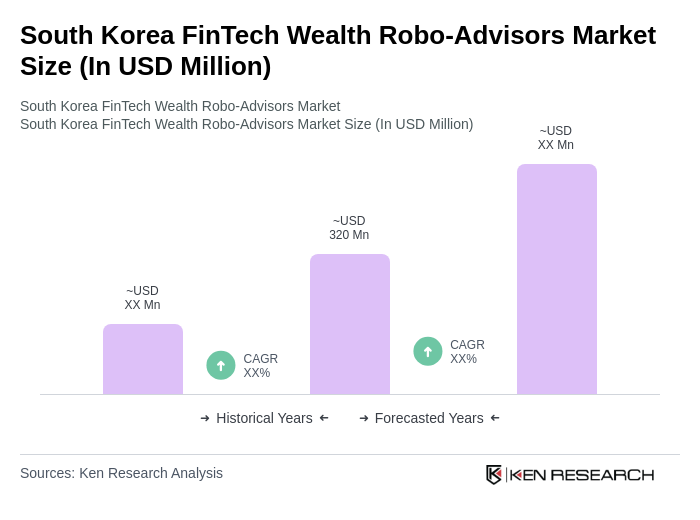
The South Korea FinTech Wealth Robo-Advisors Market is valued at approximately USD 320 million, reflecting its significant share in the Asia Pacific robo-advisor market, driven by the increasing adoption of digital financial services and investment interest among younger demographics.

What makes us stand out is that our consultants follow Robust, Refine and Result (RRR) methodology. Robust for clear definitions, approaches and sanity checking, Refine for differentiating respondents' facts and opinions, and Result for presenting data with story.

We have set a benchmark in the industry by offering our clients with syndicated and customized market research reports featuring coverage of entire market as well as meticulous research and analyst insights.

While we don't replace traditional research, we flip the method upside down. Our dual approach of Top Bottom & Bottom Top ensures quality deliverable by not just verifying company fundamentals but also looking at the sector and macroeconomic factors.

With one step in the future, our research team constantly tries to show you the bigger picture. We help with some of the tough questions you may encounter along the way: How is the industry positioned? Best marketing channel? KPI's of competitors? By aligning every element, we help maximize success.

Our report gives you instant access to the answers and sources that other companies might choose to hide. We elaborate each steps of research methodology we have used and showcase you the sample size to earn your trust.

If you need any support, we are here! We pride ourselves on universe strength, data quality, and quick, friendly, and professional service.













