About the Report
Base Year 2024Tanzania Inland Container Depot Market Overview
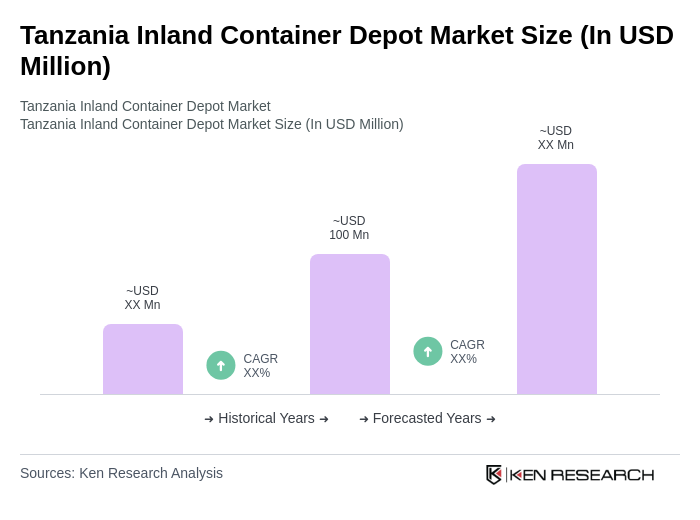
- The Tanzania Inland Container Depot Market is valued at USD 100 million, based on a five-year historical analysis. This growth is primarily driven by the increasing demand for efficient logistics and transportation services, as well as the expansion of trade activities in the region. The rise in import and export activities, coupled with the government's focus on improving infrastructure, has significantly contributed to the market's expansion.
- Key players in this market include Dar es Salaam, Mwanza, and Arusha. These cities dominate the market due to their strategic locations, which facilitate trade routes and access to major transport networks. The presence of established logistics companies and container handling facilities in these areas further enhances their significance in the inland container depot market.
- In 2023, the Tanzanian government implemented a new regulation aimed at streamlining customs procedures for container handling. This regulation mandates the use of electronic documentation for all imports and exports, significantly reducing processing times and enhancing efficiency in the logistics chain. The initiative is expected to improve the overall competitiveness of the Tanzanian logistics sector.
Tanzania Inland Container Depot Market Segmentation
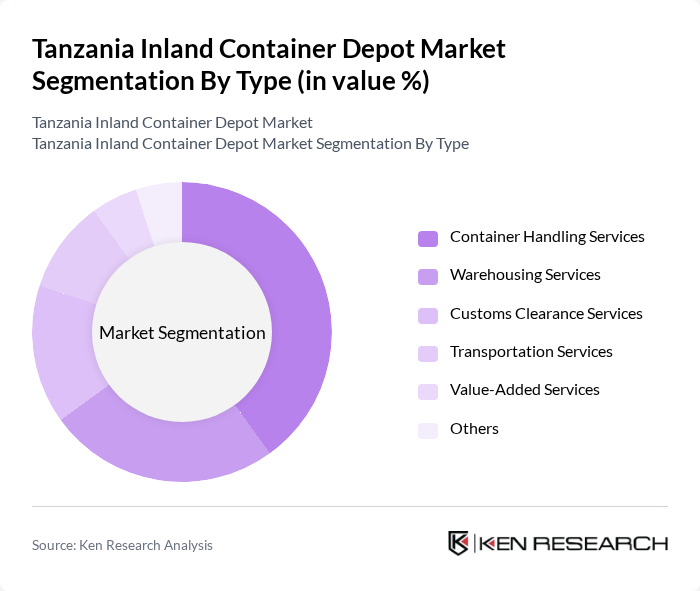
By Type:The market is segmented into various types, including Container Handling Services, Warehousing Services, Customs Clearance Services, Transportation Services, Value-Added Services, and Others. Among these, Container Handling Services is the leading segment due to the increasing volume of containers being processed at inland depots. The demand for efficient handling and storage solutions is driving growth in this segment, as businesses seek to optimize their supply chains.
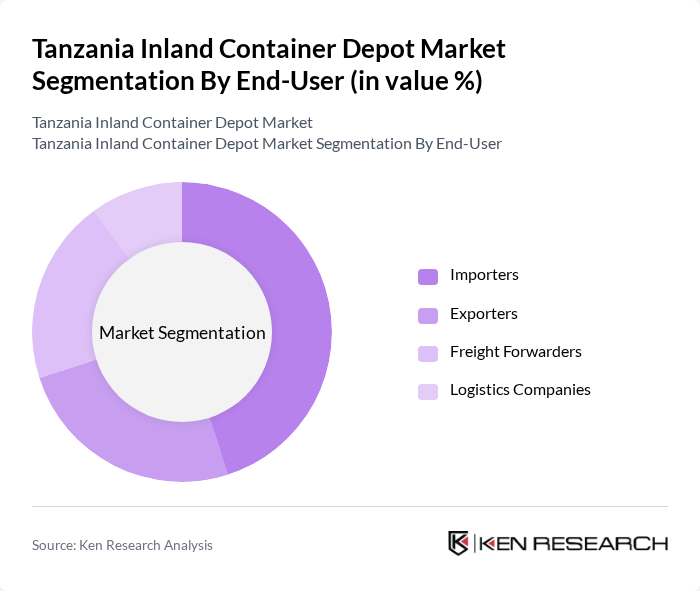
By End-User:The end-user segmentation includes Importers, Exporters, Freight Forwarders, and Logistics Companies. Importers are the dominant end-user segment, driven by the increasing volume of goods entering Tanzania. The growth in consumer demand and the expansion of retail sectors are propelling import activities, leading to a higher reliance on inland container depots for efficient logistics management.
Tanzania Inland Container Depot Market Competitive Landscape
The Tanzania Inland Container Depot Market is characterized by a dynamic mix of regional and international players. Leading participants such as Tanzania Ports Authority, Tanzania International Container Terminal Services Ltd., Freight Forwarders Association of Tanzania, Maersk Tanzania, Bolloré Transport & Logistics Tanzania, and DP World Dar es Salaam contribute to innovation, geographic expansion, and service delivery in this space.
Tanzania Inland Container Depot Market Industry Analysis
Growth Drivers
- Strategic Trade Gateway Positioning:Tanzania plays a critical gateway role, handling over 90% of the nation's cargo through the Dar es Salaam port. It serves six landlocked countries within a 1,500 km radius, including Zambia, Malawi, and the DRC. This strategic location makes Tanzania a regional logistics hub, enhancing the demand for inland container depots that support efficient cargo handling, storage, and distribution across East and Central Africa.
- Growth in Regional Transit and Re-Exports:Transit cargo volumes from DRC and Rwanda are projected to grow at 6.5% and 4.5% CAGR, respectively, between 2024 and 2029. Additionally, re-exports have increased by 10–12% year-on-year via key OSBPs such as Tunduma and Rusumo. This sustained regional demand is boosting throughput at inland depots, positioning them as vital nodes for customs clearance, value-added services, and cross-border trade facilitation.
- Capacity Enhancements and Infrastructure Upgrades:Ongoing berth expansion projects by Adani and DP World have reduced port dwelling times from 7 to 3 days, enabling an 18% volume increase. Inland transit is also improving through investments in Meter Gauge Rail (MGR) and upcoming Standard Gauge Rail (SGR) corridors. These developments are significantly reducing inland transport time and costs, driving higher throughput and efficiency in the inland container depot network.
Market Challenges
- Logistics Bottlenecks from Road Disparities and Last-Mile Gaps:Tanzania’s inland logistics infrastructure faces persistent challenges due to pavement disparities and last-mile connectivity issues. While major trunk routes like T1 and T3 handle over 60% of cross-border trade, many regional and feeder roads—especially those linking ICDs and remote ports—remain unpaved. Unpaved or single-lane access to key logistics nodes like the Kwala ICD and Kigoma port results in higher logistics costs and suboptimal cargo flow, undermining ICD efficiency and market expansion.
- Border Clearance Delays and Procedural Inefficiencies:Despite OSBP (One-Stop Border Post) upgrades, major crossings such as Nakonde/Tunduma and Kasumbalesa still experience significant truck delays of up to 36–48 hours. These inefficiencies stem from manual customs clearance and limited infrastructure at border points. The delays not only increase transit times but also elevate operational uncertainty for ICD operators, making it difficult to plan turnaround times and discouraging seamless regional trade connectivity.
Tanzania Inland Container Depot Market Future Outlook
The future of the Tanzania inland container depot market appears promising, driven by ongoing government initiatives to enhance infrastructure and streamline regulatory processes. As trade volumes continue to rise, particularly with the expansion of regional trade agreements, the demand for efficient logistics solutions will increase. Additionally, the adoption of digital technologies in logistics operations is expected to improve efficiency and customer satisfaction, positioning the market for sustainable growth in the coming years.
Market Opportunities
- SGR Network Expansion to Unlock Cross-Border Trade Potential:The Standard Gauge Railway (SGR) freight link from DAS to Kwala, greenlit in July 2025, is set to ease congestion at the main port while boosting container throughput at Kwala ICD. With 1,200 km of high-capacity line planned by 2030, direct SGR extensions to Tabora, Kigoma, and Lake Tanganyika will open strategic trade corridors to West Congo and the Southern African hinterland.
- Scalable ICD Design Enabling Future-Ready Logistics Operations:Kwala ICD’s modular layout—with dual-lift yard spacing, circulation loops, and 45 Ha net developable area—supports rapid expansion and operational efficiency. The integration of truck loops, staff zoning, and stacker-friendly layouts minimizes turnaround times. This design flexibility positions Kwala as a flagship ICD capable of absorbing rising trade volumes and supporting automated handling in future phases.
Scope of the Report
| Segment | Sub-Segments |
|---|---|
| By Type | Container Handling Services Warehousing Services Customs Clearance Services Transportation Services Value-Added Services Others |
| By End-User | Importers Exporters Freight Forwarders Logistics Companies |
| By Service Type | Full Container Load (FCL) Less than Container Load (LCL) Intermodal Services |
| By Distribution Mode | Road Transport Rail Transport Sea Transport |
| By Pricing Model | Fixed Pricing Variable Pricing Subscription-Based Pricing |
Key Target Audience
Investors and Venture Capitalist Firms
Government and Regulatory Bodies (e.g., Tanzania Ports Authority, Tanzania Revenue Authority)
Shipping and Logistics Companies
Freight Forwarders
Importers and Exporters
Customs Brokers
Infrastructure Development Agencies
Transport and Logistics Associations
Players Mentioned in the Report:
Tanzania Ports Authority
Tanzania International Container Terminal Services Ltd.
Maersk Tanzania
Bollore Transport & Logistics Tanzania
DP World Dar es Salaam
Tanzania Railways Corporation
Tanzania Shipping Agencies Corporation
Kuehne + Nagel Tanzania
Agility Logistics Tanzania
Siginon Group
Table of Contents
Market Assessment Phase
1. Executive Summary and Approach
2. Tanzania Inland Container Depot Market Overview
2.1 Key Insights and Strategic Recommendations
2.2 Tanzania Inland Container Depot Market Overview
2.3 Definition and Scope
2.4 Evolution of Market Ecosystem
2.5 Timeline of Key Regulatory Milestones
2.6 Value Chain & Stakeholder Mapping
2.7 Business Cycle Analysis
2.8 Policy & Incentive Landscape
3. Tanzania Inland Container Depot Market Analysis
3.1 Growth Drivers
3.1.1 Increased Trade Volume
3.1.2 Strategic Location of Depots
3.1.3 Government Investment in Infrastructure
3.1.4 Rising Demand for Efficient Logistics
3.2 Market Challenges
3.2.1 Inadequate Infrastructure
3.2.2 Regulatory Hurdles
3.2.3 Competition from Alternative Transport Modes
3.2.4 Limited Awareness of Services
3.3 Market Opportunities
3.3.1 Expansion of Trade Agreements
3.3.2 Technological Advancements in Logistics
3.3.3 Growth of E-commerce
3.3.4 Development of Public-Private Partnerships
3.4 Market Trends
3.4.1 Digitalization of Logistics Operations
3.4.2 Sustainability Initiatives in Transport
3.4.3 Increased Use of Automation
3.4.4 Focus on Customer-Centric Services
3.5 Government Regulation
3.5.1 Customs Regulations and Compliance
3.5.2 Environmental Regulations
3.5.3 Licensing and Operational Standards
3.5.4 Tax Incentives for Logistics Investments
4. SWOT Analysis
5. Stakeholder Analysis
6. Porter's Five Forces Analysis
7. Tanzania Inland Container Depot Market Market Size, 2019-2024
7.1 By Value
7.2 By Volume
7.3 By Average Selling Price
8. Tanzania Inland Container Depot Market Segmentation
8.1 By Type
8.1.1 Container Handling Services
8.1.2 Warehousing Services
8.1.3 Customs Clearance Services
8.1.4 Transportation Services
8.1.5 Value-Added Services
8.1.6 Others
8.2 By End-User
8.2.1 Importers
8.2.2 Exporters
8.2.3 Freight Forwarders
8.2.4 Logistics Companies
8.3 By Service Type
8.3.1 Full Container Load (FCL)
8.3.2 Less than Container Load (LCL)
8.3.3 Intermodal Services
8.4 By Distribution Mode
8.4.1 Road Transport
8.4.2 Rail Transport
8.4.3 Sea Transport
8.5 By Pricing Model
8.5.1 Fixed Pricing
8.5.2 Variable Pricing
8.5.3 Subscription-Based Pricing
9. Tanzania Inland Container Depot Market Competitive Analysis
9.1 Market Share of Key Players
9.2 Cross Comparison of Key Players
9.2.1 Company Name
9.2.2 Group Size (Large, Medium, or Small as per industry convention)
9.2.3 Revenue Growth Rate
9.2.4 Customer Retention Rate
9.2.5 Operational Efficiency
9.2.6 Market Penetration Rate
9.2.7 Pricing Strategy
9.2.8 Service Quality Index
9.2.9 Average Turnaround Time
9.2.10 Customer Satisfaction Score
9.3 SWOT Analysis of Top Players
9.4 Pricing Analysis
9.5 Detailed Profile of Major Companies
9.5.1 Tanzania Ports Authority
9.5.2 Tanzania International Container Terminal Services Ltd.
9.5.3 Maersk Tanzania
9.5.4 Bolloré Transport & Logistics Tanzania
9.5.5 DP World Dar es Salaam
9.5.6 Tanzania Railways Corporation
9.5.7 Tanzania Shipping Agencies Corporation
9.5.8 Kuehne + Nagel Tanzania
9.5.9 Agility Logistics Tanzania
9.5.10 Siginon Group
10. Tanzania Inland Container Depot Market End-User Analysis
10.1 Procurement Behavior of Key Ministries
10.1.1 Ministry of Transport
10.1.2 Ministry of Trade and Industry
10.1.3 Ministry of Finance
10.2 Corporate Spend on Infrastructure & Energy
10.2.1 Investment in Logistics Infrastructure
10.2.2 Budget Allocation for Transportation
10.2.3 Funding for Public-Private Partnerships
10.3 Pain Point Analysis by End-User Category
10.3.1 Delays in Customs Clearance
10.3.2 High Transportation Costs
10.3.3 Limited Availability of Services
10.4 User Readiness for Adoption
10.4.1 Awareness of Container Depot Services
10.4.2 Training and Capacity Building Needs
10.4.3 Technology Adoption Levels
10.5 Post-Deployment ROI and Use Case Expansion
10.5.1 Measurement of Cost Savings
10.5.2 Expansion of Service Offerings
10.5.3 Customer Feedback and Improvement
11. Tanzania Inland Container Depot Market Future Size, 2025-2030
11.1 By Value
11.2 By Volume
11.3 By Average Selling Price
Go-To-Market Strategy Phase
1. Whitespace Analysis + Business Model Canvas
1.1 Market Gaps Identification
1.2 Value Proposition Development
1.3 Revenue Streams Analysis
1.4 Cost Structure Evaluation
1.5 Key Partnerships Exploration
1.6 Customer Segmentation
1.7 Channels of Distribution
2. Marketing and Positioning Recommendations
2.1 Branding Strategies
2.2 Product USPs
3. Distribution Plan
3.1 Urban Retail vs Rural NGO Tie-ups
4. Channel & Pricing Gaps
4.1 Underserved Routes
4.2 Pricing Bands
5. Unmet Demand & Latent Needs
5.1 Category Gaps
5.2 Consumer Segments
6. Customer Relationship
6.1 Loyalty Programs
6.2 After-sales Service
7. Value Proposition
7.1 Sustainability
7.2 Integrated Supply Chains
8. Key Activities
8.1 Regulatory Compliance
8.2 Branding
8.3 Distribution Setup
9. Entry Strategy Evaluation
9.1 Domestic Market Entry Strategy
9.1.1 Product Mix
9.1.2 Pricing Band
9.1.3 Packaging
9.2 Export Entry Strategy
9.2.1 Target Countries
9.2.2 Compliance Roadmap
10. Entry Mode Assessment
10.1 JV
10.2 Greenfield
10.3 M&A
10.4 Distributor Model
11. Capital and Timeline Estimation
11.1 Capital Requirements
11.2 Timelines
12. Control vs Risk Trade-Off
12.1 Ownership vs Partnerships
13. Profitability Outlook
13.1 Breakeven Analysis
13.2 Long-term Sustainability
14. Potential Partner List
14.1 Distributors
14.2 JVs
14.3 Acquisition Targets
15. Execution Roadmap
15.1 Phased Plan for Market Entry
15.1.1 Market Setup
15.1.2 Market Entry
15.1.3 Growth Acceleration
15.1.4 Scale & Stabilize
15.2 Key Activities and Milestones
15.2.1 Activity Planning
15.2.2 Milestone Tracking
Research Methodology
Phase 1: Approach1
Desk Research
- Analysis of trade statistics from the Tanzania Ports Authority and relevant government publications
- Review of industry reports from logistics and transportation associations in East Africa
- Examination of regulatory frameworks and policies affecting inland container depots in Tanzania
Primary Research
- Interviews with key stakeholders including depot operators and logistics service providers
- Surveys targeting freight forwarders and shipping companies operating in Tanzania
- Field visits to major inland container depots to gather firsthand operational insights
Validation & Triangulation
- Cross-validation of findings through multiple data sources including government reports and industry publications
- Triangulation of qualitative insights from interviews with quantitative data from surveys
- Sanity checks conducted through expert panel reviews comprising industry veterans
Phase 2: Market Size Estimation1
Top-down Assessment
- Estimation of market size based on national logistics expenditure and container throughput data
- Segmentation of the market by key industries utilizing inland container depots, such as agriculture and manufacturing
- Incorporation of government initiatives aimed at enhancing trade facilitation and infrastructure development
Bottom-up Modeling
- Collection of operational data from leading inland container depots to establish volume benchmarks
- Analysis of service pricing structures and operational costs associated with depot management
- Calculation of market size based on volume handled and average cost per container
Forecasting & Scenario Analysis
- Development of forecasting models incorporating economic growth rates and trade volume projections
- Scenario analysis based on potential changes in trade policies and regional economic integration
- Creation of baseline, optimistic, and pessimistic forecasts through 2030
Phase 3: CATI Sample Composition1
| Scope Item/Segment | Sample Size | Target Respondent Profiles |
|---|---|---|
| Inland Container Depot Operations | 100 | Depot Managers, Operations Supervisors |
| Freight Forwarding Services | 80 | Logistics Coordinators, Freight Managers |
| Customs Clearance Processes | 70 | Customs Brokers, Compliance Officers |
| Transport and Haulage Services | 90 | Transport Managers, Fleet Operators |
| Trade Facilitation Initiatives | 60 | Policy Makers, Trade Association Representatives |
Frequently Asked Questions
What is the current value of the Tanzania Inland Container Depot Market?
The Tanzania Inland Container Depot Market is valued at approximately USD 100 million, reflecting significant growth driven by increased demand for logistics and transportation services, as well as expanding trade activities in the region.
Which cities are key players in the Tanzania Inland Container Depot Market?
What recent regulations have impacted the Tanzania Inland Container Depot Market?
What are the main types of services offered in the Tanzania Inland Container Depot Market?
Other Regional/Country Reports
Indonesia Inland Container Depot Market Outlook
Malaysia Inland Container Depot Market Outlook
KSA Inland Container Depot Market Outlook
APAC Inland Container Depot Market Outlook
SEA Inland Container Depot Market Outlook
Vietnam Inland Container Depot Market Outlook
Other Adjacent Reports
Qatar Inland Dry Port Market
Egypt Freight Forwarding Services Market
Philippines Warehousing and Storage Market
Middle East Customs Brokerage MarketVietnam Intermodal Transportation Market
Indonesia container handling equipment market report Size, Share, Growth Drivers, Trends, Opportunities & Forecast 2025–2030UAE Supply Chain Management Software MarketJapan Port Infrastructure Development Market
Mexico Rail Freight Logistics Market
KSA Road Freight Transportation Market Outlook to 2030Why Buy From Us?

What makes us stand out is that our consultants follow Robust, Refine and Result (RRR) methodology. Robust for clear definitions, approaches and sanity checking, Refine for differentiating respondents' facts and opinions, and Result for presenting data with story.

We have set a benchmark in the industry by offering our clients with syndicated and customized market research reports featuring coverage of entire market as well as meticulous research and analyst insights.

While we don't replace traditional research, we flip the method upside down. Our dual approach of Top Bottom & Bottom Top ensures quality deliverable by not just verifying company fundamentals but also looking at the sector and macroeconomic factors.

With one step in the future, our research team constantly tries to show you the bigger picture. We help with some of the tough questions you may encounter along the way: How is the industry positioned? Best marketing channel? KPI's of competitors? By aligning every element, we help maximize success.

Our report gives you instant access to the answers and sources that other companies might choose to hide. We elaborate each steps of research methodology we have used and showcase you the sample size to earn your trust.

If you need any support, we are here! We pride ourselves on universe strength, data quality, and quick, friendly, and professional service.