Region:Asia
Author(s):Geetanshi
Product Code:KRAA6326
Pages:90
Published On:January 2026
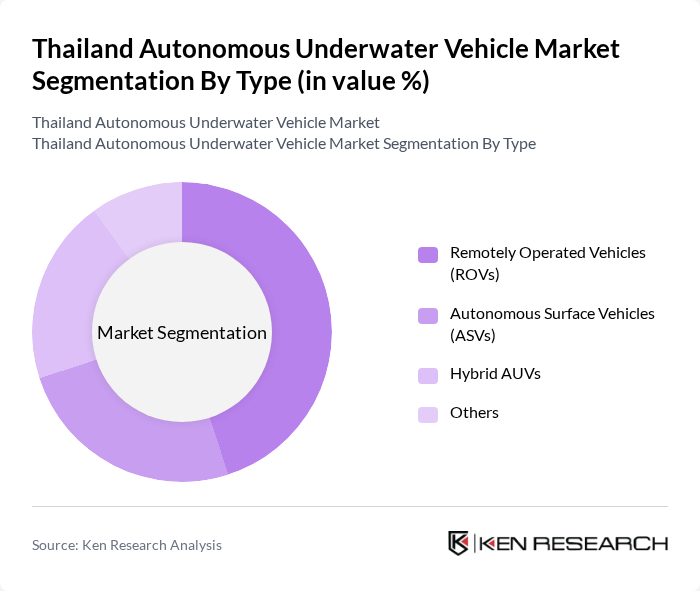
By Type:The market is segmented into three types of AUVs: Shallow AUVs (up to 100 meters), Medium AUVs (up to 1,000 meters), and Large AUVs (more than 1,000 meters). Shallow AUVs are primarily used for coastal surveys and environmental monitoring, while Medium AUVs are favored for offshore oil and gas exploration. Large AUVs are utilized for deep-sea research and military applications. The demand for Medium AUVs is particularly strong due to their versatility and capability to operate in various marine environments, with medium AUVs dominating the global market as they provide an ideal blend of operational cost-effectiveness, deep depth capability, and operational endurance.
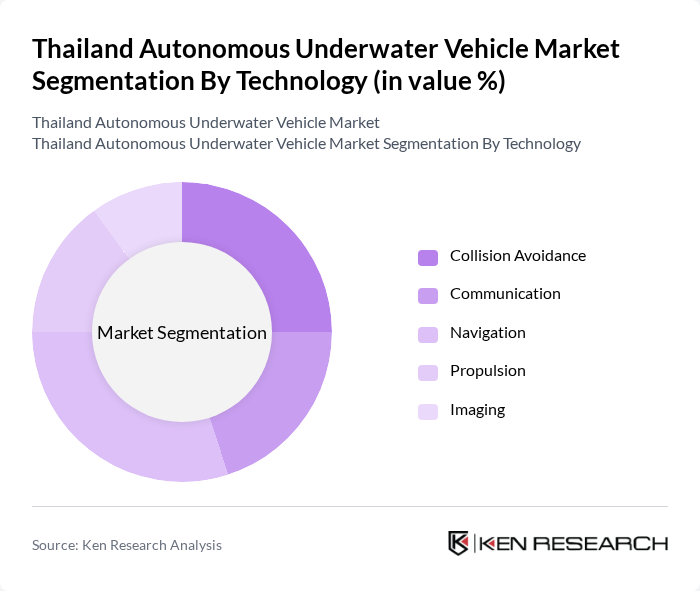
By Technology:The technology segment includes Collision Avoidance, Communication, Navigation, Propulsion, and Imaging systems. The integration of advanced navigation and imaging technologies is driving the market, as these features enhance the operational efficiency and data collection capabilities of AUVs. Navigation systems hold a dominant market share globally and are critical for precise geolocation required for proper autonomous operation in complex underwater environments. Collision Avoidance technology is particularly crucial for ensuring safe operations in complex underwater environments, with this segment expanding at a notable rate as safety becomes increasingly important for AUV deployment.
The Thailand Autonomous Underwater Vehicle Market is characterized by a dynamic mix of regional and international players. Leading participants such as Kongsberg Gruppen, Teledyne Technologies, Ocean Infinity, Bluefin Robotics, Saab AB, BAE Systems, L3Harris Technologies, ECA Group, iRobot Corporation, ASV Global, Hydroid, Inc., Deep Ocean Engineering, Maritime Robotics, Subsea 7, Fugro N.V. contribute to innovation, geographic expansion, and service delivery in this space.
The future of the Thailand Autonomous Underwater Vehicle market appears promising, driven by technological advancements and increasing government support. As the demand for marine research and environmental monitoring grows, AUVs will play a crucial role in addressing these needs. Furthermore, the integration of AI and machine learning will enhance operational efficiency, while collaborations with research institutions will foster innovation. The market is expected to evolve, with a focus on sustainable practices and eco-friendly technologies, ensuring long-term growth and development in the sector.
| Segment | Sub-Segments |
|---|---|
| By Type | Shallow AUVs (Up to 100 Meters) Medium AUVs (Up to 1,000 Meters) Large AUVs (More Than 1,000 Meters) |
| By Technology | Collision Avoidance Communication Navigation Propulsion Imaging |
| By Payload | Cameras Sensors Synthetic Aperture Sonars Echo Sounders Acoustic Doppler Current Profilers (ADCP) Others |
| By Application | Military and Defence Oil and Gas Environmental Protection and Monitoring Oceanography Archaeology and Exploration Search and Salvage Operations |
| By Shape | Torpedo Laminar Flow Body Streamlined Rectangular Style Multi-Hull Vehicle |
| Scope Item/Segment | Sample Size | Target Respondent Profiles |
|---|---|---|
| Defense Applications of AUVs | 120 | Defense Procurement Officers, Military Technology Experts |
| Environmental Monitoring Projects | 100 | Marine Biologists, Environmental Scientists |
| Commercial AUV Usage | 90 | Commercial Fishermen, Marine Survey Companies |
| Research Institutions Utilizing AUVs | 80 | Research Directors, Oceanography Professors |
| Regulatory Bodies and Policy Makers | 70 | Government Officials, Policy Analysts |
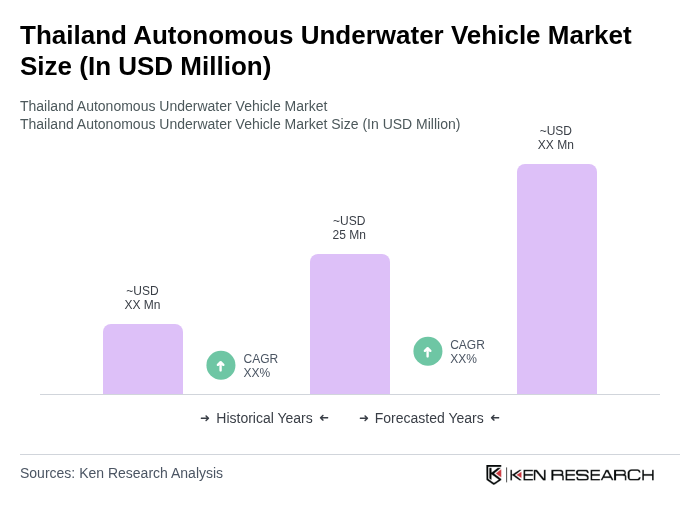
The Thailand Autonomous Underwater Vehicle market is valued at approximately USD 165 million, driven by advancements in marine technology and increasing demand for underwater exploration and monitoring in marine environments.

What makes us stand out is that our consultants follow Robust, Refine and Result (RRR) methodology. Robust for clear definitions, approaches and sanity checking, Refine for differentiating respondents' facts and opinions, and Result for presenting data with story.

We have set a benchmark in the industry by offering our clients with syndicated and customized market research reports featuring coverage of entire market as well as meticulous research and analyst insights.

While we don't replace traditional research, we flip the method upside down. Our dual approach of Top Bottom & Bottom Top ensures quality deliverable by not just verifying company fundamentals but also looking at the sector and macroeconomic factors.

With one step in the future, our research team constantly tries to show you the bigger picture. We help with some of the tough questions you may encounter along the way: How is the industry positioned? Best marketing channel? KPI's of competitors? By aligning every element, we help maximize success.

Our report gives you instant access to the answers and sources that other companies might choose to hide. We elaborate each steps of research methodology we have used and showcase you the sample size to earn your trust.

If you need any support, we are here! We pride ourselves on universe strength, data quality, and quick, friendly, and professional service.













