About the Report
Base Year 2024Listen to the audio summary
Thailand Cold Chain for Seafood & Fisheries Market Overview
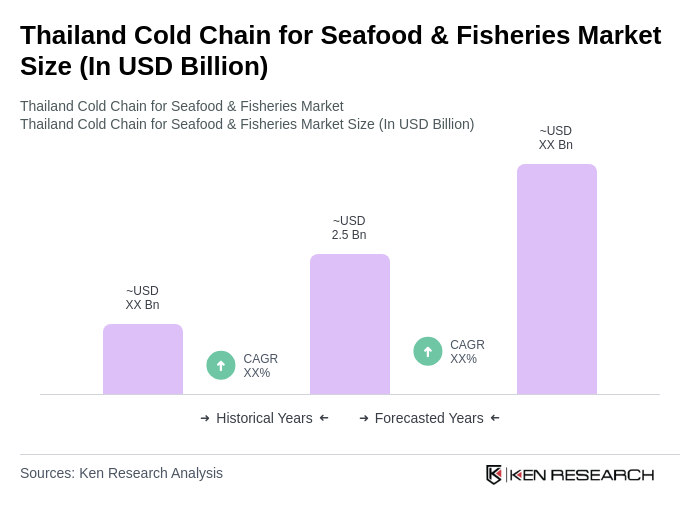
- The Thailand Cold Chain for Seafood & Fisheries Market is valued at USD 2.5 billion, based on a five-year historical analysis. This growth is primarily driven by the increasing demand for fresh and high-quality seafood products, coupled with the expansion of the seafood export market. The rise in consumer awareness regarding food safety and quality has also significantly contributed to the market's growth.
- Key players in this market include Bangkok, Phuket, and Samut Sakhon, which dominate due to their strategic locations near major fishing grounds and ports. These cities serve as critical hubs for seafood processing and distribution, facilitating efficient logistics and supply chain management, thus enhancing their competitive advantage in the cold chain sector.
- In 2023, the Thai government implemented regulations mandating that all seafood products must be transported and stored at specific temperature ranges to ensure quality and safety. This regulation aims to enhance food safety standards and reduce foodborne illnesses, thereby promoting consumer confidence in seafood products.
Thailand Cold Chain for Seafood & Fisheries Market Segmentation
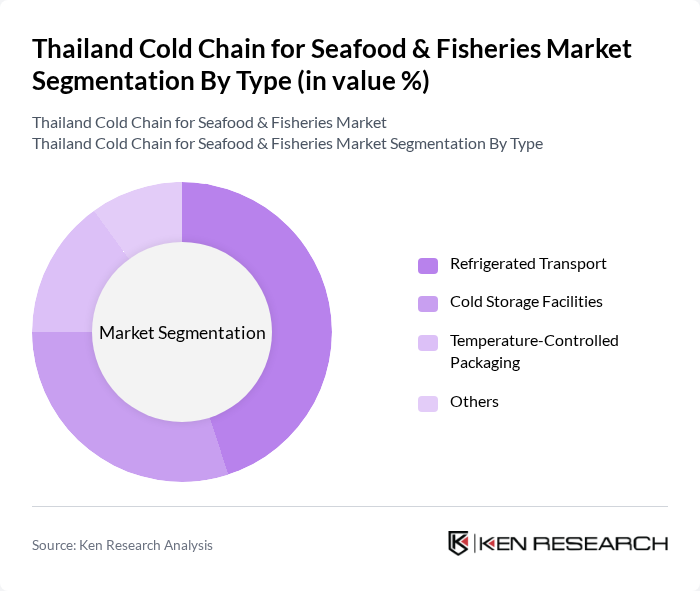
By Type:The cold chain market is segmented into various types, including Refrigerated Transport, Cold Storage Facilities, Temperature-Controlled Packaging, and Others. Each of these segments plays a crucial role in maintaining the quality and safety of seafood products throughout the supply chain. Among these, Refrigerated Transport is the leading sub-segment due to the increasing demand for efficient logistics solutions that ensure timely delivery of fresh seafood to markets.
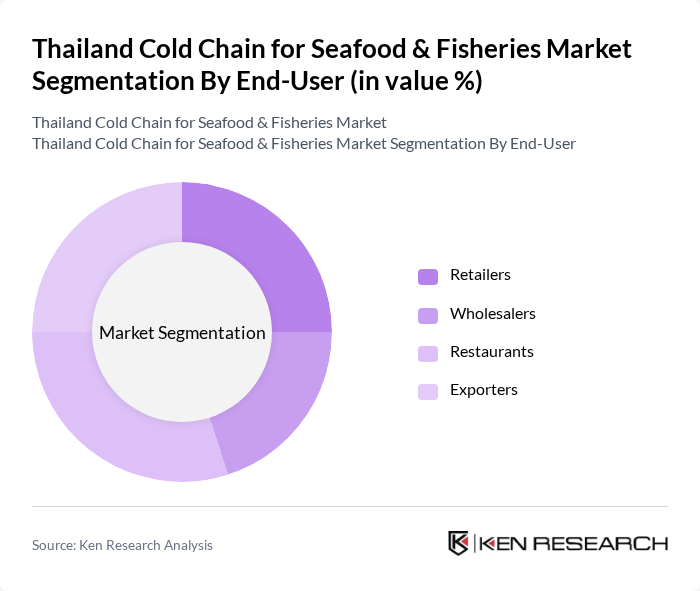
By End-User:The end-user segmentation includes Retailers, Wholesalers, Restaurants, and Exporters. Each of these segments has unique requirements for cold chain logistics, with Exporters being the dominant sub-segment. This is largely due to the growing international demand for Thai seafood products, necessitating robust cold chain solutions to meet export standards and maintain product integrity during transportation.
Thailand Cold Chain for Seafood & Fisheries Market Competitive Landscape
The Thailand Cold Chain for Seafood & Fisheries Market is characterized by a dynamic mix of regional and international players. Leading participants such as Thai Union Group PCL, CP Foods, Sea Value Public Company Limited, Marine Gold Products Public Company Limited, Thai Fishery Producers Association, S&P Syndicate Public Company Limited, Bangkok Frozen Foods, Siam Canadian Group, Sriracha Seafood, Saha Farms, Ocean Fresh, Thai Seafood Co., Ltd., Poonphol Seafood, Charoen Pokphand Foods PCL, Thai Fishery Co., Ltd. contribute to innovation, geographic expansion, and service delivery in this space.
Thailand Cold Chain for Seafood & Fisheries Market Industry Analysis
Growth Drivers
- Increasing Demand for Fresh Seafood:The demand for fresh seafood in Thailand is projected to reach 1.5 million tons in future, driven by rising consumer preferences for healthy diets. The seafood consumption per capita in Thailand is approximately 25 kg annually, significantly higher than the global average of 20 kg. This growing appetite for fresh products necessitates efficient cold chain logistics to maintain quality and safety, thereby propelling market growth in the cold chain sector.
- Expansion of Export Markets:Thailand's seafood exports are expected to exceed $7 billion in future, with key markets including the United States and Japan. The Thai government aims to increase seafood exports by 10% annually, supported by trade agreements and improved logistics. This expansion necessitates robust cold chain solutions to ensure product integrity during transportation, thus driving investments in cold storage and distribution networks across the country.
- Technological Advancements in Cold Chain Logistics:The adoption of advanced technologies in cold chain logistics is set to enhance operational efficiency. In future, investments in IoT-enabled cold storage systems are projected to reach $150 million, improving temperature monitoring and inventory management. These innovations not only reduce spoilage rates, currently estimated at 20% for seafood, but also enhance traceability, meeting consumer demands for transparency in food sourcing.
Market Challenges
- High Operational Costs:The operational costs for cold chain logistics in Thailand are estimated at $1.2 billion annually, primarily due to energy expenses and maintenance of refrigeration systems. These high costs can deter small and medium-sized enterprises from investing in necessary infrastructure, limiting their competitiveness in the seafood market. As energy prices continue to rise, managing these costs will be crucial for sustaining growth in the cold chain sector.
- Inadequate Infrastructure in Rural Areas:Approximately 60% of Thailand's seafood production occurs in rural areas, where cold chain infrastructure is often lacking. Reports indicate that only 30% of rural producers have access to adequate cold storage facilities. This deficiency leads to significant post-harvest losses, estimated at 15%, and hampers the ability to meet both domestic and international market demands, posing a substantial challenge to the industry.
Thailand Cold Chain for Seafood & Fisheries Market Future Outlook
The future of Thailand's cold chain for seafood and fisheries market appears promising, driven by increasing consumer awareness of food safety and sustainability. As e-commerce continues to grow, the demand for efficient cold chain solutions will rise, necessitating further investments in technology and infrastructure. Additionally, partnerships between seafood producers and logistics providers are expected to enhance distribution efficiency, ensuring that fresh seafood reaches consumers promptly while minimizing waste and environmental impact.
Market Opportunities
- Growth in E-commerce Seafood Sales:The e-commerce seafood market in Thailand is projected to grow to $500 million in future, driven by changing consumer behaviors. This shift presents an opportunity for cold chain providers to develop specialized logistics solutions that cater to online seafood sales, ensuring freshness and quality during delivery, thus capturing a larger market share.
- Investment in Sustainable Practices:With increasing regulatory focus on sustainability, investments in eco-friendly cold chain technologies are expected to rise. In future, the market for sustainable cold storage solutions could reach $200 million, driven by consumer demand for environmentally responsible practices. This trend offers a significant opportunity for companies to differentiate themselves and attract environmentally conscious consumers.
Scope of the Report
| Segment | Sub-Segments |
|---|---|
| By Type | Refrigerated Transport Cold Storage Facilities Temperature-Controlled Packaging Others |
| By End-User | Retailers Wholesalers Restaurants Exporters |
| By Distribution Mode | Direct Distribution Third-Party Logistics E-commerce Platforms Others |
| By Application | Fresh Seafood Processed Seafood Frozen Seafood Others |
| By Sales Channel | Online Sales Offline Sales B2B Sales Others |
| By Price Range | Premium Mid-Range Budget Others |
| By Packaging Type | Vacuum Packaging Modified Atmosphere Packaging Insulated Packaging Others |
Key Target Audience
Investors and Venture Capitalist Firms
Government and Regulatory Bodies (e.g., Department of Fisheries, Ministry of Agriculture and Cooperatives)
Seafood Processors and Exporters
Cold Chain Logistics Providers
Retail Chains and Supermarkets
Packaging Solution Providers
Industry Associations (e.g., Thai Frozen Foods Association)
Financial Institutions and Banks
Players Mentioned in the Report:
Thai Union Group PCL
CP Foods
Sea Value Public Company Limited
Marine Gold Products Public Company Limited
Thai Fishery Producers Association
S&P Syndicate Public Company Limited
Bangkok Frozen Foods
Siam Canadian Group
Sriracha Seafood
Saha Farms
Ocean Fresh
Thai Seafood Co., Ltd.
Poonphol Seafood
Charoen Pokphand Foods PCL
Thai Fishery Co., Ltd.
Table of Contents
Market Assessment Phase
1. Executive Summary and Approach
2. Thailand Cold Chain for Seafood & Fisheries Market Overview
2.1 Key Insights and Strategic Recommendations
2.2 Thailand Cold Chain for Seafood & Fisheries Market Overview
2.3 Definition and Scope
2.4 Evolution of Market Ecosystem
2.5 Timeline of Key Regulatory Milestones
2.6 Value Chain & Stakeholder Mapping
2.7 Business Cycle Analysis
2.8 Policy & Incentive Landscape
3. Thailand Cold Chain for Seafood & Fisheries Market Analysis
3.1 Growth Drivers
3.1.1 Increasing demand for fresh seafood
3.1.2 Expansion of export markets
3.1.3 Technological advancements in cold chain logistics
3.1.4 Government support for fisheries sector
3.2 Market Challenges
3.2.1 High operational costs
3.2.2 Inadequate infrastructure in rural areas
3.2.3 Regulatory compliance complexities
3.2.4 Environmental concerns and sustainability issues
3.3 Market Opportunities
3.3.1 Growth in e-commerce seafood sales
3.3.2 Investment in sustainable practices
3.3.3 Development of new cold storage technologies
3.3.4 Partnerships with logistics providers
3.4 Market Trends
3.4.1 Increasing consumer preference for traceability
3.4.2 Rise of online seafood marketplaces
3.4.3 Adoption of IoT in cold chain management
3.4.4 Focus on reducing food waste
3.5 Government Regulation
3.5.1 Food safety standards
3.5.2 Import/export regulations
3.5.3 Environmental protection laws
3.5.4 Subsidies for cold chain infrastructure
4. SWOT Analysis
5. Stakeholder Analysis
6. Porter's Five Forces Analysis
7. Thailand Cold Chain for Seafood & Fisheries Market Market Size, 2019-2024
7.1 By Value
7.2 By Volume
7.3 By Average Selling Price
8. Thailand Cold Chain for Seafood & Fisheries Market Segmentation
8.1 By Type
8.1.1 Refrigerated Transport
8.1.2 Cold Storage Facilities
8.1.3 Temperature-Controlled Packaging
8.1.4 Others
8.2 By End-User
8.2.1 Retailers
8.2.2 Wholesalers
8.2.3 Restaurants
8.2.4 Exporters
8.3 By Distribution Mode
8.3.1 Direct Distribution
8.3.2 Third-Party Logistics
8.3.3 E-commerce Platforms
8.3.4 Others
8.4 By Application
8.4.1 Fresh Seafood
8.4.2 Processed Seafood
8.4.3 Frozen Seafood
8.4.4 Others
8.5 By Sales Channel
8.5.1 Online Sales
8.5.2 Offline Sales
8.5.3 B2B Sales
8.5.4 Others
8.6 By Price Range
8.6.1 Premium
8.6.2 Mid-Range
8.6.3 Budget
8.6.4 Others
8.7 By Packaging Type
8.7.1 Vacuum Packaging
8.7.2 Modified Atmosphere Packaging
8.7.3 Insulated Packaging
8.7.4 Others
9. Thailand Cold Chain for Seafood & Fisheries Market Competitive Analysis
9.1 Market Share of Key Players(Micro, Small, Medium, Large Enterprises)
9.2 Cross Comparison of Key Players
9.2.1 Company Name
9.2.2 Group Size (Large, Medium, or Small as per industry convention)
9.2.3 Revenue Growth Rate
9.2.4 Market Penetration Rate
9.2.5 Customer Retention Rate
9.2.6 Operational Efficiency Ratio
9.2.7 Pricing Strategy
9.2.8 Supply Chain Efficiency
9.2.9 Product Quality Index
9.2.10 Innovation Rate
9.3 SWOT Analysis of Top Players
9.4 Pricing Analysis(By Class and Payload)
9.5 Detailed Profile of Major Companies
9.5.1 Thai Union Group PCL
9.5.2 CP Foods
9.5.3 Sea Value Public Company Limited
9.5.4 Marine Gold Products Public Company Limited
9.5.5 Thai Fishery Producers Association
9.5.6 S&P Syndicate Public Company Limited
9.5.7 Bangkok Frozen Foods
9.5.8 Siam Canadian Group
9.5.9 Sriracha Seafood
9.5.10 Saha Farms
9.5.11 Ocean Fresh
9.5.12 Thai Seafood Co., Ltd.
9.5.13 Poonphol Seafood
9.5.14 Charoen Pokphand Foods PCL
9.5.15 Thai Fishery Co., Ltd.
10. Thailand Cold Chain for Seafood & Fisheries Market End-User Analysis
10.1 Procurement Behavior of Key Ministries
10.1.1 Ministry of Agriculture and Cooperatives
10.1.2 Ministry of Commerce
10.1.3 Ministry of Public Health
10.2 Corporate Spend on Infrastructure & Energy
10.2.1 Investment in Cold Storage Facilities
10.2.2 Budget Allocation for Transportation
10.2.3 Expenditure on Technology Upgrades
10.3 Pain Point Analysis by End-User Category
10.3.1 Retail Sector Challenges
10.3.2 Exporter Concerns
10.3.3 Wholesaler Issues
10.4 User Readiness for Adoption
10.4.1 Awareness of Cold Chain Benefits
10.4.2 Training and Skill Development Needs
10.4.3 Financial Readiness for Investment
10.5 Post-Deployment ROI and Use Case Expansion
10.5.1 Measurement of Efficiency Gains
10.5.2 Expansion into New Markets
10.5.3 Customer Satisfaction Metrics
11. Thailand Cold Chain for Seafood & Fisheries Market Future Size, 2025-2030
11.1 By Value
11.2 By Volume
11.3 By Average Selling Price
Go-To-Market Strategy Phase
1. Whitespace Analysis + Business Model Canvas
1.1 Market Gaps Identification
1.2 Value Proposition Development
1.3 Revenue Streams Analysis
1.4 Key Partnerships Exploration
1.5 Cost Structure Assessment
1.6 Customer Segmentation
1.7 Channels of Distribution
2. Marketing and Positioning Recommendations
2.1 Branding Strategies
2.2 Product USPs
2.3 Target Market Identification
2.4 Communication Strategy
2.5 Digital Marketing Approaches
2.6 Customer Engagement Tactics
2.7 Performance Metrics
3. Distribution Plan
3.1 Urban Retail Strategies
3.2 Rural NGO Tie-ups
3.3 Logistics Optimization
3.4 Distribution Partnerships
3.5 Inventory Management
3.6 Delivery Mechanisms
4. Channel & Pricing Gaps
4.1 Underserved Routes
4.2 Pricing Bands Analysis
4.3 Competitor Pricing Strategies
4.4 Customer Price Sensitivity
4.5 Value-Based Pricing Models
5. Unmet Demand & Latent Needs
5.1 Category Gaps Identification
5.2 Consumer Segments Analysis
5.3 Emerging Trends Exploration
5.4 Product Development Opportunities
6. Customer Relationship
6.1 Loyalty Programs
6.2 After-sales Service
6.3 Customer Feedback Mechanisms
6.4 Relationship Management Strategies
7. Value Proposition
7.1 Sustainability Initiatives
7.2 Integrated Supply Chains
7.3 Competitive Advantages
7.4 Customer-Centric Approaches
8. Key Activities
8.1 Regulatory Compliance
8.2 Branding Efforts
8.3 Distribution Setup
8.4 Training and Development
9. Entry Strategy Evaluation
9.1 Domestic Market Entry Strategy
9.1.1 Product Mix Considerations
9.1.2 Pricing Band Strategy
9.1.3 Packaging Innovations
9.2 Export Entry Strategy
9.2.1 Target Countries Analysis
9.2.2 Compliance Roadmap Development
10. Entry Mode Assessment
10.1 Joint Ventures
10.2 Greenfield Investments
10.3 Mergers & Acquisitions
10.4 Distributor Model Evaluation
11. Capital and Timeline Estimation
11.1 Capital Requirements Analysis
11.2 Timelines for Implementation
12. Control vs Risk Trade-Off
12.1 Ownership Considerations
12.2 Partnership Dynamics
13. Profitability Outlook
13.1 Breakeven Analysis
13.2 Long-term Sustainability Strategies
14. Potential Partner List
14.1 Distributors
14.2 Joint Ventures
14.3 Acquisition Targets
15. Execution Roadmap
15.1 Phased Plan for Market Entry
15.1.1 Market Setup
15.1.2 Market Entry
15.1.3 Growth Acceleration
15.1.4 Scale & Stabilize
15.2 Key Activities and Milestones
15.2.1 Milestone Planning
15.2.2 Activity Tracking
Research Methodology
Phase 1: Approach1
Desk Research
- Analysis of government reports on seafood production and export statistics
- Review of industry publications and market reports specific to the Thai seafood cold chain
- Examination of logistics and supply chain frameworks from relevant trade associations
Primary Research
- Interviews with key stakeholders in the seafood supply chain, including processors and distributors
- Surveys targeting logistics providers specializing in cold chain solutions for seafood
- Field visits to cold storage facilities and seafood processing plants to gather firsthand insights
Validation & Triangulation
- Cross-validation of data through multiple sources, including trade data and expert opinions
- Triangulation of findings from desk research and primary interviews to ensure consistency
- Sanity checks conducted through expert panel reviews comprising industry veterans
Phase 2: Market Size Estimation1
Top-down Assessment
- Estimation of the cold chain market size based on national seafood export values
- Segmentation of the market by product type, including fish, crustaceans, and mollusks
- Incorporation of growth rates from government initiatives promoting seafood exports
Bottom-up Modeling
- Collection of operational data from leading cold storage and logistics companies
- Estimation of costs associated with cold chain logistics, including transportation and storage
- Volume and cost analysis based on historical data and projected growth trends
Forecasting & Scenario Analysis
- Multi-factor regression analysis incorporating factors such as consumer demand and export trends
- Scenario modeling based on potential regulatory changes affecting the seafood industry
- Development of baseline, optimistic, and pessimistic forecasts through 2030
Phase 3: CATI Sample Composition1
| Scope Item/Segment | Sample Size | Target Respondent Profiles |
|---|---|---|
| Seafood Processing Facilities | 100 | Operations Managers, Quality Control Supervisors |
| Cold Storage Providers | 80 | Logistics Managers, Facility Operators |
| Seafood Exporters | 70 | Export Managers, Supply Chain Directors |
| Retail Seafood Outlets | 60 | Store Managers, Procurement Officers |
| Government Regulatory Bodies | 50 | Policy Makers, Compliance Officers |
Frequently Asked Questions
What is the current value of the Thailand Cold Chain for Seafood & Fisheries Market?
The Thailand Cold Chain for Seafood & Fisheries Market is valued at approximately USD 2.5 billion, reflecting a significant growth driven by rising demand for fresh seafood and the expansion of the seafood export market.
What are the key drivers of growth in the Thailand Cold Chain for Seafood & Fisheries Market?
Which cities are major hubs for the cold chain seafood market in Thailand?
What regulations has the Thai government implemented regarding seafood transportation?
Other Regional/Country Reports
Indonesia Cold Chain for Seafood & Fisheries Market
Malaysia Cold Chain for Seafood & Fisheries Market
KSA Cold Chain for Seafood & Fisheries Market
APAC Cold Chain for Seafood & Fisheries Market
SEA Cold Chain for Seafood & Fisheries Market
Vietnam Cold Chain for Seafood & Fisheries Market
Other Adjacent Reports
Vietnam Seafood Processing Market
Malaysia Fisheries Equipment Market
Mexico Refrigerated Transportation Market
Malaysia Cold Storage Facilities Market
Vietnam Aquaculture Feed MarketKuwait Seafood Export Logistics Market
KSA Food Safety Testing Market
Europe Sustainable Packaging Market Size, Share & Forecast 2025-2031New Zealand Marine Biotechnology Market Report Size, Share, Growth Drivers, Trends, Opportunities & Forecast 2025–2030UAE Supply Chain Management Software MarketWhy Buy From Us?

What makes us stand out is that our consultants follow Robust, Refine and Result (RRR) methodology. Robust for clear definitions, approaches and sanity checking, Refine for differentiating respondents' facts and opinions, and Result for presenting data with story.

We have set a benchmark in the industry by offering our clients with syndicated and customized market research reports featuring coverage of entire market as well as meticulous research and analyst insights.

While we don't replace traditional research, we flip the method upside down. Our dual approach of Top Bottom & Bottom Top ensures quality deliverable by not just verifying company fundamentals but also looking at the sector and macroeconomic factors.

With one step in the future, our research team constantly tries to show you the bigger picture. We help with some of the tough questions you may encounter along the way: How is the industry positioned? Best marketing channel? KPI's of competitors? By aligning every element, we help maximize success.

Our report gives you instant access to the answers and sources that other companies might choose to hide. We elaborate each steps of research methodology we have used and showcase you the sample size to earn your trust.

If you need any support, we are here! We pride ourselves on universe strength, data quality, and quick, friendly, and professional service.