About the Report
Base Year 2024Thailand Flexible Polyethylene PE Market Overview
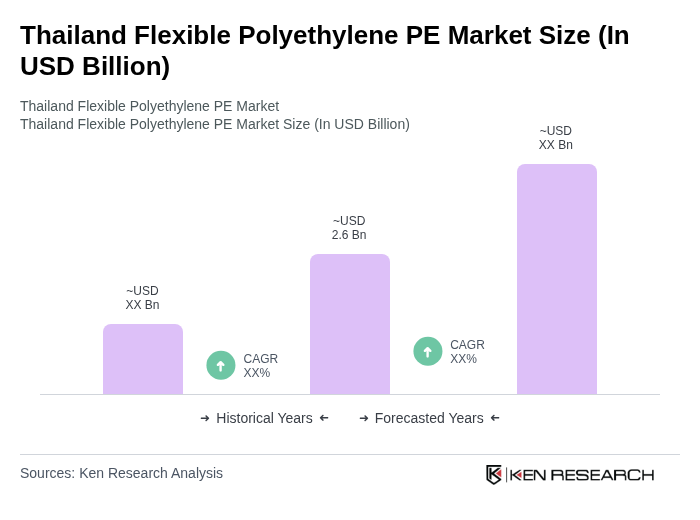
- The Thailand Flexible Polyethylene PE Market is valued at USD 2.6 billion, based on a five-year historical analysis and taking into account that polyethylene remains the leading raw material within Thailand’s flexible packaging segment, which itself is assessed in the low?to?mid single?digit billion?USD range. This growth is primarily driven by the increasing demand for packaging solutions across food and beverage, personal care, healthcare, and e?commerce channels, alongside a strong shift toward mono?material PE structures to improve recyclability and reduce material usage. The market is also supported by advancements in production technologies such as multi?layer blown film, downgauging, and Industry 4.0-enabled converting lines, which enhance the quality, processability, and performance of polyethylene-based flexible products.
- Key players in this market are concentrated in major urban and industrial centers such as Bangkok, Chonburi, Rayong, and Samut Prakan, which host Thailand’s core petrochemical and flexible packaging clusters along the Eastern Economic Corridor. These regions dominate due to their robust industrial infrastructure, proximity to deep?sea ports (Laem Chabang, Map Ta Phut), and a high concentration of downstream plastics converters, packaging manufacturers, and logistics hubs serving domestic and export-oriented food and consumer goods industries. The presence of leading chemical and packaging companies, integrated petrochemical complexes, and access to skilled labor further bolster the market's growth in these areas.
- The Thai government has introduced measures to reduce plastic waste and promote more circular use of polyethylene and other plastics under the Roadmap on Plastic Waste Management 2018–2030 and related action plans, which phase out several single?use plastic items and encourage design for recyclability and increased recycled content in packaging. In parallel, the Notification of the Ministry of Industry Re: Industrial Standard for Plastic Packaging for Food Contact and other Thai Industrial Standards (TIS) for plastic packaging set technical and safety specifications that manufacturers must comply with, including material, labeling, and performance requirements relevant to PE-based flexible packaging. These regulatory and policy instruments are part of a broader strategy to promote sustainable practices, driving investment in recycling technologies, recyclable mono?material PE films, and eco?designed flexible products.
Thailand Flexible Polyethylene PE Market Segmentation
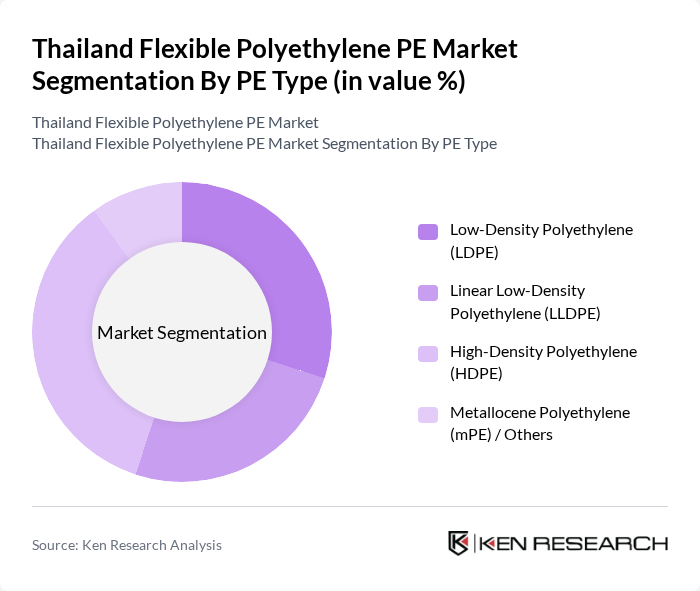
By PE Type:The market is segmented into four main types of polyethylene: Low-Density Polyethylene (LDPE), Linear Low-Density Polyethylene (LLDPE), High-Density Polyethylene (HDPE), and Metallocene Polyethylene (mPE) / Others. Each type serves different applications and industries, with LDPE and LLDPE widely used in films, wraps, and e?commerce mailers, HDPE dominating in stronger carrier bags and industrial liners, and metallocene grades increasingly adopted for high?performance, downgauged films with improved sealability and stiffness-to-thickness ratios.
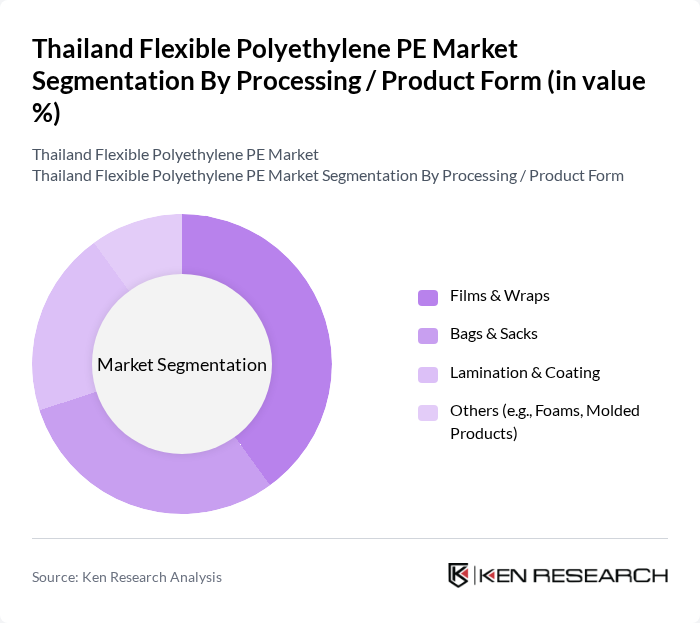
By Processing / Product Form:The market is further divided into Films & Wraps, Bags & Sacks, Lamination & Coating, and Others (e.g., Foams, Molded Products). Each product form caters to different sectors, with films and wraps representing the largest share due to their pervasive use in food, beverage, and industrial packaging, followed by bags and sacks for retail, grocery, refuse, and industrial applications, while PE-based lamination and coating structures are increasingly engineered as mono?material solutions compatible with existing recycling streams.
Thailand Flexible Polyethylene PE Market Competitive Landscape
The Thailand Flexible Polyethylene PE Market is characterized by a dynamic mix of regional and international players. Leading participants such as PTT Global Chemical Public Company Limited (GC), SCG Chemicals Public Company Limited, IRPC Public Company Limited, Thai Plastic and Chemicals Public Company Limited (TPC) / TPCIR, Bangkok Synthetics Co., Ltd., Siam Cement Group (SCG), Thai Polyethylene Co., Ltd., Indorama Ventures Public Company Limited, Thai Oil Public Company Limited, Dow Thailand Group, ExxonMobil Chemical, Chevron Phillips Chemical Company, Mitsui Chemicals, Inc., LyondellBasell Industries N.V., BASF SE contribute to innovation, geographic expansion, and service delivery in this space.
Thailand Flexible Polyethylene PE Market Industry Analysis
Growth Drivers
- Increasing Demand from Packaging Industry:The packaging industry in Thailand is projected to reach a value of THB 300 billion in future, driven by the rising consumption of packaged goods. Flexible polyethylene (PE) is favored for its lightweight and durable properties, making it ideal for food and consumer goods packaging. The sector's growth is supported by a 5% annual increase in retail sales, indicating a robust demand for flexible packaging solutions that utilize PE materials.
- Rising Consumer Preference for Flexible Packaging:A significant shift towards flexible packaging is evident, with the market for flexible packaging in Thailand expected to grow to THB 80 billion in future. This trend is fueled by consumer preferences for convenience and sustainability. Approximately 60% of consumers now prefer products in flexible packaging due to its reduced environmental impact and ease of use, further driving the demand for flexible PE solutions in various sectors.
- Expansion of E-commerce and Retail Sectors:The e-commerce sector in Thailand is anticipated to grow to THB 3 trillion in future, significantly impacting packaging needs. Flexible PE packaging is increasingly utilized for shipping and delivery due to its lightweight nature and protective qualities. The rise in online shopping, with a 20% increase in online retail sales, necessitates efficient and cost-effective packaging solutions, further boosting the demand for flexible polyethylene products.
Market Challenges
- Environmental Concerns and Regulations:Growing environmental concerns regarding plastic waste have led to stricter regulations in Thailand. The government aims to significantly reduce plastic waste in future, impacting the flexible PE market. Compliance with these regulations requires significant investment in sustainable practices and materials, posing a challenge for manufacturers who must adapt to changing consumer expectations and regulatory frameworks.
- Volatility in Raw Material Prices:The flexible PE market faces challenges due to fluctuations in raw material prices, particularly crude oil, which directly affects polyethylene production costs. In recent periods, the international price of crude oil has averaged around 80 to 90 United States dollars per barrel, leading to increased production costs for PE manufacturers. This volatility can squeeze profit margins and create uncertainty in pricing strategies, impacting overall market stability.
Thailand Flexible Polyethylene PE Market Future Outlook
The future of the Thailand flexible polyethylene market appears promising, driven by increasing consumer demand for sustainable packaging solutions and technological advancements in production processes. As the government implements stricter regulations on plastic use, companies are likely to invest in innovative recycling technologies and biodegradable alternatives. Additionally, the expansion of e-commerce will continue to create opportunities for flexible PE packaging, aligning with the growing trend towards convenience and sustainability in consumer behavior.
Market Opportunities
- Growth in Biodegradable Plastics:The demand for biodegradable plastics is expected to rise, with the market projected to reach THB 10 billion in future. This shift presents an opportunity for flexible PE manufacturers to innovate and develop eco-friendly alternatives, catering to environmentally conscious consumers and aligning with government sustainability goals.
- Investment in Recycling Technologies:With the government's push for recycling, investments in advanced recycling technologies are anticipated to increase. The market for recycling technologies is expected to grow to THB 5 billion in future, providing flexible PE manufacturers with opportunities to enhance their sustainability practices and reduce waste, thereby improving their market competitiveness.
Scope of the Report
| Segment | Sub-Segments |
|---|---|
| By PE Type | Low-Density Polyethylene (LDPE) Linear Low-Density Polyethylene (LLDPE) High-Density Polyethylene (HDPE) Metallocene Polyethylene (mPE) / Others |
| By Processing / Product Form | Films & Wraps Bags & Sacks Lamination & Coating Others (e.g., Foams, Molded Products) |
| By Application | Food & Beverage Packaging Consumer & Household Products Agriculture (Mulch Films, Greenhouse Films, etc.) Industrial & Logistics (Shrink/Stretch Wraps, Liners) Construction & Infrastructure Others |
| By End-User Industry | Food & Beverage Retail & E?commerce Agriculture Construction & Real Estate Industrial, Chemical & Automotive Healthcare & Pharmaceutical Others |
| By Geography | Central Region (incl. Bangkok) Northern Region Southern Region Northeastern Region Eastern Economic Corridor (EEC) |
| By Sustainability Profile | Virgin PE Mechanically Recycled PE Content Chemically Recycled / Advanced Recycling PE Bio-based / Renewable PE Others |
Key Target Audience
Investors and Venture Capitalist Firms
Government and Regulatory Bodies (e.g., Ministry of Industry, Pollution Control Department)
Manufacturers and Producers
Distributors and Retailers
Packaging Industry Stakeholders
Plastic Recycling Companies
Trade Associations (e.g., Thai Plastic Industries Association)
Financial Institutions
Players Mentioned in the Report:
PTT Global Chemical Public Company Limited (GC)
SCG Chemicals Public Company Limited
IRPC Public Company Limited
Thai Plastic and Chemicals Public Company Limited (TPC) / TPCIR
Bangkok Synthetics Co., Ltd.
Siam Cement Group (SCG)
Thai Polyethylene Co., Ltd.
Indorama Ventures Public Company Limited
Thai Oil Public Company Limited
Dow Thailand Group
ExxonMobil Chemical
Chevron Phillips Chemical Company
Mitsui Chemicals, Inc.
LyondellBasell Industries N.V.
BASF SE
Table of Contents
Market Assessment Phase
1. Executive Summary and Approach
2. Thailand Flexible Polyethylene PE Market Overview
2.1 Key Insights and Strategic Recommendations
2.2 Thailand Flexible Polyethylene PE Market Overview
2.3 Definition and Scope
2.4 Evolution of Market Ecosystem
2.5 Timeline of Key Regulatory Milestones
2.6 Value Chain & Stakeholder Mapping
2.7 Business Cycle Analysis
2.8 Policy & Incentive Landscape
3. Thailand Flexible Polyethylene PE Market Analysis
3.1 Growth Drivers
3.1.1 Increasing Demand from Packaging Industry
3.1.2 Rising Consumer Preference for Flexible Packaging
3.1.3 Expansion of E-commerce and Retail Sectors
3.1.4 Government Initiatives to Promote Plastic Recycling
3.2 Market Challenges
3.2.1 Environmental Concerns and Regulations
3.2.2 Volatility in Raw Material Prices
3.2.3 Competition from Alternative Materials
3.2.4 Supply Chain Disruptions
3.3 Market Opportunities
3.3.1 Growth in Biodegradable Plastics
3.3.2 Technological Advancements in Production
3.3.3 Export Potential to ASEAN Markets
3.3.4 Investment in Recycling Technologies
3.4 Market Trends
3.4.1 Shift Towards Sustainable Packaging Solutions
3.4.2 Increasing Use of Smart Packaging
3.4.3 Adoption of Circular Economy Practices
3.4.4 Growth in Online Retail and Home Delivery Services
3.5 Government Regulation
3.5.1 Plastic Waste Management Act
3.5.2 Regulations on Single-Use Plastics
3.5.3 Standards for Recyclable Materials
3.5.4 Incentives for Sustainable Practices
4. SWOT Analysis
5. Stakeholder Analysis
6. Porter's Five Forces Analysis
7. Thailand Flexible Polyethylene PE Market Market Size, 2019-2024
7.1 By Value
7.2 By Volume
7.3 By Average Selling Price
8. Thailand Flexible Polyethylene PE Market Segmentation
8.1 By PE Type
8.1.1 Low-Density Polyethylene (LDPE)
8.1.2 Linear Low-Density Polyethylene (LLDPE)
8.1.3 High-Density Polyethylene (HDPE)
8.1.4 Metallocene Polyethylene (mPE) / Others
8.2 By Processing / Product Form
8.2.1 Films & Wraps
8.2.2 Bags & Sacks
8.2.3 Lamination & Coating
8.2.4 Others (e.g., Foams, Molded Products)
8.3 By Application
8.3.1 Food & Beverage Packaging
8.3.2 Consumer & Household Products
8.3.3 Agriculture (Mulch Films, Greenhouse Films, etc.)
8.3.4 Industrial & Logistics (Shrink/Stretch Wraps, Liners)
8.3.5 Construction & Infrastructure
8.3.6 Others
8.4 By End-User Industry
8.4.1 Food & Beverage
8.4.2 Retail & E?commerce
8.4.3 Agriculture
8.4.4 Construction & Real Estate
8.4.5 Industrial, Chemical & Automotive
8.4.6 Healthcare & Pharmaceutical
8.4.7 Others
8.5 By Geography
8.5.1 Central Region (incl. Bangkok)
8.5.2 Northern Region
8.5.3 Southern Region
8.5.4 Northeastern Region
8.5.5 Eastern Economic Corridor (EEC)
8.6 By Sustainability Profile
8.6.1 Virgin PE
8.6.2 Mechanically Recycled PE Content
8.6.3 Chemically Recycled / Advanced Recycling PE
8.6.4 Bio-based / Renewable PE
8.6.5 Others
9. Thailand Flexible Polyethylene PE Market Competitive Analysis
9.1 Market Share of Key Players
9.2 Cross Comparison of Key Players
9.2.1 Company Name
9.2.2 Group Size (Large, Medium, or Small as per industry convention)
9.2.3 Thailand Flexible PE Revenue (USD Million)
9.2.4 Thailand Flexible PE Volume Sold (Kilo Tons per Annum)
9.2.5 Revenue CAGR in Thailand Flexible PE (Last 3–5 Years)
9.2.6 EBITDA Margin from Flexible PE Business (%)
9.2.7 Capacity Utilization Rate (%)
9.2.8 Share of Flexible PE in Total Company Revenue (%)
9.2.9 Market Share in Thailand Flexible PE Market (%)
9.2.10 Average Realization / ASP (USD per Ton)
9.2.11 R&D Intensity (% of Revenue)
9.2.12 Capex Intensity in Thailand (USD Million per Year)
9.2.13 Share of Sales to Export Markets (%)
9.2.14 On-time Delivery / Service Level (%)
9.2.15 ESG / Sustainability Score (Recycled Content, Certifications, etc.)
9.3 SWOT Analysis of Top Players
9.4 Pricing Analysis
9.5 Detailed Profile of Major Companies
9.5.1 PTT Global Chemical Public Company Limited (GC)
9.5.2 SCG Chemicals Public Company Limited
9.5.3 IRPC Public Company Limited
9.5.4 Thai Plastic and Chemicals Public Company Limited (TPC) / TPCIR
9.5.5 Bangkok Synthetics Co., Ltd.
9.5.6 Siam Cement Group (SCG)
9.5.7 Thai Polyethylene Co., Ltd.
9.5.8 Indorama Ventures Public Company Limited
9.5.9 Thai Oil Public Company Limited
9.5.10 Dow Thailand Group
9.5.11 ExxonMobil Chemical
9.5.12 Chevron Phillips Chemical Company
9.5.13 Mitsui Chemicals, Inc.
9.5.14 LyondellBasell Industries N.V.
9.5.15 BASF SE
10. Thailand Flexible Polyethylene PE Market End-User Analysis
10.1 Procurement Behavior of Key Ministries
10.1.1 Ministry of Industry
10.1.2 Ministry of Commerce
10.1.3 Ministry of Environment
10.1.4 Others
10.2 Corporate Spend on Infrastructure & Energy
10.2.1 Investment Trends
10.2.2 Budget Allocations
10.2.3 Project Prioritization
10.2.4 Others
10.3 Pain Point Analysis by End-User Category
10.3.1 Packaging Sector
10.3.2 Construction Sector
10.3.3 Agriculture Sector
10.3.4 Others
10.4 User Readiness for Adoption
10.4.1 Awareness Levels
10.4.2 Training Needs
10.4.3 Technology Adoption Rates
10.4.4 Others
10.5 Post-Deployment ROI and Use Case Expansion
10.5.1 Performance Metrics
10.5.2 Case Studies
10.5.3 User Feedback
10.5.4 Others
11. Thailand Flexible Polyethylene PE Market Future Size, 2025-2030
11.1 By Value
11.2 By Volume
11.3 By Average Selling Price
Go-To-Market Strategy Phase
1. Whitespace Analysis + Business Model Canvas
1.1 Market Gaps Identification
1.2 Business Model Development
2. Marketing and Positioning Recommendations
2.1 Branding Strategies
2.2 Product USPs
3. Distribution Plan
3.1 Urban Retail Strategies
3.2 Rural NGO Tie-ups
4. Channel & Pricing Gaps
4.1 Underserved Routes
4.2 Pricing Bands
5. Unmet Demand & Latent Needs
5.1 Category Gaps
5.2 Consumer Segments
6. Customer Relationship
6.1 Loyalty Programs
6.2 After-sales Service
7. Value Proposition
7.1 Sustainability Initiatives
7.2 Integrated Supply Chains
8. Key Activities
8.1 Regulatory Compliance
8.2 Branding Efforts
8.3 Distribution Setup
9. Entry Strategy Evaluation
9.1 Domestic Market Entry Strategy
9.1.1 Product Mix
9.1.2 Pricing Band
9.1.3 Packaging
9.2 Export Entry Strategy
9.2.1 Target Countries
9.2.2 Compliance Roadmap
10. Entry Mode Assessment
10.1 Joint Ventures
10.2 Greenfield Investments
10.3 Mergers & Acquisitions
10.4 Distributor Model
11. Capital and Timeline Estimation
11.1 Capital Requirements
11.2 Timelines
12. Control vs Risk Trade-Off
12.1 Ownership Considerations
12.2 Partnerships
13. Profitability Outlook
13.1 Breakeven Analysis
13.2 Long-term Sustainability
14. Potential Partner List
14.1 Distributors
14.2 Joint Ventures
14.3 Acquisition Targets
15. Execution Roadmap
15.1 Phased Plan for Market Entry
15.1.1 Market Setup
15.1.2 Market Entry
15.1.3 Growth Acceleration
15.1.4 Scale & Stabilize
15.2 Key Activities and Milestones
15.2.1 Milestone Planning
15.2.2 Activity Tracking
Research Methodology
Phase 1: Approach1
Desk Research
- Analysis of industry reports from the Thailand Plastics Institute and other relevant trade associations
- Review of government publications and statistics from the Ministry of Industry and the National Statistical Office
- Examination of market trends and forecasts from academic journals and research papers focused on polyethylene applications
Primary Research
- Interviews with key stakeholders in the polyethylene supply chain, including manufacturers and distributors
- Surveys conducted with end-users in sectors such as packaging, agriculture, and construction
- Field visits to production facilities to gather insights on operational practices and capacity utilization
Validation & Triangulation
- Cross-validation of findings through comparison with historical market data and growth rates
- Triangulation of insights from primary interviews with secondary data sources to ensure consistency
- Sanity checks performed by consulting industry experts to validate assumptions and projections
Phase 2: Market Size Estimation1
Top-down Assessment
- Estimation of total market size based on national consumption data and import/export statistics
- Segmentation of the market by application areas such as packaging, agriculture, and consumer goods
- Incorporation of macroeconomic indicators and trends influencing polyethylene demand in Thailand
Bottom-up Modeling
- Collection of production volume data from major polyethylene manufacturers operating in Thailand
- Estimation of market share based on sales data and capacity of leading firms
- Calculation of average selling prices across different polyethylene grades and applications
Forecasting & Scenario Analysis
- Development of forecasts using time-series analysis and market growth drivers
- Scenario modeling based on potential regulatory changes and shifts in consumer preferences
- Creation of multiple growth scenarios (baseline, optimistic, and pessimistic) through 2030
Phase 3: CATI Sample Composition1
| Scope Item/Segment | Sample Size | Target Respondent Profiles |
|---|---|---|
| Packaging Industry Stakeholders | 120 | Production Managers, Procurement Officers |
| Agricultural Applications | 90 | Farm Managers, Agricultural Product Distributors |
| Construction Sector Users | 70 | Project Managers, Material Suppliers |
| Consumer Goods Manufacturers | 60 | Product Development Managers, Supply Chain Analysts |
| Recycling and Waste Management Firms | 50 | Operations Managers, Environmental Compliance Officers |
Frequently Asked Questions
What is the current value of the Thailand Flexible Polyethylene PE Market?
The Thailand Flexible Polyethylene PE Market is valued at approximately USD 2.6 billion, driven by the demand for flexible packaging solutions across various sectors, including food and beverage, personal care, and e-commerce.
What are the main drivers of growth in the Thailand Flexible Polyethylene PE Market?
Which regions in Thailand are key players in the Flexible Polyethylene PE Market?
What types of polyethylene are included in the Thailand Flexible Polyethylene PE Market?
Other Regional/Country Reports
Other Adjacent Reports
Indonesia Petrochemical Market
India Plastic Recycling Market Size, Share & Forecast, By Polymer Type, Waste Source & Recycling Technology, 2026-2032Kuwait biodegradable plastics market size, share, growth drivers, trends, opportunities & forecast 2025–2030KSA food packaging market size, share, growth drivers, trends, opportunities & forecast 2025–2030India Beverage Packaging Market Size, Share & Forecast, By Material, Packaging Format, Beverage Type & Distribution Channel, 2026-2031Oman E-commerce Packaging Market
Egypt Healthcare Packaging Market
Middle East personal care packaging market size, share, growth drivers, trends, opportunities & forecast 2025–2030UAE Industrial Plastics Market
Why Buy From Us?

What makes us stand out is that our consultants follow Robust, Refine and Result (RRR) methodology. Robust for clear definitions, approaches and sanity checking, Refine for differentiating respondents' facts and opinions, and Result for presenting data with story.

We have set a benchmark in the industry by offering our clients with syndicated and customized market research reports featuring coverage of entire market as well as meticulous research and analyst insights.

While we don't replace traditional research, we flip the method upside down. Our dual approach of Top Bottom & Bottom Top ensures quality deliverable by not just verifying company fundamentals but also looking at the sector and macroeconomic factors.

With one step in the future, our research team constantly tries to show you the bigger picture. We help with some of the tough questions you may encounter along the way: How is the industry positioned? Best marketing channel? KPI's of competitors? By aligning every element, we help maximize success.

Our report gives you instant access to the answers and sources that other companies might choose to hide. We elaborate each steps of research methodology we have used and showcase you the sample size to earn your trust.

If you need any support, we are here! We pride ourselves on universe strength, data quality, and quick, friendly, and professional service.