About the Report
Base Year 2024Listen to the audio summary
Thailand Fuel Injection Systems Market Overview
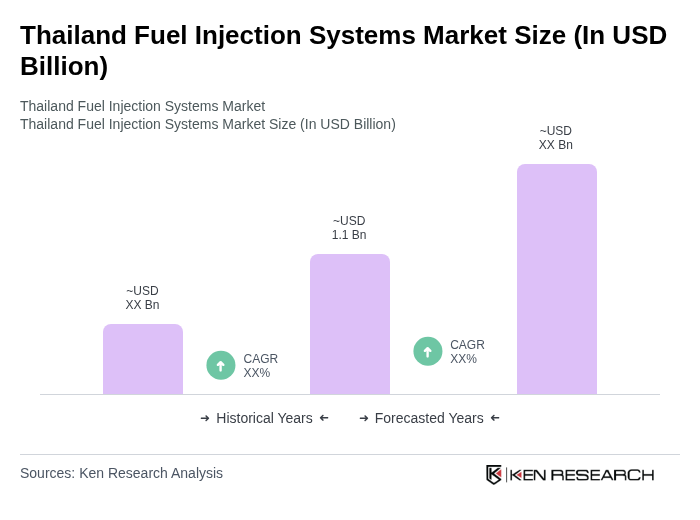
- The Thailand Fuel Injection Systems Market is valued at USD 1.1 billion, based on a five-year historical analysis. This growth is primarily driven by the increasing demand for fuel-efficient vehicles, stringent emission regulations across ASEAN, and continuous advancements in gasoline direct injection, common rail diesel, and electronically controlled injection technologies, in line with global trends where fuel injectors lead the component segment. The automotive sector's shift towards more efficient fuel systems, including the replacement of carburetors with injectors and the use of high-pressure systems, has significantly contributed to the market's expansion as manufacturers seek to enhance performance, improve fuel economy, and reduce CO₂ and particulate emissions.
- Key cities such as Bangkok, Chonburi, and Rayong dominate the market due to their robust automotive manufacturing bases and proximity to major industrial hubs. Bangkok serves as the economic and administrative center and hosts regional headquarters and engineering offices of major Tier‑1 suppliers, while Chonburi and Rayong form part of Thailand’s Eastern Economic Corridor, where numerous OEM assembly plants and component suppliers, including powertrain and injection-system manufacturers, are clustered, supporting a strong supply chain and fostering innovation in fuel injection systems.
- In 2023, the Thai government advanced its implementation of stricter emission controls through the Notification of the Ministry of Industry Re: Industrial Standard for Automotive Diesel Fuel, aligning fuel quality and vehicle emission requirements with Euro 5 reference values and complementing the Euro 4–equivalent vehicle emission limits under the Pollution Control Department’s vehicle emission standards. This regulatory framework aims to reduce NOx, particulate matter, and other harmful pollutants and promotes the use of cleaner combustion technologies, thereby driving demand for advanced fuel injection systems such as high‑pressure common rail diesel and gasoline direct injection that can meet these tighter emission thresholds.
Thailand Fuel Injection Systems Market Segmentation
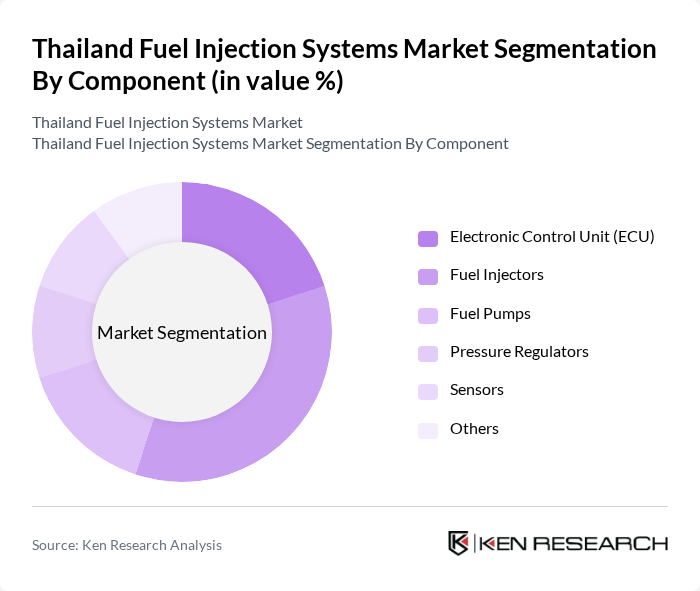
By Component:The components of fuel injection systems are critical for their functionality and efficiency. The primary components include Electronic Control Units (ECUs), Fuel Injectors, Fuel Pumps, Pressure Regulators, Sensors, and Others. Among these, Fuel Injectors are the most dominant sub-segment due to their essential role in delivering precise amounts of fuel to the engine, which is crucial for optimizing performance and fuel efficiency, consistent with global patterns where injectors account for the largest component share of the fuel system value. The increasing focus on reducing emissions and enhancing engine performance has led to a surge in demand for advanced multi-hole, high-pressure, and electronically controlled fuel injectors, making them a key driver in the market, particularly in Thailand’s passenger car and light commercial vehicle segments.
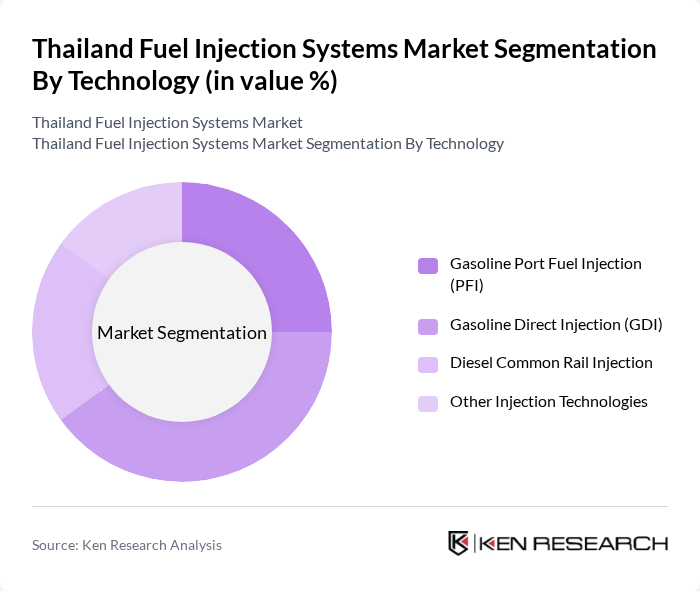
By Technology:The technology segment of fuel injection systems includes Gasoline Port Fuel Injection (PFI), Gasoline Direct Injection (GDI), Diesel Common Rail Injection, and Other Injection Technologies. Gasoline Direct Injection (GDI) is the leading technology due to its ability to improve fuel efficiency and reduce emissions significantly by enabling higher compression ratios, precise fuel metering, and better atomization, in line with global trends where GDI is among the fastest-growing injection technologies. The growing trend towards high-performance and downsized turbocharged engines, together with the need for compliance with increasingly stringent emission regulations in Thailand and export markets, has propelled the adoption of GDI and advanced diesel common rail systems, making them a focal point in the market.
Thailand Fuel Injection Systems Market Competitive Landscape
The Thailand Fuel Injection Systems Market is characterized by a dynamic mix of regional and international players. Leading participants such as Bosch (Thailand) Co., Ltd., Denso (Thailand) Co., Ltd., Delphi Technologies (BorgWarner Inc.), Continental Automotive (Thailand) Co., Ltd., Hitachi Astemo (Thailand) Ltd., Marelli Corporation, Aisin Corporation, ZF Friedrichshafen AG, Valeo S.A., NGK Spark Plug Co., Ltd. (Niterra Co., Ltd.), Parker Hannifin Corporation, Eaton Corporation plc, Infineon Technologies AG, Johnson Controls International plc contribute to innovation, geographic expansion, and service delivery in this space, reflecting the global structure of the fuel injection system market where large Tier‑1 suppliers dominate technology development and OEM relationships.
Thailand Fuel Injection Systems Market Industry Analysis
Growth Drivers
- Increasing Demand for Fuel-Efficient Vehicles:The Thai automotive market is projected to produce approximately 2 million vehicles in future, driven by a growing consumer preference for fuel-efficient models. The demand for vehicles with lower emissions is expected to rise, with the Thai government targeting a 30% reduction in greenhouse gas emissions in future under its long-term low greenhouse gas emission development strategy and updated nationally determined contribution. This shift towards fuel-efficient vehicles is propelling the adoption of advanced fuel injection systems, which enhance engine performance and fuel economy.
- Government Initiatives Promoting Cleaner Technologies:The Thai government has implemented various policies to promote cleaner automotive technologies, including the "Thailand 4.0" initiative, which aims to enhance the country's automotive industry. The government has also introduced measures such as excise tax incentives and support schemes through the Board of Investment to encourage investment in low-emission and next-generation vehicles, including electric and hybrid vehicles. These initiatives are expected to stimulate the fuel injection systems market as manufacturers align with regulatory standards and consumer expectations for sustainability.
- Rising Automotive Production in Thailand:Thailand is recognized as a major automotive manufacturing hub in Southeast Asia, with production of motor vehicles (including passenger cars and commercial vehicles) having reached around 1.8–1.9 million units in recent years. Production is expected to increase in future, supported by domestic demand and exports, particularly to ASEAN countries. As automotive production increases, the demand for fuel injection systems is anticipated to rise correspondingly, with manufacturers seeking to enhance vehicle efficiency and performance to meet market needs.
Market Challenges
- High Initial Investment Costs:The development and implementation of advanced fuel injection systems require significant capital investment, often exceeding THB 1 billion (approximately USD 30 million) for research and production facilities. This high initial cost can deter smaller manufacturers from entering the market, limiting competition and innovation. As a result, the market may experience slower growth as companies weigh the financial risks against potential returns on investment.
- Stringent Regulatory Requirements:Compliance with increasingly stringent emission standards poses a significant challenge for fuel injection system manufacturers in Thailand. Thailand has adopted progressively tighter vehicle emission standards aligned with Euro regulations, including moves toward Euro 5/Euro 6-equivalent standards for new vehicles, to reduce key pollutants such as nitrogen oxides (NOx) and particulate matter. The government has set ambitious targets for reducing emissions from the transport sector under its climate and air quality policies, requiring continuous investment in technology and processes, which can strain resources and impact profitability for manufacturers striving to comply.
Thailand Fuel Injection Systems Market Future Outlook
The Thailand fuel injection systems market is poised for significant transformation as the automotive industry shifts towards sustainability and advanced technologies. With the increasing integration of IoT in fuel injection systems, manufacturers are expected to enhance vehicle performance and efficiency. Additionally, the expansion of electric and hybrid vehicle markets will create new opportunities for innovation in fuel injection technologies, driving growth and collaboration among industry players. The focus on cleaner technologies will further shape the market landscape in the coming years.
Market Opportunities
- Expansion of Electric Vehicle Market:The electric vehicle (EV) market in Thailand is projected to grow significantly, supported by government incentives and investment promotion measures that target the production and use of battery electric vehicles and plug-in hybrids. In recent years, registrations and production of battery electric vehicles have risen rapidly from a low base, and further substantial growth is expected in future. This growth presents opportunities for fuel injection system manufacturers to develop hybrid solutions that cater to both traditional and electrified powertrains, enhancing their market presence and technological capabilities.
- Development of Hybrid Fuel Injection Systems:As the automotive industry increasingly embraces hybrid technologies, there is a growing demand for hybrid fuel injection systems that optimize fuel efficiency and reduce emissions. Manufacturers can capitalize on this trend by investing in R&D to create innovative solutions that meet the evolving needs of consumers and regulatory standards, positioning themselves as leaders in this emerging segment.
Scope of the Report
| Segment | Sub-Segments |
|---|---|
| By Component | Electronic Control Unit (ECU) Fuel Injectors Fuel Pumps Pressure Regulators Sensors Others |
| By Technology | Gasoline Port Fuel Injection (PFI) Gasoline Direct Injection (GDI) Diesel Common Rail Injection Other Injection Technologies |
| By Vehicle Type | Passenger Vehicles Light Commercial Vehicles Heavy Commercial Vehicles Two-Wheelers Others |
| By Fuel Type | Gasoline Diesel Alternative and Hybrid Powertrains |
| By Sales Channel | OEM Aftermarket |
| By Region | Central Thailand Northern Thailand Southern Thailand Eastern Thailand |
| By Application | Passenger Car OEM Applications Commercial Vehicle OEM Applications Two-Wheeler OEM Applications Aftermarket Replacement and Upgrades |
Key Target Audience
Investors and Venture Capitalist Firms
Government and Regulatory Bodies (e.g., Ministry of Energy, Department of Land Transport)
Manufacturers and Producers
Distributors and Retailers
Automotive OEMs (Original Equipment Manufacturers)
Aftermarket Service Providers
Industry Associations (e.g., Thai Automotive Industry Association)
Financial Institutions
Players Mentioned in the Report:
Bosch (Thailand) Co., Ltd.
Denso (Thailand) Co., Ltd.
Delphi Technologies (BorgWarner Inc.)
Continental Automotive (Thailand) Co., Ltd.
Hitachi Astemo (Thailand) Ltd.
Marelli Corporation
Aisin Corporation
ZF Friedrichshafen AG
Valeo S.A.
NGK Spark Plug Co., Ltd. (Niterra Co., Ltd.)
Parker Hannifin Corporation
Eaton Corporation plc
Infineon Technologies AG
Johnson Controls International plc
Table of Contents
Market Assessment Phase
1. Executive Summary and Approach
2. Thailand Fuel Injection Systems Market Overview
2.1 Key Insights and Strategic Recommendations
2.2 Thailand Fuel Injection Systems Market Overview
2.3 Definition and Scope
2.4 Evolution of Market Ecosystem
2.5 Timeline of Key Regulatory Milestones
2.6 Value Chain & Stakeholder Mapping
2.7 Business Cycle Analysis
2.8 Policy & Incentive Landscape
3. Thailand Fuel Injection Systems Market Analysis
3.1 Growth Drivers
3.1.1 Increasing demand for fuel-efficient vehicles
3.1.2 Government initiatives promoting cleaner technologies
3.1.3 Rising automotive production in Thailand
3.1.4 Technological advancements in fuel injection systems
3.2 Market Challenges
3.2.1 High initial investment costs
3.2.2 Stringent regulatory requirements
3.2.3 Competition from alternative fuel technologies
3.2.4 Supply chain disruptions
3.3 Market Opportunities
3.3.1 Expansion of electric vehicle market
3.3.2 Development of hybrid fuel injection systems
3.3.3 Increasing aftermarket services
3.3.4 Collaborations with automotive manufacturers
3.4 Market Trends
3.4.1 Shift towards direct fuel injection systems
3.4.2 Growing focus on sustainability and emissions reduction
3.4.3 Integration of IoT in fuel injection systems
3.4.4 Rise in demand for performance tuning solutions
3.5 Government Regulation
3.5.1 Emission standards compliance
3.5.2 Incentives for fuel-efficient technologies
3.5.3 Safety regulations for automotive components
3.5.4 Import/export regulations for automotive parts
4. SWOT Analysis
5. Stakeholder Analysis
6. Porter's Five Forces Analysis
7. Thailand Fuel Injection Systems Market Market Size, 2019-2024
7.1 By Value
7.2 By Volume
7.3 By Average Selling Price
8. Thailand Fuel Injection Systems Market Segmentation
8.1 By Component
8.1.1 Electronic Control Unit (ECU)
8.1.2 Fuel Injectors
8.1.3 Fuel Pumps
8.1.4 Pressure Regulators
8.1.5 Sensors
8.1.6 Others
8.2 By Technology
8.2.1 Gasoline Port Fuel Injection (PFI)
8.2.2 Gasoline Direct Injection (GDI)
8.2.3 Diesel Common Rail Injection
8.2.4 Other Injection Technologies
8.3 By Vehicle Type
8.3.1 Passenger Vehicles
8.3.2 Light Commercial Vehicles
8.3.3 Heavy Commercial Vehicles
8.3.4 Two-Wheelers
8.3.5 Others
8.4 By Fuel Type
8.4.1 Gasoline
8.4.2 Diesel
8.4.3 Alternative and Hybrid Powertrains
8.5 By Sales Channel
8.5.1 OEM
8.5.2 Aftermarket
8.6 By Region
8.6.1 Central Thailand
8.6.2 Northern Thailand
8.6.3 Southern Thailand
8.6.4 Eastern Thailand
8.7 By Application
8.7.1 Passenger Car OEM Applications
8.7.2 Commercial Vehicle OEM Applications
8.7.3 Two-Wheeler OEM Applications
8.7.4 Aftermarket Replacement and Upgrades
9. Thailand Fuel Injection Systems Market Competitive Analysis
9.1 Market Share of Key Players
9.2 Cross Comparison of Key Players
9.2.1 Company Name
9.2.2 Group Size (Large, Medium, or Small as per industry convention)
9.2.3 Thailand Fuel Injection Systems Revenue (USD Million)
9.2.4 3-Year Revenue CAGR in Thailand (%)
9.2.5 Thailand Market Share (%)
9.2.6 EBITDA Margin (%) – Thailand Operations
9.2.7 R&D Spend as % of Revenue – Fuel Injection Systems
9.2.8 Number of OEM Programs Supplied in Thailand
9.2.9 Installed Production Capacity in Thailand (Units/Year)
9.2.10 Average Selling Price per System (USD)
9.2.11 Aftermarket Revenue Contribution (%)
9.2.12 On-time Delivery Rate (%)
9.2.13 Quality PPM (Defective Parts per Million)
9.3 SWOT Analysis of Top Players
9.4 Pricing Analysis
9.5 Detailed Profile of Major Companies
9.5.1 Bosch (Thailand) Co., Ltd.
9.5.2 Denso (Thailand) Co., Ltd.
9.5.3 Delphi Technologies (BorgWarner Inc.)
9.5.4 Continental Automotive (Thailand) Co., Ltd.
9.5.5 Hitachi Astemo (Thailand) Ltd.
9.5.6 Marelli Corporation
9.5.7 Aisin Corporation
9.5.8 ZF Friedrichshafen AG
9.5.9 Valeo S.A.
9.5.10 NGK Spark Plug Co., Ltd. (Niterra Co., Ltd.)
9.5.11 Parker Hannifin Corporation
9.5.12 Eaton Corporation plc
9.5.13 Infineon Technologies AG
9.5.14 Johnson Controls International plc
10. Thailand Fuel Injection Systems Market End-User Analysis
10.1 Procurement Behavior of Key Ministries
10.1.1 Government procurement policies
10.1.2 Budget allocation for automotive technologies
10.1.3 Collaboration with private sector
10.1.4 Evaluation criteria for suppliers
10.2 Corporate Spend on Infrastructure & Energy
10.2.1 Investment in automotive infrastructure
10.2.2 Spending on R&D for fuel injection technologies
10.2.3 Budget for sustainability initiatives
10.2.4 Partnerships with technology providers
10.3 Pain Point Analysis by End-User Category
10.3.1 Cost of fuel injection systems
10.3.2 Availability of skilled technicians
10.3.3 Maintenance and service challenges
10.3.4 Regulatory compliance issues
10.4 User Readiness for Adoption
10.4.1 Awareness of fuel injection benefits
10.4.2 Training programs for technicians
10.4.3 Availability of financing options
10.4.4 Market perception of new technologies
10.5 Post-Deployment ROI and Use Case Expansion
10.5.1 Measurement of fuel savings
10.5.2 Performance improvements
10.5.3 Customer feedback and satisfaction
10.5.4 Opportunities for system upgrades
11. Thailand Fuel Injection Systems Market Future Size, 2025-2030
11.1 By Value
11.2 By Volume
11.3 By Average Selling Price
Go-To-Market Strategy Phase
1. Whitespace Analysis + Business Model Canvas
1.1 Market gaps and opportunities
2. Marketing and Positioning Recommendations
2.1 Branding strategies
2.2 Product USPs
3. Distribution Plan
3.1 Urban retail vs rural NGO tie-ups
4. Channel & Pricing Gaps
4.1 Underserved routes
4.2 Pricing bands
5. Unmet Demand & Latent Needs
5.1 Category gaps
5.2 Consumer segments
6. Customer Relationship
6.1 Loyalty programs
6.2 After-sales service
7. Value Proposition
7.1 Sustainability
7.2 Integrated supply chains
8. Key Activities
8.1 Regulatory compliance
8.2 Branding
8.3 Distribution setup
9. Entry Strategy Evaluation
9.1 Domestic Market Entry Strategy
9.1.1 Product mix
9.1.2 Pricing band
9.1.3 Packaging
9.2 Export Entry Strategy
9.2.1 Target countries
9.2.2 Compliance roadmap
10. Entry Mode Assessment
10.1 JV, Greenfield, M&A, Distributor Model
11. Capital and Timeline Estimation
11.1 Capital requirements
11.2 Timelines
12. Control vs Risk Trade-Off
12.1 Ownership vs Partnerships
13. Profitability Outlook
13.1 Breakeven analysis
13.2 Long-term sustainability
14. Potential Partner List
14.1 Distributors
14.2 JVs
14.3 Acquisition targets
15. Execution Roadmap
15.1 Phased Plan for Market Entry
15.1.1 Market Setup
15.1.2 Market Entry
15.1.3 Growth Acceleration
15.1.4 Scale & Stabilize
15.2 Key Activities and Milestones
15.2.1 Milestone planning
Research Methodology
Phase 1: Approach1
Desk Research
- Industry reports from the Thailand Automotive Industry Association
- Market analysis publications from government agencies and trade organizations
- Academic journals and white papers on fuel injection technologies and trends
Primary Research
- Interviews with engineers and product managers at leading fuel injection system manufacturers
- Surveys with automotive service providers and repair shop owners
- Field interviews with automotive industry experts and consultants
Validation & Triangulation
- Cross-validation of data through multiple industry sources and reports
- Triangulation of findings from primary interviews and secondary data
- Sanity checks conducted through expert panel discussions and feedback
Phase 2: Market Size Estimation1
Top-down Assessment
- Analysis of national automotive sales data to estimate fuel injection system demand
- Segmentation of the market by vehicle type and fuel type
- Incorporation of government policies promoting fuel efficiency and emissions reduction
Bottom-up Modeling
- Volume estimates based on production data from major automotive manufacturers in Thailand
- Cost analysis of fuel injection systems based on supplier pricing and market trends
- Estimation of replacement rates and aftermarket sales for existing vehicles
Forecasting & Scenario Analysis
- Multi-variable regression analysis incorporating economic indicators and automotive trends
- Scenario modeling based on potential regulatory changes and technological advancements
- Development of baseline, optimistic, and pessimistic market forecasts through 2030
Phase 3: CATI Sample Composition1
| Scope Item/Segment | Sample Size | Target Respondent Profiles |
|---|---|---|
| Passenger Vehicle Fuel Injection Systems | 120 | Product Managers, Automotive Engineers |
| Commercial Vehicle Fuel Injection Systems | 90 | Fleet Managers, Procurement Specialists |
| Aftermarket Fuel Injection Solutions | 70 | Service Center Owners, Automotive Technicians |
| Hybrid and Electric Vehicle Systems | 60 | R&D Managers, Sustainability Officers |
| Fuel Injection System Components | 80 | Supply Chain Managers, Quality Control Inspectors |
Frequently Asked Questions
What is the current value of the Thailand Fuel Injection Systems Market?
The Thailand Fuel Injection Systems Market is valued at approximately USD 1.1 billion, reflecting a significant growth driven by the demand for fuel-efficient vehicles and advancements in fuel injection technologies.
What factors are driving the growth of the fuel injection systems market in Thailand?
Which cities are the main hubs for the Thailand Fuel Injection Systems Market?
How is the Thai government influencing the fuel injection systems market?
Other Regional/Country Reports
Other Adjacent Reports
South Korea Emission Control Systems Market
North America Automotive Sensors Market Outlook to 2030: Size, Share, Growth and TrendsBelgium Fuel Pump Systems Market
Kuwait Electronic Control Units Market
UAE gasoline direct injection market report Size, Share, Growth Drivers, Trends, Opportunities & Forecast 2025–2030Mexico Diesel Common Rail Market
Oman Hybrid Powertrain Market
Kuwait Electric Vehicle Components Market
Belgium Automotive Turbochargers Market
Why Buy From Us?

What makes us stand out is that our consultants follow Robust, Refine and Result (RRR) methodology. Robust for clear definitions, approaches and sanity checking, Refine for differentiating respondents' facts and opinions, and Result for presenting data with story.

We have set a benchmark in the industry by offering our clients with syndicated and customized market research reports featuring coverage of entire market as well as meticulous research and analyst insights.

While we don't replace traditional research, we flip the method upside down. Our dual approach of Top Bottom & Bottom Top ensures quality deliverable by not just verifying company fundamentals but also looking at the sector and macroeconomic factors.

With one step in the future, our research team constantly tries to show you the bigger picture. We help with some of the tough questions you may encounter along the way: How is the industry positioned? Best marketing channel? KPI's of competitors? By aligning every element, we help maximize success.

Our report gives you instant access to the answers and sources that other companies might choose to hide. We elaborate each steps of research methodology we have used and showcase you the sample size to earn your trust.

If you need any support, we are here! We pride ourselves on universe strength, data quality, and quick, friendly, and professional service.